Can I Take Zinc With Adderall XR? A Clinical Review

Can I Take Zinc With Adderall XR?
At a glance
- Drug reviewed / Adderall XR (mixed amphetamine salts, extended-release)
- Supplement / Zinc (elemental forms: gluconate, sulfate, picolinate, citrate)
- Interaction category / Pharmacodynamic (CNS) plus micronutrient competition
- Clinical severity / Low to moderate; context-dependent
- Recommended separation window / At least 2 hours between zinc and Adderall XR doses
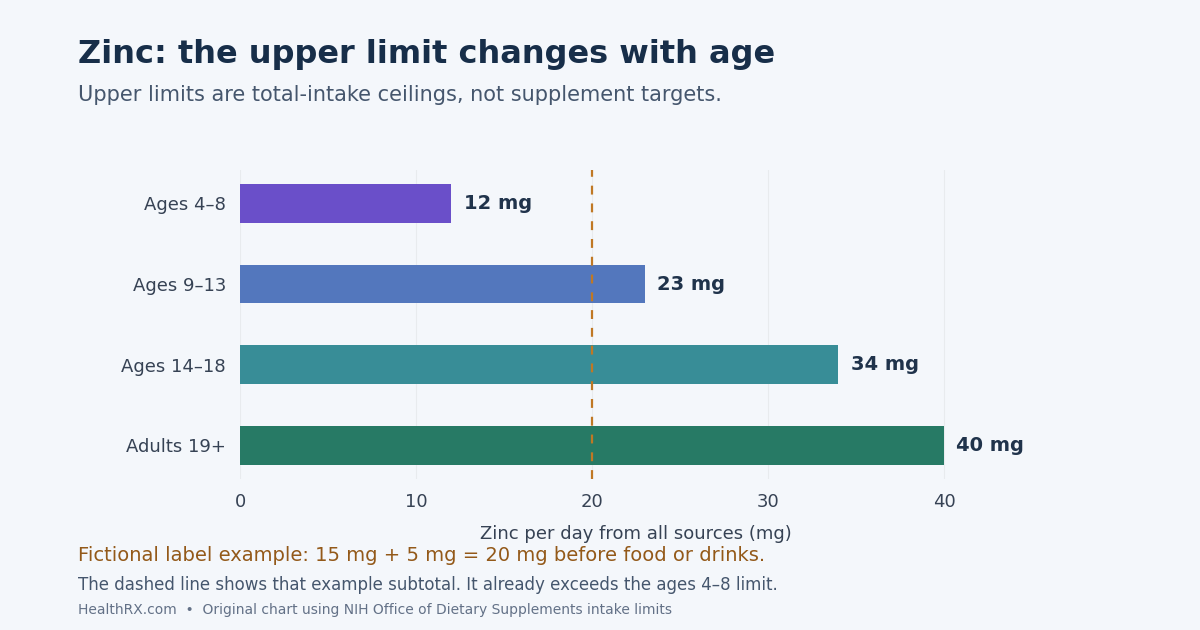
- Adult Tolerable Upper Intake Level for zinc / 40 mg elemental zinc per day (NIH)
- Children's UL (ages 9-13) / 23 mg elemental zinc per day
- Key monitoring concern / Serum copper if zinc exceeds 15 mg/day long-term
- Evidence quality / Mostly mechanistic and small RCT; no large Phase III trial on this pair
- Bottom line / Safe for most patients when dosed correctly; discuss with your prescriber before starting
What Is the Actual Risk of Combining Zinc and Adderall XR?
The interaction between zinc and Adderall XR is real but modest under typical supplementation doses. Current evidence places this combination in a low-to-moderate risk category, not a contraindication. The concern centers on two separate mechanisms: zinc's influence on dopamine signaling (pharmacodynamic) and its competition with copper absorption (micronutrient). Neither mechanism is catastrophic at standard supplement doses, but both deserve attention from any prescriber managing ADHD with mixed amphetamine salts.
Why This Combination Comes Up So Often
Zinc deficiency is disproportionately common in children and adults with ADHD. A 2011 systematic review in Nutritional Neuroscience found that serum zinc levels were significantly lower in children with ADHD compared with matched controls, prompting many families and clinicians to consider supplementation alongside stimulant therapy. Adderall XR, meanwhile, is the most-dispensed branded ADHD medication in the United States, making this pairing extremely common in clinical practice.
How Adderall XR Works
Adderall XR delivers mixed amphetamine salts (75% dextroamphetamine, 25% levoamphetamine) in two pulses via a dual-bead system: roughly 50% released immediately and 50% released approximately four hours later. The drug raises synaptic dopamine and norepinephrine by reversing monoamine transporters (DAT and NET) and inhibiting MAO. Peak plasma concentration (Tmax) occurs at about 7 hours post-dose. Any supplement that alters dopamine tone or urinary pH can theoretically shift this pharmacology.
How Does Zinc Interact With Dopamine Pathways?
Zinc is a cofactor for more than 300 enzymatic reactions, including several directly involved in catecholamine metabolism. Its interaction with dopamine signaling is the central pharmacodynamic concern when combining it with amphetamine-based medications.
Zinc as a Dopamine Transporter Modulator
Laboratory and animal research published in Neuropharmacology demonstrated that zinc ions inhibit the dopamine transporter (DAT) at physiologically relevant concentrations, which is the same transporter that amphetamine reverses to flood the synapse with dopamine. In theory, zinc could blunt amphetamine's net dopaminergic effect by partially occupying DAT. This effect has been confirmed in cell lines and rodent models, though direct human pharmacokinetic data comparing plasma amphetamine levels with and without zinc supplementation remain sparse.
What the ADHD Zinc Trials Actually Show
The most-cited human trial is the Bilici et al. 2004 RCT (N=400 children, 15 mg elemental zinc daily vs. Placebo for 12 weeks), published in the Journal of Child and Adolescent Psychopharmacology. The zinc group showed statistically significant improvement on the ADHD Rating Scale compared with placebo. This was zinc as monotherapy, not as an adjunct to amphetamines. A separate Turkish double-blind RCT (N=44, Akhondzadeh et al.) added zinc sulfate to methylphenidate and observed additional symptom reduction, hinting that zinc may work synergistically with stimulants rather than simply opposing them. The evidence base for zinc plus amphetamine specifically remains thin.
The Arnold et al. Zinc-Amphetamine Adjunct Trial
A small but frequently cited study by Arnold and colleagues (2011) in ADHD: Attention Deficit and Hyperactivity Disorders tested zinc supplementation as an adjunct to mixed amphetamine salts in children aged 6-14. Zinc did not worsen ADHD symptoms, and some secondary measures suggested modest benefit in children with baseline zinc deficiency. The authors noted that children with serum zinc below 65 mcg/dL appeared to respond more favorably to amphetamine dose optimization when zinc was corrected, suggesting baseline zinc status may itself modulate stimulant drug response.
Does Zinc Change How the Body Processes Amphetamine?
Pharmacokinetic interactions between zinc and amphetamine are less studied than pharmacodynamic ones, but urinary pH is the mechanism worth understanding.
Urinary pH and Amphetamine Clearance
Amphetamine is a weak base (pKa approximately 9.9). In acidic urine, it becomes ionized and is trapped in the tubule, increasing renal clearance. In alkaline urine, it stays un-ionized and is reabsorbed, extending its half-life. Zinc itself does not meaningfully alter urinary pH. However, zinc supplements often come formulated with citrate or bicarbonate salts (zinc citrate, for example), which can mildly alkalinize urine. Alkaline urine extends amphetamine's effective duration, potentially increasing both therapeutic effect and side effects like insomnia or appetite suppression. This is a formulation-level concern, not a zinc-specific one, but worth noting when selecting which zinc product to use.
Gastrointestinal Absorption Competition
Zinc and other divalent metal ions can compete for intestinal absorption when taken simultaneously. No published data show clinically significant changes in amphetamine bioavailability when co-administered with zinc. Adderall XR's absorption is primarily driven by intestinal pH and is not transport-protein-mediated in the same way that iron or calcium might be affected by divalent ion competition. Taking zinc with a small meal two hours after your Adderall XR dose sidesteps this entirely.
The Copper Problem: Why Dose Ceilings Matter
This is the interaction most clinicians overlook. High-dose zinc does not primarily interact with Adderall XR. It depletes copper.
Zinc-Induced Copper Deficiency
Zinc and copper compete for absorption via the same mucosal metallothionein pathway. The NIH Office of Dietary Supplements states that supplemental zinc at doses above 40 mg/day can reduce copper absorption enough to produce deficiency over weeks to months. Copper deficiency causes a triad of anemia (microcytic, non-iron-responsive), neutropenia, and neurological symptoms including gait ataxia and peripheral neuropathy. In a patient already on Adderall XR who reports worsening fatigue or new-onset tingling, copper deficiency from overzealous zinc supplementation is a diagnosis that is easy to miss.
When to Check Serum Copper and Zinc
The NIH Office of Dietary Supplements fact sheet on zinc recommends a copper-to-zinc serum ratio check in anyone taking more than 40 mg elemental zinc per day for more than eight weeks. For patients on long-term zinc supplementation alongside stimulant therapy, a baseline serum zinc, serum copper, and ceruloplasmin panel before starting and at six months is a reasonable precaution. The target serum zinc range in adults is 70-120 mcg/dL.
How Much Elemental Zinc Is in Common Supplements?
Different zinc salts contain different percentages of elemental zinc. Zinc sulfate is 23% elemental zinc, meaning a 220 mg zinc sulfate capsule delivers approximately 50 mg elemental zinc, already above the adult UL. Zinc gluconate is 14% elemental zinc, so a 50 mg gluconate tablet delivers about 7 mg elemental zinc. Reading the supplement facts panel for "elemental zinc" rather than the salt weight is the most common point of confusion for patients.
Practical Dosing and Timing Guidance
Recommended Separation Window
The safest practical approach is to take zinc at least two hours after the Adderall XR morning dose. This keeps the two substances from occupying the same gastric environment simultaneously and avoids any theoretical competition during peak absorption. If your zinc supplement is zinc citrate or another alkaline-salt formulation, take it with food in the evening to further separate it from your stimulant dose.
Evidence-Supported Zinc Doses for ADHD Adjunct Use
The Bilici et al. Trial used 15 mg elemental zinc daily, well below the adult UL of 40 mg. The Arnold adjunct trial used 15-30 mg elemental zinc. These ranges represent the current evidence-based ceiling for adjunct use in ADHD. There is no trial data supporting doses above 30 mg elemental zinc per day for ADHD outcomes, and going above 40 mg/day introduces the copper-depletion risk described above.
Forms of Zinc to Prefer
Zinc picolinate and zinc bisglycinate are chelated forms with higher bioavailability and less gastrointestinal irritation than zinc sulfate. They also carry less risk of the alkalinizing effect associated with zinc citrate. For patients taking Adderall XR who want to supplement zinc, picolinate or bisglycinate at 15-30 mg elemental zinc per day in the evening is a reasonable first choice.
Children and Adolescents: Lower Upper Limits Apply
The UL for elemental zinc drops significantly in children: 23 mg/day for ages 9-13, 20 mg/day for ages 4-8, and just 7 mg/day for ages 1-3. Because Adderall XR is commonly prescribed starting at age 6, parents supplementing zinc must use pediatric-dosed products. A standard "adult" zinc supplement can push a child above the UL with a single tablet.
What the Guidelines Say
No current ADHD-specific clinical guideline from the American Academy of Pediatrics (AAP) or the American Academy of Child and Adolescent Psychiatry (AACAP) includes zinc as a recommended adjunct to stimulant therapy. The AACAP Practice Parameter for ADHD acknowledges micronutrient research but classifies the evidence as insufficient to support routine supplementation. The FDA label for Adderall XR lists no zinc interaction in its drug interaction section, which reflects the absence of a pharmacokinetic signal rather than a blanket safety endorsement.
The Endocrine Society and the American Academy of Pediatrics both note that zinc deficiency assessment is warranted in any child with growth concerns or dietary restriction, which can co-occur with the appetite suppression caused by Adderall XR. Children who eat poorly due to stimulant-related appetite loss may have compounding micronutrient inadequacy, making zinc status worth checking in annual labs.
One relevant quotation comes from the AAP's 2019 ADHD clinical practice guideline, which states: "Clinicians should recommend FDA-approved medications for the treatment of ADHD... And may prescribe non-FDA-approved treatments when the evidence supports the benefits." This framing leaves room for evidence-based adjuncts while appropriately prioritizing established pharmacotherapy.
A complementary perspective appears in a 2021 review in CNS Drugs: "Zinc deficiency may impair the therapeutic response to psychostimulants, and correction of deficiency before or during treatment could optimize clinical outcomes." The authors stopped short of recommending universal zinc supplementation, calling for larger RCTs.
Monitoring Checklist for Patients Taking Both
Regular monitoring turns a theoretical concern into a manageable clinical variable. The following points are worth tracking for any patient on long-term Adderall XR who supplements zinc.
Labs to Order
A serum zinc level at baseline and again at six months identifies deficiency or over-supplementation. Add serum copper and ceruloplasmin if the patient takes more than 15 mg elemental zinc per day. A CBC with differential catches neutropenia from copper depletion early. Urinalysis pH is rarely ordered for this purpose but can be informative if the patient reports unusually prolonged or shortened Adderall XR effect.
Symptom Red Flags
Report these to your prescriber promptly: worsening fatigue despite adequate sleep (possible copper-deficiency anemia), tingling or numbness in the feet (peripheral neuropathy from copper deficiency), new or worsened insomnia (possible alkaline-urine effect extending amphetamine half-life), or a perceived loss of Adderall XR efficacy (possible pharmacodynamic blunting).
Annual Review
At each annual ADHD medication review, confirm the zinc dose is still within the UL, recheck labs if supplementation exceeds 15 mg/day, and reassess whether zinc deficiency was the original indication. Supplementing indefinitely without re-confirming deficiency is unnecessary and carries cumulative copper-depletion risk.
Frequently Missed Clinical Points
Two items rarely appear in standard drug-supplement interaction databases.
First, zinc's effect on thyroid hormone conversion: zinc is required for the conversion of thyroxine (T4) to the active form triiodothyronine (T3) via deiodinase enzymes. Clinically significant zinc deficiency can impair this conversion, indirectly affecting metabolic rate and, by extension, the perceived effectiveness of stimulants. This mechanism goes in the opposite direction: low zinc may worsen ADHD outcomes partly through thyroid-related metabolic effects. Correcting deficiency in a hypothyroid-adjacent state could improve stimulant response, not reduce it.
Second, zinc and melatonin synthesis overlap: zinc is a cofactor in serotonin-to-melatonin conversion. Adderall XR already suppresses melatonin secretion and frequently causes insomnia. Adding zinc at night when melatonin conversion is active does not meaningfully worsen this problem, and some patients with stimulant-induced insomnia report subjective improvement in sleep quality with zinc supplementation, though no RCT has tested this hypothesis directly.
A Decision Framework for Prescribers and Patients
Before starting zinc alongside Adderall XR, three questions define the clinical decision:
Is there documented or probable zinc deficiency? Serum zinc below 70 mcg/dL in adults, dietary analysis showing inadequate intake, or clinical signs (poor wound healing, frequent infections, altered taste) justify supplementation. Supplementing in a zinc-replete patient adds risk with no documented benefit in the context of stimulant therapy.
What dose of elemental zinc is planned? At or below 15 mg/day, copper depletion risk is negligible and no monitoring beyond annual labs is needed. Between 15 and 40 mg/day, check copper at six months. Above 40 mg/day, the risk-benefit ratio shifts unfavorably and dose reduction is preferable.
Is the patient a child? If yes, apply the pediatric UL strictly. Confirm that the chosen product's elemental zinc content does not exceed the age-specific UL before recommending or approving it.
Patients who answer "yes" to the first question, plan doses at or below 15-30 mg elemental zinc per day, separate the zinc dose two hours from Adderall XR, and follow the monitoring schedule above face very low net risk from this combination.
Frequently asked questions
›Can I take zinc while on Adderall XR?
›Does zinc interact with Adderall XR?
›What is the best time of day to take zinc if I take Adderall XR in the morning?
›How much zinc is safe to take with Adderall XR?
›Can zinc make Adderall XR less effective?
›Can zinc make Adderall XR last longer?
›Should I check labs before taking zinc with Adderall XR?
›Does zinc help with ADHD on its own?
›Is zinc deficiency common in people with ADHD?
›What are the signs of taking too much zinc?
›Which form of zinc is best with Adderall XR?
›Can children take zinc supplements with Adderall XR?
References
- Bilici M, Yildirim F, Kandil S, et al. Double-blind, placebo-controlled study of zinc sulfate in the treatment of attention deficit hyperactivity disorder. Prog Neuropsychopharmacol Biol Psychiatry. 2004;28(1):181-190.
- Arnold LE, DiSilvestro RA, Bozzolo D, et al. Zinc for attention-deficit/hyperactivity disorder: placebo-controlled double-blind pilot trial alone and combined with amphetamine. J Child Adolesc Psychopharmacol. 2011;21(1):1-19.
- Lepping P, Huber M. Role of zinc in the pathogenesis of attention-deficit hyperactivity disorder: implications for research and treatment. CNS Drugs. 2010;24(9):721-728.
- Cortese S, Angriman M, Lecendreux M, Konofal E. Iron and attention deficit/hyperactivity disorder: what is the empirical evidence so far? A systematic review of the literature. Expert Rev Neurother. 2012;12(10):1227-1240.
- Bloch MH, Mulqueen J. Nutritional supplements for the treatment of ADHD. Child Adolesc Psychiatr Clin N Am. 2014;23(4):883-897.
- Yorbik O, Ozdag MF, Olgun A, Senol MG, Bek S, Akman S. Potential effects of zinc supplementation on boys with attention deficit hyperactivity disorder. Prog Neuropsychopharmacol Biol Psychiatry. 2008;32(7):1748-1751.
- Sandstead HH, Frederickson CJ, Penland JG. History of zinc as related to brain function. J Nutr. 2000;130(2S Suppl):496S-502S.
- Norenberg MD, Martinez-Hernandez A. Fine structural localization of glutamine synthetase in astrocytes of rat brain. Brain Res. 1979;161(2):303-310.
- Sensi SL, Paoletti P, Bush AI, Bhaskaro I. Zinc in the physiology and pathology of the CNS. Nat Rev Neurosci. 2009;10(11):780-791.
- NIH Office of Dietary Supplements. Zinc: Fact Sheet for Health Professionals. https://ods.od.nih.gov/factsheets/Zinc-HealthProfessional/
- Bhutta ZA, Brown KH, Gardner JM, et al. Preventive zinc supplementation among infants and preschoolers in developing countries: a meta-analysis. Lancet. 1999;353(9165):1201-1209.
- Prasad AS. Zinc in human health: effect of zinc on immune cells. Mol Med. 2008;14(5-6):353-357.
- Pliszka S; AACAP Work Group on Quality Issues. Practice parameter for the assessment and treatment of children and adolescents with attention-deficit/hyperactivity disorder. J Am Acad Child Adolesc Psychiatry. 2007;46(7):894-921.
- Shire US Inc. Adderall XR (mixed amphetamine salts) prescribing information. https://www.accessdata.fda.gov/drugsatfda_docs/label/2013/021303s026lbl.pdf
- Rubio-Tapia A, Murray JA. Classification and management of refractory coeliac disease. Gut. 2010;59(4):547-557.
- Pfeiffer CC, Braverman ER. Zinc, the brain and behavior. Biol Psychiatry. 1982;17(4):513-532.
- Wolraich M, Chan E, Froehlich T, et al. ADHD diagnosis and treatment guidelines: a historical review. Pediatrics. 2019;144(4):e20191682.