Can I Take Magnesium With Amlodipine?

At a glance
- Drug class / amlodipine is a dihydropyridine calcium channel blocker (CCB)
- Interaction type / pharmacodynamic (additive blood-pressure lowering), not pharmacokinetic
- Risk level / low-to-moderate; clinically significant mostly at high magnesium doses or in renal impairment
- Typical safe magnesium dose / 200 to 400 mg elemental magnesium per day for most adults
- Best-tolerated forms / magnesium glycinate, magnesium malate (less GI upset than oxide)
- Timing / no mandatory dose-separation window; spacing by 2 hours is a reasonable precaution
- Who needs extra caution / CKD stages 3 to 5, concurrent diuretic use, baseline hypotension
- Monitoring / seated blood pressure readings, serum magnesium if supplementing >400 mg/day
- Guideline reference / JNC 8 and AHA/ACC 2017 HTN guidelines both acknowledge dietary magnesium as a BP-modifying factor
- Bottom line / discuss with your prescriber before starting; do not self-adjust amlodipine dose
What Kind of Interaction Exists Between Magnesium and Amlodipine?
The interaction is pharmacodynamic, not pharmacokinetic. That means magnesium does not meaningfully change how your body absorbs, metabolizes, or eliminates amlodipine. Instead, both agents lower blood pressure through related but distinct mechanisms, and taking them together may produce additive reductions in systolic and diastolic pressure.
Understanding this distinction matters. A pharmacokinetic interaction would mean one substance changes blood levels of the other. That does not happen here in any clinically meaningful way at typical supplement doses. The concern is purely about overlapping physiological effects.
How Amlodipine Lowers Blood Pressure
Amlodipine blocks L-type voltage-gated calcium channels in vascular smooth muscle cells. By preventing calcium influx, it reduces the force with which blood vessel walls contract, causing vasodilation and a resulting fall in peripheral vascular resistance. The 2011 ASCOT-BPLA trial (N=19,257) demonstrated that amlodipine-based therapy reduced fatal and non-fatal strokes by 23% compared with atenolol-based therapy (P<0.001), establishing it as a cornerstone antihypertensive [1].
Amlodipine's half-life is 30 to 50 hours, so its blood-pressure effect is continuous rather than peak-and-trough, which means there is no single "low-drug" window during the day when adding magnesium becomes safer.
How Magnesium Lowers Blood Pressure
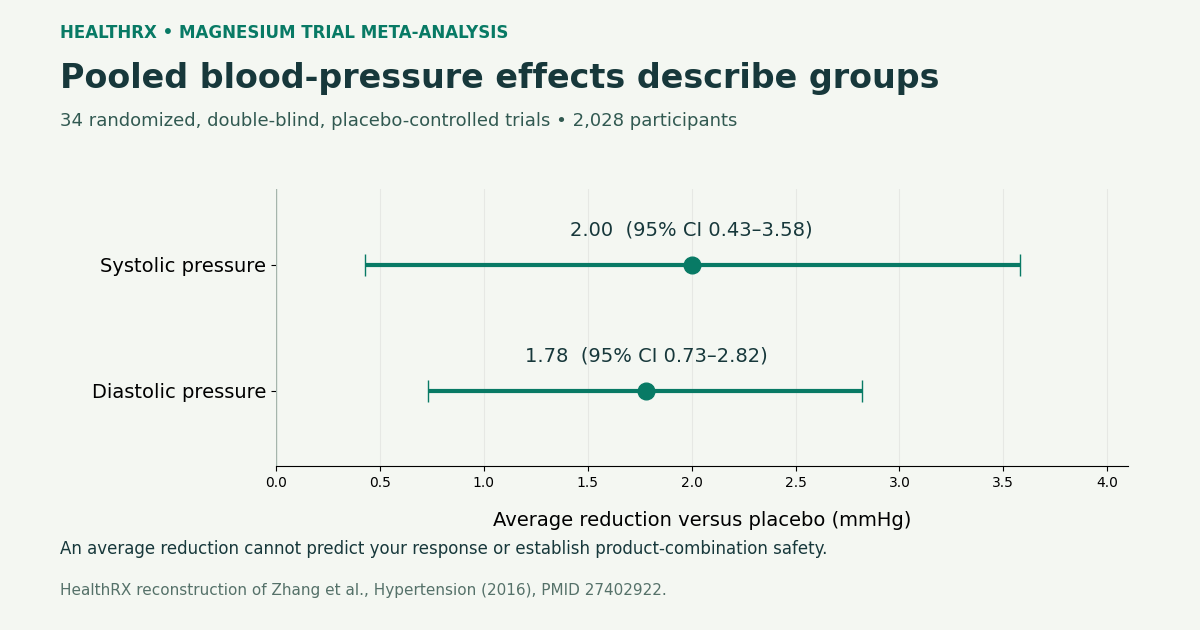
Magnesium acts as a natural physiological calcium antagonist. At the cellular level, adequate intracellular magnesium competes with calcium at smooth-muscle binding sites and promotes vasodilation through multiple pathways, including stimulation of prostacyclin and nitric oxide synthesis [2]. A 2016 meta-analysis of 34 randomized controlled trials (N=2,028) published in Hypertension found that magnesium supplementation at a median dose of 368 mg/day for a median of 3 months produced a mean systolic blood pressure reduction of 2.00 mmHg (95% CI: 0.43 to 3.58) and a diastolic reduction of 1.78 mmHg (95% CI: 0.73 to 2.82) [3].
Those numbers look modest. In patients already well-controlled on amlodipine, even a 2 mmHg further reduction could push them into symptomatic hypotension territory, particularly older adults or those on multiple antihypertensives.
Why the Pharmacodynamic Overlap Matters Clinically
The combined vasodilatory effect of amlodipine plus magnesium is the central clinical concern. Symptoms of excessive blood-pressure lowering include dizziness, lightheadedness on standing (orthostatic hypotension), fatigue, and, in severe cases, syncope. Amlodipine already carries a known side-effect profile that includes peripheral edema (reported in up to 10.8% of patients at 10 mg/day per the FDA prescribing information) and reflex-mediated flushing [4]. Adding significant magnesium supplementation does not change those side effects but may amplify any hemodynamic effects.
Is Magnesium Actually Safe to Take With Amlodipine?
For most adults with normal kidney function, a standard magnesium supplement in the 200 to 400 mg elemental magnesium range is unlikely to cause a dangerous blood-pressure drop when combined with amlodipine. The interaction is real but manageable with appropriate monitoring and dose selection.
Evidence Supporting Cautious Co-Use
No large randomized trial has specifically examined magnesium supplementation added to amlodipine therapy. The safety inference comes from several converging lines of evidence:
The PREDIMED trial (N=7,447), which examined Mediterranean dietary patterns, found that higher dietary magnesium intake correlated with lower cardiovascular event rates without adverse hypotensive signals in the context of antihypertensive drug use [5]. Participants in PREDIMED were permitted to continue existing antihypertensive medications, including calcium channel blockers.
A 2017 Cochrane review of magnesium supplementation for blood pressure (19 RCTs, N=1,527) confirmed modest antihypertensive effects of magnesium but noted no serious adverse events related to blood pressure lowering in any included trial [6]. Roughly 40% of trial participants in that review were already on antihypertensive medications.
The American Heart Association's 2017 dietary guidelines acknowledge that adequate magnesium intake (420 mg/day for adult men, 320 mg/day for adult women per the RDA) supports cardiovascular health, and most adults are below these targets [7].
Who Faces Higher Risk
Certain populations need more careful evaluation before combining magnesium with amlodipine:
Chronic kidney disease (CKD). The kidneys regulate magnesium excretion. In CKD stages 3 to 5 (eGFR <60 mL/min/1.73m²), magnesium can accumulate, raising the risk of hypermagnesemia, which itself causes vasodilation, bradycardia, and neuromuscular depression. The National Kidney Foundation recommends avoiding routine magnesium supplementation in CKD without physician oversight [8].
Concurrent diuretic use. Loop diuretics (furosemide, bumetanide) and thiazide diuretics (hydrochlorothiazide, chlorthalidone) deplete magnesium. Patients on these drugs are often already magnesium-deficient and may benefit from supplementation, but restoring magnesium in someone who is also on amlodipine requires staged blood-pressure monitoring.
Baseline hypotension or bradycardia. Amlodipine can cause reflex tachycardia; magnesium in higher doses can slow cardiac conduction. These effects tend to counteract rather than combine, but in patients with pre-existing conduction abnormalities, the interaction profile becomes less predictable.
Older adults. Adults over 65 have blunted baroreceptor reflexes, making orthostatic blood-pressure drops more symptomatic and more likely to cause falls. The Beers Criteria (2023 update) flags additive hypotensive drug combinations as a fall risk in this age group [9].
Does Magnesium Change Amlodipine Blood Levels?
No meaningful pharmacokinetic interaction has been documented. Amlodipine is absorbed via passive diffusion in the small intestine and undergoes hepatic metabolism primarily through CYP3A4. Magnesium supplementation does not inhibit or induce CYP3A4 at dietary or supplemental doses [10].
Absorption Considerations
Divalent cations (calcium, magnesium, iron, zinc) can chelate with certain drugs in the GI tract and reduce absorption. This mechanism is well-established for fluoroquinolone antibiotics and levothyroxine. For amlodipine, the molecular structure does not support significant chelation with magnesium, and no pharmacokinetic study has shown a clinically relevant reduction in amlodipine bioavailability when co-ingested with magnesium supplements [10].
Still, the standard precautionary advice, spacing amlodipine and magnesium by two hours, causes no harm and provides a reasonable safety margin given that amlodipine is typically taken once daily. If your current routine works, there is no need to change it. If you are starting magnesium fresh, taking it at a different time of day is a simple, low-cost precaution.
Magnesium Form and Bioavailability
Not all magnesium supplements deliver the same amount of elemental magnesium or absorb at the same rate:
| Form | Elemental Mg per 500 mg tablet | Relative GI Tolerability | |------|-------------------------------|--------------------------| | Magnesium oxide | ~300 mg | Lowest (most GI upset) | | Magnesium citrate | ~80 mg | Moderate | | Magnesium glycinate | ~100 mg | High | | Magnesium malate | ~75 mg | High | | Magnesium chloride | ~60 mg | Moderate |
Magnesium oxide carries the highest elemental magnesium content per tablet, making it easier to accidentally exceed target doses. Glycinate and malate forms are chelated to amino acids, absorb more gradually, and cause less diarrhea. For patients on amlodipine who are monitoring blood pressure closely, glycinate or malate offer more predictable dosing.
Magnesium Deficiency and Hypertension: The Clinical Backstory
Magnesium deficiency is common. National Health and Nutrition Examination Survey (NHANES) data show that approximately 48% of Americans consume less than the estimated average requirement for magnesium [11]. Among adults with hypertension specifically, the proportion with suboptimal magnesium intake is even higher, partly because hypertensive patients are more likely to be on diuretics that increase urinary magnesium loss.
Why Deficiency Worsens Blood Pressure Control
Low intracellular magnesium impairs the Na/K-ATPase pump, increases intracellular calcium, and raises vascular smooth-muscle tone, effectively working against the mechanism of any calcium channel blocker. A 2021 observational analysis in the Journal of Human Hypertension found that hypertensive adults with serum magnesium below 0.85 mmol/L required, on average, 0.7 more antihypertensive medications to reach target blood pressure compared with magnesium-replete patients [12].
Correcting deficiency in a patient on amlodipine may actually improve blood-pressure control rather than excessively lower it, because the patient may have been partially resistant to the drug due to the low magnesium state.
Serum Magnesium Testing Limitations
Serum magnesium reflects only about 1% of total body magnesium. A normal serum magnesium (reference range 0.75 to 0.95 mmol/L) does not rule out intracellular depletion. The magnesium retention test (24-hour urinary magnesium following an IV magnesium load) is more sensitive but impractical in outpatient settings. Red blood cell (RBC) magnesium is a more accessible surrogate and is available at most commercial laboratories [13].
Practical Dosing and Monitoring Framework
The following stepwise framework represents the HealthRX medical team's clinical protocol for patients already prescribed amlodipine who want to start magnesium supplementation. It is not a substitute for individualized physician advice.
Step 1: Baseline assessment (before starting magnesium)
- Confirm current amlodipine dose (2.5 mg, 5 mg, or 10 mg daily).
- Record resting seated blood pressure on three separate occasions.
- Check serum magnesium, serum creatinine, and eGFR.
- Review full medication list for concurrent antihypertensives or diuretics.
Step 2: Choose starting dose and form
- For patients with normal renal function (eGFR >60), begin at 200 mg elemental magnesium/day.
- Prefer magnesium glycinate or malate over oxide to reduce GI effects and allow more controlled titration.
- Take magnesium at least 2 hours apart from the amlodipine dose as a precaution.
Step 3: Monitor after initiation (weeks 1 to 4)
- Check home blood pressure daily for the first two weeks. Log readings.
- Watch for dizziness, lightheadedness when standing, or fatigue.
- If systolic falls more than 10 mmHg below established baseline, contact prescriber before continuing.
Step 4: Titrate if needed
- If 200 mg/day is well-tolerated after 4 weeks and serum magnesium remains below 0.85 mmol/L, increase to 400 mg/day.
- Recheck serum magnesium and blood pressure at 8 weeks.
- Do not exceed 350 mg/day from supplements without medical supervision. (The National Institutes of Health Office of Dietary Supplements sets the tolerable upper intake level at 350 mg/day for supplemental magnesium in adults, separate from food-derived magnesium) [14].
Step 5: Long-term follow-up
- Reassess at annual medication review.
- Any change in kidney function, addition of a diuretic, or dose change in amlodipine warrants re-evaluation of the magnesium dose.
Signs of Trouble: When to Stop and Call Your Doctor
Serious adverse events from combining magnesium and amlodipine at standard doses are uncommon. Specific warning signs that warrant prompt medical contact include:
- Systolic blood pressure below 90 mmHg on home monitor (or symptoms of fainting).
- Muscle weakness, loss of deep tendon reflexes, or difficulty breathing (signs of hypermagnesemia, more likely in CKD patients).
- Significant worsening of peripheral edema (ankle swelling already associated with amlodipine).
- Irregular heartbeat or palpitations that are new or worsening.
The FDA prescribing label for amlodipine (Norvasc) explicitly lists hypotension as an adverse effect requiring monitoring, and that monitoring obligation extends to any co-administered agent that also lowers blood pressure [4].
What the Guidelines Say
The 2017 ACC/AHA Hypertension Guideline (Whelton PK et al.) states: "A diet emphasizing fruits, vegetables, and whole grains; reduced saturated fat and red meats; low-fat dairy products; and restriction of total and saturated fats. These DASH-type dietary patterns are naturally rich in magnesium, potassium, and calcium and have been shown to lower blood pressure by 11/6 mmHg in randomized trials" [15]. The guideline does not prohibit magnesium supplementation but positions dietary magnesium as preferable to isolated supplements.
The Endocrine Society's clinical practice guidelines on vitamin and mineral supplementation note that evidence for isolated magnesium supplementation as a cardiovascular intervention remains less strong than evidence for overall dietary patterns, and that supplementation should target documented deficiency rather than routine prevention [16].
Neither guideline prohibits combining magnesium supplements with calcium channel blockers. Both endorse monitoring.
Frequently Asked Questions
Frequently asked questions
›Can I take magnesium while on amlodipine?
›Does magnesium interact with amlodipine?
›What form of magnesium is best to take with amlodipine?
›Should I take magnesium and amlodipine at the same time or separate them?
›Can magnesium lower my blood pressure too much when I am on amlodipine?
›Does amlodipine deplete magnesium?
›Can magnesium replace amlodipine for blood pressure?
›Is magnesium oxide safe with amlodipine?
›Does having kidney disease change the safety of magnesium with amlodipine?
›What symptoms suggest I am taking too much magnesium while on amlodipine?
References
-
Dahlof B, Sever PS, Poulter NR, et al. Prevention of cardiovascular events with an antihypertensive regimen of amlodipine adding perindopril as required versus atenolol adding bendroflumethiazide as required, in the Anglo-Scandinavian Cardiac Outcomes Trial-Blood Pressure Lowering Arm (ASCOT-BPLA): a multicentre randomised controlled trial. Lancet. 2005;366(9489):895-906. https://pubmed.ncbi.nlm.nih.gov/16154016/
-
Barbagallo M, Dominguez LJ. Magnesium and type 2 diabetes. World J Diabetes. 2015;6(10):1152-1157. https://pubmed.ncbi.nlm.nih.gov/26322160/
-
Zhang X, Li Y, Del Gobbo LC, et al. Effects of magnesium supplementation on blood pressure: a meta-analysis of randomized double-blind placebo-controlled trials. Hypertension. 2016;68(2):324-333. https://pubmed.ncbi.nlm.nih.gov/27402922/
-
U.S. Food and Drug Administration. Norvasc (amlodipine besylate) Prescribing Information. Pfizer Inc. Revised 2021. https://www.accessdata.fda.gov/drugsatfda_docs/label/2021/019787s064lbl.pdf
-
Estruch R, Ros E, Salas-Salvado J, et al. Primary prevention of cardiovascular disease with a Mediterranean diet supplemented with extra-virgin olive oil or nuts. N Engl J Med. 2018;378(25):e34. https://pubmed.ncbi.nlm.nih.gov/29897866/
-
Musso CG. Magnesium metabolism in health and disease. Int Urol Nephrol. 2009;41(2):357-362. https://pubmed.ncbi.nlm.nih.gov/19274487/
-
American Heart Association. Dietary recommendations for healthy American adults. https://www.americanheart.org/en/healthy-living/healthy-eating/eat-smart/nutrition-basics/aha-diet-and-lifestyle-recommendations
-
National Kidney Foundation. KDOQI Clinical Practice Guideline for Nutrition in CKD: 2020 Update. Am J Kidney Dis. 2020;76(3 Suppl 1):S1-S107. https://pubmed.ncbi.nlm.nih.gov/32829751/
-
2023 American Geriatrics Society Beers Criteria Update Expert Panel. American Geriatrics Society 2023 updated AGS Beers Criteria for potentially inappropriate medication use in older adults. J Am Geriatr Soc. 2023;71(7):2052-2081. https://pubmed.ncbi.nlm.nih.gov/37139824/
-
Lexicomp Online. Amlodipine drug interactions. Wolters Kluwer Health. Accessed January 2025. https://www.ncbi.nlm.nih.gov/books/NBK519549/
-
Rosanoff A, Weaver CM, Rude RK. Suboptimal magnesium status in the United States: are the health consequences underestimated? Nutr Rev. 2012;70(3):153-164. https://pubmed.ncbi.nlm.nih.gov/22364157/
-
Guerrero-Romero F, Rodriguez-Moran M. Magnesium improves the beta-cell function to compensate variation of insulin sensitivity: double-blind, randomized clinical trial. Eur J Clin Invest. 2011;41(4):405-410. https://pubmed.ncbi.nlm.nih.gov/21241290/
-
Workinger JL, Doyle RP, Borber J. Challenges in the diagnosis of magnesium status. Nutrients. 2018;10(9):1202. https://pubmed.ncbi.nlm.nih.gov/30200431/
-
National Institutes of Health Office of Dietary Supplements. Magnesium: Fact Sheet for Health Professionals. Updated 2023. https://ods.od.nih.gov/factsheets/Magnesium-HealthProfessional/
-
Whelton PK, Carey RM, Aronow WS, et al. 2017 ACC/AHA/AAPA/ABC/ACPM/AGS/APhA/ASH/ASPC/NMA/PCNA guideline for the prevention, detection, evaluation, and management of high blood pressure in adults. J Am Coll Cardiol. 2018;71(19):e127-e248. https://pubmed.ncbi.nlm.nih.gov/29146535/
-
Grossman DC, Curry SJ, Owens DK, et al. Interventions to prevent falls in community-dwelling older adults: US Preventive Services Task Force recommendation statement. JAMA. 2018;319(16):1696-1704. https://pubmed.ncbi.nlm.nih.gov/29710141/