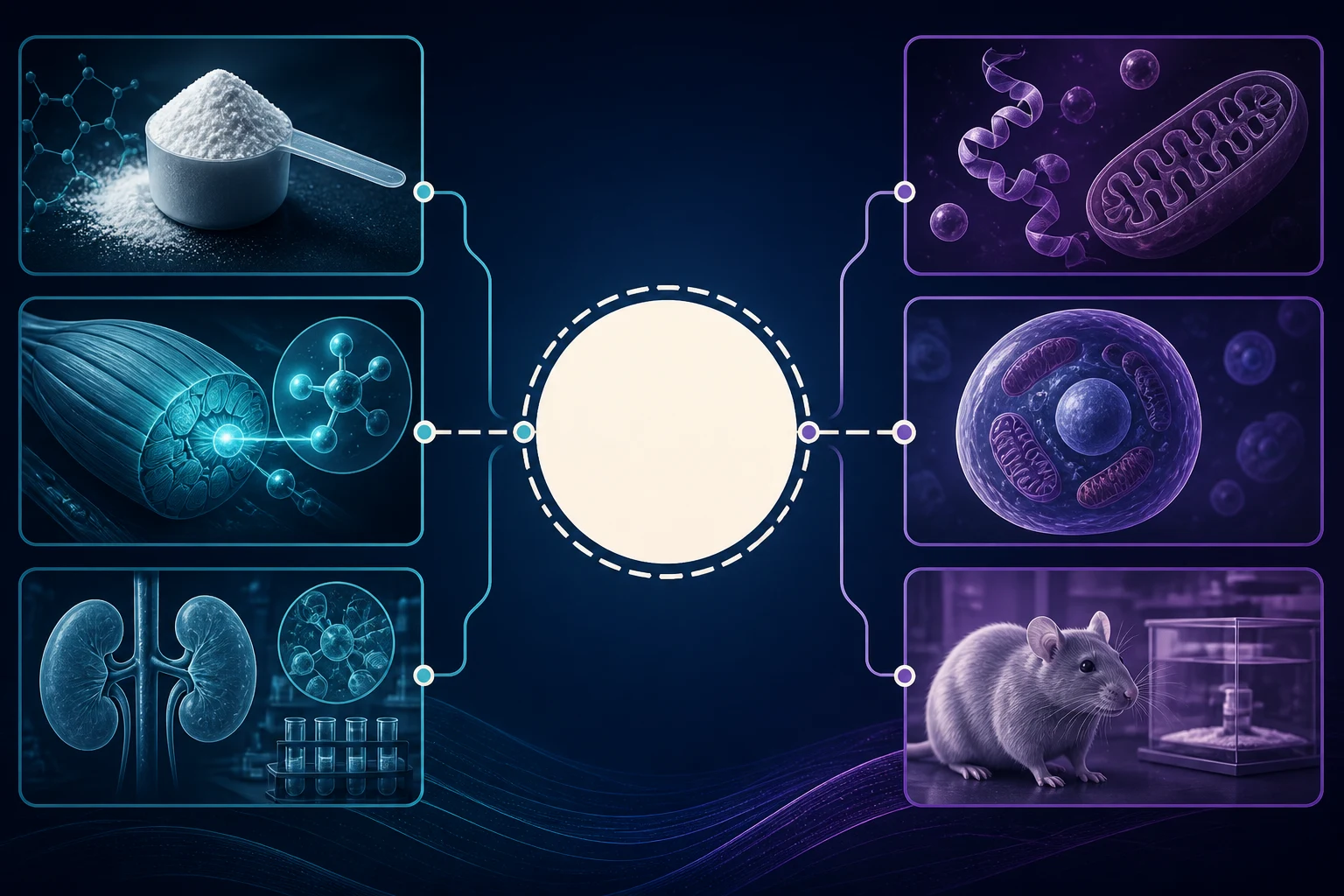
MOTS-c and Creatine: Two Evidence Streams, No Combination Study
At a glance
- Direct MOTS-c-plus-creatine study / none identified
- Creatine evidence / multiple randomized trials and systematic reviews
- MOTS-c administered-human evidence / none identified by FDA in July 2026
- Proven pharmacokinetic compatibility / not established
- Proven AMPK synergy or opposition in people / not established
- Creatine and serum creatinine / small average increase in a 2026 meta-analysis
- Universal cystatin-C or lab schedule for the combination / not established
- Medical review / current review of this revision is pending
“No Interaction Found” Is Not the Same as “Studied Together”
A database may contain no listed interaction because no direct study exists. That absence cannot establish that two products are compatible, require dose separation, or are safe for a particular person.
The evidence is asymmetric. Creatine monohydrate has a large human literature. MOTS-c does not have an administered-human record in FDA’s July 2026 evaluation. A responsible answer must keep those streams separate.
The Two-Stream Interaction Matrix
| Question | Creatine evidence | MOTS-c evidence | Combination evidence | Responsible conclusion |
|---|---|---|---|---|
| Human exposure | Extensive supplement trials | None identified by FDA | None identified | One well-studied component cannot validate the other |
| Kidney markers | Meta-analyses report a modest serum-creatinine rise and no significant pooled GFR/eGFR change | Human renal PK and safety not established | None identified | Creatine may complicate interpretation; no MOTS-c-specific monitoring rule follows |
| Cellular energy signaling | Human and experimental exercise literature | Cell and mouse metabolic studies | None identified | Pathway overlap does not prove synergy, cancellation, or harm |
| Timing and dose separation | Oral creatine protocols are studied independently | No validated human MOTS-c regimen identified | None identified | No evidence-based combination schedule exists |
| Product quality | Commercial supplement quality varies | FDA reviewed unresolved injectable impurity and aggregation concerns | None identified | Each actual product needs its own provenance |
The combination column is empty. That is the core finding.
What the Best Current Creatine Synthesis Says
A 2026 systematic review and meta-analysis included 19 randomized controlled trials and one randomized crossover study. Creatine was associated with a mean serum-creatinine increase of 0.13 mg/dL; pooled urea and eGFR differences were not statistically significant. The authors concluded:
“Cre supplementation seems to relate to an increase in serum Crn, but this is not related to significant alterations in urea concentrations and eGFR.”
Andreas Tsiaras and colleagues are medical and nutrition researchers affiliated with Aristotle University of Thessaloniki and collaborating institutions. This 24-word conclusion applies to the included creatine studies. It does not establish kidney safety for every dose, duration, condition, product, or MOTS-c combination and does not imply endorsement (PMID 42035842; DOI 10.1053/j.jrn.2026.04.010).
A separate 2025 systematic review similarly found a modest, likely transient increase in serum creatinine without a significant GFR change, while emphasizing study heterogeneity and the value of longer-term data (PMID 41199218; PMCID PMC12590749).
Why a Creatinine Change Can Matter Clinically
Creatinine-based eGFR equations use serum creatinine as an input. If creatine supplementation changes serum creatinine without the same change in filtration, the calculated eGFR may move. That is an interpretation issue, not proof of injury and not proof that injury is impossible.
Clinical context still matters: baseline kidney function, trend, hydration, muscle mass, dose, duration, other supplements and medicines, symptoms, and the reason testing was ordered. Alternative filtration markers may be useful in some circumstances, but the evidence cited here does not create a universal cystatin-C testing interval or a percentage threshold for stopping this unstudied combination.
The MOTS-c Side of the Matrix Is the Limiting Factor
FDA’s Center for Drug Evaluation and Research reported in July 2026 that it had not identified human exposure data for MOTS-c by any route. The review also found no human pharmacokinetic study and discussed potential injectable-product concerns involving aggregation, peptide-related impurities, and immunogenicity (FDA briefing, sections II.C.2 and II.D.2, PDF pages 15–16 and 27–29).
Those findings invalidate confident claims that MOTS-c and creatine use different proven human clearance pathways or lack a pharmacokinetic interaction. MOTS-c cell and mouse mechanisms do not supply the missing human absorption, distribution, metabolism, excretion, or combination data.
The rare-but-serious risk review separates those potential product risks from adverse events actually observed in people.
AMPK Does Not Settle Compatibility
The founding MOTS-c paper reported metabolic effects involving the folate cycle and AMPK in cells and mice (PMID 25738459; DOI 10.1016/j.cmet.2015.02.009). Creatine supports phosphocreatine energy buffering and has its own exercise-signaling literature.
From those separate mechanisms, marketers sometimes conclude that creatine and MOTS-c are complementary; others claim creatine’s energy buffering will blunt MOTS-c signaling. Neither conclusion has been tested in an administered-human combination study. A pathway diagram cannot predict the net clinical effect of two exposures across tissues and time.
The exercise evidence audit shows the same transfer problem when endogenous human MOTS-c responses are presented as proof of an injected “exercise mimetic.”
What the Recruiting Trial May—and May Not—Add
NCT07505745 is recruiting adults with prediabetes and overweight or obesity for a randomized MOTS-c-versus-placebo study. It lists insulin sensitivity, adverse events, glucose outcomes, and antidrug antibodies, but no results are posted. The registry does not identify a creatine-combination arm (ClinicalTrials.gov, NCT07505745).
Future results could add information about the study product and selected participants. They would not directly validate a creatine combination that the trial did not test.
A Product-and-Lab Timeline Is More Useful Than a Stack Rule
If someone already uses both products, the useful record is factual:
- When creatine began, the exact product, daily amount, and any loading phase.
- When the product labeled MOTS-c began, its source, lot, concentration, route, and directions.
- Kidney-marker results before and after each change, including which eGFR equation or marker was used.
- Hydration, illness, exercise, diet, muscle-mass change, and medicines around each test.
- Symptoms and the dates they appeared or resolved.
This timeline lets a clinician interpret a change without assuming causation. It does not make continued exposure safe or turn the page into a dosing protocol.
The young-adult evidence map explains why age-specific monitoring cannot be manufactured from observational data.
Medical review of this revision is pending. FDA, investigators, authors, journals, institutions, and quoted authorities do not endorse MOTS-c, creatine products, HealthRX.com, or this page.
Frequently asked questions
Can I take creatine with MOTS-c?
Does creatine damage the kidneys?
Should everyone using creatine get cystatin C?
Do creatine and MOTS-c cancel each other through AMPK?
References
- Tsiaras A; Loufopoulos G; Theodoridis X; Liakopoulos V; Poulia KA; Chourdakis M. The effect of creatine supplementation on kidney function: a systematic review and meta-analysis of randomized controlled trials. Journal of renal nutrition : the official journal of the Council on Renal Nutrition of the National Kidney Foundation. 2026 Apr 24. DOI 10.1053/j.jrn.2026.04.010. PMID 42035842. Quoted passage: PubMed abstract, Conclusions, first sentence. https://pubmed.ncbi.nlm.nih.gov/42035842/
- Naeini EK; Eskandari M; Mortazavi M; Gholaminejad A; Karevan N. Effect of creatine supplementation on kidney function: a systematic review and meta-analysis. BMC nephrology. 2025 Nov 6;26(1):622. DOI 10.1186/s12882-025-04558-6. PMID 41199218. PMCID PMC12590749. https://pubmed.ncbi.nlm.nih.gov/41199218/
- U.S. Food and Drug Administration, Center for Drug Evaluation and Research. Evaluation of MOTS-c-Related Bulk Drug Substances. Presented to the Pharmacy Compounding Advisory Committee, July 23–24, 2026. Sections II.C.2 and II.D.2; PDF pages 15–16 and 27–29. https://www.fda.gov/media/193347/download
- Lee C; Zeng J; Drew BG; Sallam T; Martin-Montalvo A; Wan J; Kim SJ; Mehta H; Hevener AL; de Cabo R; Cohen P. The mitochondrial-derived peptide MOTS-c promotes metabolic homeostasis and reduces obesity and insulin resistance. Cell metabolism. 2015 Mar 3;21(3):443-54. DOI 10.1016/j.cmet.2015.02.009. PMID 25738459. PMCID PMC4350682. https://pubmed.ncbi.nlm.nih.gov/25738459/
- National Library of Medicine, ClinicalTrials.gov. Hudson Biotech. A Phase 2a, Randomized, Double-blind, Placebo-controlled Study to Evaluate the Efficacy, Safety, and Pharmacodynamics of MOTS-c (a Mitochondrial-Derived Peptide) in Adults With Prediabetes and Overweight/Obesity. NCT07505745. Phase 2a; recruiting; estimated enrollment 120; first and last update posted April 1, 2026; no results posted; accessed August 30, 2026. https://clinicaltrials.gov/study/NCT07505745