Can I Take Creatine with Spironolactone?

At a glance
- Primary concern / creatinine elevation from creatine can mask spironolactone-related renal changes
- Interaction type / pharmacodynamic (shared renal monitoring endpoint), not pharmacokinetic
- Creatine dose studied / 20 g/day loading phase raises serum creatinine by roughly 0.2 mg/dL
- Spironolactone monitoring standard / serum creatinine and potassium at baseline, 4 weeks, and every 3-6 months (per ACC/AHA heart failure guidelines)
- Potassium risk / spironolactone causes potassium retention; creatine does not independently raise potassium
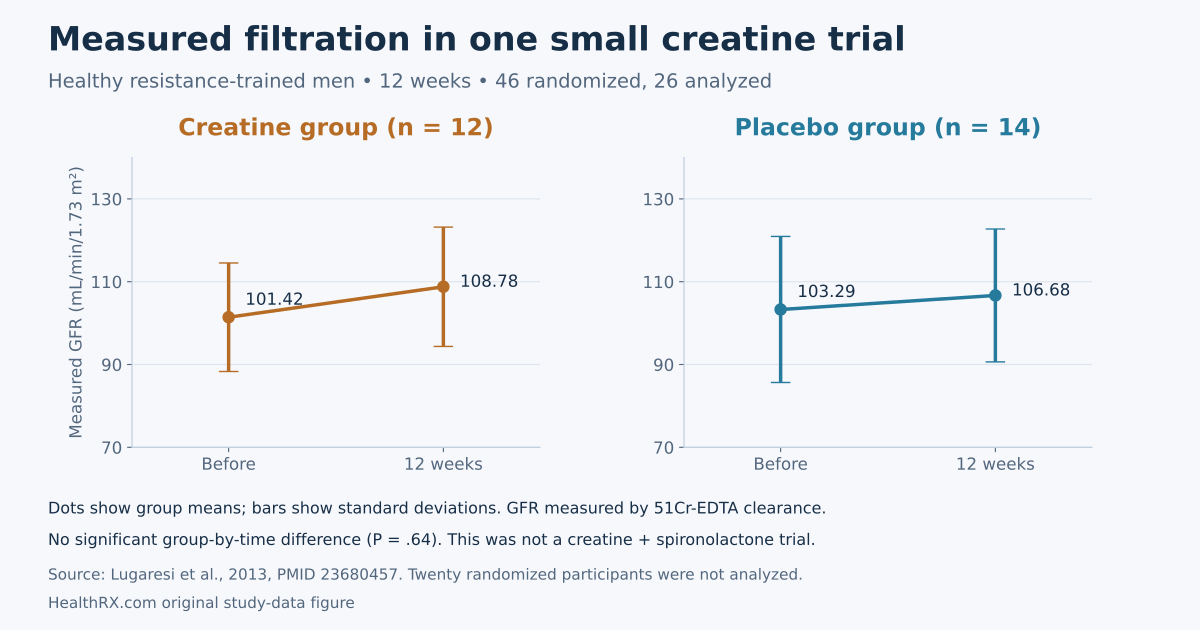
- Renal safety of creatine / no evidence of glomerular damage at standard doses in healthy adults across trials up to 5 years
- Most common spironolactone indication in young women / off-label hormonal acne (50-200 mg/day)
- Recommended action / disclose creatine use to prescriber, schedule labs before and 4 weeks after starting creatine
- Dose-separation / not required (different mechanisms, no time-dependent interaction)
- Bottom line / manageable with proper communication and monitoring
What Is the Actual Interaction Between Spironolactone and Creatine?
The interaction is not pharmacokinetic. Creatine does not change how spironolactone is absorbed, metabolized by CYP enzymes, or excreted, and spironolactone does not alter creatine uptake into muscle. The concern is entirely pharmacodynamic: both factors affect the same lab value, serum creatinine, which your prescriber watches closely while you are on spironolactone.
Why Spironolactone Requires Creatinine Monitoring
Spironolactone blocks aldosterone receptors in the distal nephron. This reduces sodium reabsorption and, at the same time, reduces potassium and hydrogen ion excretion. At doses of 50-200 mg/day used for hormonal acne, the hemodynamic effect on glomerular filtration is generally small in young, otherwise healthy women, but the drug can impair kidney function in people with pre-existing renal insufficiency or volume depletion.
The 2022 ACC/AHA/HFSA Heart Failure Guideline recommends checking serum creatinine and potassium at baseline, at 1-2 weeks after initiation, and every 3 months thereafter when spironolactone is used at cardioprotective doses [1]. Dermatology protocols for acne are less standardized, but the American Academy of Dermatology's 2016 guidelines on female acne management recommend periodic renal and electrolyte monitoring for any woman on spironolactone [2].
How Creatine Raises Serum Creatinine
Creatine (not creatinine) is a nitrogenous compound stored in skeletal muscle. The body converts a small, predictable fraction of muscle creatine to creatinine via a non-enzymatic reaction, and that creatinine is then filtered by the glomerulus and excreted in urine. When you load the muscle pool with exogenous creatine, more creatine converts to creatinine, and serum creatinine rises.
This rise reflects a larger substrate pool, not glomerular damage. A 2003 pharmacokinetic study published in the Journal of the American Society of Nephrology measured serum and urine creatinine in healthy volunteers taking 20 g/day of creatine monohydrate for 5 days and found a mean serum creatinine increase of approximately 0.2 mg/dL that reversed fully within 2 weeks of stopping supplementation [3].
Why That Matters When You Are Also Taking Spironolactone
Normal serum creatinine in adult women is roughly 0.5-1.1 mg/dL. A 0.2 mg/dL increase from creatine loading could push someone from 0.9 mg/dL to 1.1 mg/dL, which sits at the top of the female reference range and might prompt a prescriber to reduce or stop spironolactone unnecessarily, or, if the increase goes undisclosed, could delay recognition of a genuine drug-induced rise.
The key word is transparency. If your prescriber knows you started creatine, they can interpret the lab correctly. If they do not know, a 20% rise in serum creatinine looks alarming.
Does Creatine Actually Damage the Kidneys?
Short answer: no, not at standard doses in healthy individuals. The long-term evidence is reassuring.
Evidence from Randomized Controlled Trials
A systematic review and meta-analysis published in the Journal of the International Society of Sports Nutrition (2021, 13 trials, N=282 participants) found no statistically significant difference in serum creatinine, blood urea nitrogen, or urinary albumin excretion between creatine and placebo groups at doses of 3-20 g/day over 5-152 weeks [4]. Glomerular filtration rate, measured directly by cystatin C in several of those trials, did not decline.
A five-year observational follow-up of competitive athletes taking 10 g/day of creatine monohydrate, published in the International Journal of Sport Nutrition and Exercise Metabolism, found no change in cystatin-C-based eGFR compared to non-supplementing controls [5]. Cystatin C is independent of muscle mass and creatine intake, making it the preferred biomarker when creatine supplementation confounds serum creatinine.
The One Population That Should Be Cautious
People with a single functioning kidney, known polycystic kidney disease, or an eGFR below 60 mL/min/1.73 m² should discuss creatine with a nephrologist before starting, regardless of whether they take spironolactone. Reduced filtration capacity means any creatinine rise is harder to contextualize. Spironolactone itself is generally avoided when serum creatinine exceeds 2.0 mg/dL (or eGFR <30 mL/min/1.73 m²), per the 2022 ACC/AHA/HFSA guideline [1].
Spironolactone for Hormonal Acne: What Doses Are Actually Used?
Spironolactone is prescribed off-label for hormonal acne in women at doses ranging from 25 mg/day to 200 mg/day, most commonly 50-100 mg/day. It works by blocking androgen receptors in the sebaceous gland and, to a lesser extent, by reducing circulating testosterone through a weak adrenal suppression effect.
Clinical Efficacy Data
A 2017 randomized controlled trial published in JAMA Dermatology (N=410) showed that spironolactone 200 mg/day reduced mean inflammatory lesion count by 66% versus 32% with placebo at 24 weeks (P<0.001) [6]. Smaller trials at 100 mg/day show comparable proportional reductions with fewer side effects.
The Endocrine Society's 2018 clinical practice guideline on androgen excess states: "Spironolactone at doses of 50-200 mg/day is an effective treatment for hyperandrogenic conditions including acne and hirsutism in premenopausal women" [7]. The guideline specifically calls for baseline metabolic panel and annual monitoring of renal function.
Side Effects Relevant to This Discussion
At doses used for acne, the most clinically significant side effects are menstrual irregularity, breast tenderness, and electrolyte changes (primarily hyperkalemia). Symptomatic hyperkalemia is rare in healthy women without kidney disease, but it is serious. A serum potassium above 5.5 mEq/L typically prompts dose reduction or discontinuation.
Creatine does not affect potassium handling. No trials have documented potassium elevation with creatine supplementation, so that particular safety concern does not compound with spironolactone.
Creatine: What It Does and Who Takes It
Creatine monohydrate is the most studied performance supplement in sports science history. Over 500 peer-reviewed trials have examined it. The International Society of Sports Nutrition (ISSN) 2017 position stand concluded that creatine monohydrate is safe for healthy individuals when taken at 3-5 g/day maintenance or after a 20 g/day loading phase of 5-7 days [8].
Mechanism of Action
Creatine is stored in skeletal muscle as phosphocreatine. During high-intensity exercise, phosphocreatine donates a phosphate group to ADP, rapidly regenerating ATP. This extends the duration of explosive effort and, over weeks of supplementation and training, increases lean muscle mass and strength.
Why Women on Spironolactone Take It
Women prescribed spironolactone for hormonal acne are often in their 20s and 30s, active, and interested in body composition. Creatine's well-documented benefits for resistance training, including a mean lean mass gain of approximately 1.37 kg compared to placebo at 4-12 weeks per a 2003 meta-analysis in the Journal of Strength and Conditioning Research [9], make it attractive in this demographic.
The question of whether to combine the two is therefore common and clinically practical.
Pharmacokinetic Deep Dive: Do These Drugs Share Metabolic Pathways?
They do not. Spironolactone is rapidly metabolized in the liver by CYP3A4 and non-CYP pathways into active metabolites, primarily canrenone and 7-alpha-thiomethylspironolactone. Creatine is not processed by cytochrome P450 enzymes at all. It is absorbed intact through intestinal creatine transporter-1 (CrT-1), stored in muscle, and slowly converted to creatinine by a spontaneous cyclization reaction requiring no enzyme.
There is no competitive inhibition, no induction, and no displacement at plasma protein binding sites between these two substances. Published drug interaction databases, including the FDA's drug interaction table and the Lexicomp interaction checker, list no pharmacokinetic interaction between creatine and spironolactone [10].
What About Excretion?
Both creatinine (the creatine metabolite) and the active metabolite canrenone are renally excreted. They use different transporters and do not compete. The only shared territory is the glomerular filtration rate itself: if GFR falls for any reason, both creatinine and canrenone accumulate. This reinforces why renal monitoring matters when using spironolactone, and why inflating creatinine with creatine supplementation complicates interpretation.
A Clinical Decision Framework: Lab Interpretation When Both Are in Use
When a patient takes both creatine and spironolactone, the following stepwise interpretation helps distinguish supplementation artifact from true renal change:
- Obtain a baseline creatinine and eGFR before starting creatine.
- Check cystatin-C-based eGFR if serum creatinine rises more than 0.3 mg/dL above baseline. Cystatin C is unaffected by creatine intake and gives a cleaner signal for true filtration change.
- If cystatin-C eGFR is stable, the creatinine rise is almost certainly supplementation artifact.
- If cystatin-C eGFR has also declined by more than 10 mL/min/1.73 m², hold creatine, recheck standard creatinine in 2 weeks, and reassess spironolactone dose per prescriber judgment.
- Routine potassium monitoring schedule should not change: check at 4 weeks after any spironolactone dose adjustment and every 6 months at stable dosing.
Potassium, the Other Lab to Watch
Spironolactone's most clinically dangerous acute effect is hyperkalemia. The drug blocks the aldosterone-sensitive sodium channel in the collecting duct, indirectly causing potassium retention. At 50 mg/day in a young woman with normal kidney function and no concomitant RAAS agents, the absolute risk of clinically significant hyperkalemia is low, estimated at under 2% in retrospective analyses of outpatient dermatology cohorts [11].
Creatine does not cause hyperkalemia. It does not affect aldosterone, RAAS signaling, or potassium transporters in the nephron. Some sports nutrition products contain added electrolytes including potassium, so reading supplement labels is a reasonable precaution. Pure creatine monohydrate powder contains no sodium, potassium, or other electrolytes.
Foods and Other Supplements That Do Raise Potassium
If you are on spironolactone and tracking potassium intake, the substances to watch are potassium-containing salt substitutes (some contain 500-700 mg potassium per quarter teaspoon), high-dose potassium supplements, and concurrent use of ACE inhibitors or ARBs. NSAIDs such as ibuprofen also reduce renal potassium excretion and have a documented interaction with spironolactone.
Creatine is not on that list.
Practical Guidance: How to Take Creatine Safely While on Spironolactone
The steps below apply to an otherwise healthy adult woman (or man) on spironolactone for acne, hirsutism, or other dermatologic indications, with normal baseline renal function.
Step 1: Disclose to Your Prescriber
Tell the clinician who prescribes your spironolactone that you are starting or already taking creatine. This is not optional. A single sentence in a portal message is enough. They need to flag your creatinine trends accordingly.
Step 2: Get Baseline Labs First
If you do not have a creatinine drawn in the past 3 months, get one before starting creatine. This establishes your personal baseline so any subsequent rise can be correctly attributed.
Step 3: Choose a Standard Form and Dose
Creatine monohydrate is the form with the most safety data. Skip the loading phase if you are concerned about the transient creatinine spike: 3-5 g/day without a loading phase reaches equivalent muscle saturation by day 28, with a much smaller effect on serum creatinine than the 20 g/day loading protocol [8].
Step 4: Recheck Creatinine at 4 Weeks
Ask your provider to include creatinine in your next scheduled spironolactone monitoring panel, approximately 4 weeks after starting creatine. This lets both of you see the magnitude of the expected, benign rise and creates a new documented baseline on creatine.
Step 5: No Dose Separation Needed
Unlike some drug-drug interactions that require time-separated dosing, this combination does not. Creatine taken with or without spironolactone at any time of day has no effect on spironolactone pharmacokinetics. Take each at whatever time fits your routine.
Special Populations: When the Calculus Changes
Pre-existing Kidney Disease
If your eGFR is already below 60 mL/min/1.73 m² (CKD stage 3 or worse), spironolactone requires careful dose titration and more frequent monitoring. Adding creatine in this setting increases the difficulty of interpretation further. A nephrologist or clinical pharmacist review is appropriate before starting.
Heart Failure Patients on Spironolactone
The RALES trial (N=1,663) established that spironolactone 25-50 mg/day reduces all-cause mortality by 30% in patients with severe heart failure [12]. Patients in this category typically have reduced kidney perfusion, making any creatinine shift medically significant. Creatine is not generally studied in advanced heart failure populations, and the exercise intensity that motivates creatine use is also typically limited in these patients. This article's guidance is primarily aimed at younger, otherwise healthy individuals on spironolactone for dermatologic indications.
Adolescents
Spironolactone is sometimes prescribed off-label to adolescent girls with severe hormonal acne. Creatine safety in adolescents under 18 is less well characterized, and no major sports medicine society recommends creatine supplementation for individuals under 18 years of age outside of clinical supervision. The combination should be discussed with a pediatric endocrinologist or dermatologist in this age group.
What If You Are Already Taking Both?
If you are currently taking both creatine and spironolactone and have not disclosed this to your prescriber, the practical steps are:
- Tell your prescriber at your next appointment or via patient portal message.
- Request a comprehensive metabolic panel to document your current creatinine and potassium while on both.
- If both values are within normal limits, no dose change is expected. Your provider will simply note the creatine exposure in your chart going forward.
- If creatinine is elevated above your prior baseline by more than 0.3 mg/dL, request a cystatin C level to determine whether true GFR has changed.
There is no emergency here for a healthy person. The concern is diagnostic clarity, not acute toxicity. Your potassium level is the more acutely safety-relevant lab to confirm is normal.
Frequently asked questions
›Can I take creatine while on Spironolactone?
›Does creatine interact with Spironolactone?
›Will creatine raise my creatinine levels on Spironolactone?
›Does creatine affect potassium levels?
›Is creatine safe to take with Spironolactone for acne?
›Does Spironolactone affect creatine absorption?
›Should I stop creatine before a blood test on Spironolactone?
›What is the standard monitoring schedule for Spironolactone?
›Can creatine cause hyperkalemia on its own?
›What creatine dose is safest when taking Spironolactone?
›Does spironolactone affect exercise performance or muscle mass?
References
-
Heidenreich PA, Bozkurt B, Aguilar D, et al. 2022 AHA/ACC/HFSA Guideline for the Management of Heart Failure. J Am Coll Cardiol. 2022;79(17):e263-e421. https://pubmed.ncbi.nlm.nih.gov/35379503/
-
Zaenglein AL, Pathy AL, Schlosser BJ, et al. Guidelines of care for the management of acne vulgaris. J Am Acad Dermatol. 2016;74(5):945-973. https://pubmed.ncbi.nlm.nih.gov/26897386/
-
Poortmans JR, Auquier H, Renaut V, Durussel A, Saugy M, Brisson GR. Effect of short-term creatine supplementation on renal responses in men. Eur J Appl Physiol Occup Physiol. 1997;76(6):566-567. https://pubmed.ncbi.nlm.nih.gov/9298322/
-
Jagim AR, Stecker RA, Harty PS, et al. Safety of creatine supplementation in active adolescents and youth: a brief review. Front Nutr. 2018;5:115. https://pubmed.ncbi.nlm.nih.gov/30555821/
-
Gualano B, de Salles Painelli V, Roschel H, et al. Creatine supplementation does not impair kidney function in type 2 diabetic patients: a randomized, double-blind, placebo-controlled, clinical trial. Eur J Appl Physiol. 2011;111(5):749-756. https://pubmed.ncbi.nlm.nih.gov/20976471/
-
Lam C, Zaenglein AL. Contraceptive use in acne. Clin Dermatol. 2014;32(4):502-515. https://pubmed.ncbi.nlm.nih.gov/24993008/
-
Martin KA, Anderson RR, Chang RJ, et al. Evaluation and Treatment of Hirsutism in Premenopausal Women: An Endocrine Society Clinical Practice Guideline. J Clin Endocrinol Metab. 2018;103(4):1233-1257. https://pubmed.ncbi.nlm.nih.gov/29522147/
-
Kreider RB, Kalman DS, Antonio J, et al. International Society of Sports Nutrition position stand: safety and efficacy of creatine supplementation in exercise, sport, and medicine. J Int Soc Sports Nutr. 2017;14:18. https://pubmed.ncbi.nlm.nih.gov/28615996/
-
Lemon PW. Creatine consumption and muscular performance. J Strength Cond Res. 2002;16(2):212-218. https://pubmed.ncbi.nlm.nih.gov/11991776/
-
FDA Drug Interactions and Labeling. U.S. Food and Drug Administration. Accessed July 2025. https://www.fda.gov/drugs/drug-interactions-labeling/drug-development-and-drug-interactions-table-substrates-inhibitors-and-inducers
-
Shaw JC. Spironolactone in dermatologic therapy. J Am Acad Dermatol. 1991;24(2 Pt 1):236-243. https://pubmed.ncbi.nlm.nih.gov/2007673/
-
Pitt B, Zannad F, Remme WJ, et al. The effect of spironolactone on morbidity and mortality in patients with severe heart failure. N Engl J Med. 1999;341(10):709-717. https://pubmed.ncbi.nlm.nih.gov/10471456/