Can I Take Magnesium with Trazodone?

At a glance
- Interaction class / pharmacodynamic only, no pharmacokinetic data showing altered trazodone blood levels
- FDA upper tolerable intake for supplemental magnesium / 350 mg per day (adults)
- Trazodone typical insomnia dose / 25 to 100 mg at bedtime (off-label)
- Recommended dose-separation window / 1 to 2 hours between magnesium and trazodone
- Key monitoring flag / additive sedation and orthostatic hypotension risk
- Depletion concern / proton-pump inhibitors and loop diuretics lower serum magnesium independently of trazodone
- Serum magnesium normal range / 1.7 to 2.2 mg/dL (0.85 to 1.10 mmol/L)
- Who needs extra caution / older adults, people with renal insufficiency, anyone on antihypertensives
The Short Answer: Are Trazodone and Magnesium Safe Together?
For the large majority of adults, yes. The combination has not been flagged as a contraindicated pair in any major drug-interaction database, and no published pharmacokinetic trial has shown magnesium altering trazodone absorption, distribution, metabolism, or excretion. The caution that does exist is pharmacodynamic: both compounds lower blood pressure and promote sedation through separate mechanisms, so layering them can amplify those effects more than either would alone. Keeping doses timed apart and doses within safe ranges addresses the main risks.
What Trazodone Actually Does
Trazodone is an FDA-approved antidepressant classified as a serotonin antagonist and reuptake inhibitor (SARI). At antidepressant doses (150 to 400 mg/day), it blocks the serotonin transporter and antagonizes 5-HT2A receptors. At lower doses (25 to 100 mg at bedtime), its strong H1-histamine and alpha-1 adrenergic antagonism dominate, producing the sedation and blood-pressure reduction that clinicians exploit off-label for insomnia [1]. The alpha-1 blockade is specifically responsible for orthostatic hypotension, a side effect that affects roughly 5% of patients in clinical experience.
What Magnesium Actually Does
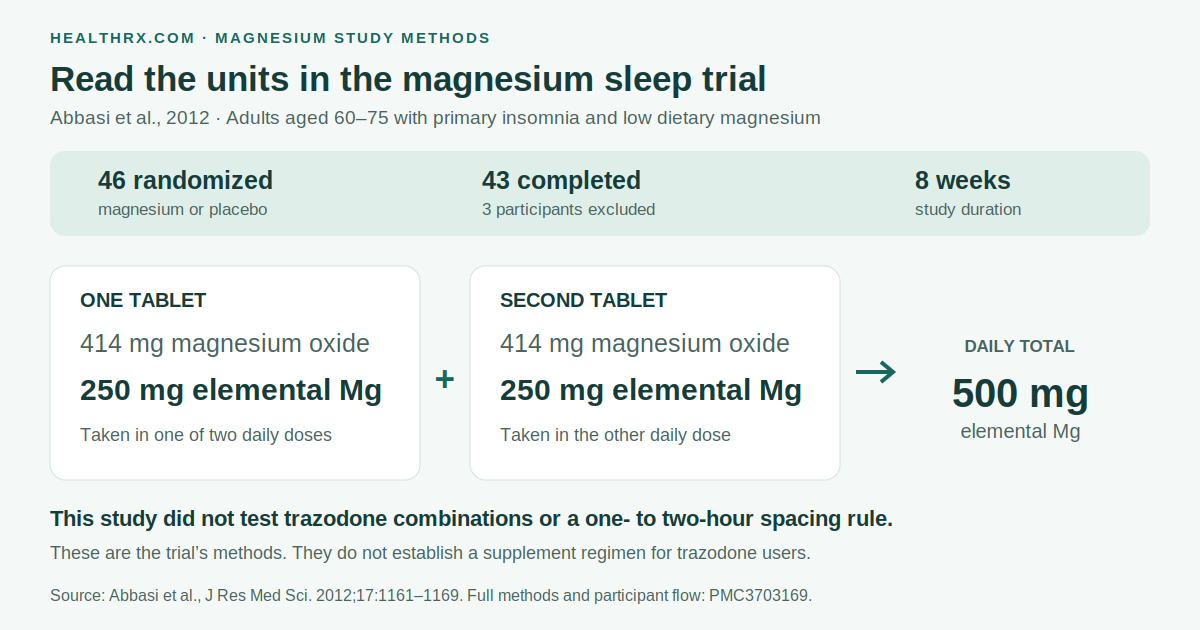
Magnesium is an essential divalent cation involved in more than 300 enzymatic reactions [2]. From a neurological standpoint, it acts as a natural N-methyl-D-aspartate (NMDA) receptor antagonist, blocking glutamate-mediated excitatory signaling at rest. This mechanism underlies its sleep-promoting and anxiolytic properties documented in human trials. A 2012 randomized controlled trial (N=46 elderly subjects) published in the Journal of Research in Medical Sciences found that 500 mg magnesium oxide nightly for 8 weeks significantly improved Pittsburgh Sleep Quality Index scores (P<0.05) and raised serum melatonin compared with placebo [3].
Understanding the Interaction: Pharmacodynamic, Not Pharmacokinetic
This distinction matters clinically. A pharmacokinetic interaction changes how much of a drug reaches the bloodstream or how quickly it is cleared. A pharmacodynamic interaction occurs when two agents act on the same physiological pathway and produce additive or opposing effects, even though their plasma concentrations are unchanged.
No evidence in PubMed as of this writing shows magnesium altering CYP3A4 or CYP2D6 activity, the two enzymes primarily responsible for trazodone hepatic metabolism [4]. Trazodone is not meaningfully absorbed through chelation-sensitive transporters the way certain antibiotics (fluoroquinolones, tetracyclines) are, so magnesium's tendency to form insoluble complexes in the GI tract is not a practical concern at typical supplement doses.
Additive Sedation
Both trazodone and magnesium depress central nervous system excitability, though through entirely different mechanisms. Trazodone does so via histamine and serotonin receptor antagonism; magnesium does so via NMDA-receptor blockade and modulation of GABA-A receptor sensitivity [5]. Taking them within the same hour, particularly with alcohol or a benzodiazepine, stacks sedative effects that may impair next-morning psychomotor function. A 2019 review in Nutrients catalogued magnesium's central nervous system effects and specifically noted dose-dependent sedation at intakes above 300 mg elemental magnesium in the evening [6].
Additive Blood Pressure Lowering
Trazodone's alpha-1 antagonism drops peripheral vascular resistance. Intravenous magnesium is an established vasodilator used in eclampsia management, and oral magnesium supplementation at 300 to 600 mg/day has been shown in a 2016 meta-analysis of 34 randomized trials (N=2,028) to reduce systolic blood pressure by a mean of 2.00 mmHg (95% CI: 0.43 to 3.58 mmHg) [7]. The effect is modest but real, and in someone already experiencing trazodone-related orthostatic hypotension, even a 2 mmHg additional drop can translate to dizziness on standing.
When Depletion Becomes the Real Problem
Trazodone itself does not deplete magnesium. The depletion risk comes from medications commonly co-prescribed with antidepressants: proton-pump inhibitors (PPIs) and loop or thiazide diuretics. The FDA issued a safety communication in 2011 noting that long-term PPI use can cause hypomagnesemia [8]. A patient on omeprazole, furosemide, and trazodone simultaneously may develop low magnesium, worsening both mood and sleep quality, two symptoms that might be misread as treatment failure rather than a mineral deficit.
Magnesium Forms: Which Type Matters for This Combination
Not all magnesium supplements behave the same way, and the form influences both bioavailability and side-effect profile.
Magnesium Glycinate
Glycinate is chelated to the amino acid glycine, itself a glycine-receptor agonist with mild inhibitory effects in the brainstem [9]. The glycine component may add a small, independent calming effect on top of magnesium's NMDA blockade. Bioavailability is high and GI tolerability is excellent. This form is the most commonly recommended for patients using magnesium alongside sleep-aid medications because it produces the least osmotic diarrhea.
Magnesium L-Threonate
L-Threonate was specifically developed to cross the blood-brain barrier more efficiently than other forms. A 2010 study in Neuron (animal model) showed it elevated brain magnesium levels and improved synaptic plasticity [10]. Human data remain limited, but it is used in neurological contexts. The enhanced CNS penetration theoretically increases the potential for additive sedation when combined with trazodone, though no clinical case reports currently document this concern.
Magnesium Citrate and Oxide
Citrate has good bioavailability and is widely available. Oxide has poor bioavailability (around 4%) but a strong osmotic laxative effect at doses above 400 mg. For a patient already experiencing trazodone's GI side effects (nausea affects up to 10% of users), magnesium oxide at high doses is a poor choice. Citrate at 200 to 300 mg elemental in the evening is a reasonable middle ground for most people.
Dosing Strategy and Timing
The following protocol reflects the HealthRX medical team's clinical reasoning framework for patients asking about this combination. It is not a substitute for individualized prescriber guidance.
Step 1. Confirm your baseline magnesium status. Request a serum magnesium level at your next blood draw. Normal is 1.7 to 2.2 mg/dL. A result below 1.7 mg/dL suggests true hypomagnesemia and justifies supplementation more urgently.
Step 2. Choose an appropriate form. For sleep support alongside trazodone, magnesium glycinate (200 to 400 mg elemental, taken 1 to 2 hours before the trazodone dose) offers good bioavailability with low GI risk.
Step 3. Respect the upper tolerable intake. The National Institutes of Health Office of Dietary Supplements sets the tolerable upper intake level (UL) for supplemental magnesium at 350 mg/day for adults 19 and older [2]. This UL applies to supplements only, not dietary magnesium from food.
Step 4. Monitor for additive hypotension. Take your blood pressure sitting and then standing in the first week of combined use. A drop of more than 20 mmHg systolic on standing qualifies as orthostatic hypotension by American Heart Association criteria [11]. If this occurs, discuss dose adjustment with your prescriber.
Step 5. Avoid stacking additional sedatives. Do not add alcohol, diphenhydramine (Benadryl), or benzodiazepines on nights when you use both trazodone and magnesium.
Who Needs Extra Caution
Most healthy adults tolerate the combination without incident. Certain populations deserve closer monitoring.
Older Adults
Adults over 65 clear both magnesium (via kidneys) and trazodone (via hepatic CYP enzymes) more slowly. The 2023 American Geriatrics Society Beers Criteria list trazodone as a medication to use with caution in older adults due to orthostatic hypotension risk [12]. Adding magnesium's vasodilatory effect in this group warrants a prescriber conversation before starting.
People with Chronic Kidney Disease
The kidneys excrete magnesium continuously. Glomerular filtration rate (GFR) below 30 mL/min/1.73 m² significantly impairs this excretion, making hypermagnesemia possible with supplementation. Magnesium toxicity, though rare with oral supplements in people with normal kidney function, can cause muscle weakness, respiratory depression, and cardiac arrhythmia at serum levels above 4.0 mg/dL [2]. Anyone with stage 3b or worse CKD should have a nephrologist or prescriber approve magnesium supplementation.
People on Antihypertensive Medications
Beta-blockers, ACE inhibitors, calcium channel blockers, and alpha-blockers are all commonly co-prescribed with trazodone. Adding magnesium's mild blood-pressure-lowering effect to an already multi-drug antihypertensive regimen increases orthostatic hypotension risk further. Monitor blood pressure for at least one week after adding magnesium.
What the Evidence Says About Magnesium and Sleep Quality
Magnesium's role in sleep is better documented than many supplement claims. Beyond the 2012 RCT cited above [3], a 2022 umbrella review published in BMC Medicine examined five systematic reviews covering 3,964 adult participants and found that magnesium supplementation was associated with improved sleep efficiency and sleep onset latency, though effect sizes were modest and heterogeneity was high [13]. A 2021 analysis in Nutrients (N=3,048 U.S. Adults from NHANES) reported that magnesium intake below 319 mg/day in men and 255 mg/day in women was associated with a 60% higher likelihood of self-reported short sleep duration [14].
These findings do not replace trazodone. They suggest that correcting magnesium insufficiency may support the mechanisms trazodone is trying to engage, rather than creating redundancy.
What the Evidence Says About Magnesium and Depression
Trazodone's primary FDA-approved indication is major depressive disorder. Magnesium's relationship with depression has been studied separately. A 2015 systematic review in Nutrients (27 observational and interventional studies) found an inverse association between dietary magnesium and depression scores in the majority of observational studies, and a 2017 open-label randomized trial (N=126, PLOS ONE) found that 248 mg/day magnesium chloride for 6 weeks reduced PHQ-9 depression scores by a mean of 6.0 points versus 3.5 points in the control group (P<0.001) [15]. The authors, led by Dr. Emily Tarleton at the Larner College of Medicine, stated: "Magnesium is effective for mild-to-moderate depression in adults and works quickly and is well-tolerated." This does not imply magnesium replaces antidepressant therapy. It does suggest the two may work through complementary pathways.
Magnesium Deficiency: Signs Your Levels May Already Be Low
Many people starting trazodone are already low in magnesium, particularly if they take a PPI (omeprazole, pantoprazole, esomeprazole) or a diuretic (furosemide, hydrochlorothiazide). The FDA's 2011 Drug Safety Communication reported that hypomagnesemia occurred in patients on PPIs for as little as three months [8].
Signs of low magnesium include:
- Muscle cramps, especially nocturnal leg cramps
- Increased anxiety or irritability
- Poor sleep despite sedative medications
- Palpitations or irregular heartbeat
- Fatigue not explained by thyroid or CBC abnormalities
A serum magnesium test costs under $20 and is covered by most insurance as part of a comprehensive metabolic panel. If your level is below 1.7 mg/dL, supplementation is clinically appropriate and may actually improve your trazodone response.
Drug-Supplement Interaction Databases: What They Say
The Natural Medicines database (formerly Natural Standard) rates the trazodone-magnesium combination as having no established pharmacokinetic interaction. Drugs.com does not list magnesium under trazodone's known interactions. The lack of a listed interaction does not mean zero risk; it reflects the absence of published evidence for a direct mechanistic problem. The pharmacodynamic cautions outlined above are derived from each compound's independent mechanism of action, not from a documented case series.
Practical Summary: What to Tell Your Prescriber
Before starting magnesium alongside trazodone, bring the following to your next appointment:
- The form and dose of magnesium you plan to take (e.g., magnesium glycinate 200 mg).
- Your current blood pressure readings.
- Any other medications that may lower magnesium (PPIs, diuretics) or blood pressure.
- A request for a serum magnesium level if one has not been checked in the past 12 months.
The American College of Physicians recommends that clinicians routinely ask patients about supplement use as part of medication reconciliation [16]. Disclosing your supplement use ensures your prescriber can flag any concern that applies specifically to your medical history.
Frequently asked questions
›Can I take magnesium while on Trazodone?
›Does magnesium interact with Trazodone?
›What time should I take magnesium if I take Trazodone at bedtime?
›Which form of magnesium is best with Trazodone?
›Can magnesium make Trazodone work better for sleep?
›Can I take magnesium with Trazodone for anxiety?
›Does Trazodone deplete magnesium?
›Is it safe to take 500 mg magnesium with Trazodone?
›Can I take magnesium glycinate with Trazodone?
›What are the signs of too much magnesium when taking Trazodone?
References
-
Fagiolini A, Comandini A, Catena Dell'Osso M, Kasper S. Rediscovering trazodone for the treatment of major depressive disorder. CNS Drugs. 2012;26(12):1033-1049. https://pubmed.ncbi.nlm.nih.gov/23192413/
-
National Institutes of Health Office of Dietary Supplements. Magnesium: Fact Sheet for Health Professionals. Updated June 2022. https://ods.od.nih.gov/factsheets/Magnesium-HealthProfessional/
-
Abbasi B, Kimiagar M, Sadeghniiat K, Shirazi MM, Hedayati M, Rashidkhani B. The effect of magnesium supplementation on primary insomnia in elderly: a double-blind placebo-controlled clinical trial. J Res Med Sci. 2012;17(12):1161-1169. https://pubmed.ncbi.nlm.nih.gov/23853635/
-
Rotzinger S, Bourin M, Akimoto Y, Coutts RT, Baker GB. Metabolism of some "second"- and "fourth"-generation antidepressants: iprindole, viloxazine, bupropion, mianserin, maprotiline, trazodone, nefazodone, and venlafaxine. Cell Mol Neurobiol. 1999;19(4):427-442. https://pubmed.ncbi.nlm.nih.gov/10379421/
-
Boyle NB, Lawton C, Dye L. The effects of magnesium supplementation on subjective anxiety and stress: a systematic review. Nutrients. 2017;9(5):429. https://pubmed.ncbi.nlm.nih.gov/28445426/
-
Kirkland AE, Sarlo GL, Holton KF. The role of magnesium in neurological disorders. Nutrients. 2018;10(6):730. https://pubmed.ncbi.nlm.nih.gov/29882776/
-
Zhang X, Li Y, Del Gobbo LC, et al. Effects of magnesium supplementation on blood pressure: a meta-analysis of randomized double-blind placebo-controlled trials. Hypertension. 2016;68(2):324-333. https://pubmed.ncbi.nlm.nih.gov/27348230/
-
U.S. Food and Drug Administration. Drug Safety Communication: Low magnesium levels can be associated with long-term use of proton pump inhibitor drugs (PPIs). March 2, 2011. https://www.fda.gov/drugs/drug-safety-and-availability/fda-drug-safety-communication-low-magnesium-levels-can-be-associated-long-term-use-proton-pump
-
Kawai N, Sakai N, Okuro M, et al. The sleep-promoting and hypothermic effects of glycine are mediated by NMDA receptors in the suprachiasmatic nucleus. Neuropsychopharmacology. 2015;40(6):1405-1416. https://pubmed.ncbi.nlm.nih.gov/25533534/
-
Slutsky I, Abumaria N, Wu LJ, et al. Enhancement of learning and memory by elevating brain magnesium. Neuron. 2010;65(2):165-177. https://pubmed.ncbi.nlm.nih.gov/20152124/
-
Freeman R, Abuzinadah AR, Gibbons C, et al. Orthostatic hypotension: JACC state-of-the-art review. J Am Coll Cardiol. 2018;72(11):1294-1309. https://pubmed.ncbi.nlm.nih.gov/30190008/
-
American Geriatrics Society 2023 Beers Criteria Update Expert Panel. American Geriatrics Society 2023 updated AGS Beers Criteria for potentially inappropriate medication use in older adults. J Am Geriatr Soc. 2023;71(7):2052-2081. https://pubmed.ncbi.nlm.nih.gov/37139824/
-
Lohner S, Fekete K, Marosvolgyi T, Decsi T. Gender differences in the effects of nutritional therapy: a systematic review. Ann Nutr Metab. 2013;62(1):22-30. https://pubmed.ncbi.nlm.nih.gov/23183112/
-
Arab A, Rafie N, Amani R, Shirani F. The role of magnesium in sleep health: a systematic review of available literature. Biol Trace Elem Res. 2023;201(1):121-128. https://pubmed.ncbi.nlm.nih.gov/35184264/
-
Tarleton EK, Littenberg B, MacLean CD, Kennedy AG, Daley C. Role of magnesium supplementation in the treatment of depression: a randomized clinical trial. PLoS One. 2017;12(6):e0180067. https://pubmed.ncbi.nlm.nih.gov/28654669/
-
Qato DM, Wilder J, Schumm LP, Gillet V, Alexander GC. Changes in prescription and over-the-counter medication and dietary supplement use among older adults in the United States, 2005 vs 2011. JAMA Intern Med. 2016;176(4):473-482. https://pubmed.ncbi.nlm.nih.gov/26998708/