Magnesium With Vyvanse: Check the Product, the Purpose and the Evidence
Magnesium is not one interchangeable product. A daily supplement, a constipation treatment and a combination sleep product can contain different ingredients and serve different purposes. For someone taking Vyvanse, reviewing the actual product connects the ingredient list with health history, other medicines and the reason for taking it.
Start with the actual package
Bring the label or clear photographs to your pharmacist or prescriber. Include the front, ingredient panel, serving directions and any Drug Facts panel. A brand name alone may not identify the formulation, especially when the same brand sells several versions.
On Supplement Facts, the magnesium amount represents elemental magnesium, not the weight of the entire magnesium compound. Check the serving size before interpreting that number. Magnesium also appears in antacids and laxatives. Excess intake can cause diarrhea, nausea or cramping, and impaired kidney function increases toxicity risk. [2]
Write down what you actually use: how many capsules, scoops or doses, how often, and whether another supplement or medicine also contains magnesium. Include every ingredient in a blend rather than treating its magnesium salt as the whole product.
Distinguish product purpose from the interaction mechanism
The current Vyvanse label says urinary alkalinizing agents can increase amphetamine levels and potentiate its action; coadministration should be avoided. Urinary acidifying agents can decrease amphetamine levels. [1]
That does not establish that every magnesium supplement changes urinary pH. Nor does an antacid’s effect on stomach acidity prove that every such product alkalinizes urine. The complete formulation and its function matter. A pharmacist or prescriber should assess the actual product against this warning rather than infer compatibility from “glycinate,” “citrate” or “chelated” on the bottle.
A universal two-hour gap is not an established solution to an interaction involving persistent urinary pH changes. Do not change your Vyvanse dose or try to manipulate urine pH to accommodate a supplement.
Be clear about what you want magnesium to do
For a possible dietary gap, start with a practical review of your usual eating pattern. The decision should address what is missing, not assume that an ADHD diagnosis creates a magnesium requirement.
For insomnia, distinguish trouble falling asleep from frequent waking or an irregular sleep schedule. Tell your prescriber when the problem began and how it relates to your prescribed treatment. Magnesium has not been established as a treatment for Vyvanse-related insomnia.
For ADHD symptoms, the evidence below does not establish magnesium as an effective add-on to Vyvanse. A study showing different magnesium measurements between groups cannot tell you whether supplementation will improve your symptoms.
What the studies actually tested
| Evidence | Population and design | Findings and important limits |
|---|---|---|
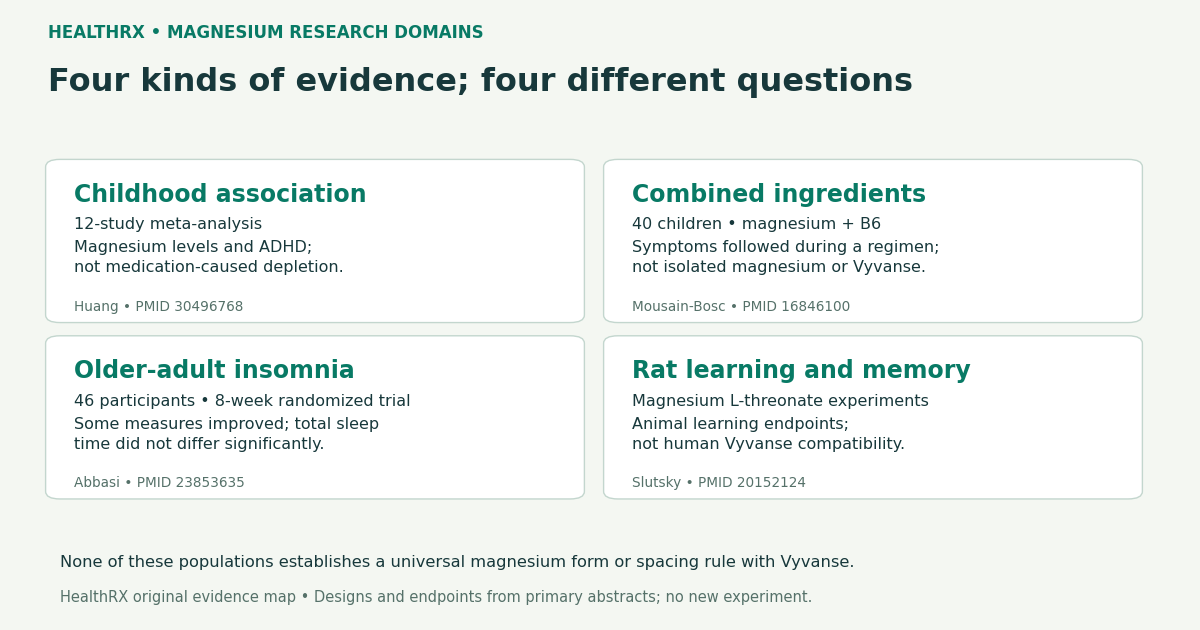
| Childhood magnesium associations | Huang and colleagues’ systematic review and meta-analysis included 12 studies comparing children with ADHD and controls. | Serum and hair magnesium levels were lower in the ADHD groups. These associations do not establish causation, adult deficiency, medication-related depletion or treatment benefit. [3] |
| Magnesium plus vitamin B6 | Mousain-Bosc and colleagues followed 40 children with clinical ADHD symptoms receiving a combined regimen for at least eight weeks; 36 control children provided a baseline magnesium comparison. | The abstract reports symptom improvement, but does not describe a randomized, placebo-controlled treatment trial. It cannot isolate magnesium’s effect from B6 or establish benefit with Vyvanse. [4] |
| Older-adult insomnia | Abbasi and colleagues randomized 46 older adults with primary insomnia to magnesium or placebo for eight weeks. | Insomnia Severity Index scores improved, but total sleep time did not differ significantly between groups. These were not stimulant-treated patients. [5] |
| Learning and memory | Slutsky and colleagues conducted rat experiments using magnesium L-threonate to elevate brain magnesium. | Findings concerned learning and memory in rodents, not human ADHD treatment, human comparisons between magnesium forms or compatibility with Vyvanse. [6] |
Make the review product-specific
A useful review combines the package with your medication list, kidney history and goal. Other medicines matter: proton pump inhibitors and certain diuretics can influence magnesium status. Assessment may combine dietary history, symptoms and testing; no single test satisfactorily establishes magnesium status. [2]
Ask for a concrete conclusion: Is this product appropriate for my intended purpose? Does its formulation raise an interaction concern? Would a different approach better address the problem? The available evidence does not identify a “best” magnesium form for people taking Vyvanse.
Frequently asked questions
Can I take magnesium while on Vyvanse?
Compatibility depends on the actual product, its ingredients and purpose, your other medicines and kidney health. Have a pharmacist or prescriber review the package rather than relying on a blanket yes.
Does magnesium interact with Vyvanse?
Vyvanse’s label warns against coadministration with urinary alkalinizing agents because they can increase amphetamine exposure. That warning does not establish an interaction with every magnesium product; the full formulation needs review. [1]
What is the best magnesium form to take with Vyvanse?
These studies do not establish a best form for Vyvanse users. Choose based on a supported purpose and product-specific review, not claims that glycinate, taurate or threonate is universally superior.
How long should I wait between taking Vyvanse and magnesium?
There is no universal separation interval that resolves every potential interaction. A two-hour gap cannot be assumed to prevent an effect involving urinary pH. Ask about the exact product instead. [1]
Can magnesium make Vyvanse less effective?
The label says urinary acidifying agents can lower amphetamine levels, but it does not establish that magnesium generally does this. Urinary alkalinizing agents can have the opposite effect. Do not adjust Vyvanse yourself. [1]
Does Vyvanse deplete magnesium?
The cited evidence does not establish Vyvanse-related magnesium depletion. The childhood meta-analysis compared magnesium measurements in ADHD and control groups; it was not a study proving medication-caused deficiency. [3]
Is magnesium glycinate safe with ADHD medication?
The glycinate name alone cannot establish safety with every ADHD medication. Review the complete product, the specific prescription and kidney status; there is no blanket clearance for all chelated magnesium products.
Can magnesium help with Vyvanse side effects like insomnia?
It is not proven to treat stimulant-related insomnia. A small trial in older adults with primary insomnia improved some outcomes, but not total sleep time, and did not study Vyvanse users. [5]
Should I get my magnesium levels tested if I take Vyvanse?
Taking Vyvanse alone does not establish a need for routine magnesium testing. Symptoms, diet, kidney health and other medicines guide assessment. Serum magnesium is commonly measured but correlates poorly with whole-body status. [2]
Can I take magnesium citrate with Vyvanse?
Check whether it is a nutritional supplement or a laxative, and identify the serving and other ingredients. Citrate on the label is not enough to settle compatibility; bring the actual product for review.
Does magnesium L-threonate interact with Vyvanse?
The cited L-threonate study involved rats, not a human Vyvanse interaction trial. It cannot establish compatibility or prove a human brain-delivery advantage over other forms. Review the complete formulation. [6]
How much magnesium should I take daily if I am on Vyvanse?
There is no established Vyvanse-specific magnesium dose. The adult upper limit of 350 mg daily covers supplements and medicines, excludes naturally occurring food magnesium, and is not a target or personal safety clearance. Individual need requires assessment. [2]
References
Sources checked October 14, 2026.
- FDA/Takeda. VYVANSE prescribing information, April 2026. Sections 2.6 and 7.1. Label.
- NIH Office of Dietary Supplements. Magnesium: Fact Sheet for Health Professionals. Fact sheet.
- Huang YH, Zeng BY, Li DJ, et al. Significantly lower serum and hair magnesium levels in children with attention deficit hyperactivity disorder than controls: A systematic review and meta-analysis. 2019. PubMed abstract, PMID 30496768.
- Mousain-Bosc M, Roche M, Polge A, Pradal-Prat D, Rapin J, Bali JP. Improvement of neurobehavioral disorders in children supplemented with magnesium-vitamin B6. I. Attention deficit hyperactivity disorders. 2006. PubMed abstract, PMID 16846100.
- Abbasi B, Kimiagar M, Sadeghniiat K, et al. The effect of magnesium supplementation on primary insomnia in elderly: A double-blind placebo-controlled clinical trial. 2012. PubMed abstract, PMID 23853635.
- Slutsky I, Abumaria N, Wu LJ, et al. Enhancement of learning and memory by elevating brain magnesium. 2010. PubMed abstract, PMID 20152124.