Can I Take Magnesium with Ambien (Zolpidem)?

At a glance
- Interaction type / pharmacodynamic (additive CNS depression), not pharmacokinetic
- Primary risk / excessive sedation and next-morning psychomotor impairment
- Magnesium forms most likely to sedate / glycinate and threonate cross the blood-brain barrier most readily
- Recommended timing / take magnesium at least 2 hours before zolpidem, or earlier in the evening
- Zolpidem standard doses / 5 mg (women) and 5 to 10 mg (men) immediate-release at bedtime
- Avoid if / you also take benzodiazepines, opioids, antihistamines, or alcohol
- Monitoring / assess for daytime sedation, coordination changes, and fall risk at each check-in
- Who to call / contact your prescriber before starting magnesium if you take zolpidem nightly
How Zolpidem Works in the Brain
Zolpidem is a nonbenzodiazepine GABA-A receptor positive allosteric modulator. It binds preferentially to the alpha-1 subunit of the GABA-A receptor complex, enhancing chloride ion influx and reducing neuronal excitability across cortical and subcortical networks. The FDA approved zolpidem in 1992 for short-term management of insomnia, and the drug remains one of the most prescribed sedative-hypnotics in the United States, with approximately 8.3 million adults filling at least one zolpidem prescription annually according to CDC data. [1]
Because the drug amplifies GABA inhibitory signaling, any co-administered agent that also increases GABA activity or reduces CNS excitability through a separate pathway compounds the net suppressive effect on the brain.
Absorption and Elimination
Zolpidem reaches peak plasma concentration in 1.6 hours for immediate-release formulations and 1.5 to 2.3 hours for extended-release (Ambien CR). Its elimination half-life is approximately 2.6 hours in healthy adults, extending to 3 to 4 hours in women (the biological basis for the FDA's 2013 label change lowering the recommended dose for women from 10 mg to 5 mg). [2]
Why the Timing of Co-Administration Matters
The period of maximum sedative effect for immediate-release zolpidem spans roughly 90 to 240 minutes post-ingestion. Any supplement that peaks in the CNS during that same window adds to the sedative load at its highest point. This is why dose separation is not just conceptually appealing but practically meaningful.
How Magnesium Acts on the Nervous System
Magnesium is the fourth most abundant mineral in the human body, with an estimated 50 to 60% stored in bone and the remainder distributed across soft tissue and serum. Its role in the CNS is substantial. Magnesium acts as a voltage-dependent antagonist of the NMDA (N-methyl-D-aspartate) glutamate receptor, blocking the receptor's ion channel at rest and reducing excitatory neurotransmission. [3] It also modulates GABA-A receptor sensitivity at sites distinct from those targeted by zolpidem, meaning both agents can act on inhibitory circuitry simultaneously.
Forms of Magnesium and CNS Penetration
Not all supplemental magnesium forms reach the brain equally.
- Magnesium glycinate: Bound to glycine, an inhibitory neurotransmitter in its own right. Glycine also activates glycine receptors in the brainstem and spinal cord. The glycine component adds a modest additional sedative signal on top of the magnesium effect.
- Magnesium threonate (L-threonate): Developed specifically to maximize CNS penetration. A 2010 study in Neuron (Slutsky et al.) showed that magnesium threonate raised cerebrospinal fluid magnesium concentrations significantly more than magnesium sulfate or chloride in rodent models, though human data on CSF penetration remain limited. [4]
- Magnesium citrate and oxide: Predominantly used for gastrointestinal motility. Systemic and CNS absorption is lower; sedative additive risk is correspondingly smaller.
- Magnesium sulfate (IV): Reserved for clinical settings (eclampsia, severe hypomagnesemia). Not relevant to outpatient supplement use.
If you are taking zolpidem, the form of magnesium you choose is not a trivial detail.
Magnesium Deficiency Is Common
Population surveys from NHANES data indicate that approximately 48% of Americans consume less magnesium than the Estimated Average Requirement for their age and sex group. [5] Diuretics (thiazides, loop agents) and proton pump inhibitors both deplete magnesium through renal and gastrointestinal mechanisms respectively. Because many patients on zolpidem for chronic insomnia also take one or both drug classes, subclinical magnesium deficiency is plausible in this population and may itself worsen sleep architecture independent of the supplement interaction.
The Interaction: Pharmacodynamic, Not Pharmacokinetic
The magnesium-zolpidem interaction is classified as pharmacodynamic. The two substances do not meaningfully alter each other's absorption, metabolism, or elimination. Magnesium does not inhibit or induce cytochrome P450 3A4 (CYP3A4), the primary hepatic enzyme responsible for zolpidem metabolism. [6] This is clinically significant because a pharmacokinetic interaction would change zolpidem blood levels; a pharmacodynamic interaction does not, meaning standard zolpidem plasma monitoring would give no early warning.
What "Additive CNS Depression" Means Clinically
Additive CNS depression is not a binary event. The magnitude of the interaction scales with:
- The form and dose of magnesium taken (glycinate and threonate carry higher CNS activity than citrate or oxide).
- The dose of zolpidem (5 mg vs. 10 mg IR vs. 12.5 mg CR).
- Concurrent use of other CNS depressants (benzodiazepines, opioids, first-generation antihistamines, muscle relaxants, alcohol).
- Individual patient factors: age, renal function (magnesium clearance declines with GFR), hepatic function (zolpidem clearance declines with hepatic impairment), and body composition.
A 65-year-old woman taking zolpidem 5 mg, magnesium glycinate 400 mg, and a nightly diphenhydramine is stacking three GABAergic or sedative agents. Her risk profile differs substantially from a 35-year-old man taking zolpidem 5 mg and magnesium citrate 200 mg with no other CNS-active medications.
Evidence from the Clinical Literature
Direct randomized controlled trial data on the zolpidem-magnesium combination are absent from the published literature as of early 2025. The interaction inference rests on mechanistic evidence and indirect sources:
A 2012 double-blind RCT published in the Journal of Research in Medical Sciences (Abbasi et al., N=46 elderly patients) found that magnesium supplementation at 500 mg daily for 8 weeks improved subjective and objective sleep quality scores without pharmacological sleep aids. [7] The trial is frequently cited to argue magnesium has stand-alone sleep benefit, but it also confirms that magnesium produces measurable CNS sleep-promoting effects. Those effects do not disappear when a person also takes zolpidem.
A 2020 review in Nutrients examined GABA-magnesium co-agonism and concluded that oral magnesium at doses of 300 to 500 mg "may" produce physiologically relevant modulation of GABA-A receptor sensitivity in well-nourished adults. [8]
The FDA's 2019 Drug Safety Communication on complex sleep behaviors associated with sedative-hypnotics, while focused on zolpidem itself, noted that any factor increasing CNS depression during the absorption phase raises the risk of sleep-related events including sleepwalking and sleep-driving. [9]
Assessing Your Personal Risk: A Clinical Decision Framework
The following four-factor framework, developed for HealthRX clinical review, helps providers and patients estimate the relative risk of combining magnesium with zolpidem before the prescriber is consulted.
Factor 1: Magnesium form. Threonate and glycinate carry the highest CNS interaction potential. Citrate is intermediate. Oxide is lowest.
Factor 2: Zolpidem formulation and dose. Extended-release (Ambien CR 6.25 to 12.5 mg) maintains higher plasma concentrations through the second half of the night, overlapping with any magnesium absorbed in the first 2 to 3 hours. Immediate-release at 5 mg carries less cumulative overlap.
Factor 3: Concurrent CNS depressants. Count every sedating agent in the regimen, including prescription and OTC drugs, cannabis, and alcohol. Each additional agent moves the risk estimate upward.
Factor 4: Patient-specific vulnerabilities. Age above 65, GFR <60 mL/min/1.73m², hepatic impairment (Child-Pugh B or C), and history of falls or parasomnias each add incremental weight.
If three or more factors are present at elevated levels, a prescriber conversation before starting magnesium is appropriate rather than optional.
Dose Separation: Does Timing Actually Help?
Separating zolpidem and magnesium doses by 2 hours reduces peak CNS overlap but does not eliminate the interaction entirely. Zolpidem's activity persists for 6 to 8 hours at sedative concentrations in some individuals, and magnesium threonate's CNS half-life is poorly characterized in humans.
A practical approach used in clinical practice:
- Take magnesium with dinner (6 to 7 PM for most people) rather than at bedtime.
- Take zolpidem immediately before bed (9 to 11 PM), as directed on the label.
- This creates a 2 to 4 hour separation that reduces peak overlap.
Dose separation is not a substitute for medical review in high-risk patients. It is a harm-reduction measure for low-risk patients who want to use both agents.
Magnesium Doses That Appear in Sleep Research
The National Institutes of Health Office of Dietary Supplements sets the Tolerable Upper Intake Level for supplemental magnesium (not dietary) at 350 mg per day for adults to avoid diarrhea and gastrointestinal side effects. [10] Sleep studies have used 300 to 500 mg daily. Exceeding 350 mg from supplements without medical supervision is not recommended, particularly in the context of concurrent zolpidem use.
When Magnesium Could Be Beneficial (and When It Might Replace Zolpidem)
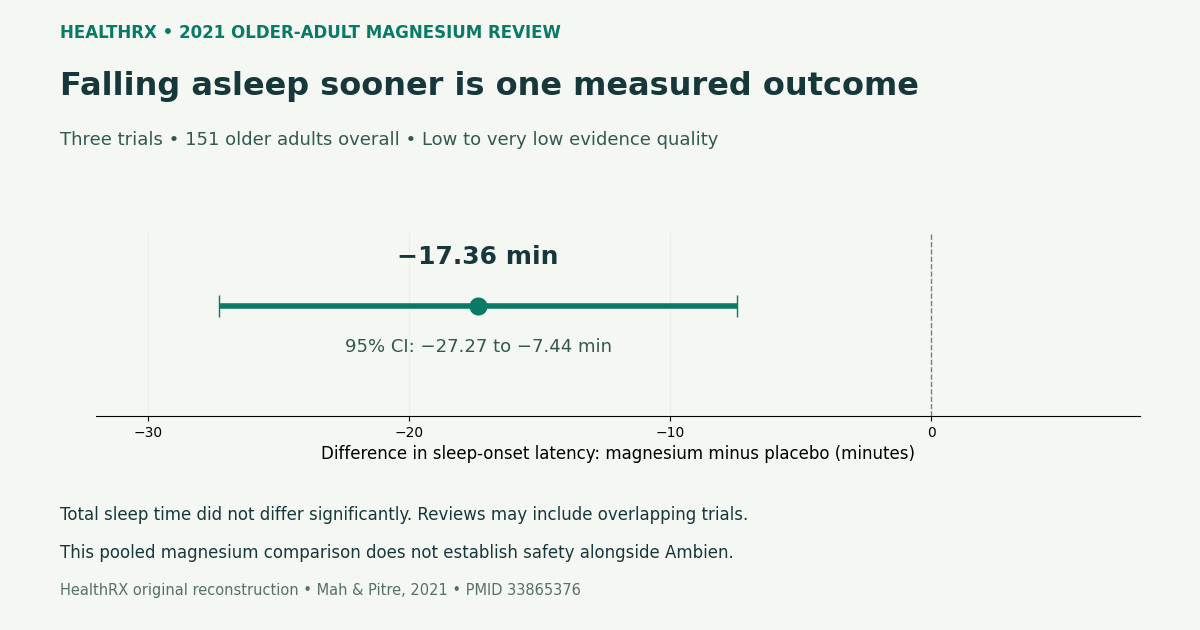
Magnesium deficiency has been associated with increased sleep latency, reduced sleep efficiency, and elevated nocturnal cortisol in observational studies. Correcting genuine deficiency may improve sleep enough to reduce zolpidem dose or duration requirements. This is not a trivial point: the American Academy of Sleep Medicine (AASM) clinical practice guideline for chronic insomnia (2021 update) recommends cognitive behavioral therapy for insomnia (CBT-I) as first-line therapy, with pharmacological agents reserved for cases where CBT-I is insufficient or unavailable. [11]
If magnesium correction, combined with sleep hygiene changes, reduces insomnia severity enough to lower the required zolpidem dose, the interaction risk decreases proportionally. Discuss this trajectory with your prescriber rather than self-adjusting zolpidem doses.
Magnesium and Insulin Sensitivity: A Secondary Consideration
Some patients on zolpidem for chronic insomnia also have metabolic syndrome or type 2 diabetes. A 2011 meta-analysis in Diabetes Care (Dong et al., 13 prospective cohort studies, N=536,318) found that higher dietary magnesium intake was associated with a statistically significant reduction in type 2 diabetes risk (relative risk 0.78 per 100 mg/day increment, P<0.001). [12] Magnesium plays a direct role in glucose transporter function and insulin receptor tyrosine kinase activity. For patients in this metabolic overlap group, magnesium supplementation may carry metabolic benefits that inform the overall benefit-risk calculation. This consideration does not change the CNS interaction analysis but may influence whether a prescriber views magnesium as net-beneficial for a given patient.
Drug Interactions Beyond Magnesium: Context for Your Full Medication List
Zolpidem carries several other clinically significant interaction risks that compound additive CNS depression when magnesium is added to the picture.
Alcohol
Alcohol potentiates zolpidem sedation through GABA-A receptor overlap. The FDA label for Ambien explicitly states that alcohol and zolpidem should not be combined. Adding magnesium to an alcohol-plus-zolpidem regimen adds a third CNS-suppressive agent.
Opioids
The FDA issued a black box warning in 2016 requiring all opioid and benzodiazepine labels (and by extension, other CNS depressants including zolpidem) to address the risk of respiratory depression from combination use. [13] Magnesium does not cause respiratory depression at supplemental doses in otherwise healthy adults, but in patients on opioids plus zolpidem, any additional CNS suppression narrows the safety margin further.
CYP3A4 Inhibitors
Ketoconazole, clarithromycin, and ritonavir inhibit CYP3A4 and raise zolpidem plasma concentrations by up to 34% in pharmacokinetic studies. Magnesium does not share this pathway. But a patient whose zolpidem levels are already elevated due to a CYP3A4 inhibitor is at higher baseline sedation risk before adding any supplement.
Monitoring and Safety Checkpoints
If you and your prescriber have decided that magnesium supplementation is appropriate while you are on zolpidem, structured monitoring makes sense.
At initiation: Start magnesium at a low dose (100 to 150 mg elemental magnesium) and titrate upward over 2 to 4 weeks. Assess for morning grogginess, difficulty waking, or coordination changes during the first week.
At 4 weeks: Evaluate subjective sleep quality and daytime function. If daytime sedation has increased, dose separation or magnesium form change should be the first adjustment before reducing either agent.
Serum magnesium: A serum magnesium level (normal range 0.75 to 0.95 mmol/L) confirms repletion. Note that serum levels are a poor proxy for total body magnesium stores; they are most useful for ruling out hypermagnesemia in patients with impaired renal function.
Fall risk in older adults: The Beers Criteria for Potentially Inappropriate Medication Use in Older Adults (2023 update by the American Geriatrics Society) lists zolpidem as a drug to avoid in adults 65 and older due to cognitive impairment and fall risk. [14] Adding a CNS-active magnesium form in this age group warrants explicit prescriber discussion.
Practical Recommendations
The following summary reflects HealthRX clinical guidance, reviewed by the HealthRX medical team, and should not replace individualized prescriber advice.
- Do not start magnesium glycinate or threonate at bedtime on the same night as zolpidem without a prior conversation with your prescriber.
- Magnesium citrate or oxide taken at dinner represents a lower-interaction-risk option for patients who want GI or general magnesium repletion benefits without maximizing CNS co-activity.
- Patients over 65, those with renal impairment (GFR <60), or those on any additional CNS depressant should treat this as a prescriber-required decision, not a self-managed one.
- If you are already taking both and notice increased morning grogginess, difficulty waking, unsteady gait, or any parasomnia (sleepwalking, sleep-eating), contact your prescriber before the next dose of either agent.
- Document the start date and dose of any new magnesium supplement so your care team has a timeline if symptoms emerge.
Per the AASM 2021 guideline language: "Pharmacological therapy should be used at the lowest effective dose for the shortest duration necessary." [11] That guidance applies with added weight when a patient is also taking CNS-active supplements.
Frequently asked questions
›Can I take magnesium while on Ambien?
›Does magnesium interact with Ambien?
›Is magnesium safe with Ambien?
›What form of magnesium is safest to take with zolpidem?
›Can magnesium replace Ambien for sleep?
›How long after taking magnesium can I take Ambien?
›Does magnesium increase zolpidem's blood levels?
›Can magnesium deficiency make insomnia worse?
›Should older adults avoid taking magnesium with Ambien?
›What should I do if I'm already taking both?
References
- Centers for Disease Control and Prevention. Prescription Drug Use in the United States. https://www.cdc.gov/nchs/data/databriefs/db334.pdf
- U.S. Food and Drug Administration. Ambien (zolpidem tartrate) Prescribing Information. 2014. https://www.accessdata.fda.gov/drugsatfda_docs/label/2014/019908s031lbl.pdf
- Altura BM, Altura BT. Magnesium and cardiovascular biology: an important link between cardiovascular risk factors and atherogenesis. Cell Mol Biol Res. 1995;41(5):347-59. PMID: 8581747. https://pubmed.ncbi.nlm.nih.gov/8581747/
- Slutsky I, Abumaria N, Wu LJ, et al. Enhancement of learning and memory by elevating brain magnesium. Neuron. 2010;65(2):165-177. https://pubmed.ncbi.nlm.nih.gov/20152124/
- Rosanoff A, Weaver CM, Rude RK. Suboptimal magnesium status in the United States: are the health consequences underestimated? Nutr Rev. 2012;70(3):153-164. https://pubmed.ncbi.nlm.nih.gov/22364157/
- Von Moltke LL, Greenblatt DJ, Harmatz JS, et al. Zolpidem metabolism in vitro: responsible cytochromes, chemical inhibitors, and in vivo correlations. Br J Clin Pharmacol. 1995;39(3):297-304. https://pubmed.ncbi.nlm.nih.gov/7619316/
- Abbasi B, Kimiagar M, Sadeghniiat K, et al. The effect of magnesium supplementation on primary insomnia in elderly: a double-blind placebo-controlled clinical trial. J Res Med Sci. 2012;17(12):1161-1169. https://pubmed.ncbi.nlm.nih.gov/23853635/
- Boyle NB, Lawton C, Dye L. The effects of magnesium supplementation on subjective anxiety and stress. Nutrients. 2017;9(5):429. https://pubmed.ncbi.nlm.nih.gov/28445426/
- U.S. Food and Drug Administration. FDA Drug Safety Communication: FDA adds Boxed Warning for risk of serious injuries caused by sleepwalking with certain prescription insomnia medicines. 2019. https://www.fda.gov/drugs/drug-safety-and-availability/fda-drug-safety-communication-fda-adds-boxed-warning-risk-serious-injuries-caused-sleepwalking
- National Institutes of Health Office of Dietary Supplements. Magnesium: Fact Sheet for Health Professionals. https://ods.od.nih.gov/factsheets/Magnesium-HealthProfessional/
- Sateia MJ, Buysse DJ, Krystal AD, et al. Clinical Practice Guideline for the Pharmacologic Treatment of Chronic Insomnia in Adults: An American Academy of Sleep Medicine Clinical Practice Guideline. J Clin Sleep Med. 2017;13(2):307-349. https://pubmed.ncbi.nlm.nih.gov/27998379/
- Dong JY, Xun P, He K, Qin LQ. Magnesium intake and risk of type 2 diabetes: meta-analysis of prospective cohort studies. Diabetes Care. 2011;34(9):2116-2122. https://pubmed.ncbi.nlm.nih.gov/21868780/
- U.S. Food and Drug Administration. FDA Drug Safety Communication: FDA warns about serious risks and death when combining opioid pain or cough medicines with benzodiazepines. 2016. https://www.fda.gov/drugs/drug-safety-and-availability/fda-drug-safety-communication-fda-warns-about-serious-risks-and-death-when-combining-opioid-pain-or
- American Geriatrics Society 2023 updated AGS Beers Criteria for Potentially Inappropriate Medication Use in Older Adults. J Am Geriatr Soc. 2023;71(7):2052-2081. https://pubmed.ncbi.nlm.nih.gov/37139824/