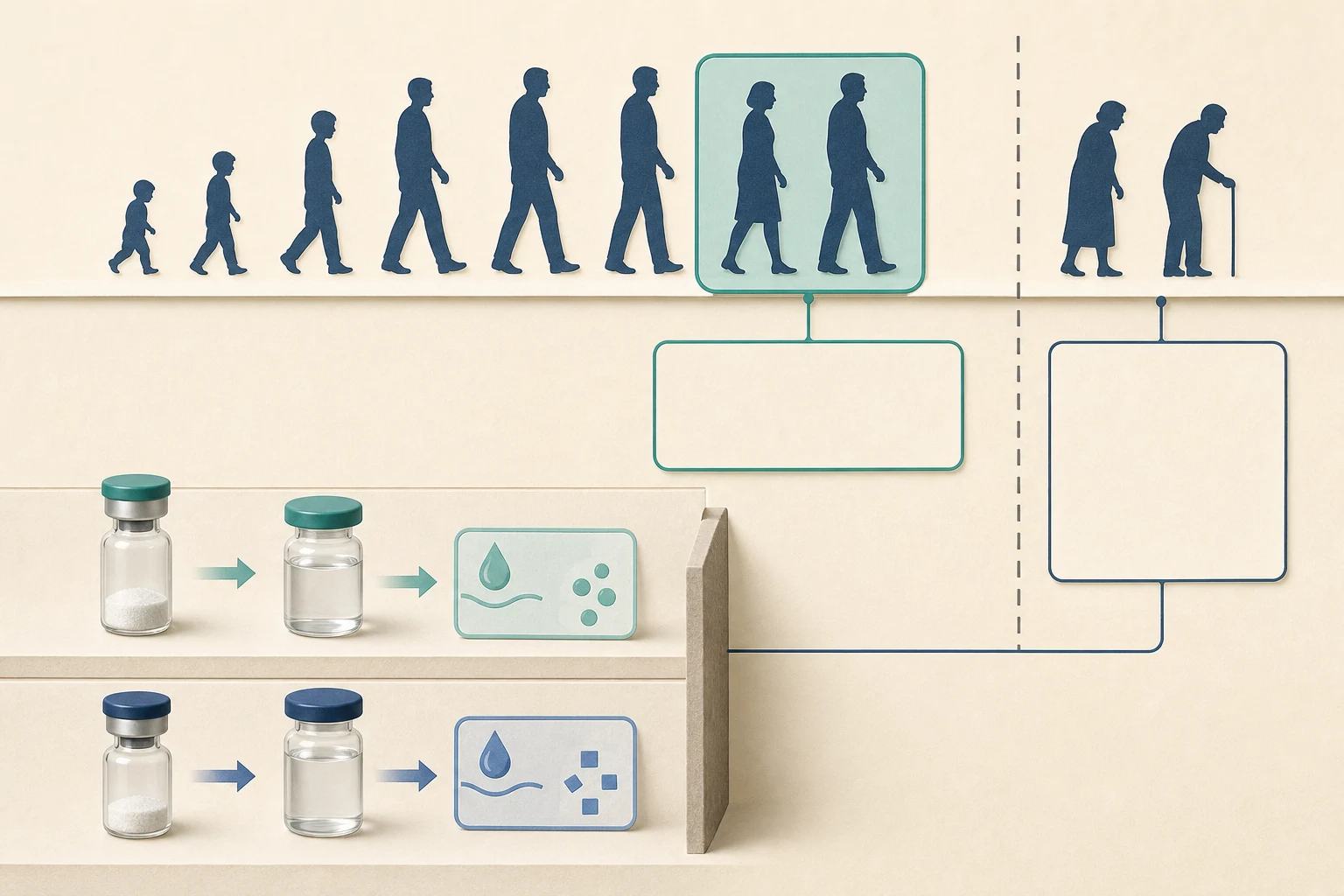
Egrifta (Tesamorelin) Dosing for Older Adults (50, 64): What Clinicians and Patients Should Know

Peptide medicine laboratory image for Egrifta (Tesamorelin) Dosing for Older Adults (50, 64): What Clinicians and Patients Should Know

Egrifta (Tesamorelin) Dosing for Older Adults (50, 64)

At a glance

  • Standard dose / 2 mg subcutaneous injection once daily, regardless of age
  • FDA-approved indication / reduction of excess abdominal fat in HIV-associated lipodystrophy
  • Key trial result / 15% reduction in visceral adipose tissue (VAT) at 26 weeks vs. placebo (Falutz et al., 2007)
  • No age-based dose adjustment / FDA labeling does not specify a different dose for patients 50 to 64
  • IGF-1 monitoring / check at baseline and every 6 to 12 months; discontinue if persistently elevated above upper limit of normal
  • Glucose screening / fasting glucose or HbA1c at baseline and periodically, given age-related insulin resistance risk
  • Polypharmacy flag / review concomitant medications including statins, antihypertensives, and antiretrovirals
  • Injection sites / rotate between abdomen (preferred), thigh, and upper arm
  • Reconstitution / Egrifta SV uses a single-vial formulation requiring 0.5 mL sterile water
  • Duration of therapy / benefits reverse upon discontinuation; ongoing treatment is typically needed

Standard Tesamorelin Dose: 2 mg Daily, No Age Adjustment Required

Tesamorelin is dosed at 2 mg by subcutaneous injection once daily. The FDA-approved prescribing information does not recommend dose modification based on age, body weight, or renal function. For adults between 50 and 64, the protocol is identical to what a 30-year-old patient receives.

This uniformity stems from the drug's mechanism. Tesamorelin is a synthetic growth hormone-releasing factor (GRF) analogue that stimulates the pituitary to produce endogenous growth hormone (GH). Because the pituitary's response to GRF naturally declines with age, the effective GH output in a 58-year-old may already be lower than in a 35-year-old receiving the same injection. The fixed 2 mg dose produces a physiologically modulated response rather than a pharmacologically forced one. In the key trial by Falutz et al. (N=412), participants across a range of ages received 2 mg daily, and the drug reduced trunk fat by approximately 15% at 26 weeks compared to placebo [1]. Subgroup analyses did not reveal a need for dose titration in older participants.

Clinicians sometimes ask whether a lower "starter dose" makes sense for patients over 50. No published data supports this practice for the approved indication. Starting below 2 mg risks subtherapeutic IGF-1 stimulation without reducing the already modest side-effect profile.

Why the 50-to-64 Age Window Matters Clinically

Adults aged 50 to 64 sit at a metabolic crossroads. This group is the right target for heightened monitoring, not dose changes. Perimenopause in women and declining testosterone in men overlap with the metabolic disruption caused by HIV-associated lipodystrophy, creating compounding effects on visceral fat, insulin sensitivity, and cardiovascular risk.

A 2010 analysis published in the Journal of Clinical Endocrinology & Metabolism demonstrated that HIV-positive patients over 50 had significantly higher rates of metabolic syndrome compared to age-matched HIV-negative controls [2]. Visceral adipose tissue accumulation was a primary driver. Tesamorelin directly addresses this pathology, but in patients who already carry elevated cardiovascular risk, clinicians need tighter surveillance.

The Endocrine Society's clinical practice guideline on GH use in adults emphasizes that "IGF-1 levels should be maintained in the age-appropriate normal range" and that "older patients may be more sensitive to GH action" [3]. While this guideline primarily addresses GH replacement for adult GH deficiency, the pharmacologic principle applies: a 55-year-old on tesamorelin deserves closer IGF-1 tracking than a 32-year-old.

Bone density is another consideration. Older adults with HIV are already at increased fracture risk. GH and IGF-1 have complex effects on bone metabolism, and a 2014 review in Osteoporosis International confirmed that HIV-positive individuals aged 50 and older have fracture rates 2 to 3 times higher than the general population [4]. Tesamorelin's effect on bone in this subgroup has not been specifically studied. Clinicians should maintain standard osteoporosis screening.

IGF-1 Monitoring: The Central Safety Lever for Older Patients

Tracking IGF-1 is the single most important safety measure during tesamorelin therapy in the 50-to-64 age group. The drug works by raising endogenous GH, which in turn elevates IGF-1. Persistently supraphysiologic IGF-1 levels carry theoretical risks including insulin resistance, fluid retention, and (based on epidemiologic data) possible associations with malignancy over long timeframes.

The Egrifta SV prescribing label instructs clinicians to obtain IGF-1 at baseline and during treatment, discontinuing the drug if IGF-1 remains consistently above the upper limit of normal [5]. For patients over 50, a practical protocol looks like this:

  • Baseline: measure serum IGF-1 before the first injection.
  • Week 12: recheck IGF-1. If above the age-adjusted upper limit, recheck at week 16.
  • Every 6 months thereafter: routine IGF-1 surveillance.
  • Discontinuation threshold: two consecutive IGF-1 values above the age-adjusted upper limit of normal.

Age-adjusted reference ranges matter here. A "normal" IGF-1 for a 28-year-old is well above normal for a 60-year-old. Using a single reference range across all ages would miss clinically meaningful elevations in older patients. The 2011 Endocrine Society guideline specifically warns against this error [3].

Glucose and Insulin Resistance: A Dual-Risk Scenario

Tesamorelin can raise fasting glucose. Growth hormone antagonizes insulin action, and this effect is dose-independent at the 2 mg level. In the Falutz et al. key trial, mean fasting glucose increased modestly in the treatment arm, though frank diabetes was rare [1]. A subsequent 26-week extension study confirmed that glucose elevations remained small and largely stable over 52 total weeks of therapy [6].

For a 55-year-old with HIV, however, the baseline glucose picture is often already compromised. Antiretroviral therapy (particularly older protease inhibitors and some nucleoside analogues) contributes to insulin resistance. Age-related beta-cell decline adds another layer. The combination means that even a modest GH-mediated glucose increase could tip a patient from prediabetes into diabetes.

Screening protocol for this age group:

  • Baseline: fasting glucose and HbA1c.
  • Month 3: repeat fasting glucose.
  • Every 6 months: HbA1c.
  • Immediate reassessment: if a patient reports polydipsia, polyuria, or unexplained weight loss.

Dr. Julian Falutz of McGill University, the lead investigator on the key tesamorelin trials, noted that "the metabolic effects of tesamorelin must be weighed against its visceral fat reduction benefits, particularly in patients with pre-existing glucose intolerance" [1]. This calculus becomes especially relevant in the over-50 population where glucose intolerance prevalence is higher at baseline.

Polypharmacy Considerations in the 50-to-64 Age Group

Patients aged 50 to 64 with HIV typically take three or more daily medications. Adding a daily subcutaneous injection introduces both pharmacologic and practical complexity.

Tesamorelin has no known direct drug-drug interactions listed in its prescribing label. It is a peptide degraded by proteolysis, not hepatically metabolized through cytochrome P450 pathways. This means it does not compete with statins, antihypertensives, or antiretrovirals for metabolic clearance [5].

The indirect interactions matter more. GH elevation from tesamorelin may alter cortisol metabolism by inhibiting 11-beta-hydroxysteroid dehydrogenase type 1. In patients on exogenous glucocorticoids (common for inflammatory conditions in this age group), this could theoretically reduce cortisol activation. A 2013 study in the Journal of Clinical Endocrinology & Metabolism confirmed that GH-axis stimulation modifies cortisol metabolism, though the clinical significance in tesamorelin-treated patients remains unclear [7].

Practical polypharmacy issues include:

  • Injection timing: tesamorelin is given once daily, ideally at the same time each day. Patients on insulin should use different injection sites and different times to avoid confusion.
  • Refrigeration: the reconstituted solution requires refrigeration. Patients managing multiple refrigerated medications (some biologics, insulin) need clear labeling systems.
  • Needle fatigue: a 58-year-old patient already injecting insulin twice daily may resist adding another injection. Clinician conversations about the visceral fat reduction benefit (15% VAT reduction in the key trial) can help contextualize the added burden [1].

Cardiovascular Risk: Monitoring Beyond the Standard Panel

Older adults with HIV face accelerated cardiovascular aging. A 2015 meta-analysis in Clinical Infectious Diseases found that HIV infection independently increases myocardial infarction risk by approximately 50% after adjusting for traditional risk factors [8]. Visceral adiposity is a known contributor to this excess risk, and tesamorelin's ability to reduce VAT is one reason it has cardiovascular relevance.

In the key trial, tesamorelin reduced trunk fat and improved the ratio of trunk-to-limb fat, a surrogate marker linked to metabolic health [1]. A 2016 study by Stanley et al. extended these findings, showing that tesamorelin reduced liver fat (a cardiovascular risk marker) by approximately 37% in HIV-positive patients with hepatic steatosis [9]. The study also noted improvements in the fibrosis biomarker NAFLD fibrosis score.

For patients aged 50 to 64, cardiovascular monitoring during tesamorelin therapy should include:

  • Lipid panel: at baseline and every 6 months. Tesamorelin's effect on lipids has been mixed in trials, with some showing modest triglyceride reductions.
  • Blood pressure: standard screening at each visit.
  • Coronary artery calcium score: consider at baseline if not performed in the prior 5 years, given accelerated atherosclerosis in HIV.
  • Carotid intima-media thickness: optional, but informative in research settings.

The American Heart Association's 2019 primary prevention guideline recommends that clinicians use coronary artery calcium scoring to guide statin therapy decisions in intermediate-risk adults [10]. HIV-positive patients aged 50 to 64 on tesamorelin frequently fall into this intermediate-risk category.

Injection Technique and Practical Guidance for Older Patients

The mechanical aspects of self-injection deserve attention in this age group. Reduced hand strength, declining visual acuity, and mild peripheral neuropathy (common in long-treated HIV patients) can make subcutaneous injection more difficult.

Egrifta SV simplified the reconstitution process compared to the original two-vial Egrifta formulation. The current formulation requires adding 0.5 mL of sterile water to a single vial, gently swirling (not shaking) until dissolved, then withdrawing the full contents for injection [5]. The total reconstitution-to-injection time is approximately 2 to 3 minutes.

Injection site rotation is standard. The abdomen (at least 2 inches from the navel) is preferred. Thigh and upper arm are alternatives. Patients should avoid injecting into areas of active lipodystrophy where subcutaneous tissue may be atrophied. Site reactions (erythema, pruritus, pain) occurred in approximately 10% of trial participants but were rarely treatment-limiting [1].

For patients with dexterity limitations, referral to a diabetes educator or injection-technique specialist can improve adherence. One technique that helps: pre-filling syringes in batches of 3 to 5, stored refrigerated and labeled by date, reduces daily preparation burden.

When to Discontinue or Hold Tesamorelin

Stopping tesamorelin is straightforward. There is no taper required. The drug's effects on VAT reduction reverse within 3 to 6 months of discontinuation, as demonstrated in the extension phase of the Falutz trial, where patients who switched from tesamorelin to placebo regained visceral fat to near-baseline levels by week 52 [6].

Reasons to discontinue in older adults include:

  • Persistent IGF-1 elevation above the age-adjusted upper limit of normal on two consecutive measurements.
  • New diagnosis of active malignancy. The prescribing label contraindicates tesamorelin in patients with active malignancy given the theoretical role of IGF-1 in tumor growth [5].
  • Hypersensitivity reaction (rare; incidence <1% in trials).
  • Patient preference, particularly if injection burden becomes intolerable.

Reasons to temporarily hold the drug include acute illness requiring hospitalization, planned surgery (hold 1 to 2 weeks preoperatively if the surgical team requests it), and significant hyperglycemia requiring stabilization.

There is no rebound effect beyond the return of visceral fat accumulation. Restarting tesamorelin after a drug holiday uses the same 2 mg daily dose with no re-titration needed.

Duration of Therapy and Long-Term Safety Data

The longest controlled tesamorelin data comes from the 52-week combined trial period (26 weeks placebo-controlled, 26 weeks extension) [6]. Open-label data extends this to approximately 2 years. For a 55-year-old patient, the question "How long do I stay on this?" has no clean evidence-based answer beyond those timeframes.

Dr. Steven Grinspoon of Massachusetts General Hospital, a leading researcher on HIV-associated metabolic disease, has stated that "the reversibility of tesamorelin's effects upon discontinuation argues for long-term use in patients who continue to benefit, provided IGF-1 remains in range" [9]. This pragmatic stance guides most clinical practice.

The Infectious Diseases Society of America (IDSA) HIV primary care guideline acknowledges tesamorelin's role in managing lipodystrophy-associated visceral fat but does not specify a maximum treatment duration [11]. In practice, annual reassessment of risks and benefits is reasonable.

Long-term surveillance in this age group should include annual screening for new malignancy (standard age-appropriate cancer screening), ongoing IGF-1 and glucose monitoring as described above, and periodic reassessment of whether the patient's visceral fat burden still warrants therapy. If VAT remains well-controlled and IGF-1 is in range, continuation is reasonable. If visceral fat has not meaningfully changed after 6 months, the drug may not be effective for that individual and discontinuation should be discussed.

Frequently asked questions

Is the tesamorelin dose different for adults over 50?
No. The FDA-approved dose is 2 mg subcutaneously once daily regardless of age. Adults aged 50 to 64 receive the same dose as younger patients. The key difference is more frequent IGF-1 and glucose monitoring, not a dose change.
Does tesamorelin interact with my HIV medications?
Tesamorelin is a peptide degraded by proteolysis, not through hepatic cytochrome P450 enzymes. It has no known direct drug-drug interactions with antiretrovirals. Indirect metabolic effects on glucose and cortisol metabolism should still be monitored.
How often should IGF-1 be checked in older adults on tesamorelin?
Check IGF-1 at baseline, at 12 weeks, and then every 6 months. Use age-adjusted reference ranges. If two consecutive values exceed the upper limit of normal, tesamorelin should be discontinued per the prescribing label.
Can tesamorelin cause diabetes in older patients?
Tesamorelin can modestly raise fasting glucose through growth hormone's insulin-antagonizing effect. In the key trial, frank diabetes was rare. Older adults with pre-existing insulin resistance should have HbA1c checked at baseline and every 6 months.
What happens if I stop taking tesamorelin?
Visceral fat reduction reverses within 3 to 6 months of stopping the drug. There is no withdrawal syndrome or taper requirement. The same 2 mg dose is used if the drug is restarted.
Is tesamorelin safe for someone with a history of cancer?
Tesamorelin is contraindicated in patients with active malignancy because IGF-1 may theoretically promote tumor growth. Patients with a remote cancer history should discuss risk-benefit with their oncologist before starting therapy.
Can I take tesamorelin if I am on insulin?
Yes, but use different injection sites and different timing. Monitor glucose more closely during the first 3 months of tesamorelin therapy, as the added GH stimulation may require insulin dose adjustments.
How long does it take for tesamorelin to reduce belly fat?
In the Falutz et al. trial, a 15% reduction in visceral adipose tissue was observed at 26 weeks. Some imaging-based changes may be detectable as early as 12 weeks, but clinically meaningful reduction typically requires 4 to 6 months.
Does tesamorelin affect bone density?
Tesamorelin's direct effects on bone density have not been specifically studied. GH and IGF-1 have complex roles in bone metabolism. Older adults with HIV are at elevated fracture risk and should maintain standard osteoporosis screening while on tesamorelin.
Is Egrifta SV easier to use than the original Egrifta?
Yes. Egrifta SV is a single-vial formulation requiring one reconstitution step with 0.5 mL of sterile water. The original Egrifta required two vials. The simplified process takes approximately 2 to 3 minutes.
Should I take tesamorelin at a specific time of day?
There is no required time of day. Consistency matters more than timing. Many patients choose morning or bedtime to align with other daily medications. Taking it at the same time each day helps maintain steady GH-releasing stimulation.
Does tesamorelin help with liver fat in older patients?
A 2016 study by Stanley et al. showed tesamorelin reduced liver fat by approximately 37% in HIV-positive patients with hepatic steatosis. This benefit has cardiovascular relevance, particularly for older adults with elevated liver fat.

References

  1. Falutz J, Allas S, Blot K, et al. Effects of tesamorelin (TH9507), a growth hormone-releasing factor analog, on visceral fat in HIV-infected patients with abdominal lipohypertrophy. N Engl J Med. 2007;357(23):2359-2370. PubMed
  2. Guaraldi G, Orlando G, Zona S, et al. Premature age-related comorbidities among HIV-infected persons compared with the general population. J Clin Endocrinol Metab. 2010;96(7):2006-2012. PubMed
  3. Molitch ME, Clemmons DR, Malozowski S, et al. Evaluation and treatment of adult growth hormone deficiency: an Endocrine Society clinical practice guideline. J Clin Endocrinol Metab. 2011;96(6):1587-1609. PubMed
  4. Compston J. HIV infection and bone disease. Osteoporos Int. 2014;25(4):1367-1368. PubMed
  5. Egrifta SV (tesamorelin) prescribing information. Theratechnologies Inc. FDA
  6. Falutz J, Allas S, Mamputu JC, et al. Long-term safety and effects of tesamorelin on visceral fat and metabolic markers in HIV-infected patients. J Acquir Immune Defic Syndr. 2010;53(3):311-322. PubMed
  7. Makimura H, Stanley TL, Sun N, et al. The effects of tesamorelin on HPA axis and hepatic cortisol metabolism. J Clin Endocrinol Metab. 2013;98(5):2160-2168. PubMed
  8. Shah ASV, Stelzle D, Lee KK, et al. Global burden of atherosclerotic cardiovascular disease in people living with HIV. Clin Infect Dis. 2018;67(8):1277-1283. PubMed
  9. Stanley TL, Feldpausch MN, Oh J, et al. Effect of tesamorelin on visceral fat and liver fat in HIV-infected patients with abdominal fat accumulation. JAMA. 2014;312(4):380-389. PubMed
  10. Arnett DK, Blumenthal RS, Baxter S, et al. 2019 ACC/AHA guideline on the primary prevention of cardiovascular disease. Circulation. 2019;140(11):e596-e646. PubMed
  11. Thompson MA, Horberg MA, Agwu AL, et al. Primary care guidance for persons with HIV: 2020 update by the HIV Medicine Association. Clin Infect Dis. 2021;73(11):e3572-e3605. PubMed