Testosterone Cypionate After 50: Put the Lab Result in Its Injection Cycle
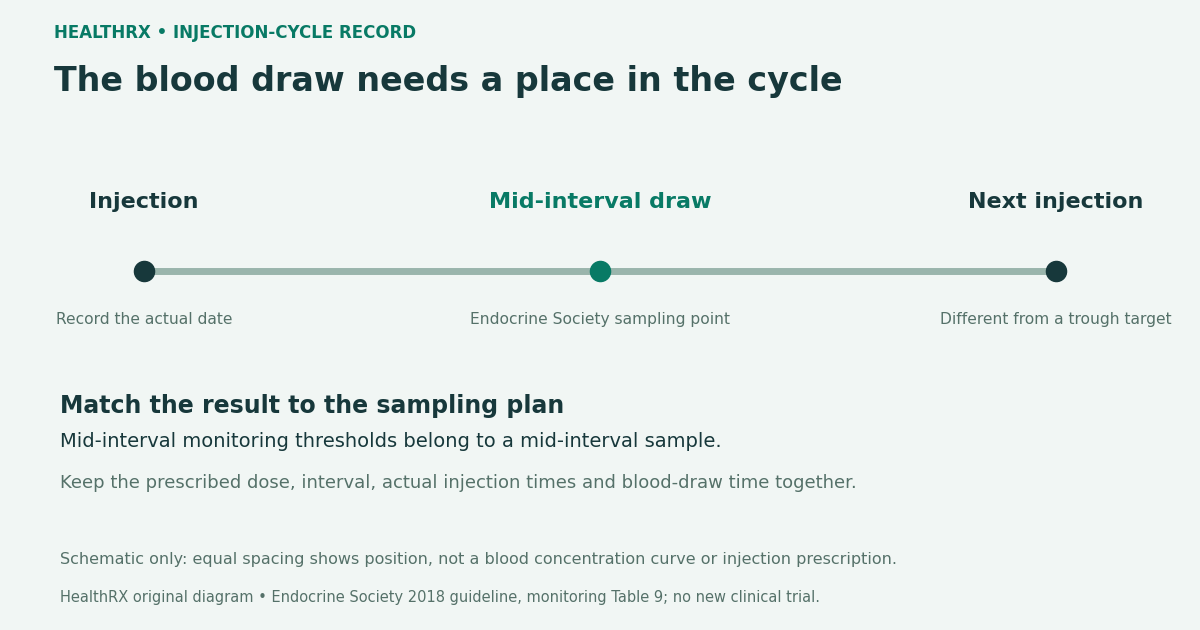
A testosterone result of 320 ng/dL means something different immediately before an injection than halfway between injections. Without the injection date and blood-draw date, a clinician may compare a trough with a midinterval target and draw the wrong conclusion about treatment.
For men aged 50–64, age alone does not establish a testosterone cypionate starting dose. Diagnosis, formulation, treatment response and adverse effects guide prescribing. Correctly timed testing makes those decisions more reliable.
Establish the diagnosis before choosing a dose
The Endocrine Society recommends diagnosing hypogonadism when symptoms or signs occur alongside consistently low testosterone concentrations. A low result should be confirmed with a repeat fasting morning total testosterone measurement. Free testosterone can help when total testosterone is borderline or conditions affecting sex hormone–binding globulin complicate interpretation. LH and FSH help distinguish testicular causes from pituitary or hypothalamic causes.[1]
The Depo-Testosterone label likewise requires low morning testosterone concentrations on two separate days before treatment. It lists a broad replacement range of 50–400 mg intramuscularly every two to four weeks, with dosage determined by diagnosis, response and adverse effects. That range is neither an age-specific starting recommendation nor a personal dosing plan. Safety and efficacy for age-related hypogonadism have not been established.[2]
Fatigue, lower libido and reduced strength deserve assessment, but they do not establish testosterone deficiency by themselves. Sleep problems, medications and other illnesses may contribute. Fertility plans also matter: external testosterone can suppress sperm production. Before prescribing, clinicians assess contraindications and relevant risks, including elevated hematocrit, untreated severe obstructive sleep apnea and prostate-related concerns.[1]
| Clinical question | Relevant evidence | What it does—and does not—establish |
|---|---|---|
| Is testosterone deficiency present? | Symptoms/signs plus consistently low morning values; repeat fasting morning total testosterone.[1] | One low value or age over 50 is insufficient. |
| Does age 50–64 determine the dose? | The label individualizes intramuscular dosing by diagnosis, response and adverse effects.[2] | The broad labeled range is not a dedicated starting dose for this age group. |
| When is injectable testosterone assessed? | Endocrine Society monitoring for cypionate/enanthate specifies midinterval sampling.[1] | Its numerical thresholds cannot be relabeled as trough targets. |
| Do gel safety findings apply directly to injections? | TRAVERSE studied daily 1.62% testosterone gel.[4] | It did not directly test testosterone cypionate injections. |
Attach every result to the injection schedule
Cypionate concentrations rise after an injection and decline before the next one. A peak, a midinterval value and a trough answer different questions. Comparing them as though they were interchangeable can make the same regimen appear excessive on one visit and inadequate on another.
For cypionate or enanthate, the Endocrine Society specifies measuring testosterone midway between injections. A midinterval result above 600 ng/dL or below 350 ng/dL prompts clinician review of dose or frequency. Those thresholds are not a universal trough range.[1]
The AUA describes a physiologic treatment goal around 450–600 ng/dL, using the minimum dose needed alongside symptom improvement.[3] That broader treatment goal does not erase the importance of sampling time. A result should carry its timing context before it is compared with any target.
This simple record helps preserve that context; it is not a dosing calculator.
| Record item | Information to capture |
|---|---|
| Product and route | Exact product, concentration and prescribed route |
| Prescribed schedule | Dose in mg and interval documented by the prescriber |
| Recent injections | Actual dates and times, including delayed or missed doses |
| Blood draw | Date, time and elapsed time since the last injection |
| Intended sampling point | Midinterval, trough or another clinician-specified point |
| Results and response | Testosterone with units; hematocrit; blood pressure; symptom changes and adverse effects |
The labeled Depo-Testosterone route is intramuscular. Subcutaneous use of testosterone cypionate is off-label; approval of a different subcutaneous testosterone product does not change that label.[2]
Follow hematocrit, blood pressure and benefit
Testosterone can increase red blood cell production. The Endocrine Society recommends hematocrit testing before treatment, at three to six months and annually thereafter. If hematocrit exceeds 54%, treatment is held until it reaches a safe level, hypoxia and sleep apnea are evaluated, and treatment may be restarted at a lower dose when appropriate. This is clinician-directed management, not a home blood-removal protocol.[1]
A controlled study analyzed 61 men aged 19–35 and 60 men aged 60–75 receiving a GnRH agonist and weekly testosterone enanthate at five doses for 20 weeks. Hemoglobin and hematocrit rose with dose, with larger responses in older men. It supports careful monitoring; it does not establish a cypionate starting dose for ages 50–64.[6]
Blood pressure also needs periodic assessment. Current product labeling warns that testosterone can increase blood pressure and does not recommend use in uncontrolled hypertension.[2] Once treatment is established, the AUA recommends testosterone monitoring every six to twelve months and considering cessation after three to six months if levels normalize without symptom improvement.[3]
Read cardiovascular findings within their limits
TRAVERSE enrolled 5,246 men aged 45–80 with symptoms, two fasting testosterone values below 300 ng/dL, and established cardiovascular disease or elevated cardiovascular risk. Participants received 1.62% testosterone gel or placebo. Major cardiovascular events occurred in 7.0% versus 7.3%; the hazard ratio was 0.96, with a 95% confidence interval of 0.78–1.17. The trial met its noninferiority criterion. It did not show cardiovascular superiority or zero risk. Atrial fibrillation, acute kidney injury and pulmonary embolism were more frequent in the testosterone group. These findings concern the studied gel and population, rather than direct evidence for cypionate injections.[4]
In February 2025, FDA removed boxed-warning language about adverse cardiovascular outcomes while retaining the limitation for age-related hypogonadism and requiring blood-pressure warnings.[5] Monitoring remains important even when testosterone results fall within the intended range.
Frequently asked questions
Is there a standard testosterone cypionate dose for men aged 50 to 64?
No. Neither age alone nor the broad labeled range establishes a starting dose for this group. Prescribing depends on the diagnosis, response, adverse effects and appropriately timed laboratory results.[1,2]
How many testosterone tests are needed before treatment?
Two separate morning measurements are needed to confirm low testosterone. The Endocrine Society recommends repeating fasting morning total testosterone and requires compatible symptoms or signs. Free testosterone may clarify selected cases.[1,2]
When should testosterone be measured on cypionate injections?
The Endocrine Society specifies midway between injections. Its above-600 or below-350 ng/dL review thresholds apply to that midinterval measurement, not a universal trough target. Record injection and blood-draw timing.[1]
What happens if hematocrit exceeds 54%?
The guideline recommends holding therapy until hematocrit is safe, evaluating hypoxia and sleep apnea, and restarting at a lower dose when appropriate. Management belongs with the treating clinician.[1]
Did TRAVERSE prove testosterone cypionate is cardiovascularly safe?
No. TRAVERSE studied testosterone gel in men with established or elevated cardiovascular risk. It met noninferiority for major cardiovascular events, but did not establish zero risk or directly test cypionate.[4]
Is subcutaneous testosterone cypionate FDA-approved?
Depo-Testosterone is labeled for intramuscular use only. Subcutaneous cypionate use is off-label; a different product’s approval does not extend to cypionate.[2]
Should obesity automatically mean a higher dose?
No. Obesity can affect testosterone interpretation, including through sex hormone–binding globulin. Dose decisions require clinical response, timed measurements and safety monitoring; these sources establish no automatic obesity-based increase.[1,2]
Does every patient need estradiol testing or anastrozole?
No. Estradiol testing is considered when clinically indicated, such as breast symptoms. Routine anastrozole for every patient is not supported by these guidelines.[1,3]
Can testosterone cypionate be stopped abruptly?
There is no universal taper schedule in these sources. Stopping may allow deficiency symptoms to return while endogenous production remains suppressed. The label’s dependence and withdrawal discussion concerns supratherapeutic abuse, not proof that all prescribed replacement causes dependence. Discontinuation should be planned with the prescriber.[2]
What did FDA change about cardiovascular warnings in 2025?
FDA removed boxed-warning language about adverse cardiovascular outcomes, retained the age-related hypogonadism limitation, and required blood-pressure warnings. The change does not mean testosterone is risk-free.[5]
References
Sources checked October 14, 2026.
- Bhasin S, et al. Testosterone Therapy in Men With Hypogonadism: An Endocrine Society Clinical Practice Guideline. 2018. PubMed PMID 29562364.
- DailyMed. Depo-Testosterone prescribing information.
- Mulhall JP, et al. Evaluation and Management of Testosterone Deficiency: AUA Guideline. 2018. PubMed PMID 29601923.
- Lincoff AM, et al. Cardiovascular Safety of Testosterone-Replacement Therapy. 2023. PubMed PMID 37326322.
- FDA. FDA issues class-wide labeling changes for testosterone products. February 28, 2025.
- Coviello AD, et al. Effects of Graded Doses of Testosterone on Erythropoiesis in Healthy Young and Older Men. 2008. PubMed PMID 18160461.