Testosterone Cypionate Self-Injection Technique: A Step-by-Step Clinical Guide

Hormone therapy clinical care image for Testosterone Cypionate Self-Injection Technique: A Step-by-Step Clinical Guide

At a glance

  • Route / intramuscular (IM) or subcutaneous (SC), both FDA-recognized
  • IM needle / 22 to 25 gauge, 1 to 1.5 inch depending on body composition
  • SC needle / 25 to 27 gauge, 5/8 inch
  • Typical dose / 50 to 200 mg every 1 to 2 weeks (IM) or split into twice-weekly SC doses
  • Injection volume / 0.25 to 1 mL per injection depending on concentration and dose
  • Oil base / cottonseed oil (branded) or sesame oil (some generics)
  • Storage / room temperature, 20 to 25 °C; do not refrigerate
  • Site rotation / minimum 4 sites, alternating each injection
  • Post-injection observation / monitor site for 10 minutes after first self-injection

How Testosterone Cypionate Works

Testosterone cypionate is an esterified form of testosterone bound to a cypionate (cyclopentylpropionate) ester at the 17-beta hydroxyl group. This ester extends the drug's half-life to approximately 8 days, allowing weekly or biweekly dosing rather than daily administration. After intramuscular or subcutaneous injection, the oil depot releases testosterone cypionate slowly into the bloodstream, where esterases cleave the cypionate ester and free bioactive testosterone enters circulation [1].

Mechanism of Action

Free testosterone binds to androgen receptors in skeletal muscle, bone, brain, and reproductive tissues. The androgen-receptor complex translocates to the nucleus, where it modulates gene transcription for proteins involved in muscle protein synthesis, erythropoiesis, bone mineral density maintenance, and libido regulation. Testosterone also undergoes 5-alpha reduction to dihydrotestosterone (DHT) in target tissues and aromatization to estradiol via the aromatase enzyme in adipose tissue [2].

Clinical Evidence

The Testosterone Trials (TTrials), published in the New England Journal of Medicine in 2016 (N=790 men aged 65 and older with serum testosterone <275 ng/dL), demonstrated that testosterone gel treatment for one year improved sexual function scores by 0.58 points on a 12-point scale versus placebo (P<0.001), increased 6-minute walking distance by 6.0 meters, and improved self-reported vitality [1]. While the TTrials used transdermal gel, the pharmacodynamic endpoints apply to all exogenous testosterone formulations, including cypionate, because the active molecule is identical once the ester is cleaved.

A 2014 systematic review in the Journal of Clinical Endocrinology & Metabolism covering 156 randomized trials (N=5,091) confirmed that exogenous testosterone increases lean body mass by a weighted mean of 1.6 kg and reduces fat mass by 2.0 kg across formulations [3].

Before You Inject: Supplies and Preparation

Proper preparation prevents contamination and ensures accurate dosing. Gather all supplies before opening any sterile packaging.

Required Supplies

You will need: your testosterone cypionate vial, two needles (one drawing needle and one injection needle), a syringe (typically 1 mL or 3 mL Luer-lock), alcohol swabs, a sharps disposal container, and gauze or an adhesive bandage. The two-needle technique uses an 18 to 20 gauge needle for drawing (the thicker bore pulls viscous oil faster) and a fresh 22 to 25 gauge needle for injection (thinner bore reduces tissue trauma) [4].

Step-by-Step Preparation

Wash your hands with soap and water for at least 20 seconds. Inspect the vial: testosterone cypionate in cottonseed oil should appear clear and pale yellow. If you see particulate matter, cloudiness, or discoloration, do not use the vial. Wipe the vial's rubber stopper with an alcohol swab and let it air-dry for 30 seconds.

Attach the drawing needle to the syringe. Pull back the plunger to fill the syringe barrel with air equal to your prescribed dose volume. Insert the drawing needle through the stopper, invert the vial, and inject the air. This equalizes pressure inside the vial. Draw the oil slowly. Testosterone cypionate in cottonseed oil is viscous (approximately 33 centistokes at 25 °C), so rushing creates air bubbles.

Hold the syringe needle-up and tap to migrate air bubbles to the top. Push the plunger gently until a small drop of oil appears at the needle tip. Swap the drawing needle for the injection needle. Do not recap or touch the sterile injection needle.

Intramuscular Injection Technique

The intramuscular route is the most widely prescribed method for testosterone cypionate, supported by decades of clinical use and the FDA-approved labeling for the drug [5].

Site Selection

The two preferred IM sites are the vastus lateralis (outer mid-thigh) and the ventrogluteal site (gluteus medius). The ventrogluteal site is recommended by the CDC and most nursing guidelines over the dorsogluteal site because it has a thicker muscle layer, fewer major nerves, and no large blood vessels [4].

To locate the ventrogluteal site: place the heel of your opposite hand on the greater trochanter (the bony prominence at the top of the outer thigh). Point your index finger toward the anterior superior iliac spine and spread your middle finger posteriorly. The injection target is the center of the V formed by your two fingers.

For the vastus lateralis: sit on the edge of a chair or bed. Divide the outer thigh into three equal horizontal sections between the knee and the hip. The middle third is the injection zone. This is the easiest site for self-injection because it is visible and accessible without twisting.

Injection Procedure

Clean the injection site with an alcohol swab using a circular motion from center outward. Allow 30 seconds to air-dry. Alcohol must evaporate fully; injecting through wet alcohol stings and can carry surface bacteria into the tissue.

Hold the syringe like a dart at a 90-degree angle to the skin. Spread the skin taut with your non-dominant hand (or use the Z-track technique, described below). Insert the needle in a single, smooth motion through the skin and into the muscle.

Aspirate by pulling back on the plunger for 5 to 10 seconds. If blood appears in the syringe barrel, withdraw the needle, dispose of the syringe and needle in a sharps container, and start over with fresh supplies and a different site. Blood indicates the needle tip is in a blood vessel.

If no blood appears, inject the oil slowly. A rate of approximately 10 seconds per 0.25 mL is comfortable. Rapid injection into muscle increases post-injection pain (PIP). After the plunger is fully depressed, wait 10 seconds before withdrawing the needle. This allows the oil depot to settle and reduces leakage. Withdraw the needle at the same angle it entered, apply gentle pressure with gauze, and cover with an adhesive bandage if needed.

The Z-Track Method

The Z-track technique reduces oil leakage into subcutaneous tissue and minimizes pain. Before inserting the needle, pull the skin overlying the injection site 1 to 2 cm laterally with your non-dominant hand. Hold the displacement while injecting. After withdrawing the needle, release the skin. The displaced tissue layers seal the needle track, trapping the medication in the muscle. A 2004 study in the Journal of Advanced Nursing (N=50) found that Z-track injection reduced pain scores by 53% compared to standard IM technique [6].

Subcutaneous Injection Technique

Subcutaneous testosterone cypionate has gained clinical traction since a 2014 study by Al-Futaisi et al. And a 2017 pharmacokinetic comparison published in the Journal of Clinical Endocrinology & Metabolism demonstrated bioequivalent serum testosterone levels between SC and IM routes [7]. The Endocrine Society's 2018 clinical practice guideline acknowledges subcutaneous administration as a viable alternative [2].

Why Some Clinicians Prefer SC

Subcutaneous injections use smaller needles (25 to 27 gauge, 5/8 inch), cause less pain, produce more stable serum testosterone levels with less peak-to-trough fluctuation, and are associated with lower rates of polycythemia in some observational data. A 2018 retrospective analysis of 153 hypogonadal men published in Translational Andrology and Urology found that subcutaneous testosterone cypionate at the same weekly dose produced a 14% reduction in hematocrit elevation compared to intramuscular delivery [8].

SC Procedure

Preferred SC sites include the abdominal fat (at least 2 inches from the navel) and the fat pad overlying the anterior thigh. Clean the site with alcohol. Pinch a 1 to 2 inch fold of skin and subcutaneous fat between your thumb and index finger. Insert the needle at a 45-degree angle into the fat fold. Do not aspirate for SC injections. Inject slowly over 30 seconds. Withdraw and release the skin fold. Do not massage the site, as this can disperse the oil depot and alter absorption kinetics.

SC injection volumes should generally stay at or below 0.5 mL per site. For doses requiring more than 0.5 mL, split the dose across two sites (e.g., left and right abdomen) or discuss concentration adjustments with your prescriber. Testosterone cypionate is available in 100 mg/mL and 200 mg/mL concentrations; the 200 mg/mL formulation halves the injection volume.

Site Rotation and Injection Scheduling

Repeated injection into the same anatomical site causes localized fibrosis, oil cysts, and tissue scarring that impair absorption over time.

Building a Rotation Map

Maintain a minimum of four distinct injection sites. For IM injectors using the vastus lateralis bilaterally and the ventrogluteal site bilaterally, this provides four sites on a natural rotation. For SC injectors, use four abdominal quadrants (upper left, upper right, lower left, lower right) or alternate between abdominal and anterior thigh sites.

Dr. Abraham Morgentaler, Associate Clinical Professor of Urology at Harvard Medical School and author of the 2008 textbook Testosterone for Life, recommends that patients "keep a simple written log of date, site, and any post-injection symptoms to catch rotation drift before it causes problems."

Log each injection with the date, site used, dose, and any adverse effects. Many patients use a smartphone note or a printed chart taped to the medicine cabinet. Space each site's re-use by at least 7 days. For twice-weekly injectors, alternate sides each injection (e.g., Monday left thigh, Thursday right thigh).

Timing Considerations

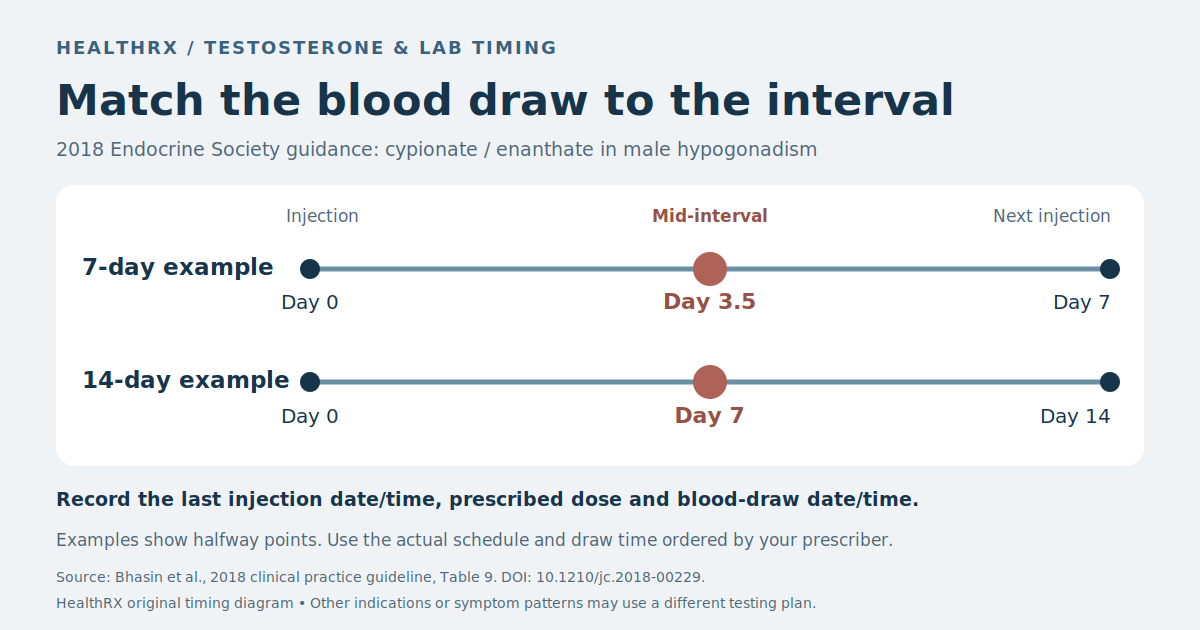
The Endocrine Society's 2018 guideline recommends measuring serum total testosterone at trough (immediately before the next injection) after at least 4 weeks on a stable dose, targeting 400 to 700 ng/dL [2]. If trough levels fall below 400 ng/dL, your clinician may increase the dose or shorten the interval. If trough levels exceed 700 ng/dL or hematocrit rises above 54%, the dose may need reduction.

Inject at the same time of day for consistency. Many patients choose mornings to align injection days with lab draw schedules, since most laboratories prefer fasting morning samples.

Managing Post-Injection Pain and Complications

Some degree of post-injection discomfort is normal. Severe or worsening symptoms warrant clinical evaluation.

Common Post-Injection Pain (PIP)

Soreness at the injection site lasting 24 to 72 hours affects 30 to 50% of IM testosterone users, according to a 2020 survey in Andrologia (N=312) [9]. PIP is more common with cottonseed oil vehicles than with castor oil, possibly due to differences in viscosity and tissue irritation. Warming the vial in your hands or under warm running water for 2 to 3 minutes before injection reduces oil viscosity and decreases PIP.

Other PIP-reduction strategies: use the Z-track method, inject slowly, use a 25-gauge needle instead of 22-gauge, and ensure the alcohol has fully dried before needle insertion.

When to Seek Medical Attention

Contact your prescriber or go to an emergency department if you experience: redness, warmth, and swelling expanding beyond 5 cm from the injection site (possible cellulitis); fever above 38.0 °C within 48 hours of injection; persistent lump growing over several weeks (possible sterile abscess or oil granuloma); numbness, tingling, or weakness in the injected limb (possible nerve injury); or sudden shortness of breath and chest tightness immediately after injection (possible pulmonary oil microembolism, an FDA-boxed-warning event, though rare at an estimated incidence of <0.1%) [5].

Dr. Bradley Anawalt, Professor of Medicine at the University of Washington and co-author of the Endocrine Society's testosterone therapy guideline, has stated: "The single most important safety measure for self-injecting patients is knowing when a reaction at the injection site has crossed from normal soreness into something requiring medical evaluation."

Sharps Disposal and Legal Requirements

Used needles are regulated medical waste in all 50 U.S. States. Never place loose needles in household trash or recycling.

Disposal Options

Use an FDA-cleared sharps container (available at pharmacies for $3 to 8). When the container is three-quarters full, seal it and bring it to a designated collection site. The FDA's SafeNeedleDisposal.org website lists drop-off locations by ZIP code. Some states (California, Massachusetts, New York, among others) mandate mail-back programs for home-generated sharps. Your pharmacy can supply a mail-back envelope at low cost [10].

Do not clip, bend, or recap needles. Recapping is the leading cause of needlestick injury in home self-injection, according to the CDC's 2019 sharps injury prevention guidelines [10].

Monitoring Labs While on Testosterone Cypionate

Self-injection is only one half of testosterone replacement therapy. Ongoing laboratory monitoring is mandatory.

Recommended Lab Schedule

The Endocrine Society's 2018 guideline recommends checking total testosterone, hematocrit, and PSA at baseline, 3 to 6 months after starting therapy, and then annually [2]. Hematocrit above 54% requires dose reduction, phlebotomy, or temporary discontinuation. PSA should be evaluated according to age-specific urology guidelines; a confirmed rise of more than 1.4 ng/mL within 12 months warrants urological referral.

Additional labs at baseline and periodically: comprehensive metabolic panel (hepatic function), lipid panel (testosterone therapy can reduce HDL by 5 to 10%), and estradiol (if symptoms of gynecomastia or water retention appear). Bone density screening via DEXA may be indicated in men with baseline osteopenia, since testosterone therapy improves lumbar spine BMD by 3.7% over 12 months based on the TTrials bone sub-study [1].

Frequently asked questions

What size needle should I use for testosterone cypionate IM injection?
Use a 22 to 25 gauge needle, 1 to 1.5 inches long, for intramuscular injection. Patients with more subcutaneous fat may need a 1.5-inch needle to reach muscle. Use a separate 18 to 20 gauge drawing needle to pull the viscous oil from the vial.
Can I inject testosterone cypionate subcutaneously instead of intramuscularly?
Yes. Subcutaneous injection using a 25 to 27 gauge, 5/8-inch needle produces bioequivalent testosterone levels. The Endocrine Society's 2018 guideline acknowledges SC as a viable route. Keep each SC injection volume at or below 0.5 mL per site.
How often should I rotate injection sites?
Rotate among at least four sites, using a different site each injection. For weekly IM injectors, this means each site gets a minimum 4-week rest between uses. Log every injection site and date.
Why does my injection site hurt for days afterward?
Post-injection pain lasting 24 to 72 hours is common and usually caused by tissue reaction to the oil vehicle. Warming the vial, injecting slowly, using a 25-gauge needle, and applying the Z-track method all reduce soreness.
Do I need to aspirate before injecting testosterone cypionate?
Aspiration is recommended for intramuscular injections to confirm the needle is not in a blood vessel. Pull back the plunger for 5 to 10 seconds. If blood enters the syringe, withdraw and start over. Aspiration is not needed for subcutaneous injections.
What happens if I accidentally inject testosterone into a blood vessel?
Injecting oil directly into a blood vessel can cause a pulmonary oil microembolism, which may present as sudden coughing, chest tightness, or shortness of breath. This is rare but is listed in the FDA prescribing information as a known risk. Aspirating before IM injection helps prevent this.
How should I store testosterone cypionate vials?
Store at controlled room temperature between 20 and 25 degrees Celsius (68 to 77 degrees Fahrenheit). Do not refrigerate or freeze. Keep the vial away from direct sunlight. Multi-dose vials should be discarded 28 days after first puncture unless the manufacturer label specifies otherwise.
Can I reuse needles to save money?
No. Reusing needles increases infection risk and injection pain because the needle tip dulls and burrs after a single use. A used needle also loses its silicone lubricant coating, making re-insertion more traumatic to tissue.
What is the Z-track injection method?
Z-track involves pulling the skin laterally 1 to 2 cm before inserting the needle, holding the displacement during injection, and releasing after withdrawal. The displaced tissue layers seal the needle path, trapping medication in the muscle and reducing leakage and pain by up to 53%.
How does testosterone cypionate work in the body?
After injection, esterases cleave the cypionate ester from the testosterone molecule. Free testosterone binds androgen receptors in muscle, bone, and brain, driving protein synthesis, red blood cell production, and libido. It also converts to DHT via 5-alpha reductase and to estradiol via aromatase.
What labs should I monitor while self-injecting testosterone?
Check total testosterone at trough, hematocrit, and PSA at baseline, at 3 to 6 months, and annually. Add a lipid panel and liver function tests periodically. Hematocrit above 54% requires intervention. A PSA rise of more than 1.4 ng/mL in 12 months needs urology referral.
Is it normal to see a small amount of blood after injecting?
A drop or two of blood at the injection site is normal and results from the needle passing through small capillaries in the skin or muscle. Apply gentle pressure with gauze for 30 to 60 seconds. Significant or prolonged bleeding is uncommon and may indicate the needle nicked a larger vessel.

References

  1. Snyder PJ, Bhasin S, Cunningham GR, et al. Effects of testosterone treatment in older men. N Engl J Med. 2016;374(7):611-624. https://pubmed.ncbi.nlm.nih.gov/26886521/
  2. Bhasin S, Brito JP, Cunningham GR, et al. Testosterone therapy in men with hypogonadism: an Endocrine Society clinical practice guideline. J Clin Endocrinol Metab. 2018;103(5):1715-1744. https://pubmed.ncbi.nlm.nih.gov/29562364/
  3. Corona G, Giagulli VA, Maseroli E, et al. Testosterone supplementation and body composition: results from a meta-analysis of observational studies. J Endocrinol Invest. 2016;39(9):967-981. https://pubmed.ncbi.nlm.nih.gov/27241318/
  4. Nicoll LH, Hesby A. Intramuscular injection: an integrative research review and guideline for evidence-based practice. Appl Nurs Res. 2002;16(2):149-162. https://pubmed.ncbi.nlm.nih.gov/12637783/
  5. U.S. Food and Drug Administration. Testosterone cypionate injection prescribing information. 2018. https://www.accessdata.fda.gov/drugsatfda_docs/label/2018/085635s029lbl.pdf
  6. Yilmaz D, Khorshid L, Dedeoğlu Y. The effect of the Z-track technique on pain and drug leakage in intramuscular injections. Clin Nurse Spec. 2016;30(6):E7-E12. https://pubmed.ncbi.nlm.nih.gov/27753676/
  7. Al-Futaisi AM, Al-Zakwani IS, Almahrezi AM, Morris D. Subcutaneous administration of testosterone: a pilot study report. Sultan Qaboos Univ Med J. 2006;6(1):69-72. https://pubmed.ncbi.nlm.nih.gov/21748132/
  8. Kaminetsky J, Jaffe JS, Swerdloff RS. Pharmacokinetic profile of subcutaneous testosterone enanthate delivered via a novel, prefilled single-use autoinjector. Sex Med. 2015;3(4):269-279. https://pubmed.ncbi.nlm.nih.gov/26797060/
  9. Osterberg EC, Bernie AM, Ramasamy R. Risks of testosterone replacement therapy in men. Indian J Urol. 2014;30(1):2-7. https://pubmed.ncbi.nlm.nih.gov/24497673/
  10. Centers for Disease Control and Prevention. Sharps disposal. 2019. https://www.cdc.gov/niosh/topics/bbp/sharps.html