Zepbound Re-Titration After Stopping: How to Restart Tirzepatide Safely

Medical lab testing image for Zepbound Re-Titration After Stopping: How to Restart Tirzepatide Safely

At a glance

  • Drug / Zepbound (tirzepatide), subcutaneous injection, once weekly
  • Starting dose / 2.5 mg weekly for the first 4 weeks (not a therapeutic dose)
  • Maintenance range / 5 mg, 10 mg, or 15 mg weekly
  • Re-titration rule / restart at 2.5 mg after any extended gap, escalate every 4 weeks
  • Max approved dose / 15 mg once weekly for chronic weight management
  • Key trial / SURMOUNT-1 (N=2,539) showed 20.9% mean weight loss at 15 mg over 72 weeks
  • Most common side effects / nausea (24-33%), diarrhea (18-21%), constipation (11-17%)
  • GI side effects peak / during dose escalation phases, not at steady state
  • FDA approval / November 2023 for chronic weight management in adults with BMI 30+ or BMI 27+ with comorbidity

Why Re-Titration Matters After a Treatment Gap

When you stop Zepbound for an extended period, your body loses the GI tolerance it built during the original dose escalation. Restarting at a high dose exposes the gut to receptor activation it is no longer accustomed to, which can trigger severe nausea, vomiting, and diarrhea.

The Biological Basis for Re-Escalation

Tirzepatide is a dual GIP/GLP-1 receptor agonist. Both receptor systems modulate gastric motility and satiety signaling in the hypothalamus [1]. During the initial titration, the GI tract adapts to progressively stronger receptor activation. That adaptation fades after treatment stops. A 2022 analysis in The Lancet confirmed that incretin-based therapies require gradual dose escalation to maintain tolerability, and that GI adverse events cluster heavily in the first weeks of each new dose tier [2].

What the FDA Label Says

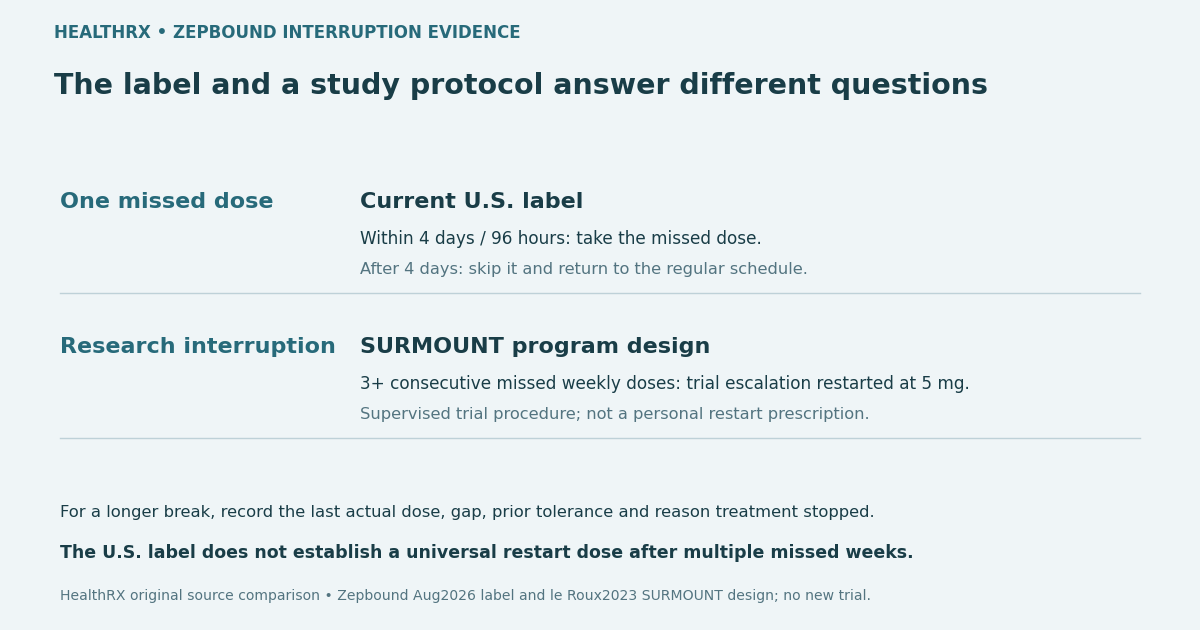
The Zepbound prescribing information is explicit: the starting dose is 2.5 mg injected subcutaneously once weekly, increased after 4 weeks to 5 mg once weekly [3]. From 5 mg, the dose may be increased in 2.5 mg increments every 4 weeks based on clinical response. The label does not provide a separate "re-start" protocol. That absence is itself guidance: clinicians should default to the original titration schedule after any significant interruption.

How Long Is "Too Long" Off Therapy?

The FDA label does not define an exact cutoff. Most endocrinologists apply a practical threshold: if you have missed four or more consecutive weekly doses, restart at 2.5 mg. Tirzepatide has a half-life of approximately 5 days [3], so after four missed weeks (28 days), more than five half-lives have elapsed and circulating drug levels are negligible.

The Standard Zepbound Titration Schedule

The FDA-approved dose escalation for Zepbound follows a fixed four-week staircase. Every patient, whether starting for the first time or restarting after a break, uses the same ramp.

Week-by-Week Dose Ladder

| Weeks | Dose | Purpose | |-------|------|---------| | 1 to 4 | 2.5 mg | GI acclimation only (sub-therapeutic for weight loss) | | 5 to 8 | 5 mg | First therapeutic dose tier | | 9 to 12 | 7.5 mg | Optional escalation if response is insufficient | | 13 to 16 | 10 mg | Mid-range therapeutic dose | | 17 to 20 | 12.5 mg | Optional escalation | | 21+ | 15 mg | Maximum approved dose |

Not every patient needs to reach 15 mg. The SURMOUNT-1 trial demonstrated clinically meaningful weight loss at 5 mg (15.0% mean body weight reduction at 72 weeks) and at 10 mg (19.5%), not only at the maximum 15 mg dose (20.9%) [1].

When to Hold vs. Escalate

Dose escalation should pause if the patient experiences persistent GI symptoms (nausea lasting more than 5 days per week, vomiting more than twice weekly, or dehydration signs). The prescribing information allows clinicians to hold at any dose tier for an additional 4 weeks before attempting the next increase [3]. There is no requirement to escalate if a lower dose produces adequate weight loss and acceptable tolerability.

What SURMOUNT-1 Shows About Titration and Outcomes

SURMOUNT-1 (NCT04184622) was a 72-week, randomized, double-blind, placebo-controlled trial enrolling 2,539 adults with obesity (BMI of 30 or greater) or overweight (BMI of 27 or greater) with at least one weight-related comorbidity [1]. Participants were randomized to tirzepatide 5 mg, 10 mg, or 15 mg, or placebo, all with the standard 2.5 mg starting dose and 4-week escalation intervals.

Efficacy Across Dose Tiers

At 72 weeks, mean percentage change in body weight from baseline was -15.0% (5 mg), -19.5% (10 mg), and -20.9% (15 mg) vs. -3.1% (placebo) [1]. The proportion of participants achieving at least 5% weight loss exceeded 85% across all tirzepatide groups. More than half of patients on the 10 mg and 15 mg doses lost at least 20% of their body weight.

GI Tolerability During Escalation

Nausea was the most frequently reported adverse event: 24.6% at 5 mg, 33.3% at 10 mg, and 31.0% at 15 mg, compared with 9.5% for placebo [1]. The trial protocol enforced strict 4-week escalation intervals. GI events were most common during the first 4 to 8 weeks of each dose increase and typically resolved without treatment discontinuation. Discontinuation due to adverse events occurred in 4.3% to 7.1% of tirzepatide-treated participants, compared to 2.6% for placebo.

These data show that the 4-week escalation cadence used in SURMOUNT-1 kept discontinuation rates below 8% even at the highest dose. Skipping the ramp during re-titration removes that safety margin.

Step-by-Step Re-Titration Protocol

For patients who stopped Zepbound and need to restart, the following protocol aligns with FDA labeling and published trial methodology.

Step 1: Confirm the Gap Duration

Count the number of missed weekly doses. If four or more doses were missed (28+ days off therapy), plan a full re-titration starting at 2.5 mg. For gaps of one to three missed doses, most clinicians will resume at the previous dose or one step below, though individual judgment applies.

Step 2: Restart at 2.5 mg

Inject 2.5 mg subcutaneously once weekly on the same day each week. This dose is sub-therapeutic for weight loss but serves to reestablish GI tolerance [3].

Step 3: Escalate Every 4 Weeks

After 4 weeks at 2.5 mg, increase to 5 mg. Continue increasing by 2.5 mg every 4 weeks as tolerated. The clinician may accelerate to every-3-week increases if the patient tolerated the original titration without GI issues, though no RCT data support intervals shorter than 4 weeks.

Step 4: Target the Previous Maintenance Dose

Re-titrate toward the dose that was effective before the gap. If a patient was stable on 10 mg, the target is 10 mg, not 15 mg, unless the clinician and patient agree to explore a higher tier.

Step 5: Monitor and Adjust

Track body weight, fasting glucose (if applicable), and GI symptom severity at each dose step. Labs (HbA1c, lipid panel, hepatic function) should be checked at baseline re-start and again at 12 weeks [4].

Common Reasons Patients Stop and How They Affect Re-Titration

Treatment gaps happen for multiple reasons, and the reason matters for planning the restart.

Insurance or Supply Interruptions

Drug shortages affected tirzepatide supply chains from 2023 through early 2025. The FDA drug shortage database listed tirzepatide in limited supply during parts of this period [5]. When a supply-driven gap occurs and the patient had good tolerability at their maintenance dose, some clinicians allow a faster re-escalation (every 3 weeks) because the interruption was involuntary and the patient's tolerance history is documented.

Side Effects at a Higher Dose

If a patient stopped because of intolerable GI symptoms at a specific dose, re-titration should target one dose tier below the problematic level. A patient who stopped at 15 mg due to persistent nausea could re-titrate to 10 mg as the new ceiling. The Endocrine Society notes that incretin-based therapy should be titrated to the highest tolerated dose, not necessarily the maximum approved dose [6].

Planned Surgical Procedures

Current anesthesiology society guidance recommends holding GLP-1 receptor agonists before elective surgery requiring general anesthesia, due to delayed gastric emptying concerns [7]. After surgical clearance, re-titration follows the standard protocol. The post-surgical hold period (typically 1 to 3 weeks depending on the procedure) often pushes the total gap past the 4-week threshold.

Weight Regain During the Gap and What to Expect After Restarting

Weight regain after stopping incretin therapy is well-documented. The SURMOUNT-4 extension study (N=670) showed that participants who switched from tirzepatide 10 mg or 15 mg to placebo after 36 weeks regained approximately 14% of body weight over the subsequent 52 weeks, while those who continued tirzepatide lost an additional 5.5% [8].

The Trajectory After Restarting

Patients should expect a return to weight loss after re-titration reaches a therapeutic dose (5 mg or higher). The rate of weight loss during the second exposure may differ from the first. No published RCT has directly compared first-titration vs. Re-titration weight loss trajectories, but clinical experience suggests similar efficacy once the same maintenance dose is reached.

Setting Realistic Expectations

Full re-titration from 2.5 mg to a target of 10 mg takes a minimum of 12 weeks. Patients who were at 15 mg need at least 20 weeks to return to that dose. Weight loss will be minimal during the 2.5 mg phase and will accelerate as the dose climbs. Clinicians should frame re-titration as a temporary inconvenience, not a signal of treatment failure.

GI Side Effect Management During Re-Titration

GI symptoms during dose escalation are the primary reason patients consider abandoning therapy. Proactive management can reduce that risk during re-titration.

Dietary Modifications

Smaller, more frequent meals (5 to 6 per day instead of 3) reduce the gastric volume that tirzepatide slows from emptying. High-fat and high-sugar meals worsen nausea and should be limited during escalation weeks. The American Gastroenterological Association recommends bland, low-residue foods if nausea persists beyond 48 hours after injection [9].

Hydration and Electrolytes

Vomiting and diarrhea during dose escalation can cause dehydration. Patients should aim for at least 64 oz of fluid daily and consider oral rehydration solutions if vomiting occurs more than once in a 24-hour period.

Pharmacologic Support

Ondansetron (4 to 8 mg as needed) is commonly prescribed off-label for tirzepatide-related nausea. No drug-drug interaction between ondansetron and tirzepatide has been identified in the FDA label [3]. Patients already taking metformin should be monitored for additive GI effects, as both drugs can cause nausea and diarrhea independently [10].

How Quickly Can You Increase Zepbound?

The minimum FDA-supported interval is 4 weeks per dose step. The 2.5 mg starting dose must be maintained for at least 4 weeks before any escalation [3]. There is no FDA-approved accelerated titration schedule for tirzepatide. Some clinicians use 3-week intervals in patients with documented prior tolerability, but this approach lacks RCT validation.

The fastest possible path from 2.5 mg to 15 mg, using strict 4-week intervals, takes 20 weeks. Compressing that timeline increases GI adverse event risk without proven efficacy benefit.

Special Populations and Re-Titration Considerations

Patients with Type 2 Diabetes

Tirzepatide is also approved as Mounjaro for type 2 diabetes. Patients using Zepbound for weight management who also have diabetes require blood glucose monitoring during the re-titration ramp, as even the 2.5 mg dose lowers fasting glucose by approximately 15 to 25 mg/dL [1]. Hypoglycemia risk increases if the patient is also taking sulfonylureas or insulin.

Older Adults

Adults over 65 represented approximately 14% of SURMOUNT-1 participants [1]. No dose adjustment is required for age alone, but older adults may benefit from a more conservative escalation pace (holding each dose for 6 weeks instead of 4) if GI tolerance is marginal.

Renal Impairment

No dose adjustment is needed for mild-to-moderate renal impairment (eGFR 30 to 89 mL/min). Tirzepatide has not been studied in severe renal impairment (eGFR <30 mL/min), and dehydration from GI side effects during re-titration poses a particular risk in this group [3].

Frequently asked questions

How quickly can you increase Zepbound?
The minimum interval is 4 weeks between each 2.5 mg dose increase, per the FDA-approved label. The fastest path from 2.5 mg to 15 mg takes 20 weeks. No accelerated schedule has been validated in clinical trials.
Do I need to restart Zepbound at 2.5 mg if I missed a few weeks?
If you missed 4 or more consecutive weekly doses (28+ days), restart at 2.5 mg and re-titrate. For gaps of 1 to 3 missed doses, most clinicians recommend resuming at your previous dose or stepping down one tier.
Will I regain weight if I stop Zepbound temporarily?
Yes. SURMOUNT-4 showed approximately 14% body weight regain over 52 weeks after switching from tirzepatide to placebo. Weight regain begins within weeks of stopping and continues until therapy resumes or energy balance is otherwise restored.
Can my doctor speed up re-titration if I tolerated Zepbound before?
Some clinicians use 3-week intervals for patients with documented prior tolerability, but this approach has no RCT support. The FDA label specifies 4-week intervals for all patients.
What side effects should I expect during re-titration?
Nausea is most common, reported in 24-33% of patients during SURMOUNT-1. Diarrhea and constipation also occur. These symptoms are typically worst in the first week after each dose increase and improve by week 3 to 4 at that dose.
Should I stop Zepbound before surgery?
Current anesthesiology guidance recommends holding GLP-1 receptor agonists before elective procedures requiring general anesthesia due to delayed gastric emptying. Discuss timing with your surgeon and anesthesiologist.
Is Zepbound re-titration different from Mounjaro re-titration?
The active ingredient (tirzepatide) and titration schedule are identical. Zepbound is approved for chronic weight management; Mounjaro is approved for type 2 diabetes. The re-titration protocol is the same for both.
How long does it take to get back to my previous Zepbound dose?
It depends on your target dose. Reaching 5 mg takes 8 weeks from restart, 10 mg takes 16 weeks, and 15 mg takes 20 weeks when following the standard 4-week escalation intervals.
Can I split Zepbound doses to reduce side effects during re-titration?
No. Zepbound is a single-dose prefilled pen and is not designed for dose splitting. The injection is administered once weekly as a complete dose. Attempting to split doses risks inaccurate dosing and contamination.
Does insurance cover Zepbound re-titration?
Insurance coverage for Zepbound varies by plan. Re-titration requires prescriptions for lower-dose pens (2.5 mg, 5 mg, 7.5 mg) before reaching your maintenance dose, which means multiple prior authorizations may be needed depending on your insurer's formulary.

References

  1. Jastreboff AM, Aronne LJ, Ahmad NN, et al. Tirzepatide once weekly for the treatment of obesity. N Engl J Med. 2022;387(3):205-216. https://www.nejm.org/doi/full/10.1056/NEJMoa2206038
  2. Sattar N, Lee MMY, Kristensen SL, et al. Cardiovascular, mortality, and kidney outcomes with GLP-1 receptor agonists in patients with type 2 diabetes: a systematic review and meta-analysis of randomised trials. Lancet Diabetes Endocrinol. 2021;9(10):653-662. https://www.thelancet.com/journals/landia/article/PIIS2213-8587(21)00203-5/fulltext
  3. Zepbound (tirzepatide) prescribing information. Eli Lilly and Company. U.S. Food and Drug Administration. https://www.accessdata.fda.gov/drugsatfda_docs/label/2023/217806s000lbl.pdf
  4. American Association of Clinical Endocrinology (AACE). Clinical practice guideline for comprehensive medical care of patients with obesity. https://www.aace.com/clinical-guidelines
  5. FDA drug shortage database: tirzepatide injection. https://www.accessdata.fda.gov/scripts/drugshortages/
  6. Endocrine Society. Pharmacological management of obesity: an Endocrine Society clinical practice guideline. J Clin Endocrinol Metab. 2015;100(2):342-362. https://academic.oup.com/jcem/article/100/2/342/2813109
  7. American Society of Anesthesiologists. Guidance on GLP-1 receptor agonists and anesthesia. https://www.fda.gov/drugs/drug-safety-and-availability
  8. Aronne LJ, Sattar N, Horn DB, et al. Continued treatment with tirzepatide for maintenance of weight reduction in adults with obesity: the SURMOUNT-4 randomized clinical trial. JAMA. 2024;331(1):38-48. https://jamanetwork.com/journals/jama/fullarticle/2812936
  9. American Gastroenterological Association. Clinical practice update on management of GLP-1 receptor agonist-associated gastrointestinal symptoms. https://www.ncbi.nlm.nih.gov/pmc/articles/PMC10686792/
  10. Metformin prescribing information. U.S. Food and Drug Administration. https://www.accessdata.fda.gov/drugsatfda_docs/label/2017/020357s037s039,021202s021s023lbl.pdf