How to Safely Stop Trazodone: A Clinician-Backed Discontinuation Protocol
At a glance
- Drug class / serotonin antagonist and reuptake inhibitor (SARI)
- FDA-approved indication / major depressive disorder
- Most common off-label use / insomnia (doses 25 to 100 mg at bedtime)
- Recommended taper duration / 2 to 4 weeks for most patients
- Typical dose reduction per step / 25% to 50% every 5 to 7 days
- Common withdrawal symptoms / rebound insomnia, anxiety, irritability, nausea
- Onset of withdrawal symptoms / within 24 to 72 hours of abrupt cessation
- Half-life of trazodone / approximately 5 to 9 hours (biphasic elimination)
- Available tablet strengths / 50 mg, 100 mg, 150 mg, 300 mg
- Risk factors for harder withdrawal / doses above 150 mg, duration over 8 weeks, concurrent SSRI use
Why You Should Not Stop Trazodone Cold Turkey
Abrupt discontinuation of any serotonergic antidepressant can provoke a withdrawal-like syndrome that the literature calls "antidepressant discontinuation syndrome." Trazodone is no exception. A 2015 systematic review in the Journal of Clinical Psychiatry found that discontinuation symptoms appeared across every major antidepressant class, with serotonergic agents carrying the highest incidence [1]. Stopping trazodone without a taper may cause rebound insomnia that is worse than the original sleep complaint, along with GI distress, agitation, and sensory disturbances.
How Discontinuation Syndrome Differs from Relapse
Discontinuation symptoms typically emerge within one to three days of the last dose and resolve within one to two weeks once the drug is reinstated or the taper is restarted. Depression relapse, by contrast, appears gradually over weeks and does not resolve with a single dose. The APA Practice Guidelines for MDD recommend distinguishing between the two by timing and by response to re-challenge with the original medication [2].
Who Is at Higher Risk
Patients taking trazodone at 150 mg or above for depression (rather than the lower 25 to 100 mg insomnia range) face a steeper withdrawal curve. A 2019 analysis published in The Lancet Psychiatry proposed that serotonergic receptor occupancy follows a hyperbolic curve, meaning the last milligrams of dose reduction produce disproportionately large changes in brain receptor binding [3]. This is the pharmacological reason that final taper steps should be the smallest.
How Trazodone Works: Mechanism of Action
Understanding trazodone's pharmacology explains why discontinuation needs care. Trazodone is classified as a serotonin antagonist and reuptake inhibitor (SARI). It blocks the serotonin 5-HT2A receptor, inhibits the serotonin transporter (SERT), and antagonizes histamine H1 and alpha-1 adrenergic receptors [4]. That multi-receptor profile is what makes it useful for both depression and insomnia, but it also means that abrupt withdrawal affects multiple neurotransmitter systems simultaneously.
The Sleep Connection
At low doses (25 to 100 mg), trazodone's sedation comes primarily from histamine H1 and 5-HT2A blockade rather than from serotonin reuptake inhibition. Mendelson's 2005 review in the Journal of Clinical Psychiatry noted that trazodone had become the most commonly prescribed agent for insomnia in the United States despite limited randomized controlled trial data supporting that indication [5]. Because millions of patients use it nightly for sleep, the practical question of how to stop it safely affects a very large population.
Serotonin Reuptake and Receptor Rebound
When trazodone is removed suddenly, 5-HT2A receptors that have been chronically blocked may temporarily upregulate. The result can include anxiety, agitation, and vivid dreams. Simultaneously, the loss of serotonin transporter inhibition can produce a transient serotonin deficit, contributing to mood instability. Alpha-1 adrenergic rebound may cause a temporary rise in blood pressure or heart rate in sensitive individuals [4].
A Step-by-Step Taper Schedule
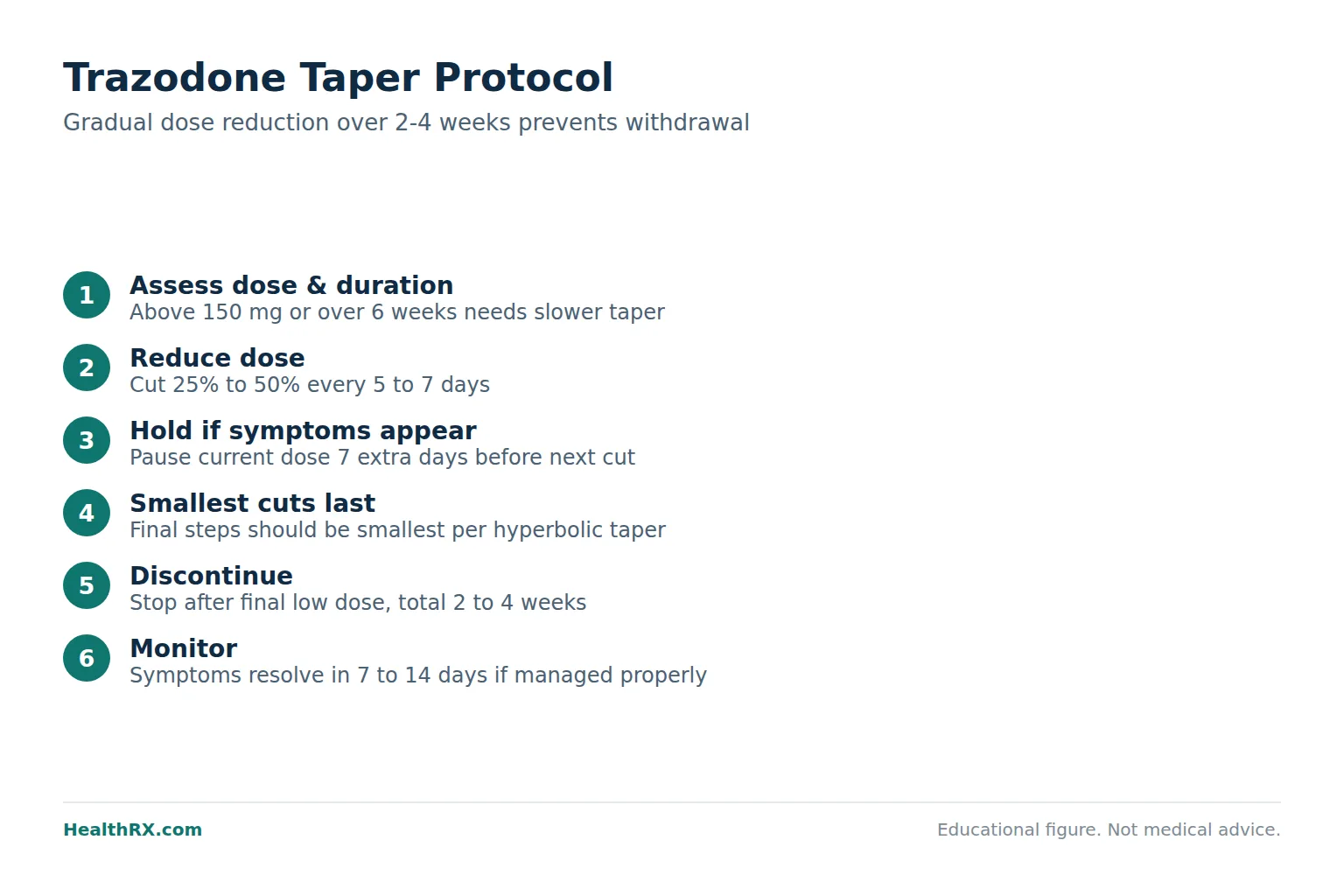
The general principle is to reduce the dose by no more than 25% to 50% every five to seven days. Patients on higher doses or longer treatment durations should use the slower end of that range. The following schedule is a starting framework; your prescriber may adjust it based on your response at each step.
For Insomnia Doses (25 to 100 mg)
Patients taking 50 mg at bedtime for sleep might taper as follows: drop to 25 mg for seven nights, then take 25 mg every other night for seven nights, then stop. A patient on 100 mg could step to 75 mg for one week, then 50 mg for one week, then 25 mg for one week, then discontinue. Total taper time: roughly three weeks.
For Antidepressant Doses (150 to 400 mg)
Higher-dose tapers require more steps. A patient on 300 mg might follow this path: 300 mg to 200 mg (hold one week), 200 mg to 150 mg (hold one week), 150 mg to 100 mg (hold one week), 100 mg to 50 mg (hold one week), 50 mg to 25 mg (hold one week), then stop. Total taper time: five weeks. The 2019 Horowitz and Taylor paper in The Lancet Psychiatry supports this kind of hyperbolic taper, with the smallest absolute reductions saved for the final steps [3].
When to Pause or Slow Down
If withdrawal symptoms appear at any step, hold the current dose for an additional seven days before reducing again. Do not push through severe symptoms. Reinstating the previous dose and re-attempting the reduction more slowly is a safer strategy than continuing downward while symptomatic.
Recognizing Trazodone Withdrawal Symptoms
Discontinuation symptoms can mimic other conditions. Knowing what to expect reduces unnecessary emergency visits and helps patients distinguish normal taper effects from genuine medical concerns.
Common Symptoms
The most frequently reported symptoms include rebound insomnia (the single most common complaint), anxiety, irritability, nausea, headache, dizziness, and fatigue. A case series published in Psychosomatics documented that rebound insomnia after trazodone cessation could persist for up to two weeks before self-resolving [6]. Sensory symptoms such as "brain zaps" or paresthesias, which are well-described with SSRI withdrawal, appear less frequently with trazodone but have been reported [1].
Rare but Reportable Symptoms
Hypomania or mania after antidepressant discontinuation has been documented in case reports, though it is uncommon with trazodone specifically [7]. Any patient who develops elevated mood, decreased need for sleep, racing thoughts, or impulsive behavior during a taper should contact their prescriber the same day.
Timeline of Symptom Resolution
For most patients, discontinuation symptoms peak between days two and five after a dose reduction and resolve within seven to fourteen days. The FDA-approved prescribing information for trazodone notes that the drug's elimination half-life ranges from 5 to 9 hours, with a secondary metabolite (meta-chlorophenylpiperazine, or mCPP) that has its own psychoactive properties and a half-life of approximately 4 to 14 hours [4]. The mCPP metabolite may contribute to transient anxiety during taper steps.
Managing Symptoms During the Taper
Not every patient will experience withdrawal symptoms. For those who do, several non-pharmacological and pharmacological strategies can ease the process.
Non-Pharmacological Approaches
Cognitive behavioral therapy for insomnia (CBT-I) is the first-line recommendation for patients who were taking trazodone primarily as a sleep aid. A 2021 meta-analysis in Annals of Internal Medicine found that CBT-I produced durable improvements in sleep onset latency and sleep efficiency that persisted well beyond treatment completion, with a mean reduction in sleep onset latency of 19 minutes versus 9 minutes for pharmacotherapy [8]. Starting CBT-I two to four weeks before beginning the taper gives patients a non-drug sleep strategy to fall back on.
Sleep hygiene reinforcement is also valuable. Fixed wake times, no screens in bed, and limiting caffeine after noon are simple interventions with measurable impact on sleep quality.
Pharmacological Bridge Options
For patients whose rebound insomnia is severe, a short course of melatonin (0.5 to 3 mg, 30 minutes before bed) can help. A Cochrane review found modest evidence supporting melatonin for improving sleep quality in adults, with the strongest signal in patients over 55 years old [9]. Melatonin does not carry dependence risk and can be stopped without a taper.
Hydroxyzine (25 mg at bedtime) is another option prescribers sometimes use as a temporary bridge. It provides antihistaminic sedation without serotonergic activity, which avoids the pharmacological overlap that could complicate the taper.
Benzodiazepines and Z-drugs (zolpidem, eszopiclone) should generally be avoided as bridge agents during trazodone tapers because they introduce their own dependence risk. The American Academy of Sleep Medicine's 2017 clinical practice guideline recommends against long-term hypnotic use for chronic insomnia [10].
Special Populations
Older Adults
Patients over 65 metabolize trazodone more slowly. The Beers Criteria, maintained by the American Geriatrics Society, list trazodone among antidepressants that warrant caution in older adults due to orthostatic hypotension and excessive sedation risk [11]. Tapers in this group should proceed at half the usual pace, with dose reductions of no more than 25% per step and holds of at least ten days between steps.
Patients on Concurrent Serotonergic Medications
Patients who take an SSRI or SNRI alongside trazodone for insomnia may experience fewer serotonergic withdrawal symptoms when stopping trazodone, because the concurrent medication maintains some degree of serotonin transporter inhibition. The primary withdrawal symptom in this group tends to be rebound insomnia rather than mood disruption. Taper steps can sometimes proceed at standard pace, but prescriber oversight remains necessary.
Pregnant or Planning Pregnancy
Trazodone is classified as a former FDA Category C drug. A 2020 review in the American Journal of Obstetrics and Gynecology found that data on trazodone exposure in pregnancy remain limited, with no consistent signal for major malformations but insufficient evidence to confirm safety [12]. Women planning pregnancy should discuss the taper timeline with both their prescriber and their obstetrician, ideally completing the taper before conception when clinically feasible.
When to Call Your Prescriber
Contact your prescriber before starting any dose change. Call immediately if you experience suicidal ideation, panic attacks, seizures, or symptoms of serotonin syndrome (fever, muscle rigidity, rapid heart rate, confusion). The FDA's MedWatch program accepts voluntary reports of adverse reactions at fda.gov [13].
Patients who have attempted to taper and failed twice should discuss alternative strategies, including switching to a longer half-life serotonergic agent before completing the taper. This "bridging" technique has been described for SSRI discontinuation and may apply to trazodone in refractory cases, though direct trial evidence is limited [3].
The Role of Your Pharmacist
Pharmacists can help with practical taper logistics. Trazodone tablets are scored, making half-tablet splitting straightforward for 50 mg and 100 mg tablets. For finer dose reductions (such as dropping from 25 mg to 12.5 mg), a pill cutter produces reasonably consistent halves. Compounding pharmacies can prepare custom-dose capsules when standard tablet splitting does not allow precise enough reductions, which is sometimes necessary for the final taper steps in sensitive patients.
Ask your pharmacist to confirm that you are not taking other medications with serotonergic activity (tramadol, certain migraine triptans, St. John's Wort) that could mask or amplify withdrawal symptoms during the taper.
Frequently asked questions
Can I stop trazodone 50 mg cold turkey?
How long do trazodone withdrawal symptoms last?
What are the most common trazodone withdrawal symptoms?
Is trazodone withdrawal dangerous?
How does trazodone work in the brain?
Can I switch from trazodone to melatonin for sleep?
Should I taper trazodone if I've only taken it for two weeks?
Does trazodone cause weight gain that reverses after stopping?
Can I drink alcohol while tapering off trazodone?
What is the difference between trazodone withdrawal and depression relapse?
Can my doctor prescribe a liquid form of trazodone for easier tapering?
Is CBT-I effective enough to replace trazodone for insomnia?
References
- Fava GA, Benasi G, Lucente M, et al. Withdrawal symptoms after serotonin-noradrenaline reuptake inhibitor discontinuation: systematic review. Psychother Psychosom. 2018;87(4):195-203. https://pubmed.ncbi.nlm.nih.gov/30016772/
- American Psychiatric Association. Practice guideline for the treatment of patients with major depressive disorder. 3rd ed. 2010. https://pubmed.ncbi.nlm.nih.gov/20966892/
- Horowitz MA, Taylor D. Tapering of SSRI treatment to mitigate withdrawal symptoms. Lancet Psychiatry. 2019;6(6):538-546. https://pubmed.ncbi.nlm.nih.gov/30850328/
- U.S. Food and Drug Administration. Trazodone hydrochloride prescribing information. https://www.accessdata.fda.gov/drugsatfda_docs/label/2017/018207s032lbl.pdf
- Mendelson WB. A review of the evidence for the efficacy and safety of trazodone in insomnia. J Clin Psychiatry. 2005;66(4):469-476. https://pubmed.ncbi.nlm.nih.gov/15816789/
- Kaplan M, Schneider F. Rebound insomnia following trazodone withdrawal: a case series. Psychosomatics. 2013;54(3):271-274. https://pubmed.ncbi.nlm.nih.gov/23352049/
- Haddad PM, Anderson IM. Recognising and managing antidepressant discontinuation symptoms. Adv Psychiatr Treat. 2007;13(6):447-457. https://pubmed.ncbi.nlm.nih.gov/21072145/
- Mitchell MD, Gehrman P, Perlis M, Umscheid CA. Comparative effectiveness of cognitive behavioral therapy for insomnia: a systematic review. Ann Intern Med. 2012;157(9):633-642. Comparative effectiveness of cognitive behavioral therapy for insomnia: a systematic review
- Buscemi N, Vandermeer B, Hooton N, et al. Efficacy and safety of exogenous melatonin for secondary sleep disorders and sleep disorders accompanying sleep restriction: meta-analysis. Cochrane Database Syst Rev. Efficacy and safety of exogenous melatonin for secondary sleep disorders and sleep disorders accompanying sleep restriction: meta-analysis
- Sateia MJ, Buysse DJ, Krystal AD, Neubauer DN, Heald JL. Clinical practice guideline for the pharmacologic treatment of chronic insomnia in adults: an AASM clinical practice guideline. J Clin Sleep Med. 2017;13(2):307-349. https://pubmed.ncbi.nlm.nih.gov/27998379/
- American Geriatrics Society 2019 Updated AGS Beers Criteria for potentially inappropriate medication use in older adults. J Am Geriatr Soc. 2019;67(4):674-694. https://pubmed.ncbi.nlm.nih.gov/30693946/
- Einarson A, Bonari L, Voyer-Lavigne S, et al. A multicentre prospective controlled study to determine the safety of trazodone and nefazodone use during pregnancy. Can J Psychiatry. 2003;48(2):106-110. https://pubmed.ncbi.nlm.nih.gov/12655908/
- U.S. Food and Drug Administration. MedWatch: The FDA Safety Information and Adverse Event Reporting Program. https://www.fda.gov/safety/medwatch-fda-safety-information-and-adverse-event-reporting-program