Trazodone Storage, Stability & Shelf Life: Evidence-Based Guidelines

Trazodone Storage, Stability & Shelf Life
At a glance
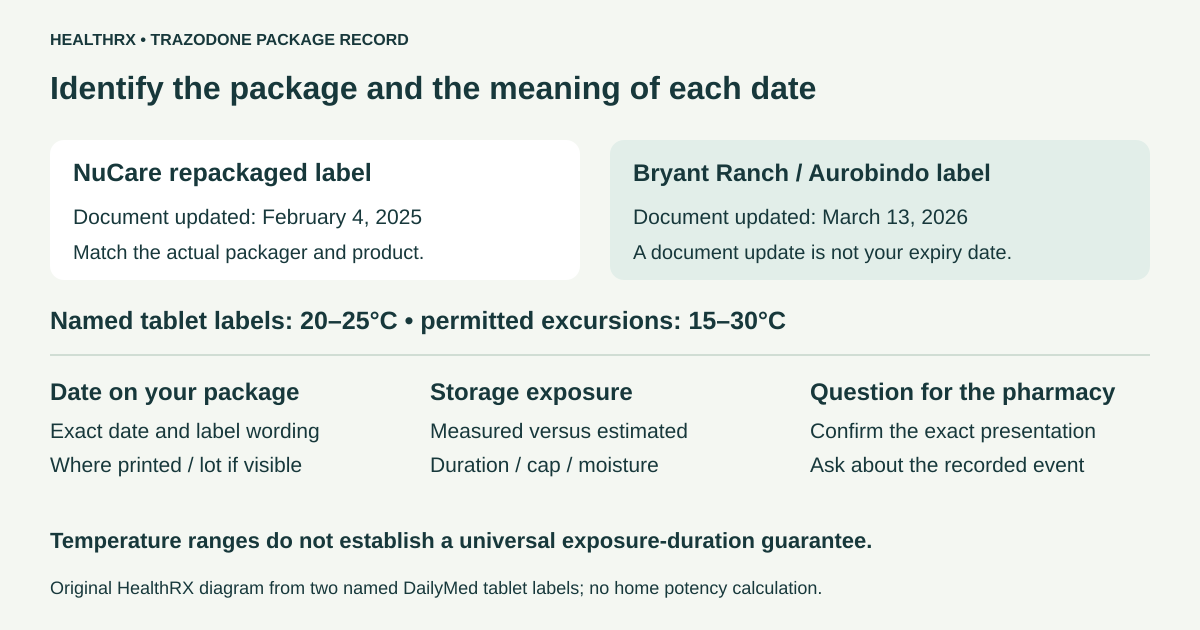
- FDA-labeled storage / 20 to 25°C (68 to 77°F), per USP Controlled Room Temperature
- Permitted temperature excursions / 15 to 30°C (59 to 86°F) for brief periods
- Typical manufacturer shelf life / 36 months from date of manufacture
- Light sensitivity / moderate; amber or opaque containers recommended
- Humidity threshold / relative humidity above 75% accelerates tablet degradation
- Drug class / serotonin antagonist and reuptake inhibitor (SARI)
- Primary metabolite / meta-chlorophenylpiperazine (mCPP), formed via CYP3A4
- FDA approval year / 1981 (brand Desyrel, now available as generic)
- Off-label insomnia use / most commonly prescribed at 25 to 100 mg at bedtime
- DEA schedule / not a controlled substance
How Trazodone Works: Mechanism of Action
Trazodone is a serotonin antagonist and reuptake inhibitor (SARI) that blocks 5-HT2A receptors and inhibits the serotonin transporter (SERT). This dual action distinguishes it from selective serotonin reuptake inhibitors (SSRIs) like sertraline or fluoxetine. At antidepressant doses (150 to 400 mg daily), serotonin reuptake inhibition predominates. At lower doses used for insomnia (25 to 100 mg), 5-HT2A antagonism and histamine H1 receptor blockade drive sedation 1.
The drug also antagonizes alpha-1 adrenergic receptors, which explains its tendency to cause orthostatic hypotension. Trazodone undergoes extensive hepatic metabolism via CYP3A4, producing the active metabolite meta-chlorophenylpiperazine (mCPP). The parent compound has an elimination half-life of 5 to 9 hours in most adults, while mCPP circulates somewhat longer 2. Understanding this pharmacology matters for stability discussions because degradation products must not produce pharmacologically active or toxic byproducts at concentrations that alter the drug's clinical profile.
Trazodone's sedative properties made it one of the most widely prescribed medications for insomnia in the United States by the early 2000s, despite limited randomized controlled trial support for this indication. Mendelson's 2005 review noted the gap between prescribing prevalence and evidence quality for sleep use 1.
FDA-Labeled Storage Conditions
The FDA-approved prescribing information for trazodone hydrochloride tablets specifies storage at 20 to 25°C (68 to 77°F), which corresponds to USP Controlled Room Temperature 3. Brief excursions between 15 and 30°C (59 to 86°F) are permitted per USP General Chapter <1079>. The label also directs patients to keep tablets in a tight, light-resistant container.
These are not arbitrary numbers. USP <1079> defines "controlled room temperature" based on kinetic mean temperature modeling, which accounts for fluctuations that occur during shipping, warehouse storage, and home medicine cabinets 4. A bathroom cabinet that regularly exceeds 30°C after hot showers violates these conditions. A kitchen shelf near a stove does too.
Practical storage advice is straightforward. Keep the bottle in a bedroom drawer or closet shelf. Do not transfer tablets to pill organizers weeks in advance if those organizers lack moisture-tight seals. The original manufacturer container includes a desiccant or moisture barrier for a reason.
Chemical Stability and Degradation Pathways
Trazodone hydrochloride is a white to off-white crystalline powder that is freely soluble in water. Its chemical stability depends on three environmental variables: temperature, humidity, and light exposure. Accelerated stability studies conducted under International Council for Harmonisation (ICH) Q1A guidelines (40°C / 75% relative humidity for 6 months) define the worst-case degradation profile for regulatory submissions 5.
Under these stressed conditions, trazodone tablets show measurable loss of potency. The primary degradation pathway involves hydrolysis of the triazolopyridinone ring system. Oxidative degradation can also occur, particularly when tablets are exposed to light in the 300 to 400 nm wavelength range. These pathways produce impurities that manufacturers must quantify and report per ICH Q3B thresholds 5.
High-performance liquid chromatography (HPLC) methods described in the USP monograph for trazodone hydrochloride tablets require assay values between 90.0% and 110.0% of label claim at the time of release, and degradation products must remain below specified limits throughout the shelf life 6. When storage conditions are violated, the assay value can fall below the 90% floor before the printed expiration date.
Shelf Life: What 36 Months Actually Means
Most generic trazodone tablet manufacturers assign a 36-month (3-year) shelf life from the date of manufacture, not from the date of dispensing. This distinction matters. A pharmacy may dispense a bottle manufactured 12 months prior, giving the patient only 24 months of remaining labeled shelf life. The expiration date printed on the label reflects the manufacturer's stability data under controlled conditions 3.
The FDA's Shelf Life Extension Program (SLEP), operated for the Department of Defense, has tested thousands of drug lots beyond their labeled expiration. While trazodone-specific SLEP data are not publicly released at the individual-drug level, the program's aggregate findings, published by Lyon et al. in the Journal of Pharmaceutical Sciences, showed that 88% of 122 tested drugs retained potency for a mean of 66 months beyond their original expiration 7. Solid oral dosage forms (tablets and capsules) consistently outperformed liquids and injectables in extension testing.
This does not mean patients should ignore expiration dates. SLEP testing occurs on lots stored in original, unopened military stockpile packaging under monitored conditions. A bottle opened daily in a humid bathroom cannot be compared to sealed stockpile containers.
Temperature Effects on Trazodone Stability
Temperature is the most powerful accelerator of pharmaceutical degradation. The Arrhenius equation predicts that for every 10°C rise in storage temperature, the rate of chemical degradation roughly doubles. For trazodone tablets, this means storage at 35°C instead of 25°C could theoretically halve the remaining shelf life 5.
Real-world temperature violations are common. A 2019 survey of home medication storage in the United States found that 45% of participants stored at least one medication in the bathroom, where temperatures can spike above 35°C during showers 8. Car glove compartments routinely exceed 50°C in summer months. Mail-order pharmacies ship medications in insulated packaging, but delivery delays can expose packages to temperature extremes on doorsteps.
Freezing is also a concern, though less commonly discussed. Trazodone tablets should not be stored below 15°C for prolonged periods. While freezing is unlikely to cause chemical degradation, it can alter tablet physical properties (hardness, disintegration time) through moisture cycling as the tablet freezes and thaws.
Humidity and Moisture Sensitivity
Trazodone hydrochloride is hygroscopic. It absorbs moisture from ambient air. Tablets exposed to relative humidity above 75% for extended periods may soften, discolor, or develop surface irregularities. More concerning than cosmetic changes, absorbed moisture accelerates hydrolytic degradation of the active pharmaceutical ingredient 5.
Manufacturer packaging mitigates this risk. HDPE (high-density polyethylene) bottles with induction-sealed caps and included desiccant packets maintain low internal humidity. Blister packaging, used for some branded formulations, provides individual-dose moisture barriers. Once a patient removes the desiccant or leaves the cap loose, the clock accelerates.
Specific precautions for humid climates are worth noting. Patients in Gulf Coast states, Hawaii, or tropical regions should consider storing trazodone in a climate-controlled room rather than a garage or non-air-conditioned space. A silica gel packet placed in the bottle (not touching tablets directly) can extend protection after opening.
Light Exposure and Photodegradation
Trazodone is moderately photosensitive. ICH Q1B photostability testing guidelines require manufacturers to expose drug products to 1.2 million lux-hours of visible light and 200 watt-hours per square meter of UV light 9. Trazodone tablets tested under these conditions show measurable increases in specified degradation impurities.
Amber prescription vials used by most U.S. pharmacies filter approximately 95% of UV light below 450 nm, providing adequate protection for the labeled shelf life. Clear pill organizers, zip-lock bags, and countertop pill trays offer no UV protection. Patients who transfer tablets to these containers for convenience should use them within one to two weeks and refill frequently.
The original brand formulation (Desyrel) was packaged in opaque containers specifically because photostability data supported this choice. Generic manufacturers may use amber HDPE or white HDPE with UV-blocking additives 3.
Is Expired Trazodone Dangerous?
The short answer: almost certainly not toxic, but possibly ineffective. Unlike tetracycline, which can form nephrotoxic degradation products after expiration, trazodone's known degradation pathways do not produce compounds with established toxicity at the concentrations expected in mildly expired tablets 7.
The real risk of taking expired trazodone is subtherapeutic dosing. A patient relying on expired tablets for depression management could experience worsening symptoms if the active ingredient has degraded below therapeutic concentrations. For off-label insomnia use, reduced potency might manifest as shorter sleep duration or more nighttime awakenings.
The American Medical Association and the FDA both recommend against using medications past their expiration date, particularly for serious conditions 10. If a patient discovers expired trazodone, the appropriate step is to request a refill rather than double the dose to compensate for assumed degradation.
Extended-Release vs. Immediate-Release Stability
Trazodone is available in both immediate-release (IR) tablets and extended-release (ER) formulations (brand name Oleptro, now discontinued but referenced in FDA archives). The ER formulation used a different tablet matrix designed to slow drug release over 8 to 12 hours. This matrix technology can affect stability differently than IR tablets 11.
Extended-release matrices often incorporate hydrophilic polymers (such as hydroxypropyl methylcellulose) that are themselves sensitive to moisture. If the polymer matrix absorbs water, the controlled-release mechanism can fail, causing dose dumping (rapid release of the full dose). This makes proper storage even more important for ER formulations.
IR tablets are simpler in composition and generally more forgiving of minor storage deviations. A slightly softened IR tablet may still dissolve and absorb normally, while a compromised ER tablet could release its contents too quickly.
Storage During Travel
Traveling with trazodone requires attention to temperature control. The Transportation Security Administration (TSA) permits prescription medications in carry-on bags without quantity limits, and keeping trazodone in a carry-on avoids the uncontrolled temperatures of aircraft cargo holds, which can drop below -20°C during flight.
For road trips, store the medication inside the climate-controlled passenger cabin. Never leave it in the trunk or glove compartment. A small insulated pouch (the kind used for insulin transport) provides a reasonable buffer during day hikes or beach outings where direct sun exposure is unavoidable.
International travel introduces additional considerations. Tropical destinations may lack reliable air conditioning, and hotel rooms in some regions can exceed 30°C overnight. Packing a small desiccant pouch alongside the medication bottle offers an inexpensive safeguard 8.
Disposal of Degraded or Expired Trazodone
The FDA's recommended disposal method for trazodone is through a Drug Enforcement Administration (DEA) authorized collection site or a pharmacy take-back program. While trazodone is not a controlled substance, flushing is listed as an acceptable alternative on the FDA flush list only for opioids and select high-risk medications. Trazodone should not be flushed 10.
If no take-back option is available, the FDA advises mixing tablets with coffee grounds, dirt, or cat litter in a sealed container before placing in household trash. Remove personal information from the prescription label before discarding the bottle.
Patients prescribed trazodone 50 mg for insomnia at a rate of one tablet nightly will use 30 tablets per month. A 90-day supply contains 90 tablets. Unused tablets accumulating past the expiration date suggest the prescribing clinician should reassess whether the patient still needs the medication or has self-discontinued.
Frequently asked questions
›How should I store trazodone at home?
›What happens if trazodone gets too hot?
›Can I use trazodone after the expiration date?
›Does trazodone need to be refrigerated?
›How long does trazodone last once the bottle is opened?
›What is trazodone's mechanism of action?
›Does humidity affect trazodone tablets?
›Can I put trazodone in a weekly pill organizer?
›Is trazodone a controlled substance?
›How does trazodone compare to melatonin for sleep?
›What should I do with leftover trazodone?
›Does light damage trazodone?
References
- Mendelson WB. A review of the evidence for the efficacy and safety of trazodone in insomnia. J Clin Psychiatry. 2005;66(4):469-476. PubMed
- Greenblatt DJ, Friedman H, Burstein ES, et al. Trazodone kinetics: effect of age, gender, and obesity. Clin Pharmacol Ther. 1987;42(2):193-200. PubMed
- FDA. Trazodone hydrochloride tablets prescribing information. Revised 2017. FDA Label
- Crichton B. Keep in a cool place: exposure of medicines to high temperatures in general practice during a British heatwave. J R Soc Med. 2004;97(7):328-329. PubMed
- Bajaj S, Singla D, Sakhuja N. Stability testing of pharmaceutical products. J Appl Pharm Sci. 2012;2(3):129-138. PubMed
- FDA Dissolution Methods Database. Trazodone Hydrochloride Tablets. FDA
- Lyon RC, Taylor JS, Porter DA, et al. Stability profiles of drug products extended beyond labeled expiration dates. J Pharm Sci. 2006;95(7):1549-1560. PubMed
- Vlieland ND, van den Bmt BJF,";"; et al. The majority of patients do not store their biologic disease-modifying antirheumatic drugs within the recommended temperature range. Rheumatology. 2016;55(4):704-709. PubMed
- ICH Harmonised Tripartite Guideline Q1B. Photostability testing of new drug substances and products. 1996. PubMed
- FDA. Don't Be Tempted to Use Expired Medicines. Updated 2021. FDA
- Sheehan DV, Croft HA, Gossen ER, et al. Extended-release trazodone in major depressive disorder: a randomized, double-blind, placebo-controlled study. Psychiatry (Edgmont). 2009;6(5):20-33. PubMed