Missed a Vyvanse Dose? Timing, Whole Doses and Next Steps
First, identify what happened
A forgotten dose, an uncertain dose and an extra dose need different responses. If you are planning to stop Vyvanse, discuss a longer-term plan with your prescriber.
| Situation | Next step |
|---|---|
| Definitely forgot | Follow your missed-dose instructions; avoid an afternoon catch-up and never double. [1,2] |
| Unsure whether you took it | Check your record or packaging; do not automatically repeat it. Ask a pharmacist if uncertainty remains. |
| Took an extra dose | Call Poison Help promptly for individual advice. [1,2] |
| Considering stopping treatment | Discuss a longer-term plan with your prescriber rather than applying forgotten-dose advice. [1] |
If you remember later that day
The MedlinePlus patient guide says to take a missed dose when remembered unless it is almost time for the next dose, in which case you should skip it. It also says never to double a dose. The current brand label specifies morning dosing and avoiding afternoon doses because of insomnia. Read those instructions together: the general missed-dose advice does not authorize an afternoon catch-up. [1,2]
There is no label-supported universal noon, 2 p.m. or “14 hours before bedtime” cutoff. If you remember during the morning but are unsure whether it is appropriate to take your dose, ask your pharmacist using your prescription instructions and usual schedule. If it is already afternoon, skip it and resume your usual next-morning schedule; verify any different instructions you were given. [1,2]
You may notice your usual attention or functioning difficulties that day. If you feel unable to drive or perform hazardous work safely, postpone those tasks. Do not use another stimulant as a catch-up dose.
Keep the dose whole
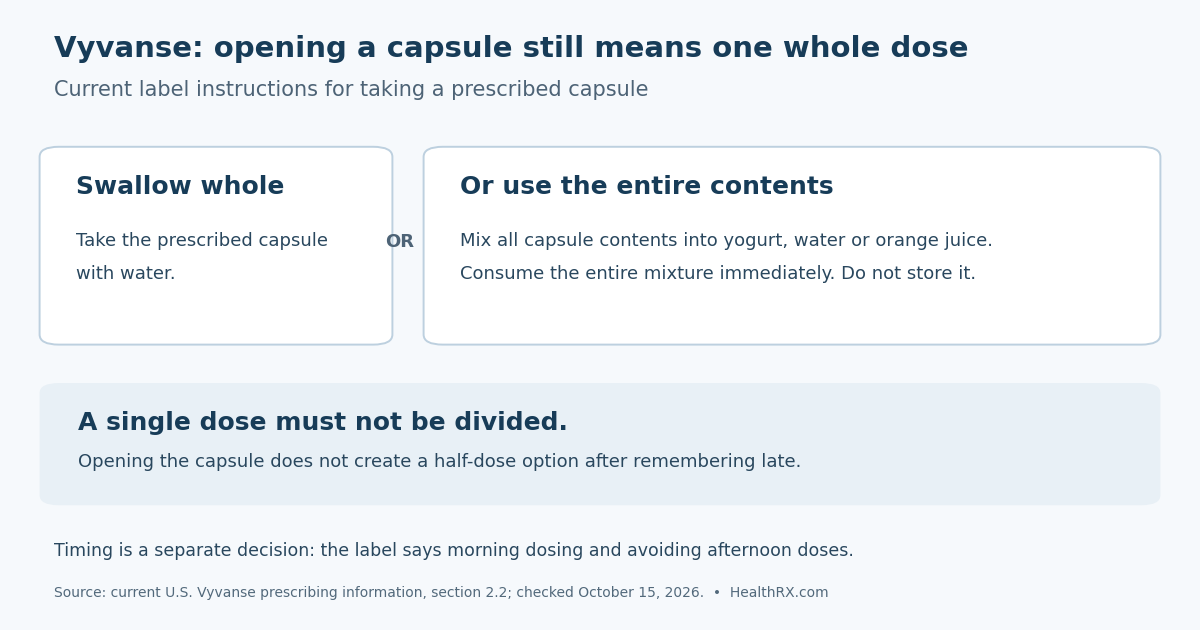
A late reminder is not a reason to take half a capsule or save half a dissolved mixture. The label says a single Vyvanse dose must not be divided. [1]
For a prescribed capsule dose, either swallow the capsule whole or open it and mix its entire contents into yogurt, water or orange juice. Consume the entire mixture immediately; do not store any for later. A chewable tablet must be thoroughly chewed before swallowing. These preparation options still deliver the full prescribed dose. [1]
Vyvanse can be taken with or without food. Eating does not make an afternoon dose appropriate. [1]
If you took an extra dose
Extra Vyvanse can cause dangerous cardiovascular and central nervous system effects. Call Poison Help at 1-800-222-1222 promptly, even if you currently feel well. Have the product, strength, amount and approximate dosing times available. Do not induce vomiting or try to counteract it with another drug. [1,2]
Call 911 for collapse, seizure, trouble breathing or inability to awaken. Chest pain, fainting or other serious symptoms also warrant urgent assessment. [1,2]
What duration and withdrawal studies measured
Clinical benefit and drug elimination are different. A laboratory-school trial in children ages 6–12, following dose optimization and using a crossover design, found better measured scores than placebo from 1.5 through 13 hours after dosing. That does not establish 13-hour benefit for everyone or make afternoon dosing safe. Active dextroamphetamine has an approximately 10–11.3-hour half-life in healthy adults, so it is not necessarily gone after 24 hours. [1,3]
Dependence can occur with prolonged prescribed use. Abrupt stopping or substantial reduction after prolonged use can produce fatigue, depression or other mood changes, sleep changes and increased appetite. The label does not quantify the likelihood after one missed day. Seek urgent help for serious mood deterioration. [1]
An adult randomized-withdrawal trial studied six weeks of discontinuation after at least six months of stable treatment. It cannot predict one forgotten day's effects or establish lifelong harm from that day. [4]
Make the next conversation specific
Before asking your pharmacist, record your prescribed product and strength, usual dosing time, whether today's dose is confirmed, possible dose times, other stimulants taken and any symptoms. Ask: “Should I skip today's dose?” and “When should I take my next scheduled dose?”
Try pairing a morning reminder with a dose log. Mark the dose after taking it, so a later reminder does not leave you guessing. If missed doses keep happening, tell your prescriber whether timing, side effects or doubts about treatment are getting in the way.
Frequently asked questions
What should I do if I miss my morning Vyvanse dose?
Follow your prescription's missed-dose instructions. MedlinePlus says to take it when remembered unless nearly time for the next dose, but the brand label says to avoid afternoon dosing. If it is already afternoon, skip it and resume your usual next-morning schedule. Never double up. Ask your pharmacist if your instructions are unclear. [1,2]
How late is too late to take a forgotten Vyvanse dose?
The label specifies morning dosing and avoiding afternoon doses because of insomnia; it gives no universal clock-time cutoff. Do not catch up in the afternoon. If you remember during the morning and are unsure, ask your pharmacist rather than calculating a cutoff from bedtime. [1]
Can I take half a Vyvanse capsule after remembering late?
No. The label says a single dose must not be divided. If you open a capsule, mix all its contents into yogurt, water or orange juice and consume the entire mixture immediately. Do not save part for later or use a half-dose rescue. [1]
What should I do after taking an extra Vyvanse dose?
Call Poison Help at 1-800-222-1222 promptly; do not wait for symptoms or induce vomiting. Call 911 for collapse, seizure, trouble breathing or inability to awaken. Chest pain, fainting or other serious symptoms warrant urgent assessment. [1,2]
How long does Vyvanse work, and is that the same as leaving the body?
Benefit varies. A dose-optimized crossover study in children ages 6–12 found better measured scores than placebo at 1.5–13 hours; this is not a guarantee for everyone. Active dextroamphetamine's half-life is approximately 10–11.3 hours in healthy adults. Benefit ending does not mean the drug has fully left the body. [1,3]
Can skipping Vyvanse cause tiredness or withdrawal symptoms?
Fatigue, mood changes, altered sleep and increased appetite can follow abrupt stopping or dose reduction after prolonged use. The label does not estimate the chance after one missed day. Report symptoms rather than assuming their cause, and seek urgent help for a severe mood change. [1]
How does Vyvanse work differently from Adderall?
Vyvanse contains lisdexamfetamine, a prodrug converted primarily in red blood cells to dextroamphetamine; its exact therapeutic action is not fully known. Adderall tablets contain mixed amphetamine salts, including d- and l-amphetamine. They are not interchangeable milligram for milligram, and Adderall should not be used to catch up a missed Vyvanse dose. [1,5,6]
Can I take Vyvanse with food?
Yes, with or without food. Capsules may also be opened and their entire contents mixed into yogurt, water or orange juice, then consumed immediately. Food does not override the instruction to avoid afternoon dosing. [1]
Can an alarm help me remember Vyvanse?
Try a reminder at your prescribed morning time and mark a dose log after taking it. A reminder cannot confirm that a dose was swallowed. If the record leaves you unsure, ask your pharmacist before repeating it.
What if I keep missing doses or worry about long-term treatment?
Discuss the pattern and your concerns with your prescriber. Repeated forgetting and prescribed long-term stopping require different plans. The adult withdrawal trial examined six weeks off treatment, not one forgotten dose, and cannot predict isolated missed-day effects. Do not turn missed-dose advice into a stopping plan. [1,4]
References
Sources checked October 15, 2026.
- DailyMed: Vyvanse prescribing information. Updated April 30, 2026.
- MedlinePlus: Lisdexamfetamine. Patient medication guide; revised 2021.
- Wigal et al. (2009): A 13-hour laboratory school study of lisdexamfetamine dimesylate in school-aged children with ADHD.
- Brams et al. (2012): Maintenance of efficacy of lisdexamfetamine dimesylate in adults with ADHD—randomized withdrawal design.
- Pennick (2010): Absorption of lisdexamfetamine dimesylate and its enzymatic conversion to d-amphetamine. Laboratory, animal, cell and human-blood research.
- DailyMed: Adderall tablets prescribing information.