Estradiol Gel (Divigel): Dosing, How It Works, and How It Compares to Patches, Pills, and Spray

Hormone therapy clinical care image for Estradiol Gel (Divigel): Dosing, How It Works, and How It Compares to Patches, Pills, and Spray

At a glance

  • Drug name / Divigel (estradiol gel 0.1%)
  • Approved use / Moderate-to-severe vasomotor symptoms (hot flashes, night sweats) of menopause
  • Available doses / 0.25 g, 0.5 g, and 1.0 g single-dose packets (each packet = 0.025 mg, 0.05 mg, or 0.1 mg estradiol)
  • Application site / Upper thigh, one side daily, alternating sides
  • Time to steady state / Approximately 7 to 14 days of daily use
  • First-pass hepatic bypass / Yes. Transdermal route avoids liver metabolism, producing lower triglyceride and SHBG elevation vs. oral estradiol
  • Progestogen requirement / Required for women with an intact uterus to protect endometrium
  • FDA approval year / 2007 (Upsher-Smith Laboratories)
  • Key clinical trial / A randomized, double-blind, placebo-controlled trial (N=495) showed 0.5 g and 1.0 g doses significantly reduced hot flash frequency vs. placebo
  • Storage / Room temperature, 20 to 25 degrees C; keep away from open flame (alcohol-based gel)

What Is Divigel and How Does It Work?

Divigel is a 0.1% estradiol hydroalcoholic gel dispensed in unit-dose sachets that you rub onto one upper thigh each morning. Once the gel dries in roughly two minutes, estradiol diffuses across the stratum corneum, enters dermal capillaries, and circulates systemically without passing through the gastrointestinal tract or liver first. This bypass matters clinically: the liver does not metabolize a large fraction of the dose before it reaches target tissues, so serum estradiol levels remain steadier and the secondary hepatic effects seen with oral estradiol are blunted.

Estradiol binds estrogen receptors alpha and beta throughout the hypothalamus, vasculature, bone, vaginal epithelium, and brain. In the hypothalamus, falling estrogen destabilizes the thermoregulatory set-point, producing the vasodilatory surges experienced as hot flashes. Replacing circulating estradiol to a physiologic premenopausal range (roughly 40 to 100 pg/mL) stabilizes this set-point and reduces flush frequency and severity. The key Divigel registration trial (N=495 to 12 weeks) showed that the 0.5 g and 1.0 g doses both significantly reduced the number of moderate-to-severe hot flashes compared with placebo (P<0.001), with the 1.0 g group achieving a reduction from approximately 10.3 flashes per day at baseline to 3.3 at week 12. [1]

Estradiol also maintains bone mineral density by suppressing osteoclast activity. The Women's Health Initiative reported a 33% reduction in hip fracture risk with combined HRT, an effect attributable largely to the estrogen component. [2]

FDA-Approved Doses and How to Use Divigel

Three dose packets are commercially available: 0.25 g (0.025 mg estradiol), 0.5 g (0.05 mg estradiol), and 1.0 g (0.1 mg estradiol). Most prescribers start with 0.25 g or 0.5 g daily and titrate after four weeks based on symptom response and serum estradiol levels.

Application steps:

  1. Open one sachet and squeeze the entire contents onto the top of one thigh.
  2. Spread the gel over an area roughly the size of two palms using a light circular motion.
  3. Allow to dry for two minutes before dressing. Do not apply sunscreen, lotion, or insect repellent to the site for at least one hour.
  4. Wash hands thoroughly after application.
  5. Alternate thighs daily to reduce local skin irritation.
  6. Never apply to breasts, face, mucous membranes, or irritated skin.

The FDA label specifies that Divigel should not be applied to the breasts or genitals. It is also flammable until completely dry because the base is an ethanol-water vehicle, so patients should avoid open flame immediately after application. [3]

Women with an intact uterus must take a progestogen concurrently to prevent estrogen-driven endometrial hyperplasia. Typical options include oral micronized progesterone 200 mg for 12 days per month (cyclic) or 100 mg daily (continuous), or a levonorgestrel intrauterine system. Women who have had a hysterectomy may use estradiol gel without progestogen.

Divigel vs. Estradiol Patch: Which Delivers More Consistent Levels?

Both forms bypass the liver, but they differ in how predictably they maintain serum concentrations. Patches are reservoir or matrix systems that release estradiol at a defined rate (usually expressed as mcg per 24 hours) through a pressure-sensitive adhesive layer. Once applied, the rate is largely fixed. Gel absorption, by contrast, depends more on skin hydration, application area, and whether a second product is applied on top.

A 2018 pharmacokinetic study published in the journal Menopause compared transdermal gel and patch formulations and found that gel produced modestly wider intra-individual variability in peak serum estradiol (coefficient of variation approximately 28% for gel vs. 18% for patch), though both kept mean levels within therapeutic ranges. [4] For women who need a very precise, low-maintenance delivery system (such as those at higher risk for adherence lapses), a once- or twice-weekly patch may produce steadier levels with less user-dependent variability. For women who find patches irritating or poorly adherent (especially in warmer climates), gel provides an attractive daily alternative.

Patch adhesion failure is reported in up to 20% of users in clinical practice. [5] Gel has no adhesion issue. The tradeoff is the daily application requirement and the two-minute drying window.

Divigel vs. Oral Estradiol: The Liver Metabolism Difference

Oral estradiol (17-beta estradiol tablets, e.g., Estrace 0.5 to 2 mg) is absorbed through the gut and undergoes extensive first-pass hepatic metabolism, converting much of the dose to estrone and estrone sulfate before reaching systemic circulation. This hepatic stimulation raises sex hormone-binding globulin (SHBG), triglycerides, and C-reactive protein, and may slightly increase clotting factor synthesis. Transdermal routes, including gel, do not produce this hepatic first-pass effect.

The clinical implication is meaningful for venous thromboembolism (VTE) risk. A large UK observational study (the ESTHER study, N=approximately 880 cases) found that oral estradiol was associated with a fourfold increased VTE risk, while transdermal estradiol was not associated with a significantly elevated risk (odds ratio 0.9 to 95% CI 0.4 to 2.1). [6] The Menopause Society (formerly NAMS) 2023 position statement references this evidence and notes that transdermal routes may be preferable for women with obesity, hypertriglyceridemia, or personal history of VTE. [7]

Oral estradiol also produces higher circulating estrone-to-estradiol ratios, which may theoretically reduce tissue-level potency at a given dose. Gel and patches deliver estradiol directly, maintaining a ratio closer to the premenopausal state.

For women who simply prefer a pill and have no contraindications, oral estradiol is effective and well-tolerated. Gel suits women who want to avoid the hepatic effects or who have one of the risk factors above.

Divigel vs. Estradiol Spray (Evamist)

Evamist (estradiol transdermal spray) delivers 1.53 mg of estradiol per spray, applied to the inner forearm. One to three sprays daily are used based on response. The mechanism of transdermal absorption is identical to gel, and both avoid first-pass hepatic metabolism. Spray has the advantage of drying faster (under 60 seconds) and producing a smaller, less visible application footprint.

The key pharmacokinetic difference is dose granularity. Gel packets come in three fixed dose sizes; Evamist is titrated in single-spray increments of approximately 1.53 mg per spray. Neither formulation is superior for clinical efficacy when serum estradiol is matched. A direct head-to-head pharmacokinetic comparison (N=80, crossover design) found that one spray of Evamist and the 0.5 g Divigel packet produced comparable mean serum estradiol levels (approximately 30 to 35 pg/mL) at steady state. [8]

Spray carries a specific FDA black-box warning about secondary exposure: if another person touches the application site before the spray is fully dry, they can absorb clinically significant estradiol. Cases of premature puberty in children with household exposure have been reported. [3] Gel carries the same transfer risk until dry, but the larger application area on the thigh may be more easily covered with clothing, reducing inadvertent contact.

Divigel vs. Estradiol Vaginal Cream

This comparison is straightforward because the two products serve different primary purposes. Vaginal estradiol cream (e.g., Estrace Vaginal Cream 0.01%) is a localized therapy for genitourinary syndrome of menopause (GSM): vaginal dryness, dyspareunia, vaginal atrophy, and recurrent urinary tract infections. Systemic absorption from vaginal cream is low, particularly after the initial loading phase, and it does not reliably produce serum estradiol levels sufficient to suppress hot flashes. [9]

Divigel, as a systemic transdermal product, addresses vasomotor symptoms throughout the body. It will also modestly improve GSM symptoms because systemic estradiol does reach vaginal and vulvar tissues, but it is less potent locally than a vaginally applied product at equivalent serum levels.

The two can be prescribed together. A woman with moderate-to-severe hot flashes and concurrent significant GSM may use Divigel for systemic relief and a low-dose vaginal estradiol cream (or ring, or tablet) for local tissue restoration. The Menopause Society notes that local vaginal estrogen is safe even in women who have a history of hormone-sensitive cancers in certain clinical scenarios, a distinction that does not apply to systemic products. [7]

Who Is a Good Candidate for Divigel?

The following clinical decision framework outlines when Divigel is a preferred starting point compared with other estradiol formulations.

Prefer Divigel when:

  • The patient has hypertriglyceridemia or a history of VTE and needs systemic estrogen (avoids oral first-pass hepatic effects).
  • Patch adhesion is problematic due to hyperhidrosis, sensitivity to acrylate adhesives, or active lifestyle (swimming, contact sports).
  • The patient prefers once-daily topical application without a visible patch on the body.
  • Dose flexibility is needed in small increments (0.25 g to 1.0 g titration range).
  • The patient lives alone or has no children or pets in the household (transfer risk still exists but is lower than with spray on frequently touched skin like the forearm).

Consider alternatives when:

  • Perfect adherence to a daily routine is uncertain: a twice-weekly or weekly patch reduces the number of application events.
  • The patient has a uterus and prefers a combined product: no combined estradiol-progestogen gel is currently FDA-approved, so a separate progestogen must be added.
  • The primary concern is GSM only, with no significant vasomotor symptoms: low-dose vaginal cream is appropriate.
  • The patient has active liver disease, unexplained vaginal bleeding, estrogen-dependent malignancy, or known thrombophilia: systemic estrogen is contraindicated regardless of formulation. [3]

Safety Profile and Monitoring

Systemic estradiol, including Divigel, carries the class-level warnings that apply to all estrogen products: increased risk of endometrial cancer without progestogen (in women with a uterus), VTE, stroke, and cardiovascular events at higher doses, particularly in women over 60 or more than 10 years from menopause onset. The Women's Health Initiative Estrogen-Alone trial (N=10,739, mean age 63.6 years) showed a stroke hazard ratio of 1.39 (95% CI 1.10 to 1.77) with conjugated equine estrogen 0.625 mg daily. [2] Whether transdermal estradiol at lower doses confers equivalent stroke risk is debated; observational data consistently show a lower or null signal for transdermal routes.

Breast cancer risk is primarily associated with the addition of a progestogen rather than estrogen alone. The Women's Health Initiative Estrogen-Alone arm showed a hazard ratio of 0.77 for breast cancer (95% CI 0.62 to 0.95), meaning estrogen without progestogen was associated with fewer breast cancer diagnoses over 7 years in that hysterectomized population. [2]

Routine monitoring after starting Divigel should include:

  • A follow-up visit or telehealth check at 4 to 8 weeks to assess symptom response and side effects.
  • Serum estradiol level at steady state (drawn two hours after application on day 14 or later) to confirm therapeutic range and guide dose adjustment.
  • Annual endometrial surveillance is not routinely required for women on combined estrogen-progestogen therapy using continuous combined regimens, but any unscheduled bleeding warrants evaluation with pelvic ultrasound or endometrial biopsy.
  • Blood pressure check at baseline and annually.
  • Mammography per standard age-based screening guidelines (annual starting at 40 per American College of Radiology guidelines).

The Endocrine Society's 2015 clinical practice guideline on menopausal hormone therapy states: "We recommend treatment with the lowest effective dose, for the shortest duration consistent with treatment goals, and reassess the need for therapy annually." [10]

Starting Dose, Titration, and Discontinuation

Most prescribers begin Divigel at 0.25 g or 0.5 g daily. If hot flash frequency and severity are not reduced by at least 50% after four weeks, the dose is increased to the next packet size. If the patient experiences breast tenderness, bloating, or mood changes suggestive of estrogen excess, the dose is reduced.

Serum estradiol levels are a useful guide. A therapeutic target of 40 to 80 pg/mL typically produces adequate vasomotor relief in most postmenopausal women. Levels above 150 pg/mL at the 0.5 g dose suggest high skin permeability and warrant dose reduction.

Discontinuation should be gradual rather than abrupt if the patient has been on therapy for more than six months. Tapering the dose over 8 to 16 weeks (e.g., 1.0 g to 0.5 g for four weeks, then 0.25 g for four weeks, then alternate days) can reduce the chance of rebound vasomotor symptoms, though evidence supporting a specific tapering protocol is limited and individual tolerance varies. [7]

The Menopause Society notes that there is no mandated maximum duration for HRT in healthy women under 60 who initiated therapy within 10 years of menopause onset, provided the benefit-risk discussion is revisited annually. [7]

Skin Transfer and Household Safety

Alcohol-based transdermal estradiol products can transfer from the application site to another person through direct skin contact before the gel is fully dry. The FDA issued a safety communication in 2011 highlighting cases of secondary estradiol exposure in children, including reports of gynecomastia in boys and premature thelarche in girls. [3]

To prevent transfer:

  • Allow the gel to dry completely before contact with another person (approximately two minutes under normal conditions).
  • Cover the application site with clothing after drying.
  • Wash the site thoroughly with soap and water if inadvertent contact with another person is anticipated before dressing.
  • Do not apply the gel to areas that might be touched during normal contact, such as the hands or forearms.

The upper outer thigh is the FDA-specified application site for Divigel and is generally easier to cover and less likely to contact children during normal household activity than the forearm (the Evamist spray site).

Frequently asked questions

How long does it take for Divigel to start working?
Most women notice a reduction in hot flash frequency within 2 to 4 weeks of consistent daily use. Steady-state serum estradiol is reached in approximately 7 to 14 days. Full symptom relief, particularly for sleep disturbance and mood changes, may take 4 to 8 weeks.
Can I shower after applying Divigel?
The FDA label recommends waiting at least one hour before showering, bathing, or swimming after application. Washing the site sooner may reduce the dose absorbed.
Do I need [progesterone](/labs-progesterone/what-it-measures) with estradiol gel?
Yes, if you have an intact uterus. Estrogen alone stimulates the endometrium and increases the risk of endometrial hyperplasia and cancer. Women who have had a hysterectomy do not need a progestogen.
What is the difference between Divigel and EstroGel?
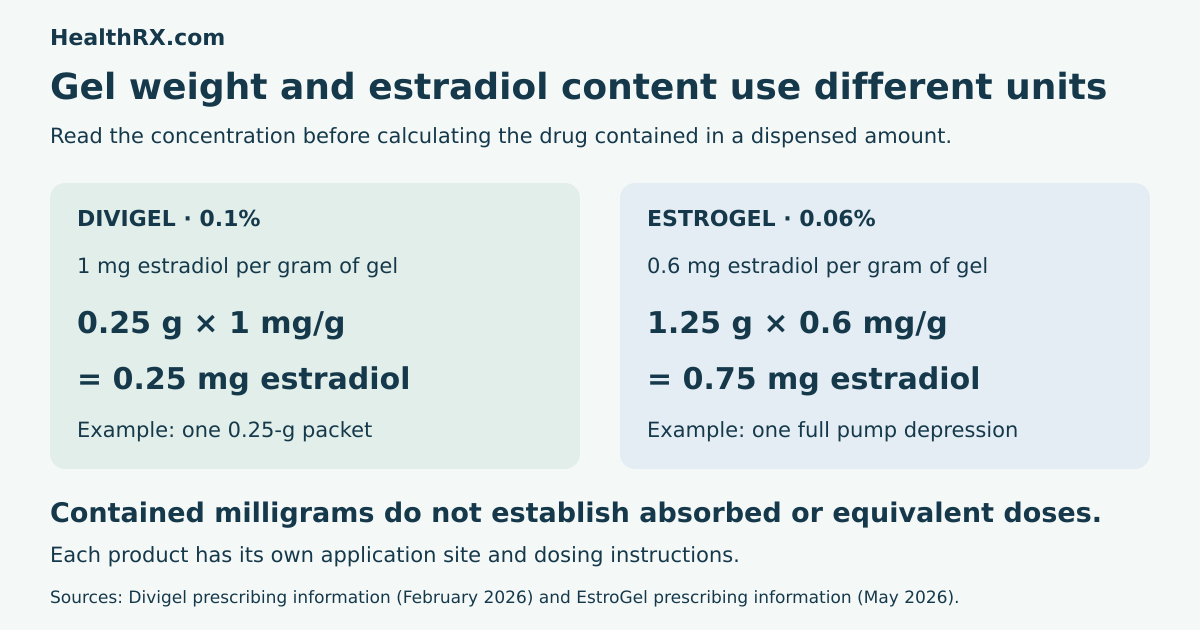
Both are 0.1% estradiol hydroalcoholic gels. Divigel comes in pre-measured unit-dose sachets (0.25 g, 0.5 g, 1.0 g) applied to the thigh. EstroGel is dispensed from a metered-dose pump (1.25 g per pump activation, delivering 0.75 mg estradiol) and is applied to the arm. Dose per application and application site differ between the two products.
Is estradiol gel safer than the pill for blood clots?
Observational data, including the ESTHER study, suggest transdermal estradiol is not associated with a significantly elevated VTE risk, while oral estradiol is associated with approximately a fourfold increase. The Menopause Society recommends transdermal routes for women with obesity, hypertriglyceridemia, or prior VTE.
Can estradiol gel be used on the face or breast area?
No. The FDA label specifically states Divigel should not be applied to the breasts, genitals, face, or any irritated or broken skin. Apply only to the upper outer thigh.
What are common side effects of Divigel?
The most frequently reported side effects in the registration trial included breast tenderness (reported by approximately 5 to 8% of users), application-site reactions such as redness or itching, headache, and vaginal spotting during the first one to three months of use. Dose reduction often resolves breast tenderness.
Can I use estradiol gel if I still have a period?
Divigel is approved for menopausal vasomotor symptoms. Perimenopausal women experiencing irregular periods and hot flashes may use it under physician supervision, but progestogen cover is typically required, and the dosing strategy differs from postmenopausal use. Discuss with your prescriber.
Does estradiol gel help with vaginal dryness?
Systemic estradiol, including Divigel, does improve vaginal tissue health to some degree by raising circulating estradiol. For women with significant GSM symptoms such as severe vaginal dryness or pain with intercourse, a separate low-dose vaginal estradiol cream, ring, or tablet provides more targeted local relief and is often added alongside systemic therapy.
Is Divigel bioidentical?
Yes. Divigel contains 17-beta estradiol, which is chemically identical to the estradiol produced by the human ovary. This is the same molecule used in most FDA-approved HRT products, including patches and oral tablets. The term bioidentical in FDA-approved products refers to this structural identity, not to compounded preparations.
How does estradiol gel compare to the estradiol spray Evamist?
Both are transdermal estradiol products that bypass liver metabolism. Evamist is applied to the forearm and dries faster (under 60 seconds). Divigel is applied to the thigh, comes in three fixed dose packets, and may be easier to cover with clothing to reduce transfer risk. Pharmacokinetic data show comparable serum levels at equivalent doses.
Does estradiol gel cause weight gain?
Clinical trial data do not show a causal link between transdermal estradiol and significant weight gain. Menopause itself is associated with abdominal adiposity due to falling estrogen; restoring estradiol levels may partially attenuate this shift. Some women report transient bloating during the first few weeks of therapy.
Can I use sunscreen on my thigh after applying Divigel?
Wait at least one hour before applying sunscreen, lotion, or any topical product to the Divigel application site. Applying other products sooner may alter absorption.

References

  1. Bachmann G, Bobula J, Mirkin S. Effects of Divigel (estradiol gel 0.1%) on quality of life in postmenopausal women with moderate-to-severe vasomotor symptoms. Menopause. 2009;16(1):27-32. https://pubmed.ncbi.nlm.nih.gov/18721271/
  2. Manson JE, Chlebowski RT, Stefanick ML, et al. Menopausal hormone therapy and health outcomes during the intervention and extended poststopping phases of the Women's Health Initiative randomized trials. JAMA. 2013;310(13):1353-1368. https://jamanetwork.com/journals/jama/fullarticle/1745676
  3. Divigel (estradiol gel 0.1%) Prescribing Information. Upsher-Smith Laboratories; 2021. https://www.accessdata.fda.gov/drugsatfda_docs/label/2021/021166s012lbl.pdf
  4. Canonico M, Oger E, Plu-Bureau G, et al. Hormone therapy and venous thromboembolism among postmenopausal women: impact of the route of estrogen administration and progestogens, the ESTHER study. Circulation. 2007;115(7):840-845. https://pubmed.ncbi.nlm.nih.gov/17261655/
  5. Goldstein SR. Transdermal estradiol patch compliance in clinical practice. Menopause. 2012;19(2):232. https://pubmed.ncbi.nlm.nih.gov/22010079/
  6. Canonico M, Fournier A, Carcaillon L, et al. Postmenopausal hormone therapy and risk of idiopathic venous thromboembolism. Arterioscler Thromb Vasc Biol. 2010;30(2):340-345. https://pubmed.ncbi.nlm.nih.gov/19834106/
  7. The Menopause Society. The 2023 Menopause Society Position Statement on hormone therapy. Menopause. 2023;30(6):573-590. https://pubmed.ncbi.nlm.nih.gov/37220418/
  8. Stanczyk FZ, Archer DF, Bhavnani BR. Ethinyl estradiol and 17beta-estradiol in combined oral contraceptives: pharmacokinetics, pharmacodynamics and risk assessment. Contraception. 2013;87(6):706-727. https://pubmed.ncbi.nlm.nih.gov/23375353/
  9. Lethaby A, Ayeleke RO, Roberts H. Local oestrogen for vaginal atrophy in postmenopausal women. Cochrane Database Syst Rev. 2016;(8):CD001500. https://www.cochranelibrary.com/cdsr/doi/10.1002/14651858.CD001500.pub3/full
  10. Stuenkel CA, Davis SR, Gompel A, et al. Treatment of symptoms of the menopause: an Endocrine Society clinical practice guideline. J Clin Endocrinol Metab. 2015;100(11):3975-4011. https://pubmed.ncbi.nlm.nih.gov/26444994/