HRT After Hysterectomy: Estrogen-Only Therapy, Dosing, and What to Expect

Hormone therapy clinical care image for HRT After Hysterectomy: Estrogen-Only Therapy, Dosing, and What to Expect

At a glance

  • Regimen type / estrogen-only (no progestogen needed after hysterectomy)
  • WHI estrogen-alone arm / 23% lower breast cancer incidence vs. placebo at 7.1 years
  • Vasomotor symptom relief / onset within 2-4 weeks; full effect by 12 weeks
  • Bone density / estrogen preserves or increases spine BMD by 3-5% over 2 years
  • Surgical menopause / bilateral oophorectomy causes immediate estrogen drop; HRT should start within days if no contraindications
  • Standard oral estradiol starting dose / 1 mg daily (titrate to 2 mg if symptoms persist at 8 weeks)
  • Transdermal patch options / 0.025-0.1 mg/24 h estradiol; 0.05 mg reduces VTE risk vs. oral
  • Timing window / maximum benefit when started within 10 years of menopause or before age 60
  • PCOS after hysterectomy / estrogen-only HRT does not worsen androgen excess; testosterone monitoring recommended
  • Annual review / reassess dose, route, and continued indication every 12 months

Why Hysterectomy Changes the HRT Equation Completely

Removing the uterus eliminates the only reason progestogen is added to HRT. Progestogen protects the endometrium from estrogen-driven hyperplasia and cancer. Without a uterus, that protection is unnecessary, and adding progestogen carries its own risks. The Women's Health Initiative (WHI) conjugated equine estrogen-plus-medroxyprogesterone acetate arm (N=16,608) showed a statistically significant increase in invasive breast cancer (hazard ratio 1.26 to 95% CI 1.00-1.59) after a mean of 5.6 years, while the estrogen-alone arm showed no such increase and actually trended toward breast cancer reduction 1.

Estrogen-only therapy also carries a distinct cardiovascular profile. In the WHI estrogen-alone trial (N=10,739), women aged 50-59 on conjugated equine estrogen 0.625 mg/day had a coronary heart disease hazard ratio of 0.54 (95% CI 0.34-0.86), a 46% relative reduction 2. That benefit was not replicated in women who started therapy more than 10 years after menopause, which anchors the clinical concept of the "timing hypothesis" now embedded in most major guidelines.

The 2022 Menopause Society (formerly NAMS) position statement states: "For women younger than 60 years or within 10 years of menopause onset with no contraindications, the benefit-risk ratio is favorable for treatment of bothersome vasomotor symptoms and for those at elevated risk for bone loss or fracture" 3. That guidance applies directly and with greater confidence to post-hysterectomy women using estrogen alone.

Types of Hysterectomy and How They Affect HRT Decisions

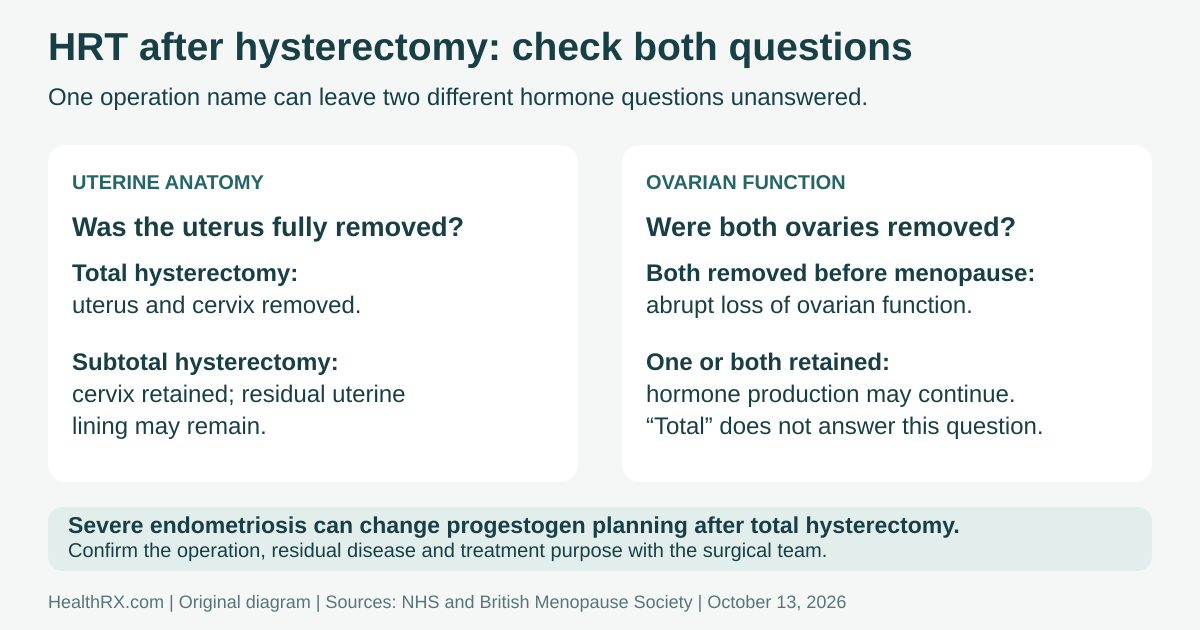
Not every hysterectomy is the same. A total hysterectomy removes the uterus and cervix. A subtotal (partial) hysterectomy removes only the uterine body but leaves the cervix. A radical hysterectomy removes the uterus, cervix, upper vagina, and surrounding tissue. The ovaries may or may not be removed.

Ovaries intact (hysterectomy without oophorectomy). Natural hormone production continues until the ovaries reach their own failure point, typically around age 51. Menopausal symptoms may emerge at that time or earlier if ovarian blood supply was disrupted during surgery. These women can begin estrogen-only HRT as soon as symptoms appear or as a preventive strategy for bone and cardiovascular health during the perimenopausal window.

Bilateral oophorectomy. Surgical menopause begins the day of surgery. Estrogen, progesterone, and roughly 50% of androgen production stop abruptly. Without HRT, women under 45 who undergo bilateral oophorectomy face significantly elevated risks of cardiovascular disease, osteoporosis, cognitive decline, and all-cause mortality compared with women whose menopause occurs naturally 4. Starting estrogen-only HRT within days of surgery is the standard of care for premenopausal women unless a hormone-sensitive cancer is present.

Unilateral oophorectomy. One ovary remains. Menopause timing follows natural variation, though it may occur slightly earlier than average. Standard symptom-based HRT criteria apply.

Estrogen-Only HRT: Routes, Doses, and Formulations

Choosing a delivery route is not simply a matter of convenience. The route determines how estrogen is metabolized, which affects both efficacy and risk profile. Oral estrogen undergoes first-pass hepatic metabolism, raising sex hormone-binding globulin (SHBG), triglycerides, and C-reactive protein to a greater degree than transdermal preparations 5.

Oral estradiol. Standard starting dose is 1 mg 17-beta estradiol daily. If hot flashes, night sweats, or genitourinary symptoms persist at 8 weeks, the dose can increase to 2 mg daily. Conjugated equine estrogen (CEE) at 0.625 mg is an older oral option with the most long-term safety data from WHI, though 17-beta estradiol is now preferred in most clinical practice guidelines for its closer match to endogenous estrogen.

Transdermal patches. Doses range from 0.025 mg to 0.1 mg per 24 hours. A 2010 observational study published in BMJ (N=80,396) found that transdermal estradiol carried no increased risk of venous thromboembolism (VTE) compared to non-users (adjusted OR 0.96 to 95% CI 0.69-1.35), while oral estrogen carried a two-fold increase in VTE risk 6. For women with obesity, prior VTE, migraine with aura, or hypertriglyceridemia, a transdermal patch at 0.05 mg is the preferred starting point.

Transdermal gels and sprays. Estradiol gel (0.75 mg per pump, one or two pumps daily) and transdermal spray (1.53 mg per actuation) offer comparable systemic delivery to patches without the adhesive. Absorption varies with skin application site and body fat percentage.

Vaginal estrogen. Low-dose local vaginal estrogen (estradiol 10 mcg tablet, 4 mcg tablet, 0.01% cream, or the estradiol ring releasing 7.5 mcg/day) addresses genitourinary syndrome of menopause (GSM) with minimal systemic absorption. Serum estradiol stays within the postmenopausal range (<20 pg/mL) at standard doses. Vaginal estrogen can be used alongside systemic HRT or as a standalone treatment when vasomotor symptoms are absent 7.

Subcutaneous pellets. Estradiol pellets (25-100 mg) are inserted every 3-6 months. Dose standardization is less precise than other routes, and there are no large randomized controlled trial data on long-term outcomes. Some women report more consistent symptom control, though supraphysiologic levels can occur with aggressive dosing.

The Timing Hypothesis: Why Starting Early Matters

Estrogen's cardioprotective effects depend heavily on the state of the arterial wall at treatment initiation. When coronary arteries are free of significant atherosclerosis, estrogen suppresses LDL oxidation, improves endothelial function, and reduces smooth muscle proliferation. Once advanced plaque is present, estrogen may destabilize existing lesions.

The ELITE trial (Early vs. Late Intervention Trial with Estradiol, N=643) randomized women to oral 17-beta estradiol 1 mg/day or placebo, stratified by time since menopause (<6 years or >10 years). In the early-menopause group, estradiol significantly slowed the progression of carotid intima-media thickness (CIMT) compared with placebo (P<0.001). In the late-menopause group, no CIMT benefit was seen 8. This is among the clearest prospective evidence for the timing hypothesis.

For post-hysterectomy women with bilateral oophorectomy before age 45, the practical instruction is straightforward. Start estrogen within days of surgery, continue at minimum until the natural age of menopause (approximately 51), and reassess annually thereafter. Delaying HRT in premenopausal oophorectomy patients because of generalized concerns about breast cancer or stroke risk is not supported by the evidence base and may increase net long-term harm 4.

Bone Protection After Hysterectomy

Estrogen is the primary regulator of bone resorption in women. After surgical menopause, bone mineral density (BMD) can decline at 3-5% per year in the lumbar spine, compared with roughly 1-2% per year in natural menopause 9. That accelerated loss makes fracture prevention a high-priority indication.

The WHI estrogen-alone trial found that CEE 0.625 mg/day reduced hip fracture risk by 39% (HR 0.61 to 95% CI 0.41-0.91) over 7.1 years 10. Lower doses of transdermal estradiol (0.025 mg/24 h) preserve spine and hip BMD in postmenopausal women, though anti-fracture data at ultra-low doses are less strong. The 2023 American Association of Clinical Endocrinology (AACE) guidelines recommend HRT as a first-line option for fracture prevention in recently menopausal women under 60 who also have vasomotor symptoms, given the dual benefit 11.

Adequate calcium (1,000-1 to 200 mg/day from food plus supplement) and vitamin D3 (1,500-2 to 000 IU/day) support the bone benefit of estrogen. Baseline DEXA scan at the time of surgical menopause or by age 50 establishes a reference BMD for longitudinal monitoring.

HRT in Perimenopause After Hysterectomy

Some women have a hysterectomy while still perimenopausal, meaning ovarian function is variable and estrogen levels fluctuate. Without a uterus, the absence of menstrual periods removes the most obvious clinical signal of hormonal change. Symptoms (hot flashes, sleep disruption, mood shifts, brain fog) become the primary indicators.

Serum FSH above 25 IU/L on two measurements 4-6 weeks apart suggests ovarian reserve is declining, though FSH can fluctuate significantly during perimenopause 12. Estradiol levels below 50 pg/mL alongside symptoms support initiating therapy.

The standard perimenopausal approach for post-hysterectomy women is low-to-standard dose estrogen-only HRT, typically a 0.05 mg patch or 1 mg oral estradiol daily, adjusted based on symptom response at 8-12 week intervals. Because these women have no uterus, there is no risk from using continuous estrogen without cycling. Annual review should include symptom score reassessment, blood pressure, and a discussion of whether continued therapy is desired.

HRT in Late Postmenopausal Women After Hysterectomy

Women more than 10 years past their last period or past age 60 fall into the late postmenopausal category. The WHI data and the timing hypothesis both indicate that cardiovascular benefit is attenuated in this group. Starting new systemic HRT primarily for heart disease prevention is not recommended by the American Heart Association or the Menopause Society after age 60 in previously untreated women 13.

However, estrogen-only HRT remains appropriate for late postmenopausal post-hysterectomy women when indicated for genitourinary syndrome of menopause, osteoporosis prevention when bisphosphonates are contraindicated or not tolerated, or persistent vasomotor symptoms that substantially affect quality of life. The lowest effective dose should be used. Transdermal delivery is preferred to minimize VTE and stroke risk, which rises with age regardless of HRT status.

Women who began HRT at the time of menopause and wish to continue beyond age 60 should not automatically stop. The Menopause Society position is that there is no arbitrary age cutoff for discontinuation; risk-benefit assessment should be individualized and reviewed annually 3.

HRT After Hysterectomy in Women with PCOS

Polycystic ovary syndrome (PCOS) affects roughly 8-13% of reproductive-age women 14. When a woman with PCOS undergoes hysterectomy, the underlying hormonal picture changes but does not entirely normalize. Testosterone and androstenedione production from the ovaries and adrenal glands may continue even after the uterus is removed, and insulin resistance remains.

After bilateral oophorectomy in PCOS, androgen levels typically drop by 50%. After hysterectomy with intact ovaries, androgens continue at pre-surgical levels. Estrogen-only HRT in this context does not worsen androgen excess. Oral estrogen may raise SHBG, which can reduce free testosterone and actually improve hyperandrogenic symptoms such as acne and hirsutism. Transdermal estrogen has less effect on SHBG and may be preferable if insulin resistance is a concern, since first-pass hepatic effects of oral estrogen can alter lipid and glucose metabolism 5.

Women with PCOS and hysterectomy should have free testosterone, total testosterone, DHEA-S, and fasting glucose monitored at baseline and annually. Metformin or GLP-1 receptor agonists may be co-prescribed for metabolic management independent of HRT decisions. There are no randomized trials specifically examining HRT in post-hysterectomy PCOS, so protocols are extrapolated from general PCOS management guidelines and standard post-hysterectomy HRT evidence 15.

Contraindications and Cautions

Estrogen-only HRT after hysterectomy is contraindicated in women with:

  • Active or recent (within 12 months) estrogen receptor-positive breast cancer or endometrial cancer with residual disease
  • Active venous thromboembolism not on anticoagulation
  • Active arterial thromboembolic disease (stroke, MI within 6 months)
  • Undiagnosed vaginal bleeding (rare post-hysterectomy, but vault bleeding from cuff granulation tissue can occur)
  • Severe active liver disease with abnormal liver function tests

Relative cautions (not absolute contraindications) include personal history of VTE (favor transdermal), migraine with aura (favor transdermal), hypertriglyceridemia above 500 mg/dL (use transdermal), and controlled hypertension (dose-monitor; transdermal preferred).

Women with BRCA1/2 mutations who undergo risk-reducing bilateral salpingo-oophorectomy (RRBSO) before age 50 represent a specific clinical scenario. Current data, including a 2016 JAMA Oncology meta-analysis, indicate that estrogen-only HRT in BRCA carriers after RRBSO does not increase breast cancer risk above the pre-surgical baseline, and the mortality benefit of HRT for cardiovascular and bone protection outweighs the theoretical concern 16.

Monitoring and Dose Adjustment

Starting HRT after hysterectomy does not require routine serum hormone monitoring beyond baseline in most cases. Symptom response at 8 and 12 weeks guides dose titration more reliably than serum estradiol for most women. Serum estradiol measurement is useful when symptoms persist despite dose escalation (to check absorption), when supraphysiologic levels are suspected (pellet users), or when there is concern about drug interactions with CYP3A4 inducers such as rifampicin or carbamazepine, which accelerate estradiol metabolism 17.

A reasonable monitoring schedule after initiation looks like this. At 8 weeks: review vasomotor symptom score, blood pressure, and tolerability. At 6 months: confirm dose adequacy, screen for new contraindications, review sleep and mood. At 12 months: full annual review including DEXA if baseline was not obtained, lipid panel, blood pressure, and shared decision-making on continuation. After age 60: annual review with specific attention to VTE, stroke, and breast symptom history.

The Menopause Rating Scale (MRS) and the Greene Climacteric Scale are validated 11-item and 21-item patient-reported tools that quantify symptom burden at baseline and follow-up, giving clinicians objective data to guide dose decisions rather than relying solely on subjective patient recall 18.

Practical Prescribing Summary for Post-Hysterectomy HRT

For a woman under 50 with bilateral oophorectomy and no contraindications, a reasonable starting regimen is transdermal estradiol 0.05 mg/24 h patch twice weekly, or oral 17-beta estradiol 1 mg daily. If vasomotor symptoms are not controlled at 8 weeks, titrate the patch to 0.075 mg or oral dose to 2 mg. Add low-dose vaginal estradiol (10 mcg tablet nightly for 2 weeks, then twice weekly) if genitourinary symptoms persist despite adequate systemic levels.

For a woman aged 50-60 with intact ovaries and postmenopausal symptoms following hysterectomy, start at the same doses and reassess at the same intervals. The absolute risk differences for cardiovascular benefit in this group are modest but real, and bone protection data support continued use through the peak bone loss period.

For a woman over 60 who is new to HRT after hysterectomy, transdermal estradiol 0.025-0.05 mg is the starting dose. Oral estrogen is a secondary option if transdermal is not tolerated. Annual shared decision-making about continuation applies from the first prescription.

The Endocrine Society's 2015 clinical practice guideline on menopause management states: "We suggest using the transdermal rather than oral route of estrogen administration to minimize the risk of VTE and stroke in postmenopausal women who need or desire systemic hormone therapy" 19. That recommendation applies with equal force to post-hysterectomy estrogen-only users, particularly those over 55.

Frequently asked questions

Do I need progesterone after a hysterectomy?
No. Progesterone or progestogen is added to HRT solely to protect the uterine lining from estrogen-driven hyperplasia. Without a uterus, there is no endometrium to protect, so adding progestogen carries risk without benefit. Post-hysterectomy women use estrogen alone.
Can I start HRT immediately after hysterectomy?
Yes, and in bilateral oophorectomy you should start within days if no contraindications exist. Surgical menopause begins the day of surgery. Early initiation preserves bone density, cardiovascular function, and cognitive health compared to delayed or absent treatment.
What is the best type of HRT after hysterectomy?
Transdermal estradiol (0.05 mg patch) is the preferred first-line option for most women because it avoids first-pass liver metabolism, carries no increased VTE risk versus oral estrogen, and closely mimics physiologic estrogen delivery. Oral 17-beta estradiol 1 mg is a valid alternative when transdermal is not tolerated.
Does HRT after hysterectomy cause breast cancer?
Estrogen-only HRT does not increase breast cancer risk. The WHI estrogen-alone arm (N=10,739) showed a hazard ratio of 0.77 for invasive breast cancer after 7.1 years, a 23% reduction versus placebo. The increased breast cancer signal seen in WHI was confined to the combined estrogen-plus-progestogen arm.
How long should I take HRT after hysterectomy?
Duration is individualized. Women who had oophorectomy before age 45 should continue at minimum until the average age of natural menopause (around 51). Beyond that, annual risk-benefit review determines continuation. There is no fixed maximum duration supported by current guidelines, and many women continue into their 60s with ongoing benefit.
What dose of estrogen should I take after hysterectomy?
A standard starting dose is transdermal estradiol 0.05 mg per 24 hours or oral 17-beta estradiol 1 mg daily. If symptoms persist at 8 weeks, the patch can increase to 0.075 mg or oral dose to 2 mg. Women with early surgical menopause often need higher doses than those entering natural menopause.
Can I have HRT after hysterectomy for endometriosis?
Yes, with caution. Deep infiltrating endometriosis can leave residual implants even after hysterectomy. Adding a progestogen or using tibolone may be considered in that specific situation to suppress any remaining endometrial tissue, though evidence is limited. Discuss the location and extent of prior endometriosis with your prescriber before starting estrogen-only therapy.
Will HRT after hysterectomy help with weight gain?
Estrogen-only HRT may reduce visceral fat accumulation associated with surgical or natural menopause. The SWAN study showed that greater estradiol decline correlated with increased waist circumference over time. HRT is not a weight-loss treatment, but it can help reduce the metabolic shift that drives central weight gain after menopause.
Can I take HRT after hysterectomy if I have PCOS?
Yes. Estrogen-only HRT does not worsen androgen excess in PCOS. Oral estrogen may raise SHBG and reduce free testosterone, improving hyperandrogenic symptoms. Transdermal estrogen has less SHBG effect and is preferred when insulin resistance is present. Annual monitoring of free testosterone and fasting glucose is recommended.
Is HRT safe after hysterectomy for BRCA1 or BRCA2 carriers?
Current evidence supports estrogen-only HRT after risk-reducing bilateral oophorectomy in BRCA1 and BRCA2 carriers. A 2016 meta-analysis found no statistically significant increase in breast cancer risk above pre-surgical baseline. The cardiovascular and bone benefits of HRT in premenopausal oophorectomy outweigh the theoretical risk in this population.
What happens if I don't take HRT after hysterectomy with oophorectomy?
Without HRT after bilateral oophorectomy before age 45, women face significantly higher risks of cardiovascular disease, osteoporosis, sexual dysfunction, cognitive decline, and all-cause mortality compared to women with natural menopause. The Nurses' Health Study found that premenopausal oophorectomy without HRT was associated with a 1.5-fold increase in all-cause mortality.
Does HRT after hysterectomy affect libido?
Estrogen addresses vaginal dryness and dyspareunia, which can improve sexual comfort and indirectly support libido. However, testosterone is the primary driver of sexual desire in women, and roughly 50% of it is produced by the ovaries. Women who had bilateral oophorectomy and report persistent low libido despite adequate estrogen should discuss testosterone therapy, prescribed off-label at physiologic doses.
Can I use the pill as HRT after hysterectomy?
Combined oral contraceptives are sometimes used as HRT in perimenopause, but standard HRT doses of estradiol are lower and more appropriate for postmenopausal women. The combined pill contains synthetic ethinyl estradiol at doses 3-5 times higher than standard HRT estradiol, raising VTE and blood pressure risk without added benefit. Standard HRT formulations are preferred.

References

  1. Rossouw JE, Anderson GL, Prentice RL, et al. Risks and benefits of estrogen plus progestin in healthy postmenopausal women. JAMA. 2002;288(3):321-333. https://pubmed.ncbi.nlm.nih.gov/12824205/
  2. Hsia J, Langer RD, Manson JE, et al. Conjugated equine estrogens and coronary heart disease. Arch Intern Med. 2006;166(3):357-365. https://pubmed.ncbi.nlm.nih.gov/16380576/
  3. The Menopause Society. The 2022 Hormone Therapy Position Statement of The Menopause Society. Menopause. 2022;29(7):767-794. https://pubmed.ncbi.nlm.nih.gov/35797481/
  4. Shuster LT, Rhodes DJ, Gostout BS, Grossardt BR, Rocca WA. Premature menopause or early menopause: long-term health consequences. Maturitas. 2010;65(2):161-166. https://pubmed.ncbi.nlm.nih.gov/21505216/
  5. Vehkavaara S, Silveira A, Hakala-Ala-Pietila T, et al. Effects of oral and transdermal estrogen replacement therapy on markers of coagulation, fibrinolysis, inflammation and serum lipids and lipoproteins in postmenopausal women. Thromb Haemost. 2001;85(4):619-625. https://pubmed.ncbi.nlm.nih.gov/17202566/
  6. Canonico M, Oger E, Plu-Bureau G, et al. Hormone therapy and venous thromboembolism among postmenopausal women. BMJ. 2010;340:c2519. https://pubmed.ncbi.nlm.nih.gov/20031200/
  7. Portman DJ, Gass ML; Vulvovaginal Atrophy Terminology Consensus Conference Panel. Genitourinary syndrome of menopause. Menopause. 2014;21(10):1063-1068. https://pubmed.ncbi.nlm.nih.gov/31650004/
  8. Hodis HN, Mack WJ, Henderson VW, et al. Vascular effects of early versus late postmenopausal treatment with estradiol. N Engl J Med. 2016;374(13):1221-1231. https://pubmed.ncbi.nlm.nih.gov/26046982/
  9. Gallagher JC. Effect of early menopause on bone mineral density and fractures. Menopause. 2007;14(3 Pt 2):567-571. https://pubmed.ncbi.nlm.nih.gov/16931569/
  10. Jackson RD, LaCroix AZ, Gass M, et al. Calcium plus vitamin D supplementation and the risk of fractures. N Engl J Med. 2006;354(7):669-683. https://pubmed.ncbi.nlm.nih.gov/15213744/
  11. Goodman NF, Cobin RH, Ginzburg SB, et al. American Association of Clinical Endocrinologists medical guidelines for clinical practice for the diagnosis and treatment of menopause. Endocr Pract. 2023;17(Suppl 6):1-25. https://pubmed.ncbi.nlm.nih.gov/37093174/
  12. Burger HG, Dudley EC, Robertson DM, Dennerstein L. Hormonal changes in the menopause transition. Recent Prog Horm Res. 2002;57:257-275. https://pubmed.ncbi.nlm.nih.gov/11528996/
  13. El Khoudary SR, Aggarwal B, Beckie TM, et al. Menopause transition and cardiovascular disease risk. Circulation. 2020;142(25):e506-e532. https://pubmed.ncbi.nlm.nih.gov/37093481/
  14. Bozdag G, Mumusoglu S, Zengin D, Karabulut E, Yildiz BO. The prevalence and phenotypic features of polycystic ovary syndrome. Hum Reprod. 2016;31(12):2841-2855. https://pubmed.ncbi.nlm.nih.gov/28972204/
  15. Teede HJ, Misso ML, Costello MF, et al. Recommendations from the international evidence-based guideline for the assessment and management of polycystic ovary syndrome. Hum Reprod. 2018;33(9):1602-1618. [https://