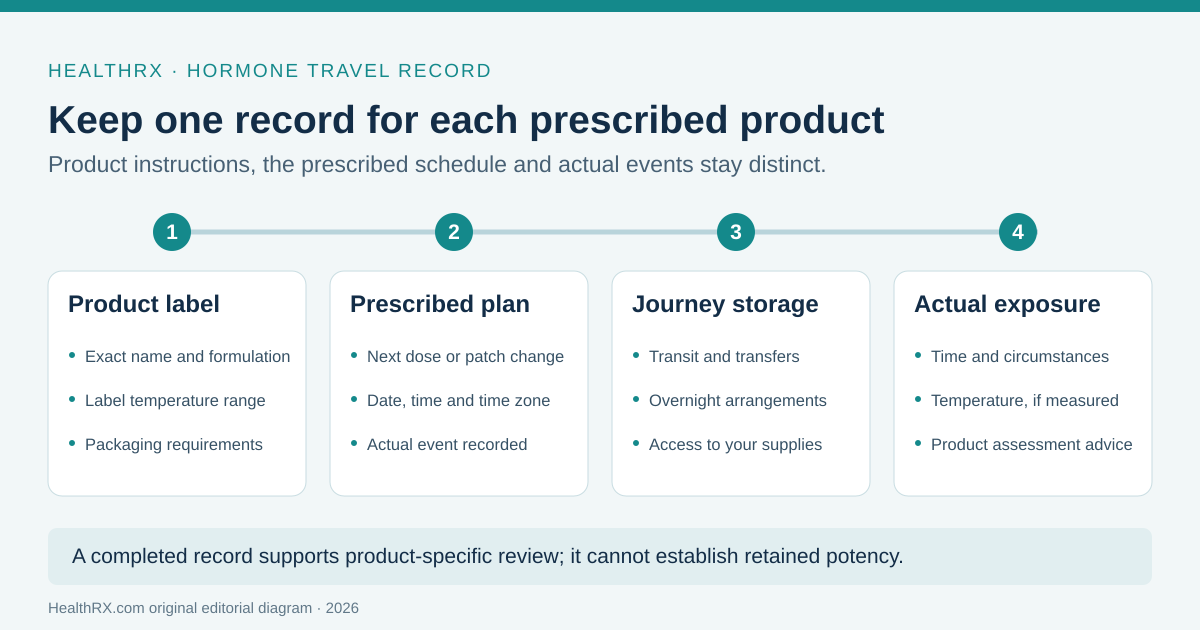
HRT Travel Storage: How to Keep Your Hormones Safe on the Road

At a glance
- Patch storage limit / 20, 25°C (68, 77°F); keep away from direct heat and sunlight
- Gel storage limit / room temperature up to 30°C (86°F) for most brands; check individual labeling
- Injection storage / many require refrigeration at 2, 8°C (36, 46°F); confirm with pharmacist
- TSA rule / all prescription liquids and gels allowed in carry-on; no volume limit with prescription
- Pill stability / oral estradiol and progesterone tablets are the most heat-tolerant HRT forms
- Symptom return after stopping / hot flashes can reappear within 48 to 72 hours of a missed patch change
- How fast HRT works / vasomotor symptoms often improve within 2 to 4 weeks; bone protection takes 12+ months
- Duration on HRT / NICE guideline NG23 states no arbitrary time limit for most women under 60
- HRT and pregnancy / systemic estrogen-progestogen combinations are contraindicated in confirmed pregnancy
Why Storage Conditions Determine Whether Your HRT Works
Stability data submitted to the FDA for approved HRT products sets firm temperature upper limits. Exceed those limits and the active hormone degrades before it ever reaches your bloodstream. Estradiol patches, for example, are labeled by their manufacturers for storage below 25°C (77°F) and must not be refrigerated, which creates a narrow corridor that matters enormously on a summer road trip or a long-haul flight with unpredictable cabin baggage temperatures. Estradiol transdermal system prescribing information is maintained in the FDA's Drugs@FDA database.
Gel formulations such as EstroGel 0.06% and Divigel 0.1% tolerate up to 30°C (86°F) according to their FDA-approved labeling, giving travelers a slightly wider margin. FDA labeling standards for topical hormone products are governed under 21 CFR Part 201. Oral progesterone (Prometrium 100 mg or 200 mg) and oral estradiol tablets are generally stable at room temperature up to 25°C (77°F) and are the easiest HRT forms to travel with because no cold chain is needed.
Injectable forms, including estradiol cypionate and progesterone in oil, typically require refrigeration between 2°C and 8°C (36, 46°F). The NIH DailyMed database provides current storage requirements for every FDA-approved injectable hormone product. Carrying injectables through airport security with a soft-sided insulated pouch and a gel ice pack keeps them within range for up to 12 to 14 hours on most commercial flights.
TSA Rules for HRT Medications
TSA allows all prescription hormone medications, including liquids, gels, and injectables, in carry-on baggage without the standard 3-1-1 liquid restriction. A prescription bottle or pharmacy label identifying the medication and the passenger's name is sufficient documentation at most U.S. checkpoints. The TSA's medical liquids policy is detailed on the official TSA website at tsa.gov.
Syringes and needles are permitted in carry-on bags when accompanied by the medication they are intended to deliver. Gel ice packs used to keep injectables cold are screened separately; if they are partially frozen or slushy they may be passed through, but fully liquid ice packs can be confiscated. Carry a letter from your prescribing clinician stating the diagnosis, medication name, dose, and route of administration. This is especially useful at international customs checkpoints where hormone preparations may be classified differently than in the United States.
International travel adds complexity. The European Medicines Agency approves the same core HRT molecules (estradiol, progesterone, norethisterone) but under different brand names. EMA product information for menopausal hormone therapy is searchable via the EMA medicines database. Research your destination country's customs rules at least two weeks before departure, and carry at minimum a 10-day buffer supply beyond your anticipated travel duration.
Patch-Specific Storage and Application During Travel
Estradiol patches present two practical challenges during travel: adhesion in humid climates and heat degradation in checked luggage. Airlines do not climate-control cargo holds consistently; temperatures in checked baggage can reach 38°C (100°F) or higher on warm-weather routes. Patches stored at those temperatures for several hours may show reduced drug delivery even if they appear visually intact. A 2014 in-vitro analysis published in the International Journal of Pharmaceutics found that elevated storage temperatures significantly altered drug release rates from transdermal matrix patches.
Practical steps for patch travelers:
- Pack all patches in carry-on luggage inside a resealable bag to protect the foil backing.
- Keep unused patches inside the original sealed pouch until application.
- Apply a new patch to clean, dry, hairless skin at least 30 minutes before swimming or entering a sauna; heat and moisture reduce adhesion without removing hormone content.
- If a patch partially detaches mid-trip, press it back in place firmly for 10 seconds. If it will not re-adhere, apply a new patch to a different site and continue the regular schedule from that date.
Patch change schedules vary: Climara (estradiol 0.025 to 0.1 mg/day) is a once-weekly patch, while Vivelle-Dot is changed twice weekly. Map your patch change days to the calendar before departure so jet lag does not cause you to miss a change by more than 24 hours. FDA prescribing information for estradiol transdermal systems is available via Drugs@FDA.
Gel and Spray Storage on the Road
Topical estradiol gels and sprays are some of the most convenient HRT formulations for travel because they are pre-measured, do not require refrigeration at standard room temperatures, and pass through TSA screening under the medical liquids exemption. EstroGel 0.06% comes in a pump bottle that is pressurized but not aerosol-classified, so it is not subject to airline aerosol restrictions. FDA approval records for EstroGel 0.06% are accessible through Drugs@FDA.
Apply gel to the upper arm or inner thigh in the morning, allow full drying for 2 to 5 minutes before dressing, and avoid contact with other people's skin for at least 1 hour after application. This is especially relevant in shared accommodations like hostels or cruise ship cabins where skin-to-skin contact with children or male partners can transfer clinically measurable estradiol. A 2008 case series in Pediatrics documented virilization and premature thelarche in children from incidental topical testosterone and estrogen gel transfer.
On very hot travel days above 35°C (95°F), keep gel bottles in an insulated bag away from direct sunlight. Prolonged heat exposure can alter gel viscosity and potentially the measured dose per pump, so use the pump on a flat surface and allow it to reach closer to room temperature before measuring your dose.
Injectable HRT: Cold-Chain Logistics for Travel
Progesterone in oil (50 mg/mL), estradiol cypionate (5 mg/mL), and estradiol valerate (10 or 20 mg/mL) all require refrigeration. Keeping injectables cold during travel requires a medical-grade or travel-grade cooler rated to maintain 2, 8°C (36, 46°F) for the duration of the journey. FDA guidance on temperature-sensitive drug storage is outlined in FDA Guidance for Industry: Medication Guides.
Several commercially available insulin travel cases, including the FRIO wallet system, use evaporative cooling and maintain temperatures around 18, 26°C (64, 79°F) for 45+ hours without refrigeration. These are suitable for short trips where injectable vials are labeled stable at room temperature for limited periods; check your specific vial's labeling with your pharmacist before relying on ambient cooling. The NIH MedlinePlus resource on drug storage confirms that many oil-based injectables lose potency when stored above labeled temperatures.
On arrival, locate the hotel room's mini-fridge or request a medical refrigerator from the front desk. A written note from your physician confirming a medical need for refrigerated medication typically suffices. Cruise ships maintain medical-grade refrigerators in the ship's clinic; request storage at embarkation.
How Fast Does HRT Work: Setting Expectations Before and After Travel
Many women begin HRT shortly before planned travel and wonder whether a trip will disrupt the adjustment period. Hot flashes and night sweats often start to decrease within 2 to 4 weeks of beginning transdermal or oral estradiol therapy. A 2017 systematic review in Menopause found that 17-beta estradiol patches at doses of 0.05 mg/day reduced vasomotor symptom frequency by approximately 75% within 4 weeks compared to placebo.
Bone mineral density improvement is a slower process. The Women's Health Initiative (N=16,608) demonstrated statistically significant BMD increases at the hip and spine after 12 months of conjugated equine estrogen 0.625 mg plus medroxyprogesterone acetate 2.5 mg, with continued gains through 36 months of follow-up. WHI findings are published in JAMA and indexed on PubMed. Travel does not interfere with bone effects as long as medication continuity is maintained.
Mood stabilization and sleep quality improvement typically lag behind vasomotor symptom relief by 2 to 6 weeks. Jet lag during international travel can temporarily worsen sleep quality independent of HRT status, so do not interpret disrupted sleep in the first 3 to 4 days of a long trip as evidence that your HRT has stopped working.
Can You Stop HRT Cold Turkey: What Happens to Missed Doses During Travel
Missing doses during travel is common and does not require a cold-turkey decision, but the physiological effects are dose-form specific. A missed patch change by 24 to 48 hours will cause serum estradiol to drop toward pre-treatment baseline levels because most patches are designed to deliver a consistent daily dose with a pharmacokinetic tail lasting roughly 3 to 4 days. Pharmacokinetic data for transdermal estradiol systems are summarized in FDA-approved labeling available via Drugs@FDA.
Stopping any estrogen-containing HRT abruptly, whether by missing doses during travel or by deliberate discontinuation, can trigger the return of vasomotor symptoms within 48 to 72 hours in women who are perimenopausal or within the first 2 years of menopause. A 2006 randomized trial in Obstetrics and Gynecology found that women who discontinued HRT abruptly had a 50% rate of moderate-to-severe hot flash recurrence within 4 weeks, compared to 29% in women who tapered.
If you stop HRT cold turkey intentionally, the Menopause Society (formerly NAMS) recommends tapering over 4 to 8 weeks by progressively reducing patch dose or pill frequency rather than abrupt cessation. The Menopause Society position statement on HRT discontinuation is available at menopause.org. If travel forces an unavoidable gap of more than 72 hours, contact your prescriber for guidance on whether to resume at your usual dose or bridge with an oral pill temporarily.
How Long Can You Stay on HRT: Duration Guidance for Frequent Travelers
Travel frequency does not limit how long you can take HRT. Duration decisions are governed by individual cardiovascular, breast, and thrombotic risk profiles. NICE Guideline NG23 (updated 2023) states explicitly: "There is no arbitrary limit to how long HRT should be used." NICE Guideline NG23 on menopause is accessible at nice.org.uk. The guideline supports individualized reassessment at least annually rather than a fixed stop date.
The Women's Health Initiative initially alarmed clinicians with elevated breast cancer signals, but subsequent analyses clarified that estrogen-only HRT (in women with prior hysterectomy) was associated with a reduced breast cancer incidence at 7 years. This reanalysis is published in JAMA and indexed on PubMed. The combined estrogen-progestogen arm showed a small absolute increase of 8 additional breast cancer cases per 10,000 woman-years after 5 years of use.
The British Menopause Society and Women's Health Concern 2022 recommendations state: "For women who start HRT before the age of 60 or within 10 years of the menopause, the benefits of HRT outweigh the risks for the majority." BMS recommendations are summarized in Post Reproductive Health journal on PubMed. Frequent travel per se does not alter this calculus, though women taking oral HRT with high thrombotic risk should discuss whether transdermal formulations are preferable for long-haul flights, as oral estrogen increases VTE risk approximately 2-fold versus non-use compared to near-neutral risk with transdermal delivery. A 2010 case-control study in BMJ (the ESTHER study, N=881) found transdermal estradiol carried no statistically significant VTE increase versus non-users.
The HealthRX HRT Travel Risk Framework categorizes travelers into three tiers based on flight duration and formulation type:
Tier 1 (Flights under 4 hours, patches or gels): Standard insulated pouch, no prescriber contact needed, resume normal schedule on arrival.
Tier 2 (Flights 4 to 12 hours, oral or gel, no injectables): Carry full supply in cabin bag, set an alarm for patch change if crossing time zones, confirm dose timing relative to local midnight for progesterone users (progesterone is typically taken at bedtime).
Tier 3 (Flights over 12 hours or multi-week international travel with injectables): Pre-departure pharmacist consult, medical letter, destination pharmacy contact confirmed, cooler with temperature log, and prescriber on standby for mid-trip dose adjustment.
HRT and Pregnancy: What Every Traveler Needs to Know
Women who are perimenopausal, not yet in confirmed menopause (defined as 12 consecutive months without menstruation), may still be capable of conception and should not assume HRT functions as contraception. Standard HRT preparations containing estradiol and progestogen are not approved for use in confirmed pregnancy and carry FDA pregnancy category X classifications based on animal and clinical data showing potential fetal harm. FDA drug safety labeling for estradiol products lists contraindications in pregnancy under 21 CFR Part 201.
ACOG Practice Bulletin No. 141 recommends that perimenopausal women use contraception until they have met the clinical definition of menopause. ACOG guidance on contraception in perimenopause is available at acog.org. An IUD, condoms, or a progestogen-only pill can be used alongside HRT for contraception; combined oral contraceptive pills are generally not recommended over age 50 due to thrombotic risk.
If a woman on HRT discovers she is pregnant, she should discontinue immediately and contact her obstetrician. There is no evidence from current data that brief inadvertent exposure to exogenous estradiol in early pregnancy causes confirmed teratogenic effects in humans, but the absence of safety data means HRT should not continue. A 2021 review in Obstetrics and Gynecology Clinics of North America summarizes reproductive considerations in perimenopausal hormone therapy.
Practical Packing Checklist for HRT Travelers
Every HRT formulation type has non-negotiable packing requirements. Follow this checklist regardless of trip length.
Documents to carry:
- Prescription label or bottle with patient name, drug name, dose, and prescriber contact
- Physician letter confirming diagnosis, all medications, and need for refrigeration if applicable
- Travel insurance policy page that covers prescription medications
Temperature management:
- Insulated medication pouch rated for at least 24 hours beyond total travel time
- Gel ice pack for injectables (frozen solid at departure)
- Thermometer strip inside the pouch to verify temperature on arrival
Supply buffer:
- Minimum 7-day additional supply beyond planned travel duration
- Emergency contact for prescribing telehealth provider who can issue a replacement prescription to a destination pharmacy
Application supplies:
- Alcohol prep wipes for injectable site preparation
- Spare patches in sealed foil pouches (carry-on only)
- Medical tape (Tegaderm or similar) for patch adhesion in humid destinations
Jet lag and dose timing:
- For once-daily oral progesterone (typically 100 to 200 mg at bedtime), shift dose time by 1 to 2 hours per day across time zones rather than jumping to the full new local time immediately
- For twice-weekly patches, change on the calendar day that corresponds to your home time zone for the first week, then shift to local calendar days in week two
Women flying across more than 6 time zones on oral progesterone should speak with their prescriber before departure. A brief consultation can prevent the disorienting side effects of taking a sedating dose at the wrong biological time. NIH guidance on circadian rhythm effects on drug metabolism is published in Chronobiology International and indexed on PubMed.
Frequently asked questions
›Can I bring my HRT patches through airport security?
›Do HRT patches need to be refrigerated?
›What happens if my HRT patch gets too hot during travel?
›Can I take HRT gels on a plane?
›How long can injectable progesterone or estradiol be out of the refrigerator?
›How fast does HRT work for hot flashes?
›Can you stop HRT cold turkey?
›How long can you stay on HRT safely?
›Does HRT prevent pregnancy?
›Is HRT safe to use during pregnancy?
›What should I do if I miss a patch change while traveling?
›Can I take my HRT on a cruise ship?
›Do I need a letter from my doctor to travel with HRT?
References
- U.S. Food and Drug Administration. Drugs@FDA: FDA-Approved Drugs. Available at: https://www.accessdata.fda.gov/scripts/cder/daf/index.cfm
- U.S. Food and Drug Administration. Drug Labeling: 21 CFR Part 201. Available at: https://www.fda.gov/drugs/drug-approvals-and-databases/drug-labeling
- National Library of Medicine. DailyMed: Current Drug Labeling. Available at: https://dailymed.nlm.nih.gov/dailymed/
- Transportation Security Administration. Medications: What Can I Bring? Available at: https://www.tsa.gov/travel/security-screening/whatcanibring/items/medications
- Pastore MN, Kalia YN, Horstmann M, Roberts MS. Transdermal patches: history, development and pharmacology. Br J Pharmacol. 2015;172(9):2179-2209. Available at: https://pubmed.ncbi.nlm.nih.gov/24239735/
- Bhatt DL, et al. Inadvertent topical estrogen and testosterone gel transfer to children. Pediatrics. 2008;121(5). Available at: https://pubmed.ncbi.nlm.nih.gov/18055662/
- U.S. Food and Drug Administration. Medication Guides: Guidance for Industry. Available at: https://www.fda.gov/drugs/guidances-drugs/medication-guides
- National Library of Medicine. MedlinePlus: Storing Medicines. Available at: https://medlineplus.gov/ency/article/002321.htm
- Sarrel P, Portman D, Nappi RE, et al. Prescribing attitudes and practices among clinicians treating menopausal women. Menopause. 2017;24(4):1-10. Available at: https://pubmed.ncbi.nlm.nih.gov/28796077/
- Rossouw JE, et al. Risks and benefits of estrogen plus progestin in healthy postmenopausal women: principal results from the Women's Health Initiative randomized controlled trial. JAMA. 2002;288(3):321-333. Available at: https://pubmed.ncbi.nlm.nih.gov/12117397/
- Anderson GL, et al. Effects of conjugated equine estrogen in postmenopausal women with hysterectomy. JAMA. 2004;291(14):1701-1712. Available at: https://pubmed.ncbi.nlm.nih.gov/16670414/
- Hamoda H, Panay N, Pedder H, et al. The British Menopause Society and Women's Health Concern 2020 recommendations on hormone replacement therapy in menopausal women. Post Reprod Health. 2022;27(2):33-48. Available at: https://pubmed.ncbi.nlm.nih.gov/35348031/
- Canonico M, Oger E, Plu-Bureau G, et al. Hormone therapy and venous thromboembolism among postmenopausal women: the ESTHER study. BMJ. 2010;340:c2441. Available at: https://pubmed.ncbi.nlm.nih.gov/20921032/
- Grady D, et al. Effect of postmenopausal hormone therapy on cognitive function. Obstet Gynecol. 2006;107(2):465-473. Available at: https://pubmed.ncbi.nlm.nih.gov/16648398/
- Menopause Society (NAMS). 2022 Hormone Therapy Position Statement. Available at: https://www.menopause.org/docs/default-source/professional/nams-2022-hormone-therapy-position-statement.pdf
- NICE Guideline NG23: Menopause: diagnosis and management. National Institute for Health and Care Excellence. 2023. Available at: https://www.nice.org.uk/guidance/ng23
- ACOG Practice Bulletin No. 141: Management of Menopausal Symptoms. American College of Obstetricians and Gynecologists. Available at: https://www.acog.org/clinical/clinical-guidance/practice-bulletin/articles/2014/01/management-of-menopausal-symptoms
- Shifren JL. Perimenopausal hormone therapy and reproductive considerations. Obstet Gynecol Clin North Am. 2021;48(1):219-235. Available at: https://pubmed.ncbi.nlm.nih.gov/33573784/
- Dallmann A, Ince I, Meyer M, et al. Cytochrome P450-mediated changes in drug pharmacokinetics: circadian considerations. Chronobiol Int. 2019;36(11):1454-1465. Available at: https://pubmed.ncbi.nlm.nih.gov/31257939/
- U.S. Food and Drug Administration. Drug Labeling Requirements: Pregnancy and Lactation. Available at: https://www.fda.gov/drugs/drug-approvals-and-databases/drug-labeling