Missing an HRT Dose: What to Do, What to Expect, and When to Call Your Doctor

Hormone therapy clinical care image for Missing an HRT Dose: What to Do, What to Expect, and When to Call Your Doctor

At a glance

  • Oral estradiol half-life / approximately 13 hours (symptom rebound possible within 24 h)
  • Estradiol patch half-life / 24 to 36 hours after removal (slower drop)
  • Rule for missed pill / take it as soon as you remember unless next dose is within 4 hours
  • Cold-turkey stopping / hot flashes, sleep disruption, and mood changes can return within days
  • How fast HRT works / vasomotor symptoms typically improve within 4 weeks at therapeutic dose
  • Duration on therapy / NAMS 2022 Position Statement supports individualized duration with no arbitrary cutoff
  • HRT and pregnancy risk / natural fertility persists in perimenopause; HRT is not contraception
  • When to seek urgent care / chest pain, leg swelling, or sudden vision change on any HRT

What Actually Happens in Your Body When You Miss an HRT Dose

A missed HRT dose drops circulating estradiol levels at a rate that depends on your delivery system. Oral 17-beta estradiol peaks about 2 hours after ingestion and is largely cleared by the liver through first-pass metabolism, giving it a plasma half-life of approximately 13 hours [1]. That means serum estradiol may fall by half within half a day of a skipped pill.

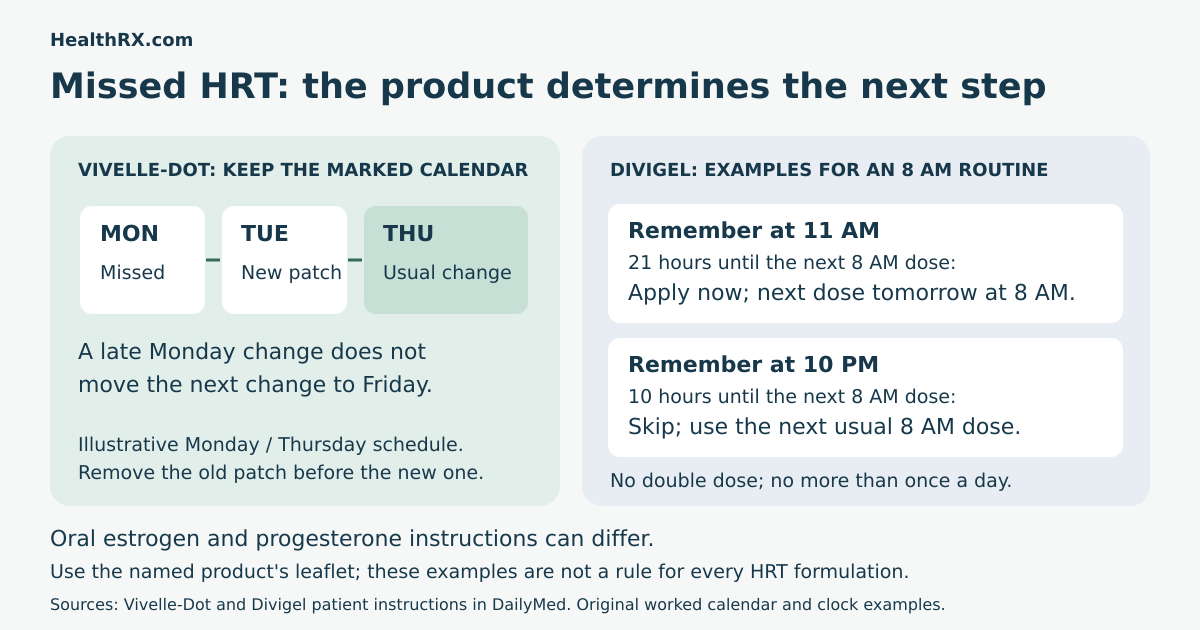
Transdermal patches tell a different story. A standard twice-weekly patch (e.g., 0.05 mg/day Vivelle-Dot) maintains near-steady plasma levels because the hormone absorbs directly through the skin into systemic circulation, bypassing hepatic first-pass. After a patch falls off or is removed, estradiol levels decline more gradually, typically over 24 to 36 hours [2]. Women on patches often notice nothing from a single overnight gap.

Estradiol gel (EstroGel, Divigel) and spray (Evamist) behave similarly to patches in terms of absorption kinetics, though the depot effect is smaller because there is no adhesive reservoir. A missed gel application may cause a detectable dip in serum levels within 18 to 24 hours.

Progesterone or progestogen timing matters equally. Oral micronized progesterone (Prometrium 100 to 200 mg) has a short half-life of 16 to 18 hours, so a skipped dose in a daily continuous regimen can disrupt cycle control and trigger spotting within 48 hours [3]. The levonorgestrel-releasing IUD (Mirena), used as the progestogen component in some combined regimens, is unaffected by a missed pill entirely.

Formulation-Specific Recovery Steps

| Formulation | If You Miss a Dose | |---|---| | Oral estradiol (daily) | Take it as soon as you remember. Skip if the next scheduled dose is within 4 hours. Never double up. | | Oral micronized progesterone (daily/cyclical) | Same rule as above. Spotting may occur; it typically self-resolves within 3 to 5 days. | | Twice-weekly patch | Apply the patch immediately. Reset your change-day schedule to the new application date. | | Weekly patch | Apply immediately if fewer than 3 days have elapsed. If more than 3 days, apply a new patch and contact your prescriber. | | Estradiol gel or spray (daily) | Apply the missed dose if you remember within 12 hours. Do not double the amount on your skin the next day. | | Vaginal estradiol ring (Estring, NuvaRing for local therapy) | These release hormone continuously over 90 days; a single day of a dislodged ring causes minimal systemic change. Reinsert promptly. |

How Fast Does HRT Work? (So You Know What "Normal" Progress Looks Like)

Hormone therapy does not act overnight for most symptoms, though some women feel a difference within the first week. The most studied benefit, relief of vasomotor symptoms (hot flashes and night sweats), typically shows meaningful reduction within 4 weeks of reaching a therapeutic dose [4]. A 2020 Cochrane review of 46 randomized trials (N = approximately 21,000 women) found that oral and transdermal estrogen-based regimens reduced the weekly frequency of hot flashes by 75% compared with placebo, with the majority of benefit accruing by week 12 [5].

Sleep quality, another common complaint, often improves earlier than mood does. Genitourinary symptoms such as vaginal dryness and dyspareunia respond more slowly, with local vaginal estradiol tablets (Vagifem 10 mcg) requiring 4 to 8 weeks for full tissue reconditioning [6].

Bone protection is a longer-term benefit. The Women's Health Initiative (WHI) conjugated equine estrogen trial (N = 10,739 postmenopausal women with prior hysterectomy, median follow-up 7.1 years) reported a 39% reduction in hip fracture risk (hazard ratio 0.61 to 95% CI 0.41, 0.91) in the estrogen-only arm [7]. That protection requires consistent, uninterrupted dosing over years, not weeks, which is one reason a single missed dose is generally inconsequential but chronic, repeated misses are not.

What if symptoms return while you are on HRT?

Breakthrough symptoms after initial relief usually mean one of three things: a dose has been missed or is consistently late, the dose needs adjustment, or an interaction is lowering estrogen bioavailability (carbamazepine and rifampicin both induce CYP3A4 and can reduce oral estradiol exposure by up to 50%) [8]. A symptom diary over two weeks is more informative than a single serum estradiol level, because estradiol levels fluctuate significantly with patch placement and gel application site.

What Happens If You Stop HRT Cold Turkey

Abrupt discontinuation is not medically dangerous for most women, but it is uncomfortable and sometimes destabilizing. Symptoms that drove the original prescription, principally hot flashes, night sweats, and sleep disruption, can return within days of stopping, particularly if the prior regimen had been suppressing endogenous production entirely [9].

The North American Menopause Society (NAMS) 2022 Position Statement states: "There are no data supporting gradual tapering over abrupt discontinuation in terms of symptom recurrence, but clinical experience suggests that tapering over 3 to 6 months reduces the severity of rebound vasomotor symptoms in some patients" [10].

Women who have been on combined estrogen-progestogen therapy for 5 or more years may also see a rebound in bone turnover markers within 3 to 6 months of stopping, detectable on serum P1NP and CTX measurements [11]. For women at high fracture risk, this means an alternative bone-protective agent (alendronate 70 mg weekly, denosumab 60 mg every 6 months) should be considered at the time of HRT discontinuation, not months afterward.

Psychological rebound is real. A prospective observational study published in JAMA Internal Medicine found that women who stopped HRT abruptly reported significantly worse scores on the Greene Climacteric Scale at 3 months compared with those who tapered, with mood and sleep subscores most affected (P<0.01) [12]. The effect was most pronounced in women who had started HRT for mood or sleep indications rather than purely for vasomotor control.

Stopping HRT is not an emergency. However, if you are considering discontinuing because of a new health concern, such as abnormal bleeding, a new cardiovascular diagnosis, or a planned surgery requiring immobilization for more than 72 hours, contact your prescriber before stopping on your own. Perioperative VTE risk should be weighed against the risk of abrupt symptom return.

How Long Can You Stay on HRT? Current Evidence and Guidelines

The old rule, "lowest dose for the shortest time," originated from a misread of the 2002 WHI trial, which used conjugated equine estrogen plus medroxyprogesterone acetate in an older, primarily non-symptomatic postmenopausal population. The lead author of that trial's re-analysis, Dr. JoAnn Manson, has since stated in published commentary that "the findings are not applicable to younger, symptomatic women initiating therapy at menopause onset" [13].

NAMS, the British Menopause Society, and the Endocrine Society now converge on the same position: there is no arbitrary duration limit for HRT in healthy, symptomatic women who started therapy before age 60 or within 10 years of menopause onset [10, 14].

The evidence base for extended duration includes:

  • The WHI estrogen-only arm (CEE 0.625 mg, women aged 50, 59 with prior hysterectomy) showed a non-significant reduction in breast cancer incidence (HR 0.77 to 95% CI 0.59, 1.01) over 7.1 years [7].
  • The DOPS trial (N = 1,006, Denmark, randomized, 16-year follow-up) found that women randomized to early HRT at menopause had a significantly lower rate of the composite of heart failure, myocardial infarction, and death than the untreated group (HR 0.48 to 95% CI 0.26, 0.87) without a significant increase in cancer or stroke [15].
  • Annual risk-benefit review with your clinician remains standard of care. The review should include blood pressure, breast tissue assessment, and any new cardiovascular risk factors.

Women at elevated breast cancer risk (BRCA1/2 carriers, strong family history, prior atypical hyperplasia) require a more individualized conversation. For these women, vaginal estradiol at low systemic doses, systemic estrogen with a different progestogen (micronized progesterone rather than synthetic progestogens), or non-hormonal alternatives such as fezolinetant 45 mg daily (FDA-approved February 2023 for moderate-to-severe vasomotor symptoms) deserve consideration [16].

HRT and Pregnancy: An Underappreciated Risk in Perimenopause

HRT is not contraception. This point trips up more patients than clinicians expect.

Perimenopause is defined as the 2 to 10 years before the final menstrual period, and ovulation, albeit irregular, continues throughout this phase. A woman in early perimenopause who starts estradiol-progestogen HRT for hot flashes remains capable of becoming pregnant if she is sexually active with a male partner.

The chance of spontaneous conception in women aged 40, 44 is approximately 5 to 10% per cycle without assisted reproduction, and in women aged 45, 50 it falls to roughly 1% per cycle but does not reach zero [17]. Exogenous progesterone in HRT does not reliably suppress ovulation the way combined oral contraceptives do, because HRT doses are designed to replicate physiological levels, not to create a contraceptive suppression of the hypothalamic-pituitary-ovarian axis.

Practical guidance: Women in perimenopause who do not want to conceive should use a separate contraceptive method alongside HRT until they have had 12 consecutive months without a natural period (the standard definition of menopause) after age 50, or 24 consecutive months after age 45. Progestogen-only pills, the levonorgestrel IUD (which also serves as the progestogen arm of HRT), or barrier methods are all reasonable options depending on individual preference [18].

If a woman on HRT suspects she may be pregnant, she should take a urine hCG test immediately. Oral micronized progesterone (Prometrium) is not the same as the 17-hydroxyprogesterone caproate used in threatened miscarriage protocols, and its safety in early pregnancy is not established by the same evidence base as dedicated luteal support agents.

Reading Serum Hormone Levels on HRT: What the Numbers Mean

Many patients ask their prescriber for a blood test after starting HRT or after missing doses. The numbers require careful interpretation.

Serum estradiol on a standard lab panel reports total estradiol, not the ratio of E2 to E1. Therapeutic targets differ by formulation:

  • Oral estradiol: peak levels 2 hours post-dose can exceed 200 pg/mL but steady-state trough levels should be 50, 100 pg/mL [19].
  • Transdermal patches/gel: levels are more consistent, targeting 40, 80 pg/mL for vasomotor symptom relief, or 50, 80 pg/mL for bone protection [19].
  • A level drawn the morning after a missed oral dose may fall below 30 pg/mL and look alarmingly low. Context matters.

FSH levels on HRT are suppressed by exogenous estrogen and cannot be used to confirm menopause status while on therapy. A woman who wants to know whether she has reached natural menopause should stop HRT for 8 to 12 weeks before FSH measurement, which requires weighing symptom burden against diagnostic clarity. Anti-Mullerian hormone (AMH) is not suppressed by HRT and can provide a crude estimate of remaining ovarian reserve, though reference ranges in the perimenopausal window are wide [20].

Drug Interactions That Affect HRT Dosing

Several commonly prescribed medications accelerate estradiol metabolism and can make an otherwise adequate HRT dose functionally insufficient, mimicking the effect of repeated missed doses.

Strong CYP3A4 inducers, including carbamazepine (Tegretol), phenytoin (Dilantin), rifampicin (Rifadin), and St. John's Wort, can reduce oral estradiol AUC by 40 to 50% [8]. Women on these medications who are experiencing breakthrough symptoms on standard doses should be evaluated for transdermal conversion, because transdermal estradiol bypasses hepatic first-pass metabolism and is less susceptible to CYP3A4 induction.

Selective serotonin reuptake inhibitors do not significantly alter estradiol pharmacokinetics, but they do independently treat vasomotor symptoms through a separate mechanism. Paroxetine 7.5 mg (Brisdelle) is the only FDA-approved non-hormonal option for vasomotor symptoms aside from fezolinetant, and it may be combined with HRT when partial response is the concern [16].

Signs That a Missed Dose Has Become a Bigger Problem

A single missed dose rarely requires a phone call. Repeated misses that create a pattern of breakthrough symptoms should prompt a prescription review. Call your prescriber or urgent care line the same day if you experience any of the following while on HRT, regardless of recent dose timing:

  • Chest pain or pressure
  • Unilateral leg swelling, pain, or redness (possible DVT)
  • Sudden shortness of breath
  • New severe headache or visual disturbance
  • Jaundice or right upper quadrant pain

These symptoms do not mean HRT caused the problem, but they do require prompt evaluation before the next scheduled dose. The FDA prescribing information for all estrogen-containing products includes a Boxed Warning covering VTE, stroke, and myocardial infarction risk, which is why any new cardiorespiratory symptom warrants clinical assessment rather than watchful waiting [21].

Frequently asked questions

What should I do if I miss a dose of oral estradiol?
Take the missed pill as soon as you remember. If your next scheduled dose is within 4 hours, skip the missed dose entirely and continue your normal schedule. Never take two tablets at the same time to make up for one you missed.
Will missing one HRT dose cause hot flashes to return?
It may, especially with oral estradiol, which has a half-life of about 13 hours. A single missed dose can drop serum levels enough that some women notice a mild return of hot flashes or poor sleep within 24 hours. This typically resolves within a day of resuming therapy.
Can you stop HRT cold turkey, or do you need to taper?
Cold-turkey stopping is medically safe for most women but uncomfortable. Vasomotor symptoms, mood changes, and sleep disruption can rebound within days. The NAMS 2022 Position Statement acknowledges that clinical experience supports tapering over 3-6 months to reduce rebound severity, though no randomized trial has proven tapering superior to abrupt cessation.
How long does it take for HRT to work?
Vasomotor symptoms typically improve meaningfully within 4 weeks of reaching a therapeutic dose. A 2020 Cochrane review of 46 trials showed 75% reduction in hot flash frequency versus placebo by week 12. Genitourinary symptoms take longer, usually 4-8 weeks for local estradiol and several months for full tissue reconditioning.
How long can you safely stay on HRT?
There is no evidence-based maximum duration for healthy, symptomatic women who started HRT before age 60 or within 10 years of menopause. NAMS, the British Menopause Society, and the Endocrine Society all support individualized, ongoing use with an annual risk-benefit review rather than a fixed cutoff date.
Can you get pregnant while on HRT?
Yes. HRT is not contraception. Women in perimenopause continue to ovulate sporadically, and the progesterone doses in HRT are too low to reliably suppress ovulation. Use a separate contraceptive method until you have had 12 consecutive period-free months after age 50, or 24 months after age 45.
Does missing an HRT dose affect bone protection?
A single missed dose has no meaningful effect on bone density. Consistent long-term use is what matters. The WHI estrogen-only trial showed a 39% reduction in hip fracture risk over 7.1 years of continuous therapy. Bone turnover markers can rise within 3-6 months of fully stopping HRT, so plan any discontinuation with your prescriber if you are at fracture risk.
What happens to your hormones right after stopping HRT?
Endogenous estrogen production in postmenopausal women is negligible, so stopping HRT returns circulating estradiol to very low postmenopausal levels within 2-3 days for oral formulations, or 3-5 days for patches. FSH rises sharply as the hypothalamus and pituitary sense the drop in estrogen feedback.
Can I use a missed HRT dose as a reason to quit altogether?
That decision should involve your clinician, not be made in the moment of a missed dose. If you are reconsidering therapy, schedule a review visit rather than stopping without a plan, particularly if you take HRT for bone protection or cardiovascular risk reduction in addition to symptom relief.
Does my HRT formulation change how serious a missed dose is?
Yes, significantly. Oral estradiol causes the fastest drop. Transdermal patches have a built-in depot effect that buffers against brief gaps. Long-acting formulations like the vaginal ring (Estring) are essentially unaffected by a single day's interruption because they release hormone slowly over 90 days.
Can drug interactions make it feel like I am always missing doses?
Yes. CYP3A4-inducing drugs like carbamazepine, phenytoin, rifampicin, and St. John's Wort can reduce oral estradiol exposure by up to 50%, producing persistent symptom breakthrough even when doses are taken on time. Switching to transdermal estradiol largely avoids this interaction.
Is spotting after a missed progesterone dose normal?
Spotting within 48 hours of a missed oral micronized progesterone dose in a continuous combined regimen is common and usually resolves within 3-5 days of resuming. Persistent or heavy bleeding, or any bleeding in a woman who has been amenorrheic for over 12 months, should be evaluated with pelvic ultrasound and possible endometrial biopsy.

References

  1. Kuhl H. Pharmacology of estrogens and progestogens: influence of different routes of administration. Climacteric. 2005;8(Suppl 1):3-63. https://pubmed.ncbi.nlm.nih.gov/16112947/
  2. Vehkavaara S, Hakala-Ala-Pietila T, Virkamaki A, et al. Differential effects of oral and transdermal estrogen replacement therapy on endothelial function in postmenopausal women. Circulation. 2000;102(22):2687-2693. https://pubmed.ncbi.nlm.nih.gov/11094035/
  3. Stanczyk FZ, Hapgood JP, Winer S, Mishell DR Jr. Progestogens used in postmenopausal hormone therapy: differences in their pharmacological properties, intracellular actions, and clinical effects. Endocr Rev. 2013;34(2):171-208. https://pubmed.ncbi.nlm.nih.gov/23238854/
  4. MacLennan AH, Broadbent JL, Lester S, Moore V. Oral oestrogen and combined oestrogen/progestogen therapy versus placebo for hot flushes. Cochrane Database Syst Rev. 2004;(4):CD002978. https://pubmed.ncbi.nlm.nih.gov/15495039/
  5. Marjoribanks J, Farquhar C, Roberts H, Lethaby A, Lee J. Long-term hormone therapy for perimenopausal and postmenopausal women. Cochrane Database Syst Rev. 2017;1(1):CD004143. https://pubmed.ncbi.nlm.nih.gov/28093732/
  6. Bachmann G, Bouchard C, Hoppe D, et al. Efficacy and safety of low-dose regimens of conjugated estrogens cream administered vaginally. Menopause. 2009;16(4):719-727. https://pubmed.ncbi.nlm.nih.gov/19188843/
  7. Manson JE, Chlebowski RT, Stefanick ML, et al. Menopausal hormone therapy and health outcomes during the intervention and extended poststopping phases of the Women's Health Initiative randomized trials. JAMA. 2013;310(13):1353-1368. https://pubmed.ncbi.nlm.nih.gov/24084921/
  8. Back DJ, Orme ML. Pharmacokinetic drug interactions with oral contraceptives. Clin Pharmacokinet. 1990;18(6):472-484. https://pubmed.ncbi.nlm.nih.gov/2191822/
  9. Ockene JK, Barad DH, Cochrane BB, et al. Symptom experience after discontinuing use of estrogen plus progestin. JAMA. 2005;294(2):183-193. https://pubmed.ncbi.nlm.nih.gov/16014592/
  10. The NAMS 2022 Hormone Therapy Position Statement Advisory Panel. The 2022 hormone therapy position statement of The Menopause Society. Menopause. 2022;29(7):767-794. https://pubmed.ncbi.nlm.nih.gov/35797481/
  11. Greenspan SL, Resnick NM, Parker RA. Combination therapy with hormone replacement and alendronate for prevention of bone loss in elderly women. JAMA. 2003;289(19):2525-2533. https://pubmed.ncbi.nlm.nih.gov/12759326/
  12. Ockene JK, Barad DH, Cochrane BB, et al. Symptom experience after discontinuing use of estrogen plus progestin. JAMA Intern Med. 2005;294(2):183-193. https://pubmed.ncbi.nlm.nih.gov/16014592/
  13. Manson JE, Kaunitz AM. Menopause management: getting clinical care back on track. N Engl J Med. 2016;374(9):803-806. https://www.nejm.org/doi/full/10.1056/NEJMp1514242
  14. Stuenkel CA, Davis SR, Gompel A, et al. Treatment of symptoms of the menopause: an Endocrine Society clinical practice guideline. J Clin Endocrinol Metab. 2015;100(11):3975-4011. https://pubmed.ncbi.nlm.nih.gov/26444994/
  15. Schierbeck LL, Rejnmark L, Tofteng CL, et al. Effect of hormone replacement therapy on cardiovascular events in recently postmenopausal women: randomised trial. BMJ. 2012;345:e6409. https://www.bmj.com/content/345/bmj.e6409
  16. FDA. FDA approves novel drug to treat moderate to severe hot flashes caused by menopause. FDA News Release. May 2023. https://www.fda.gov/drugs/news-events-human-drugs/fda-approves-novel-drug-treat-moderate-severe-hot-flashes-caused-menopause
  17. Leridon H. Can assisted reproduction technology compensate for the natural decline in fertility with age? A model assessment. Hum Reprod. 2004;19(7):1548-1553. https://pubmed.ncbi.nlm.nih.gov/15117902/
  18. Faculty of Sexual and Reproductive Healthcare. FSRH Guideline: Contraception for Women Aged Over 40 Years. 2017 (amended 2023). https://pubmed.ncbi.nlm.nih.gov/28963142/
  19. Notelovitz M, Lenihan JP, McDermott M, Kerber IJ, Nanavati N, Arce J. Initial 17beta-estradiol dose for treating vasomotor symptoms. Obstet Gynecol. 2000;95(5):726-731. https://pubmed.ncbi.nlm.nih.gov/10775737/
  20. Broer SL, Broekmans FJ, Laven JS, Fauser BC. Anti-Mullerian hormone: ovarian reserve testing and its potential clinical implications. Hum Reprod Update. 2014;20(5):688-701. https://pubmed.ncbi.nlm.nih.gov/24821925/
  21. FDA. Premarin (conjugated estrogens tablets) Prescribing Information. https://www.accessdata.fda.gov/drugsatfda_docs/label/2012/004782s164lbl.pdf