How to Safely Stop Ambien (Zolpidem): A Physician-Guided Discontinuation Protocol
At a glance
- Drug / zolpidem (brand: Ambien, Ambien CR, Edluar, Intermezzo, generics)
- FDA class / Schedule IV non-benzodiazepine hypnotic (imidazopyridine)
- Standard doses / 5 mg or 10 mg immediate-release; 6.25 mg or 12.5 mg extended-release
- Recommended taper pace / reduce by 25% of current dose every 5 to 7 days
- Typical taper duration / 2 to 4 weeks for most patients; up to 8 weeks for long-term users
- Rebound insomnia onset / usually night 1 to 3 after dose reduction or cessation
- Rebound insomnia duration / typically self-limiting within 1 to 2 weeks
- First-line non-drug replacement / CBT-I (cognitive-behavioral therapy for insomnia)
- Seizure risk / rare but documented with abrupt cessation of high-dose or prolonged use
- FDA dosing advisory / women should start at 5 mg IR or 6.25 mg ER due to slower clearance
How Zolpidem Works and Why That Matters for Stopping It
Zolpidem binds selectively to the alpha-1 subunit of the GABA-A receptor, the subunit most concentrated in brain regions that initiate sleep. Unlike older benzodiazepines, which activate multiple GABA-A subtypes and produce broad sedation, anxiolysis, and muscle relaxation, zolpidem's selectivity narrows its primary effect to sleep induction 1. That selectivity is also why it was initially marketed as having lower dependence potential than benzodiazepines.
The reality is more nuanced. With nightly use beyond two to four weeks, the brain downregulates the very GABA-A receptors zolpidem targets. Remove the drug suddenly and those under-functioning receptors leave the nervous system in a relative state of hyperexcitability. The clinical result is rebound insomnia, often worse than the original sleep complaint, plus possible anxiety, tremor, palpitations, and (rarely) seizures 2. A 2011 pharmacovigilance review of the French ADRAC database identified 104 zolpidem dependence cases, with withdrawal seizures reported in a subset of patients taking doses above 10 mg nightly 2.
This neuroadaptation is the reason a structured taper exists. You are not simply "choosing" to stop a pill. You are giving GABA receptors time to upregulate back to baseline sensitivity.
Who Should Taper (and Who Can Simply Stop)
Not everyone needs a formal taper. The distinction depends on duration of use, dose, and individual physiology.
Short-term users (fewer than 14 consecutive nights at 5 mg or 6.25 mg ER) can typically discontinue without a taper, though one to two nights of mildly disrupted sleep is common. The FDA-approved prescribing information notes that zolpidem is indicated for short-term treatment, generally seven to ten days, and that use beyond two weeks requires re-evaluation 3.
A taper is strongly recommended for anyone who has taken zolpidem nightly for more than four weeks, uses doses at or above 10 mg IR (12.5 mg ER), has a history of benzodiazepine or alcohol withdrawal, or has comorbid anxiety disorders. The American Academy of Sleep Medicine (AASM) 2017 clinical practice guideline on chronic insomnia recommends CBT-I as the first-line treatment and advises that pharmacotherapy, when used, should be accompanied by a planned discontinuation strategy 4.
Patients over age 65 deserve extra caution. The American Geriatrics Society Beers Criteria lists zolpidem as a potentially inappropriate medication in older adults due to increased sensitivity, fall risk, and cognitive impairment, making discontinuation both more important and more delicate 5.
The Step-by-Step Taper Protocol
A gradual, physician-supervised taper is the clinical standard. No single taper schedule fits every patient, but the following framework covers the majority of cases.
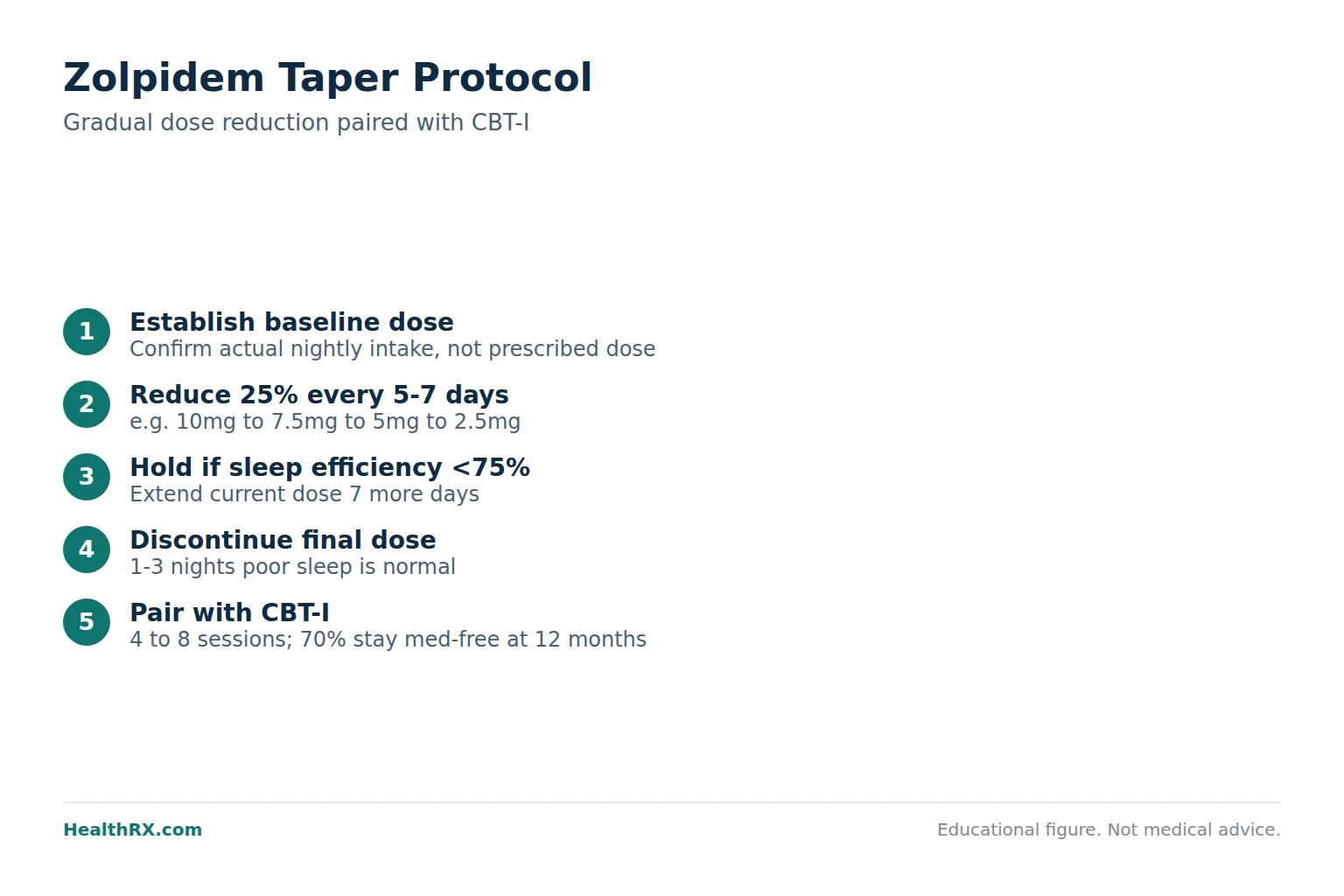
Step 1: Establish the baseline dose. Confirm the patient's actual nightly intake, not just the prescribed dose. Some patients split tablets, double up on bad nights, or combine immediate-release and extended-release formulations.
Step 2: Reduce by 25% of the current dose every five to seven days. For a patient on 10 mg IR nightly, the schedule looks like this:
- Week 1: 7.5 mg (three-quarters of a 10 mg tablet)
- Week 2: 5 mg
- Week 3: 2.5 mg (half of a 5 mg tablet)
- Week 4: discontinue
For extended-release 12.5 mg, switching to 6.25 mg ER for one to two weeks, then transitioning to 5 mg IR for one to two weeks before stopping is a practical approach, since ER tablets should not be cut.
Step 3: Hold or slow the taper if rebound insomnia is severe. If sleep efficiency drops below 75% (measured by sleep diary or actigraphy) at any step, hold that dose for an additional seven days before the next reduction. Kripke's 2016 analysis of hypnotic risks emphasized that rigid taper timelines increase dropout and relapse compared to flexible, symptom-guided reductions 6.
Step 4: Discontinue the final dose. The last step, from 2.5 mg to zero, often produces the most anxiety. Patients should be counseled that one to three nights of poor sleep is normal and self-limiting.
Managing Rebound Insomnia During the Taper
Rebound insomnia is the most common barrier to successful discontinuation. It typically peaks within the first three nights after each dose reduction and resolves within seven to fourteen days. In the Krystal et al. 2010 study of zolpidem ER 12.5 mg (N=1,018), rebound insomnia on the first night after discontinuation was observed in a statistically significant proportion of patients compared to placebo, though most experienced resolution by night three 7.
Several non-pharmacologic strategies reduce rebound severity:
Sleep restriction therapy. Limiting time in bed to match actual sleep time (typically five to six hours initially) consolidates sleep drive and reduces the fragmentation that feels so distressing during a taper. A meta-analysis by Miller et al. (2014) found sleep restriction produced effect sizes comparable to pharmacotherapy for chronic insomnia (Cohen's d = 0.87 for sleep efficiency) 8.
Stimulus control. Leave the bedroom after 20 minutes of wakefulness. Return only when sleepy. This breaks the conditioned association between the bed and hyperarousal that builds during months of medicated sleep.
Relaxation training. Progressive muscle relaxation or guided breathing exercises reduce the sympathetic nervous system activation that accompanies taper-related anxiety. These techniques are components of formal CBT-I protocols recommended by the AASM.
Dr. Michael Perlis, director of the Behavioral Sleep Medicine program at the University of Pennsylvania, has noted: "The biggest mistake patients make when tapering off a sedative-hypnotic is interpreting the first bad night as proof they cannot sleep without the drug. That single night of poor sleep becomes a self-fulfilling prophecy if not reframed" 9.
CBT-I: The Taper's Essential Partner
CBT-I is not optional during zolpidem discontinuation. It is the single intervention most likely to determine whether the taper succeeds. A 2014 randomized controlled trial by Belleville et al. (N=67) compared supervised taper alone versus supervised taper plus CBT-I in long-term benzodiazepine receptor agonist (BZRA) users, including zolpidem patients. At 12-month follow-up, 70% of the taper-plus-CBT-I group remained medication-free, compared to 24% in the taper-only group 10.
That difference is stark. Without CBT-I, three out of four patients who taper off zolpidem resume it within a year.
CBT-I can be delivered in person, via telehealth, or through FDA-cleared digital platforms such as Somryst (Pear Therapeutics) or the VA's CBT-I Coach app. A typical course is four to eight sessions. The AASM guideline rates CBT-I with "strong" recommendation strength and notes its durability exceeds that of any hypnotic medication 4.
Dr. Andrew Krystal, professor of psychiatry at UCSF, has stated: "Zolpidem was never intended for chronic nightly use. The data consistently show that combining a structured taper with CBT-I produces the highest rates of sustained drug-free sleep" 7.
Special Populations: Women, Older Adults, and High-Dose Users
Women. In January 2013, the FDA required manufacturers to lower the recommended starting dose for women from 10 mg to 5 mg (IR) and from 12.5 mg to 6.25 mg (ER). Pharmacokinetic data showed that 15% of women still had zolpidem blood levels above 50 ng/mL eight hours after a 10 mg dose, a concentration associated with impaired driving 11. Women should begin their taper from the lower FDA-recommended dose if they have not already adjusted.
Adults over 65. The Beers Criteria recommends avoiding zolpidem entirely in this group 5. A 2012 cohort study by Tom et al. (N=796,045 primary care patients in the UK) found that hypnotic use, including zolpidem, was associated with a hazard ratio of 3.46 (95% CI 3.34 to 3.59) for all-cause mortality compared to matched non-users over a mean 7.6-year follow-up 12. Tapers in older adults should use smaller decrements (12.5% to 15% per step) and longer hold periods (10 to 14 days per step).
High-dose or polysubstance users. Patients taking zolpidem at doses above 10 mg, or combining it with benzodiazepines, gabapentinoids, or alcohol, face the highest withdrawal risk. Inpatient or closely supervised outpatient tapers are appropriate. Seizure precautions should be documented and communicated to the patient.
What to Expect After Stopping: A Realistic Timeline
Week 1 post-cessation is the hardest. Sleep onset latency may increase by 20 to 40 minutes. Total sleep time may drop by 60 to 90 minutes. These changes feel alarming but are temporary.
Weeks 2 through 3 typically bring measurable improvement. Sleep diary data from Morin et al. (2004) showed that patients who completed a supervised BZRA taper with CBT-I recovered baseline sleep efficiency (85% or higher) within 10 to 21 days of their final dose 13. By week four, most patients report sleep quality equal to or better than their medicated baseline, partly because zolpidem suppresses slow-wave sleep at higher doses, and its removal allows deeper, more restorative sleep architecture to return.
Months 1 through 3 represent the consolidation phase. Sleep continues to stabilize. Anxiety about insomnia (the metacognitive component) fades as patients accumulate evidence of their ability to sleep unmedicated.
When the Taper Is Not Working: Escalation Options
If a patient cannot tolerate dose reductions despite flexible pacing and concurrent CBT-I, several options exist.
Switch to a longer-acting agent. Some clinicians convert zolpidem to a low-dose benzodiazepine with a longer half-life (such as diazepam 2 to 5 mg) to smooth out interdose withdrawal troughs, then taper the substituted agent. This cross-taper strategy mirrors the Ashton Manual approach used in benzodiazepine discontinuation 14.
Add melatonin. A 2014 randomized trial (N=82) found that prolonged-release melatonin 2 mg facilitated benzodiazepine receptor agonist discontinuation compared to placebo, with 77.8% of the melatonin group achieving cessation versus 22.2% of controls at six months 15.
Refer to a sleep medicine specialist. Persistent insomnia after taper completion may indicate an undiagnosed primary sleep disorder (such as obstructive sleep apnea or restless legs syndrome) that was being masked by sedation rather than treated.
Red Flags That Require Immediate Medical Attention
Certain symptoms during a zolpidem taper warrant urgent evaluation, not schedule adjustment:
- Seizures or convulsions (call 911)
- Hallucinations or perceptual disturbances
- Severe tremor that interferes with daily tasks
- Delirium, confusion, or disorientation
- Suicidal ideation
These events are uncommon at standard doses with a properly paced taper, but they are medical emergencies when they occur. The FDA label explicitly warns that withdrawal signs and symptoms, including life-threatening ones, have been reported after rapid dose decrease or abrupt discontinuation of zolpidem 3.
Frequently asked questions
How long does it take to taper off Ambien?
Can I stop Ambien cold turkey?
What are zolpidem withdrawal symptoms?
Does Ambien cause physical dependence?
What is the best substitute for Ambien during a taper?
Is Ambien safe for long-term use?
How does Ambien work in the brain?
Can I cut Ambien CR tablets in half for tapering?
Will my insomnia come back after stopping Ambien?
Does melatonin help when tapering off zolpidem?
Should I tell my doctor before stopping Ambien?
What is rebound insomnia and how long does it last?
References
- Sanna E, Busonero F, Talani G, et al. Comparison of the effects of zaleplon, zolpidem, and triazolam at various GABA-A receptor subtypes. Eur J Pharmacol. 2002;451(2):103-110. PubMed
- Victorri-Vigneau C, Dailly E, Veyrac G, Jolliet P. Evidence of zolpidem abuse and dependence: results of the French Centre for Evaluation and Information on Pharmacodependence (CEIP) network survey. Br J Clin Pharmacol. 2007;64(2):198-209. Evidence of zolpidem abuse and dependence: results of the French Centre for Evaluation and Information on Pharmacodependence (CEIP) network survey
- U.S. Food and Drug Administration. Ambien (zolpidem tartrate) prescribing information. Revised 2023. FDA
- Sateia MJ, Buysse DJ, Krystal AD, Neubauer DN, Heald JL. Clinical practice guideline for the pharmacologic treatment of chronic insomnia in adults: an American Academy of Sleep Medicine clinical practice guideline. J Clin Sleep Med. 2017;13(2):307-349. Clinical Practice Guideline for the Pharmacologic Treatment of Chronic Insomnia in Adults: An American Academy of Sleep Medicine Clinical Practice Guideline
- American Geriatrics Society 2019 Updated AGS Beers Criteria for Potentially Inappropriate Medication Use in Older Adults. J Am Geriatr Soc. 2019;67(4):674-694. PubMed
- Kripke DF. Mortality risk of hypnotics: strengths and limits of evidence. Drug Saf. 2016;39(2):93-107. Mortality Risk of Hypnotics: Strengths and Limits of Evidence
- Krystal AD, Erman M, Zammit GK, Soubrane C, Roth T. Long-term efficacy and safety of zolpidem extended-release 12.5 mg, administered 3 to 7 nights per week for 24 weeks, in patients with chronic primary insomnia: a 6-month, randomized, double-blind, placebo-controlled, parallel-group, multicenter study. Sleep. 2008;31(1):79-90. PubMed
- Miller CB, Espie CA, Epstein DR, et al. The evidence base of sleep restriction therapy for treating insomnia disorder. Sleep Med Rev. 2014;18(5):415-424. The evidence base of sleep restriction therapy for treating insomnia disorder
- Perlis ML, Posner D, Riemann D, Bastien CH, Teel J, Thase M. Sleep and sleep disorders: implications and interventions. Sleep Med Clin. 2014;9(4):457-476. PubMed
- Belleville G, Guay C, Guay B, Morin CM. Hypnotic taper with or without self-help treatment of insomnia: a randomized clinical trial. J Consult Clin Psychol. 2007;75(2):325-335. PubMed
- U.S. Food and Drug Administration. FDA requiring lower recommended dose for certain sleep drugs containing zolpidem. Safety announcement. January 2013. FDA
- Kripke DF, Langer RD, Kline LE. Hypnotics' association with mortality or cancer: a matched cohort study. BMJ Open. 2012;2(1):e000850. Hypnotics' association with mortality or cancer: a matched cohort study
- Morin CM, Bastien C, Guay B, Radouco-Thomas M, Leblanc J, Vallières A. Randomized clinical trial of supervised tapering and cognitive behavior therapy to support benzodiazepine discontinuation in older adults with chronic insomnia. Am J Psychiatry. 2004;161(2):332-342. PubMed
- Ashton H. The diagnosis and management of benzodiazepine dependence. Curr Opin Psychiatry. 2005;18(3):249-255. The diagnosis and management of benzodiazepine dependence
- Baandrup L, Lindschou J, Winkel P, Wernich L, Gluud C. Prolonged-release melatonin versus placebo for benzodiazepine discontinuation in patients with schizophrenia or bipolar disorder: a randomized clinical trial. World J Biol Psychiatry. 2016;17(7):514-524. PubMed