Amlodipine Extra Dose: What to Report and What the Evidence Shows
If you may have taken too much
For an extra dose, a child’s possible ingestion, or an unexpected reaction to amlodipine, contact U.S. Poison Control at 1-800-222-1222 or use webPOISONCONTROL. Call 911 for collapse, a seizure, trouble breathing, or inability to awaken. Do not delay assessment while checking blood pressure at home. Feeling well initially does not establish that an exposure is safe. [2]
An extra tablet does not have the same implications for everyone. Tablet strength, the amount taken, timing, age, other medicines, and symptoms all matter. Advice about emergency evaluation and the next scheduled dose should come from an assessment of the actual exposure. [2]
What to report
Have the container or a clear photo available when contacting Poison Control. Read the complete product name: some tablets combine amlodipine with another medicine, which changes what needs assessment. Report the strength, how many tablets might be involved, and when each dose was taken. If the amount or time is uncertain, give your best estimate and explain the uncertainty. [2]
Also report the usual prescribed dose, other medicines taken, current symptoms, and the person’s age. For a child, include weight if known. Keep these details together so the poison specialist can distinguish a possible duplicate prescribed dose from an unknown ingestion or an exposure involving several drugs. Do not postpone the call to assemble a perfect record. [2]
Why excess amlodipine can be dangerous
Amlodipine is a calcium channel blocker that lowers peripheral vascular resistance: it relaxes blood vessels so blood flows against less resistance. In overdose, excessive vessel relaxation can cause a marked fall in blood pressure. The pulse may rise in response, called reflex tachycardia. Severe low blood pressure can compromise circulation to organs. [1]
The adult labeled maximum is 10 mg daily, but that prescribing limit is not a toxicity boundary. It cannot establish that a particular extra amount is harmless or predict how an individual will respond. The label also notes that human experience with intentional overdose is limited. [1]
Dizziness, lightheadedness, weakness, or fainting can accompany low blood pressure; a faster pulse may also occur. These signs warrant prompt assessment after a possible overdose. Their absence at the first check is not individual clearance, and a home blood pressure reading cannot replace exposure assessment. [1,2]
What the evidence can—and cannot—decide
Different sources answer different questions. A prescribing label describes drug effects and precautions; poison-center data describe reported exposures; treatment recommendations guide clinicians facing poisoning. None supplies a universal safe extra dose. [1,3,5]
| Evidence | What it shows | Practical decision |
|---|---|---|
| NORVASC label [1] | Overdose can cause marked hypotension; human experience is limited. | Report the exposure rather than use the prescribed maximum as a safety cutoff. |
| Pediatric poison-center analysis [5] | Clinically important effects occurred in some young children, including at a reported 2.5 mg. | Seek assessment for a child’s possible ingestion; no safe cutoff follows from this study. |
| Adult expert consensus [3] | Treatment depends on circulation; supporting evidence is very low quality. | Hospital therapies require monitoring and individual selection. |
| EXTRIP recommendation [4] | Extracorporeal drug removal is not recommended in severe amlodipine poisoning. | Distinguish removing the drug from supporting failing circulation. |
Why children need an individual assessment
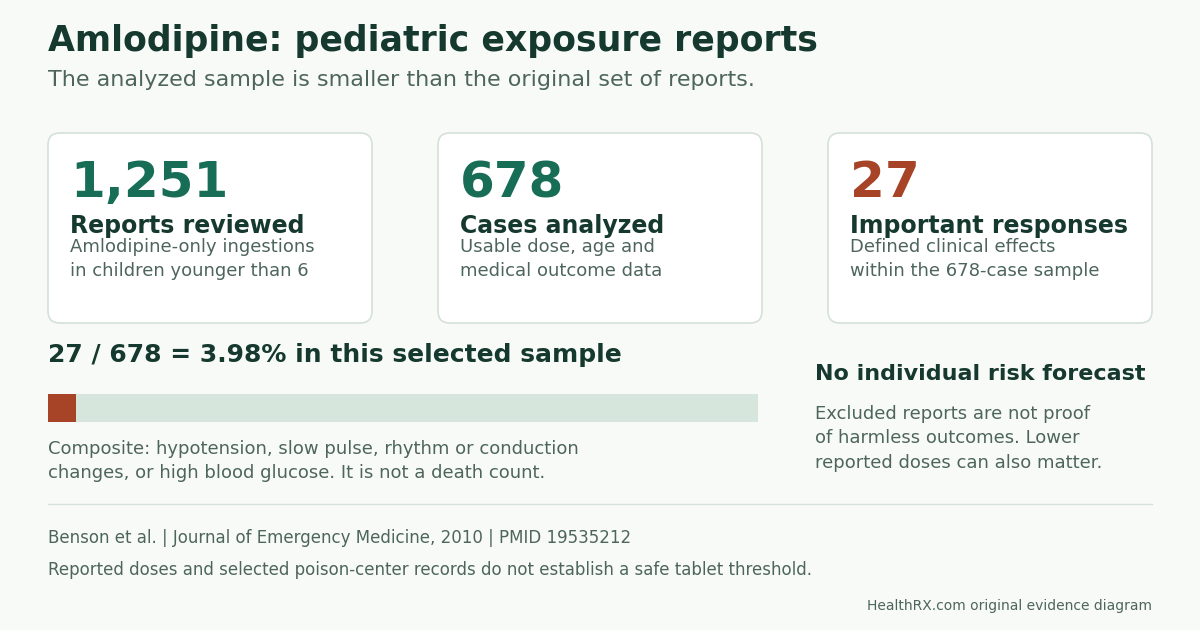
A study reviewed 1,251 amlodipine-only ingestions in children younger than six. Of these, 678 had usable dose, age, and outcome data for analysis. 27 of those 678 cases—3.98%—had clinically important responses, including hypotension, slow heart rate, rhythm or conduction disturbances, or high blood glucose. [5]
The smallest reported dose associated with a clinically important response was 2.5 mg, or 0.15 mg/kg. That is an observed case, not a proven boundary below which ingestion is safe. Selected reports and estimated doses cannot predict one child’s outcome. The percentage also does not describe risk among all children who ingest amlodipine, and the excluded reports cannot be assumed to have been symptom-free. [5]
What hospital treatment involves
For massive overdose, the label recommends cardiac, respiratory, and blood pressure monitoring, with treatment to support circulation. The adult calcium channel blocker consensus identifies intravenous calcium, high-dose insulin, and norepinephrine and/or epinephrine as first-line options selected according to the patient’s circulation. Severe or refractory poisoning may require additional support. All interventions in that consensus have very-low-quality supporting evidence. [1,3]
There is no single antidote that reliably reverses every amlodipine overdose. High-dose insulin is a monitored hospital treatment used to support heart function and metabolism in severe calcium channel blocker poisoning. It is not established as the sole best treatment for every exposure. [3]
Activated charcoal is not routinely recommended. Clinicians may consider it for selected potentially toxic ingestions of substances it can bind, especially within one hour; later benefit cannot be excluded. An intact or protected airway is necessary, and improved clinical outcomes have not been demonstrated. Do not take charcoal at home based on this information. [6]
Dialysis, support, and recovery
Amlodipine binds strongly to blood proteins, making hemodialysis unlikely to help remove it. EXTRIP recommends against adding extracorporeal drug removal to standard care for severe amlodipine poisoning, a strong recommendation based on very-low-quality evidence. This does not rule out kidney support for another medical indication. [1,4]
VA-ECMO serves a different purpose: it supports circulation rather than clearing amlodipine. The adult consensus discusses its use in selected patients with refractory shock. [3]
Amlodipine’s approximately 30–50-hour therapeutic half-life is not a countdown to symptom onset, recovery, or discharge after overdose. Observation and treatment duration depend on the exposure and clinical course. Available evidence cannot promise a symptom-free deadline, an individual survival percentage, or freedom from lasting injury. Early exposure-specific assessment helps determine the appropriate monitoring and care. [1,2,3]
Frequently asked questions
What happens if I accidentally take two amlodipine pills?
The effects depend on tablet strength, timing, your usual dose, other medicines, and your health. Extra amlodipine can lower blood pressure dangerously. Contact U.S. Poison Control at 1-800-222-1222 or webPOISONCONTROL for assessment and advice about your next scheduled dose. Call 911 for collapse, seizure, trouble breathing, or inability to awaken. [1,2]
How much amlodipine is considered an overdose?
Taking more than prescribed is a reason to seek exposure-specific advice; there is no universal amount that predicts toxicity. The adult labeled maximum of 10 mg daily is a prescribing limit, not a safe overdose threshold. Any possible ingestion by a child needs individual assessment. [1,2,5]
What is the antidote for amlodipine overdose?
There is no single reliably reversing antidote. Hospital treatment may include intravenous calcium, high-dose insulin, and medicines that support blood pressure, chosen according to the patient’s circulation. Severe poisoning may require additional circulatory support. The adult consensus rates the supporting evidence as very low quality. [3]
How does amlodipine work to lower blood pressure?
Amlodipine blocks calcium channels and relaxes blood vessels, reducing peripheral resistance. Excessive vessel relaxation in overdose can cause marked low blood pressure, sometimes with a reflex increase in heart rate. [1]
How long do amlodipine overdose symptoms last?
There is no fixed duration that applies to everyone. Amlodipine’s approximately 30–50-hour therapeutic half-life does not predict overdose symptom timing or discharge readiness. Monitoring depends on the exposure, symptoms, and response to treatment; feeling well initially does not establish safety. [1,2,3]
Can you dialyze amlodipine out of the body?
Hemodialysis is unlikely to remove much amlodipine because it binds strongly to blood proteins. EXTRIP recommends against extracorporeal drug removal added to standard care for severe amlodipine poisoning. Dialysis may still be needed for a separate medical indication. [1,4]
Should I go to the ER if I took an extra amlodipine?
Contact Poison Control promptly to determine whether you need emergency evaluation. Do not wait for symptoms or repeatedly check home blood pressure before calling. Call 911 immediately for collapse, seizure, trouble breathing, or inability to awaken. [2]
Is amlodipine overdose fatal?
Severe amlodipine poisoning can be life-threatening because profound low blood pressure can compromise circulation. Outcome depends on the exposure and clinical course; available evidence cannot provide an individual survival percentage. Prompt assessment is important. [1,2,3]
What are the first symptoms of amlodipine toxicity?
Possible symptoms include dizziness, lightheadedness, weakness, fainting, and a faster pulse as blood pressure falls. Symptoms do not follow a reliable sequence, and their initial absence does not establish safety after a possible overdose. [1,2]
Does activated charcoal help with amlodipine overdose?
Clinicians may consider charcoal in selected potentially toxic ingestions, especially within one hour, provided the airway is intact or protected. It is not routinely recommended, and improved clinical outcomes have not been demonstrated. Do not take charcoal at home based on this page. [6]
Why is high-dose insulin used for calcium channel blocker overdose?
High-dose insulin is used in hospital to support heart function and metabolism during severe calcium channel blocker poisoning. It requires close monitoring. Adult expert consensus includes it among first-line options selected according to circulation, with very-low-quality supporting evidence. [3]
Can amlodipine overdose cause permanent heart damage?
Severe poisoning can compromise circulation and cause organ injury. Lasting heart damage cannot be predicted or excluded from the amount taken alone. Assessment of blood pressure, heart function, and the clinical course helps clinicians evaluate injury and recovery. [1,3]
References
Sources checked October 14, 2026.
-
NORVASC (amlodipine besylate), Viatris Specialty LLC. Prescribing information. Revised February 2023. Official label.
-
National Capital Poison Center. What is amlodipine? Poison Control.
-
St-Onge M, et al. Experts Consensus Recommendations for the Management of Calcium Channel Blocker Poisoning in Adults. Critical Care Medicine. 2017. PubMed.
-
EXTRIP Workgroup. Calcium channel blockers: extracorporeal-treatment recommendation. Supporting systematic review published in 2021. Recommendation.
-
Benson BE, et al. Amlodipine toxicity in children less than 6 years of age: a dose-response analysis using national poison data system data. Journal of Emergency Medicine. 2010. PubMed.
-
Chyka PA, et al. Position paper: Single-dose activated charcoal. Clinical Toxicology. 2005. PubMed.