Amlodipine Switching: What the Comparison Trials Actually Compare
Switching from amlodipine involves more than choosing another tablet that lowers blood pressure. The reason for treatment, the reason for changing it, and the replacement’s formulation all matter. A comparison trial can help inform that decision, but its results rarely tell someone exactly when to stop one prescription and start another.
Amlodipine is a dihydropyridine calcium-channel blocker that relaxes peripheral blood vessels. Its labeled uses include hypertension, chronic stable or vasospastic angina, and specified indications in angiographically documented coronary artery disease. A replacement chosen for hypertension therefore needs a separate review if amlodipine is also being used for angina or another labeled coronary indication. [1]
First identify the outcome that needs to change
Blood-pressure control, angina control and ankle swelling are different outcomes. A medicine might maintain similar blood pressure while causing fewer adverse effects. That does not establish equivalent angina control or equivalent protection against cardiovascular events.
Ankle swelling is a recognized amlodipine adverse effect, and the prescribing information reports a dose-related pattern in trials. Those trial rates cannot predict an individual’s chance of a successful switch. Swelling also deserves assessment rather than an assumption that amlodipine is its only cause. [1,6]
Before changing treatment, establish what success would mean: acceptable blood-pressure readings, maintained symptom control, or improved tolerability. The follow-up plan should address the actual reason for the change, including any symptoms that need earlier review.
What the comparison evidence shows
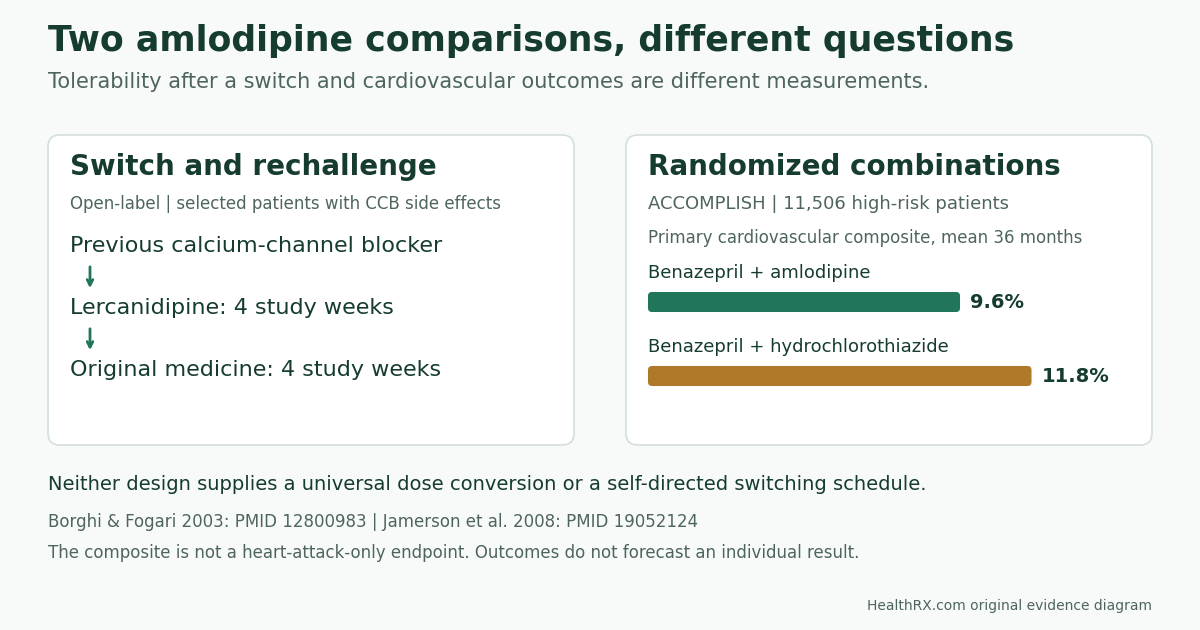
The studies below answer different questions. Neither supplies a general prescription-substitution schedule.
| Evidence | What was compared | What it can establish |
|---|---|---|
| Lercanidipine challenge trial | Selected patients with CCB-related adverse effects switched to lercanidipine for four weeks, then returned to their original medicine for four weeks | Better reported tolerability at comparable blood pressure in an eight-week open-label study; no universal switching schedule. [3] |
| ACCOMPLISH | Benazepril plus amlodipine versus benazepril plus hydrochlorothiazide in 11,506 high-risk patients | A difference in cardiovascular composite outcomes between two combination regimens; no amlodipine monotherapy conversion protocol. [4] |
The lercanidipine study enrolled people already taking amlodipine, felodipine, nifedipine GITS or nitrendipine who had CCB-specific adverse effects. Its open-label switch-and-rechallenge design supports a tolerability signal in that selected population. It does not prove that every person’s swelling resolves, or that resolution occurs within two weeks. [3]
ACCOMPLISH was randomized and ended early after a mean follow-up of 36 months. The primary cardiovascular composite occurred in 9.6% of the benazepril–amlodipine group and 11.8% of the benazepril–hydrochlorothiazide group: a 2.2-percentage-point absolute difference. That composite included cardiovascular death, nonfatal heart attack or stroke, angina hospitalization, resuscitated sudden cardiac arrest and coronary revascularization. It was not a heart-attack-only result or an individual switching trial. [4]
Product names and release forms matter
Milligram numbers do not establish equivalence across medicines. The NORVASC label contains no cross-drug conversion table. Amlodipine 10 mg therefore does not translate into nifedipine 10 mg—or another universal nifedipine dose. [1,2]
The full product name matters too. Nifedical XL is an extended-release nifedipine product whose tablets must be swallowed whole, without chewing, dividing or crushing. Its instructions illustrate why a prescription change must identify the actual formulation. They do not establish interchangeability between immediate-release and extended-release products. [2]
Diltiazem and verapamil belong to a different calcium-channel-blocker subclass from amlodipine. Their cardiac-conduction effects require condition- and product-specific review. The TIAZAC extended-release diltiazem label warns about slow heart rate or atrioventricular block and additive effects with beta-blockers or digitalis. A shared drug-class name does not supply a safe dose conversion. [1,8]
Review the whole medication list
Medication reconciliation can uncover a problem that a comparison trial never addresses. For example, a fixed-combination pill may contain amlodipine and another active ingredient. Confirm both ingredient names before changing that product; replacing the amlodipine component does not automatically continue the other medicine.
Interactions also matter. CYP3A4 inhibitors can increase amlodipine exposure. While taking amlodipine, the NORVASC label limits simvastatin to 20 mg daily. Stopping amlodipine does not itself authorize a new simvastatin dose; that prescription requires its own review. [1]
Timing and monitoring need an individual plan
Amlodipine’s therapeutic terminal half-life is approximately 30–50 hours. That explains its gradual elimination, but does not validate a washout calendar, mandatory overlap or continued protection after stopping. Its label provides no standard discontinuation taper or universal cross-taper to another drug. Follow the prescriber’s plan rather than using the half-life to schedule a change yourself. [1,6]
The 2025 AHA blood-pressure guideline replaces the 2017 guideline and emphasizes overall cardiovascular risk, coexisting disease, home monitoring and clinical follow-up. It does not establish a fixed 14-day transition for every switch. [5]
For a comparable home record, use a validated upper-arm cuff, rest for five minutes, support the arm at heart level, and take two readings one minute apart. These measurement instructions help assess treatment; they do not determine a new dose or visit schedule. Agree on follow-up and what readings or symptoms should prompt contact before changing treatment. [5,7]
Frequently asked questions
Can I switch from amlodipine to nifedipine overnight?
There is no universal overnight-switch rule. The prescriber needs to specify the nifedipine product, its release form, timing and monitoring based on why you take amlodipine. Do not infer a start date from amlodipine’s half-life or treat nifedipine formulations as interchangeable. [1,2]
What is the dose equivalent of amlodipine 10 mg in nifedipine?
There is no established universal milligram equivalent in these prescribing labels. Amlodipine 10 mg does not equal nifedipine 10 mg. Selection requires the exact nifedipine formulation, its prescribing instructions, your treatment indication and assessment of your response. [1,2]
Does amlodipine edema go away after switching?
Swelling may improve when treatment causing it is changed, but improvement is not guaranteed and no universal resolution timeline applies. Amlodipine has dose-related edema in trials. Persistent or worsening swelling needs assessment because the medicine may not be the only cause. [1,3,6]
Is lercanidipine better than amlodipine for edema?
An eight-week open-label study found better reported tolerability at comparable blood pressure after selected patients switched to lercanidipine, followed by rechallenge with their original CCB. It was not a randomized crossover trial and does not establish guaranteed edema resolution or superiority for every patient. [3]
How does amlodipine work to lower blood pressure?
Amlodipine is a dihydropyridine calcium-channel blocker. It reduces calcium entry into vascular smooth muscle, relaxing peripheral blood vessels and lowering resistance to blood flow. Its labeled uses also include certain angina and coronary artery disease indications, which matter when considering a replacement. [1]
Can I switch from amlodipine to diltiazem?
A prescriber may consider diltiazem for an appropriate indication, but there is no universal dose conversion. Diltiazem has cardiac-conduction effects, including possible slow heart rate or atrioventricular block. Beta-blockers and digitalis can add to these effects, so the full medication list needs review. [1,8]
Do I need to taper amlodipine before stopping it?
The NORVASC label does not specify a standard discontinuation taper. That does not mean you should stop independently: the treatment indication, replacement and follow-up still need a plan. NHS guidance advises stopping only when advised, and amlodipine’s long half-life does not supply a switching schedule. [1,6]
What is the best alternative to amlodipine for hypertension?
There is no single best alternative for everyone. Choice depends on cardiovascular risk, coexisting disease, adverse effects, other medicines and whether amlodipine also treats angina. The 2025 guideline supports individualized selection with home blood-pressure monitoring and clinical follow-up rather than a universal substitution. [1,5]
How long does amlodipine stay in your system after stopping?
Its therapeutic terminal half-life is approximately 30–50 hours, so elimination is gradual over several days. A half-life is not a guaranteed duration of blood-pressure or angina protection, nor does it establish how long to wait before starting another medicine. Follow the prescribed transition plan. [1]
Can I switch from amlodipine to lisinopril?
Lisinopril may be considered for hypertension when appropriate, but it is not a milligram-equivalent replacement for amlodipine. Your prescriber should review the treatment purpose, coexisting conditions, other medicines and the new product’s instructions, then arrange monitoring. An angina indication needs separate consideration. [1,5]
Is amlodipine safe to take long term?
Amlodipine is often used as long-term treatment, with ongoing review of benefit and adverse effects. It is not automatically suitable indefinitely for everyone. Discuss ankle swelling, palpitations or dizziness; pregnancy also warrants review, although NHS guidance does not describe use in pregnancy as universally prohibited. [1,6]
Why did my doctor switch me from amlodipine to losartan?
Possible reasons include adverse effects, blood-pressure response or a coexisting condition that changes treatment priorities. The prescription change alone cannot establish your doctor’s reason. Ask which outcome the switch is intended to improve and what monitoring is planned, especially if amlodipine also treated angina. [1,5,6]
References
Sources checked October 14, 2026.
- NORVASC (amlodipine besylate), Viatris Specialty LLC. Prescribing information, February 2023.
- Nifedical XL (nifedipine extended-release). Prescribing information.
- Borghi C, Fogari R. Improved tolerability of the dihydropyridine calcium-channel antagonist lercanidipine: the lercanidipine challenge trial. Blood Pressure Supplement. 2003.
- Jamerson K et al. Benazepril plus amlodipine or hydrochlorothiazide for hypertension in high-risk patients. NEJM. 2008.
- American Heart Association. Top Things to Know: 2025 High Blood Pressure Guideline.
- NHS. Amlodipine. Reviewed June 9, 2026.
- American Heart Association. Home Blood Pressure Monitoring. Reviewed August 14, 2025.
- TIAZAC (diltiazem hydrochloride extended-release). Official DailyMed prescribing information, August 2026 entry.