Compounded Semaglutide and Stress
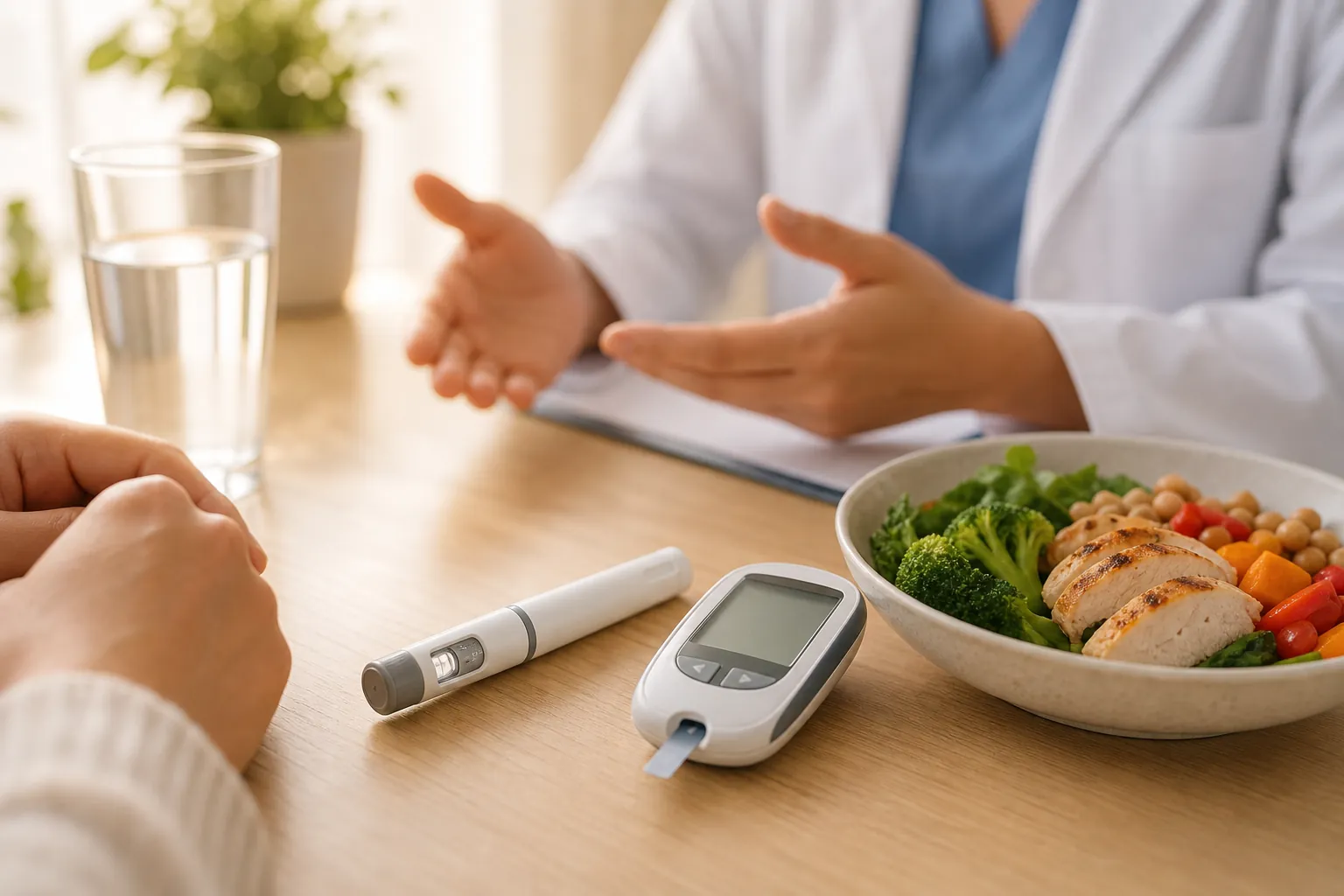
For the broader cluster context, see the semaglutide lifestyle and adherence hub.
Author: HealthRX.com Editorial Team
Compounded semaglutide is not FDA-approved. The information here is meant to educate patients and should not take the place of talking with your doctor.
This guide sits inside the broader Semaglutide Lifestyle and Adherence cluster, which is part of the compounded semaglutide pillar guide.
Does stress stop semaglutide from working?
There is no published evidence that psychological stress changes how semaglutide works in the body. Semaglutide's labeled mechanism, slowed gastric emptying and modulation of appetite and insulin signaling through the GLP-1 receptor, does not depend on a patient's stress level (FDA label, Wegovy, semaglutide injection).
What stress actually seems to affect is behavior around the medication, not the medication itself. On a lower calorie intake, every behavioral choice, meal quality, activity, sleep, injection timing, carries more weight than it would otherwise. Stress tends to disrupt exactly those routines: it is common for people under acute stress to skip injection days, eat erratically, cut sleep, or stop training. Each of those has a downstream effect on outcomes, even though the pharmacology is unchanged.
Why lifestyle variables matter more on GLP-1 therapy
Semaglutide reduces caloric intake. It does not create a metabolic state where lifestyle stops mattering, and trial data point the other way.
In the STEP 3 trial, semaglutide combined with intensive behavioral therapy (structured counseling, a low-calorie meal-replacement phase, and an activity goal) produced greater mean weight loss than semaglutide alone did in the STEP 1 trial (Wadden et al., STEP 3; Wilding et al., STEP 1). We are citing these papers for the general direction of that finding; an editor should confirm the exact effect sizes and study populations before any specific number is quoted from them on this page.
The practical read: the medication handles caloric reduction. Behavior handles composition, sustainability, and whether the weight stays off. When total intake drops meaningfully, protein intake, resistance training, and sleep each have more influence on the outcome than they would at a normal intake, because there is less margin for error.
Stress as an adherence problem, not a pharmacology problem
Online discussion of "semaglutide and stress" sometimes implies a hormonal interaction, cortisol blocking the medication or overriding GLP-1 signaling. We found no credible evidence for that. What stress does is more mundane: it disrupts routines. During high-stress stretches, people commonly report skipping Sunday meal prep, missing or delaying an injection, cutting evening walks to handle a backlog, or sleeping less. These are behavioral shifts, not biochemical ones, and they are fixable with structure rather than with a change to the drug regimen.
Anchors that tend to hold up under stress:
- A fixed weekday and time for the injection, rather than "whenever there's a free moment"
- Storing the vial or pen somewhere visible, not behind other items in the refrigerator
- A phone alarm or calendar reminder tied to injection day
- Telling a partner or housemate the schedule so there is a second check
Therapy, meditation, or other stress-management approaches belong in the broader conversation with a clinician, but they do not substitute for these structural supports. Build the routine first.
Stress-Disruption Decision Framework
Use this to sort what is actually happening during a stressful stretch and what to do about it. This is a general framework, not individualized medical advice; a prescriber should weigh in on anything involving a dose change.
| What you're noticing | Most likely explanation | What to do first | When to involve your prescriber |
|---|---|---|---|
| Missed one or two injection days during a busy week | Routine disruption, not drug failure | Reset to a fixed weekday/time; move the vial somewhere visible; set an alarm | If you're unsure whether to "make up" a missed dose |
| Scale hasn't moved in 1-2 weeks | Normal water/sodium/glycogen fluctuation | Track a weekly average instead of daily weigh-ins | Not yet; give it more time |
| Scale hasn't moved in 3+ weeks despite consistent dosing | Possible real plateau at your current intake/activity level | Review protein intake, resistance training frequency, sleep, and portion sizes (portions tend to drift up as appetite adapts) | If the plateau persists 6-8 weeks after a genuine lifestyle review |
| Skipping meals, then overeating later in the day | Stress-driven eating pattern, not a medication effect | Rebuild a basic meal schedule; don't skip protein at the first meal of the day | If eating pattern changes are severe or persistent, discuss with your prescriber |
| Considering raising your own dose because "it stopped working" | Attributing a behavioral gap to the drug | Address routine and lifestyle gaps first | Always; dose changes are a clinical decision, not a self-titration decision |
| New or worsening GI symptoms during a stressful period | May be unrelated to stress; could be dose-related or another cause | Do not assume it's "just stress" | Contact your prescriber, especially for severe or persistent symptoms |
What a plateau actually looks like
Many prescribers treat a stretch of three or more weeks without meaningful scale change, during otherwise consistent dosing and habits, as a plateau worth addressing rather than noise. Day-to-day weight can swing by a pound or more from water balance, glycogen storage, sodium intake, and bowel patterns, so a single bad weigh-in after a stressful, high-sodium week is not a plateau. A weekly average over a month gives a more honest trend than any single morning number.
When a real plateau shows up, the first moves are usually lifestyle-focused: review protein intake, resume or add resistance training, check sleep, and check whether portion sizes have crept up. Dose adjustments are typically considered later, in conversation with a prescriber, after a genuine lifestyle review.
When to talk to your prescriber about adjusting
If a plateau doesn't budge after six to eight weeks of consistent dosing and an honest lifestyle review, that is a reasonable point to raise dose strategy with your prescribing clinician. This is a clinical decision that should factor in your trajectory over months (not a single data point), your overall clinical status, and whether something else, a medication interaction, thyroid issue, or sleep disorder, might be contributing. Do not adjust your own dose based on how a stressful week went.
Misconceptions worth correcting
"Compounded semaglutide is basically the same as Wegovy or Ozempic." The active ingredient is the same molecule, but the regulatory status differs. Wegovy and Ozempic are FDA-approved products with FDA-reviewed labeling (Wegovy label; FDA-reviewed Ozempic labeling). Compounded semaglutide is prepared by a compounding pharmacy and has not gone through that same FDA approval process. The clinical evidence base for the molecule itself comes from trials of the branded products; those findings inform how the molecule is expected to behave, but a compounded preparation has not been independently tested at the same scale.
"If I'm not getting side effects, it isn't working." In the STEP trials, patients with mild GI tolerability and patients with more pronounced nausea or other GI symptoms both achieved meaningful weight loss (STEP 1; STEP 3). Side effect intensity by itself is not a reliable signal of how well the medication is working for you.
"The medication does the whole job." The STEP 3 result, greater weight loss with behavioral support added, argues against this. Lifestyle appears additive rather than optional for durable results.
"If I stop, I'll go right back to where I started." The STEP 4 trial found that participants who switched from active semaglutide to placebo at week 20 regained a substantial portion of the weight they had lost by week 48 (Rubino et al., STEP 4); an editor should confirm the exact regain figure before it's quoted precisely. The general pattern is consistent with obesity behaving as a chronic condition rather than a temporary one, similar to how blood pressure tends to drift back up after stopping an antihypertensive.
Related Topics in This Cluster
- Does Semaglutide Increase Metabolism?
- Semaglutide and Sleep Apnea: The SURMOUNT-OSA Adjacent Evidence
- Does Semaglutide Burn Fat or Muscle? Understanding Body Composition
Adjacent Reading
Where This Fits
This article is part of the Semaglutide Lifestyle and Adherence cluster. For a broader treatment of the molecule, the regulatory pathway, and the clinical evidence base, the compounded semaglutide pillar guide is the primary reference on this site.
Frequently Asked Questions
Does physical activity affect weight loss on semaglutide?
It appears to. In the STEP 3 trial, semaglutide combined with a structured lifestyle intervention that included activity produced greater total weight loss than semaglutide alone in STEP 1 (STEP 3; STEP 1). Resistance training specifically is generally recommended during weight loss to help preserve lean mass.
What counts as a real weight loss plateau on semaglutide?
Many prescribers use three or more weeks without meaningful scale change, during consistent dosing and habits, as the threshold. Daily fluctuations of a pound or more are usually noise rather than a plateau.
Can stress make semaglutide stop working?
There's no evidence stress changes the pharmacology of GLP-1 receptor activation. What stress does is disrupt the behaviors, consistent injection timing, meal quality, training, sleep, that the medication's benefits depend on for full expression.
Should I adjust my dose during a stressful period?
Not on your own. If stress has disrupted your routine and results have stalled, shore up the basics first: injection consistency, protein intake, sleep, activity. If a plateau persists for six to eight weeks despite a genuine lifestyle review, talk to your prescriber about dose strategy.
Compliance and Authorship
This article references the STEP 1, STEP 3, and STEP 4 clinical trial programs and FDA product labeling where cited above. Exact figures drawn from these sources should be verified against the source document before publication. This article is intended as patient education and does not replace consultation with a licensed clinician.
Author: HealthRX.com Editorial Team
Compounded semaglutide is not FDA-approved. HealthRX.com operates as an educational resource, not as a medical practice. Any medications discussed here are provided by licensed pharmacies after independent evaluation by a clinician. Your specific outcome will depend on your treatment plan, daily habits, and overall health situation.
References
- Wilding JPH, et al. Once-Weekly Semaglutide in Adults with Overweight or Obesity (STEP 1). https://pubmed.ncbi.nlm.nih.gov/33567185/
- Rubino D, et al. Effect of Continued Weekly Subcutaneous Semaglutide vs Placebo on Weight Loss Maintenance (STEP 4). https://pubmed.ncbi.nlm.nih.gov/33625476/
- Wadden TA, et al. Effect of Subcutaneous Semaglutide vs Placebo as an Adjunct to Intensive Behavioral Therapy (STEP 3). https://pubmed.ncbi.nlm.nih.gov/33755728/
- FDA. Wegovy (semaglutide) injection prescribing information. https://www.accessdata.fda.gov/drugsatfda_docs/label/2023/213051s012lbl.pdf
