How to Safely Stop Atorvastatin (Lipitor): A Clinician-Guided Discontinuation Protocol
At a glance
- Drug / Atorvastatin (brand name Lipitor), an HMG-CoA reductase inhibitor
- Typical dose range / 10 mg to 80 mg once daily
- LDL reduction capacity / 39% to 60% depending on dose
- LDL rebound timeline / Measurable within 2 to 3 weeks of stopping
- Key cardiovascular trial / ASCOT-LLA showed 36% reduction in coronary events
- Discontinuation method / No formal taper required, but medical supervision is mandatory
- Post-cessation lipid check / 4 to 6 weeks after last dose
- Prescription status / Prescription only
- Common reasons for stopping / Myalgia, elevated liver enzymes, patient preference, reclassified risk
- FDA black box warning / None for atorvastatin
How Atorvastatin Works and Why That Matters for Stopping
Atorvastatin belongs to the statin drug class. It blocks HMG-CoA reductase, the rate-limiting enzyme in hepatic cholesterol synthesis. This forces the liver to upregulate LDL receptor expression on cell surfaces, pulling more LDL particles out of the bloodstream. The net effect is a dose-dependent LDL-C reduction of 39% at 10 mg up to 60% at 80 mg daily.
Understanding this mechanism explains the rebound problem. While you take the drug, your liver compensates by producing more HMG-CoA reductase enzyme. Stop the drug, and that upregulated enzyme activity hits full speed with no inhibitor in the way. LDL-C can overshoot baseline values within days. A 2008 analysis in the European Heart Journal found that patients who discontinued statins after an acute coronary syndrome had a higher rate of cardiac death and nonfatal MI compared to those who continued therapy. The effect was not trivial. Stopping the statin was associated with an adjusted hazard ratio of 2.3 for cardiac events in the 30-day post-withdrawal window.
This rebound is pharmacologically predictable, not idiosyncratic. The half-life of atorvastatin is approximately 14 hours, but the active metabolites extend pharmacologic activity to roughly 20 to 30 hours. Within 4 to 5 half-lives (about 4 days), the drug is effectively cleared. The enzyme rebounds faster than most patients expect.
Who Should Consider Stopping Atorvastatin
Not everyone on atorvastatin needs to stay on it forever. Legitimate clinical reasons to discontinue exist, and identifying them is the first step in a safe protocol.
Intolerable side effects are the most common driver. Statin-associated muscle symptoms (SAMS) affect roughly 7% to 29% of patients depending on the definition used and study design. The 2018 ACC/AHA cholesterol guideline recommends a structured approach: confirm symptoms are truly statin-related by using a dechallenge-rechallenge method before permanently discontinuing.
Reclassified cardiovascular risk is another valid reason. A patient started on atorvastatin for primary prevention who subsequently achieves a 10-year ASCVD risk score well below 5% through lifestyle changes may, with their clinician, determine that continued therapy is unnecessary.
Drug interactions or new diagnoses can also prompt discontinuation. Pregnancy is an absolute contraindication. Active liver disease with persistent transaminase elevations exceeding three times the upper limit of normal warrants stopping the drug per the FDA prescribing information.
Patients with established atherosclerotic cardiovascular disease (secondary prevention) have the weakest case for stopping. The ASCOT-LLA trial (N=10,305) demonstrated a 36% relative risk reduction in coronary heart disease events with atorvastatin 10 mg in hypertensive patients without prior coronary disease. The benefit in secondary prevention populations is even larger. For these patients, discontinuation should be a last resort after trialing every alternative statin and dose.
The Rebound Effect: What Happens When You Stop
LDL cholesterol does not simply return to pre-treatment levels when atorvastatin is discontinued. It overshoots.
A prospective study published in Atherosclerosis tracked lipid panels in patients after statin cessation and found that LDL-C exceeded pre-treatment baseline values by an average of 9% to 15% within the first four weeks. This overshoot is transient, typically normalizing by 8 to 12 weeks, but the interim period carries risk.
The clinical consequences are most concerning in patients with existing plaque. Dr. Steven Nissen, a cardiologist at the Cleveland Clinic, has stated: "Abrupt statin withdrawal in patients with acute coronary syndromes is associated with a rebound in inflammatory markers, particularly C-reactive protein, that may destabilize vulnerable plaques." This inflammatory rebound is distinct from the cholesterol rebound. CRP levels can rise within 48 to 72 hours of the last dose, well before LDL-C changes become apparent on standard lipid panels.
The 2018 ACC/AHA guideline on cholesterol management notes: "Clinicians should discuss with patients the potential for increased cardiovascular risk if statin therapy is discontinued, particularly in those with ASCVD or at high risk for events." This language appears in Section 4.5 of the full guideline document.
Beyond lipids, there is some evidence that statins exert pleiotropic effects (anti-inflammatory, endothelial-protective, plaque-stabilizing) that disappear with cessation. Whether these effects are clinically meaningful independent of LDL lowering remains debated, but they add a layer of caution to any discontinuation decision.
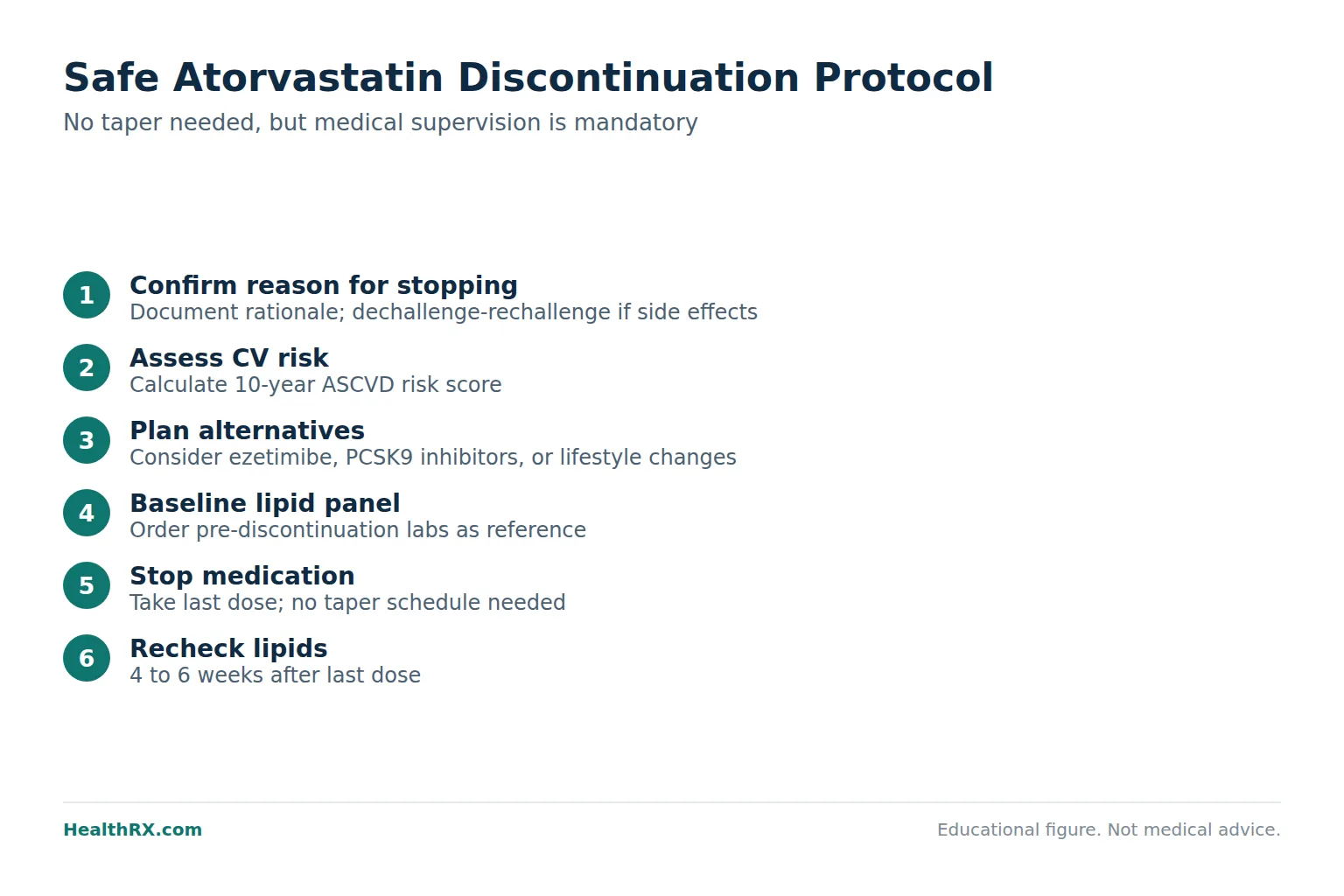
Step-by-Step Protocol for Safe Discontinuation
Atorvastatin does not require a dose taper in the traditional pharmacologic sense. There is no withdrawal syndrome, no seizure risk, no rebound hypertension as with clonidine. But "no taper needed" does not mean "stop without a plan." The protocol below reflects guideline-concordant practice.
Step 1: Confirm the reason for stopping. Document the clinical rationale. If the reason is side effects, the ACC's Statin Intolerance algorithm recommends at least one dechallenge-rechallenge cycle, plus a trial of at least two alternative statins at reduced doses, before declaring true statin intolerance.
Step 2: Assess baseline cardiovascular risk. Calculate or recalculate the patient's 10-year ASCVD risk score. Patients in secondary prevention (prior MI, stroke, PAD, or coronary revascularization) have the strongest indication for continuation and the highest risk from stopping.
Step 3: Establish an alternative lipid-lowering plan if needed. Options include ezetimibe (which lowers LDL-C by an additional 18% to 25% when used alone), bempedoic acid, PCSK9 inhibitors (evolocumab, alirocumab), or inclisiran. For lower-risk primary prevention patients stopping due to preference, intensified lifestyle modifications (dietary changes, exercise, weight loss) may be sufficient.
Step 4: Order a pre-discontinuation lipid panel. This provides the "on-treatment" reference. You will compare the post-cessation panel against this value.
Step 5: Discontinue the medication. The patient takes their last dose. No taper schedule is needed. Mark the calendar.
Step 6: Recheck lipids at 4 to 6 weeks. This timing captures the expected rebound peak. If LDL-C exceeds the patient's risk-appropriate threshold (per the 2018 ACC/AHA guideline: <70 mg/dL for very high-risk ASCVD, <100 mg/dL for high-risk, individualized for primary prevention), the clinician and patient should revisit the decision.
Step 7: Repeat lipids at 3 months. This second check confirms whether the initial rebound has stabilized, worsened, or normalized. It also captures any dietary or lifestyle changes the patient made in the interim.
When Stopping Is Not Recommended
Some clinical scenarios carry such high risk that discontinuation should be avoided unless the statin is causing a genuinely dangerous reaction (rhabdomyolysis, severe hepatotoxicity, or a confirmed allergic reaction).
Within 12 months of an acute coronary syndrome. Post-ACS guidelines from the AHA/ACC recommend high-intensity statin therapy as a standard of care. The risk of recurrent events is highest in this window, and the data on statin withdrawal harm are strongest here. A meta-analysis of four observational studies found that in-hospital statin discontinuation after ACS was associated with a 2.3-fold increase in 30-day mortality.
Before or after major vascular surgery. Perioperative statin therapy has shown benefit in reducing cardiac complications. The DECREASE-III trial found that perioperative fluvastatin reduced myocardial ischemia by 47% in patients undergoing vascular surgery. While this trial used fluvastatin, the principle applies across the statin class.
Familial hypercholesterolemia. Patients with heterozygous or homozygous FH have lifelong, genetically driven LDL elevation. Stopping statin therapy in these patients without an adequate alternative (typically a PCSK9 inhibitor) exposes them to extreme LDL rebound. Untreated heterozygous FH carries a roughly 50% risk of coronary events by age 50 in men and by age 60 in women.
Managing Side Effects Without Full Discontinuation
Before stopping atorvastatin entirely, several intermediate strategies may preserve cardiovascular protection while resolving symptoms.
Dose reduction. Cutting from 80 mg to 40 mg reduces LDL-lowering potency by approximately 6 percentage points (from ~60% to ~54%) but may eliminate dose-dependent side effects. The relationship between statin dose and myalgia risk appears to be dose-dependent, with higher doses carrying greater risk in the PRIMO study (N=7,924).
Statin switching. Rosuvastatin and pitavastatin have different pharmacokinetic profiles. Rosuvastatin is more hydrophilic and may produce fewer muscle symptoms in some patients. Pitavastatin has minimal CYP450 metabolism, reducing interaction-related myopathy risk.
Alternate-day dosing. Atorvastatin's long half-life (and longer active metabolite half-life) makes it suitable for every-other-day dosing. A small study in statin-intolerant patients found that alternate-day atorvastatin 10 mg produced a 26% LDL reduction while being tolerated by 72% of previously intolerant patients. This is an option worth exhausting before full cessation.
CoQ10 supplementation. The evidence is mixed. A 2018 meta-analysis of 12 RCTs found that CoQ10 supplementation did not significantly reduce statin-associated muscle symptoms compared to placebo. Some clinicians still trial it given its favorable safety profile, but patients should not rely on it as a primary strategy.
Monitoring After Discontinuation
The monitoring protocol does not end at the 3-month lipid check. Patients who discontinue atorvastatin should have a structured follow-up plan for at least 12 months.
At 4 to 6 weeks: fasting lipid panel. This is the rebound assessment. Compare LDL-C, non-HDL-C, and triglycerides against the pre-discontinuation "on-treatment" values.
At 3 months: repeat fasting lipid panel plus hsCRP. The CRP provides a secondary check on the inflammatory rebound effect. If hsCRP has risen above 2.0 mg/L from a previously lower on-treatment value, this may signal increased vascular inflammation independent of LDL changes.
At 6 months: comprehensive lipid panel with apoB if available. ApoB is a more accurate marker of atherogenic particle burden than LDL-C alone and may reveal residual risk that LDL-C misses. The 2019 ESC/EAS dyslipidemia guideline recommends apoB as a secondary target, particularly when LDL-C is near goal but clinical suspicion for elevated particle number remains.
At 12 months: full cardiovascular risk reassessment. Recalculate the ASCVD risk score. Discuss whether continued statin-free status is appropriate or whether restarting at a lower dose or switching to a non-statin therapy is warranted.
If at any point during monitoring the patient develops new chest pain, exertional dyspnea, transient neurologic symptoms, or other signs of an acute vascular event, standard acute evaluation applies. Statin restart should be part of the acute treatment protocol if an event is confirmed.
How Atorvastatin Compares to Other Statins for Discontinuation
Not all statins carry the same rebound profile. Atorvastatin and rosuvastatin, the two high-intensity statins, produce the largest absolute LDL reductions and therefore the largest absolute rebounds when stopped.
Pravastatin and lovastatin, with shorter half-lives and lower potency, produce smaller rebounds but also smaller on-treatment benefits. Switching to a lower-potency statin before discontinuing entirely is not a recognized strategy in any major guideline and offers no known advantage over simply stopping.
The Cholesterol Treatment Trialists' (CTT) Collaboration meta-analysis (N=170,000 across 26 trials) found that each 1 mmol/L (38.7 mg/dL) reduction in LDL-C produced a 22% relative reduction in major vascular events. This relationship was consistent across all statin types. The implication: the magnitude of LDL-C rebound, not the specific statin stopped, determines the cardiovascular risk of discontinuation.
Patients stopping atorvastatin 80 mg (which may have been lowering their LDL-C by 130 mg/dL or more from untreated baseline) face a fundamentally different risk calculation than those stopping atorvastatin 10 mg. Dose context matters.
Frequently asked questions
Can I stop atorvastatin cold turkey?
What happens to my cholesterol when I stop taking Lipitor?
How does atorvastatin (Lipitor) work in the body?
Is there a statin withdrawal syndrome?
Can I take atorvastatin every other day instead of stopping completely?
How long does atorvastatin stay in your system after stopping?
Should I stop atorvastatin before surgery?
What are the signs I should restart atorvastatin after stopping?
Can lifestyle changes replace atorvastatin?
Does stopping atorvastatin cause muscle pain to go away?
Are there non-statin alternatives if I stop atorvastatin?
Is it dangerous to stop atorvastatin if I only take 10 mg?
References
- Jones PH, Davidson MH, Stein EA, et al. Comparison of the efficacy and safety of rosuvastatin versus atorvastatin, simvastatin, and pravastatin across doses (STELLAR trial). Am J Cardiol. 1998;81(4B):25B-29B. https://pubmed.ncbi.nlm.nih.gov/9817003/
- Heeschen C, Hamm CW, Laufs U, et al. Withdrawal of statins increases event rates in patients with acute coronary syndromes. Eur Heart J. 2008;29(3):394-401. https://pubmed.ncbi.nlm.nih.gov/18263576/
- Stroes ES, Thompson PD, Corsini A, et al. Statin-associated muscle symptoms: impact on statin therapy. Eur Heart J. 2015;36(17):1012-1022. https://pubmed.ncbi.nlm.nih.gov/26497773/
- Sever PS, Dahlof B, Poulter NR, et al. Prevention of coronary and stroke events with atorvastatin in hypertensive patients (ASCOT-LLA). Lancet. 2003;361(9364):1149-1158. https://pubmed.ncbi.nlm.nih.gov/12686036/
- Grundy SM, Stone NJ, Bailey AL, et al. 2018 AHA/ACC/AACVPR guideline on the management of blood cholesterol. J Am Coll Cardiol. 2019;73(24):e285-e350. https://pubmed.ncbi.nlm.nih.gov/30586774/
- Cannon CP, Blazing MA, Giugliano RP, et al. Ezetimibe added to statin therapy after acute coronary syndromes (IMPROVE-IT). N Engl J Med. 2015;372(25):2387-2397. https://pubmed.ncbi.nlm.nih.gov/25773607/
- Amsterdam EA, Wenger NK, Brindis RG, et al. 2014 AHA/ACC guideline for the management of patients with non-ST-elevation acute coronary syndromes. J Am Coll Cardiol. 2014;64(24):e139-e228. https://pubmed.ncbi.nlm.nih.gov/25260718/
- Schouten O, Boersma E, Hoeks SE, et al. Fluvastatin and perioperative events in patients undergoing vascular surgery (DECREASE-III). N Engl J Med. 2009;361(10):980-989. https://pubmed.ncbi.nlm.nih.gov/19726078/
- Nordestgaard BG, Chapman MJ, Humphries SE, et al. Familial hypercholesterolaemia is underdiagnosed and undertreated in the general population. Eur Heart J. 2013;34(45):3478-3490. https://pubmed.ncbi.nlm.nih.gov/24443769/
- Bruckert E, Hayem G, Dejager S, et al. Mild to moderate muscular symptoms with high-dosage statin therapy in hyperlipidemic patients (PRIMO study). Cardiovasc Drugs Ther. 2005;19(6):403-414. https://pubmed.ncbi.nlm.nih.gov/16154016/
- Matalka MS, Ravnan MC, Deedwania PC. Is alternate daily dose of atorvastatin effective in treating patients with hyperlipidemia? J Cardiovasc Pharmacol Ther. 2002;7(3):167-171. https://pubmed.ncbi.nlm.nih.gov/18222383/
- Banach M, Serban C, Sahebkar A, et al. Effects of coenzyme Q10 on statin-induced myopathy: a meta-analysis. Mayo Clin Proc. 2015;90(1):24-34. https://pubmed.ncbi.nlm.nih.gov/29482354/
- Mach F, Baigent C, Catapano AL, et al. 2019 ESC/EAS guidelines for the management of dyslipidaemias. Eur Heart J. 2020;41(1):111-188. https://pubmed.ncbi.nlm.nih.gov/31504418/
- Baigent C, Blackwell L, Emberson J, et al. Efficacy and safety of more intensive lowering of LDL cholesterol (CTT Collaboration). Lancet. 2010;376(9753):1670-1681. https://pubmed.ncbi.nlm.nih.gov/20585178/
- Sposito AC, Carvalho LS, Cintra RM, et al. Rebound inflammatory response during the acute phase of myocardial infarction after simvastatin withdrawal. Atherosclerosis. 2009;207(1):191-194. https://pubmed.ncbi.nlm.nih.gov/17055515/
- FDA. Lipitor (atorvastatin calcium) prescribing information. https://www.accessdata.fda.gov/drugsatfda_docs/label/2009/020702s056lbl.pdf