
What Can I Eat on Semaglutide?
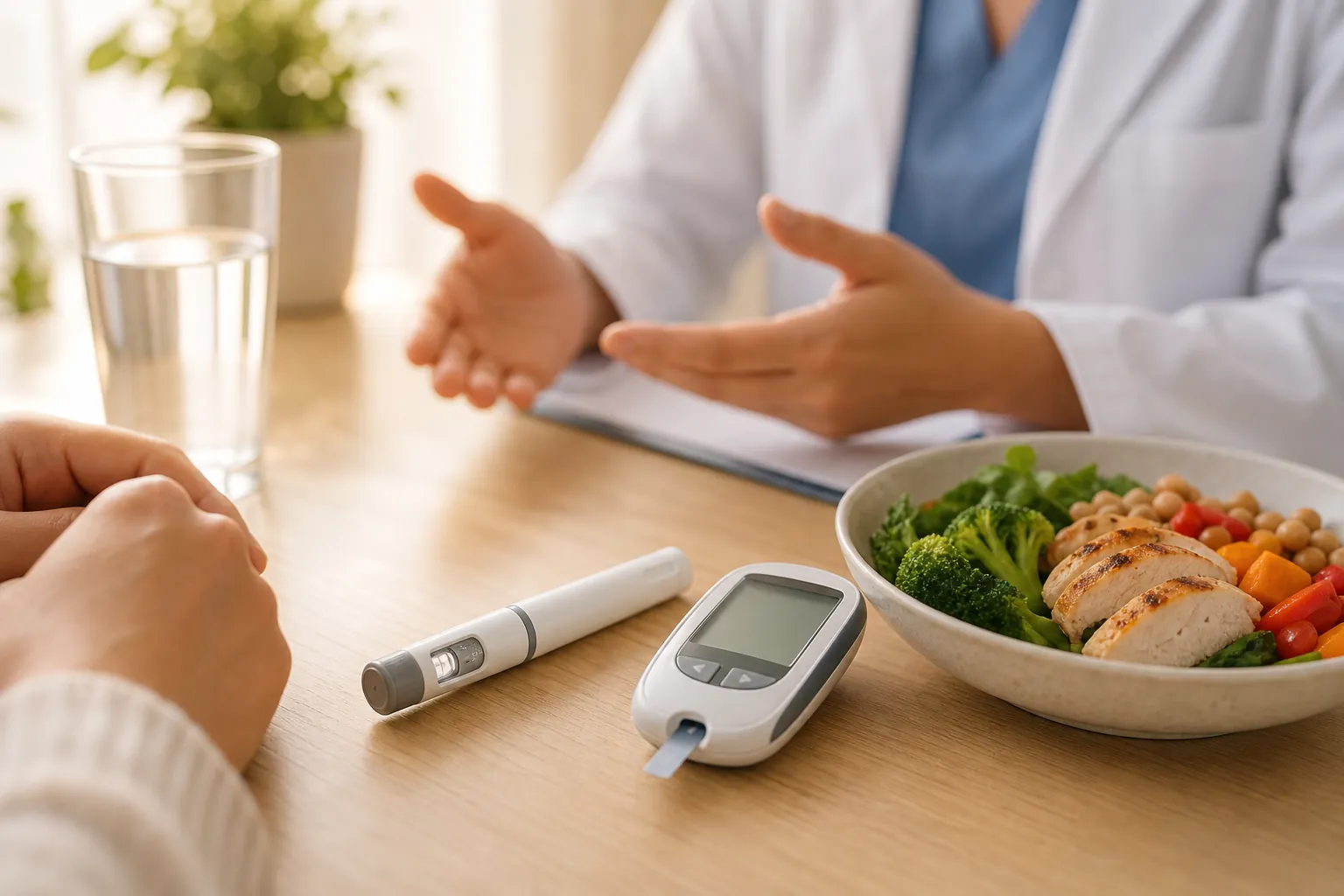
For the broader cluster context, see the semaglutide diet and food hub.
Author: HealthRX.com Editorial Team Evidence checked by: the HealthRX.com Editorial Team Last clinical review: May 2026
Compounded semaglutide is not FDA-approved. This article is patient education and does not replace consultation with a licensed clinician.
Rachel, a 42-year-old nurse in Columbus, Ohio, started compounded semaglutide at 0.25 mg in February. By her third week she had lost four pounds and felt almost no hunger before noon. "I'd get to lunch and realize I hadn't eaten anything," she told her dietitian. "Then I'd grab a granola bar and a Diet Coke and wonder why I felt terrible by 3 p.m." Her protein intake those first few weeks? Roughly 38 grams a day, less than half what her body needed. She wasn't eating wrong, exactly. She just wasn't eating with enough intention for a drug that had cut her caloric volume nearly in half.
That gap between "I'm not hungry" and "I'm eating well" is where most semaglutide patients live, especially early on. This article is about closing it.
This guide sits inside the broader Semaglutide Diet and Food cluster, which is part of the compounded semaglutide pillar guide. It draws on the published SUSTAIN, STEP-1, STEP-3, STEP-4, LEADER, and SELECT trial programs for semaglutide as a molecule, plus clinical observations from obesity medicine physicians treating GLP-1 patients. Compounded semaglutide uses the same active ingredient as Wegovy and Ozempic, is prepared by a licensed compounding pharmacy under clinician prescription, and is not FDA-approved. The compounded preparation has not been independently tested in randomized trials at the same scale as the branded products.
Fewer Calories Means Every Bite Carries More Weight
Here's the thing about semaglutide: it works primarily by reducing how much you eat. That's the design. Which means whatever you do eat has to punch above its weight nutritionally.
Think of it like packing for a carry-on instead of a checked bag. You can still bring everything you need, but you have to be selective. A 2,200-calorie day gives you room to absorb a mediocre lunch. A 1,300-calorie day does not. When total intake drops, protein adequacy, fiber, and micronutrient density stop being nice-to-haves. They become the difference between weight loss that preserves lean mass and weight loss that quietly cannibalizes muscle along with fat.
The STEP-3 trial is the clearest evidence that nutrition guidance changes outcomes. That trial paired semaglutide with a structured lifestyle intervention (calorie targets, behavioral counseling, 30 minutes of daily activity). The active arm in STEP-3 lost more weight on average than the active arm in STEP-1, which used the medication alone. You can't isolate diet as the sole variable, but the overall signal is hard to ignore: what you eat, and how deliberately you eat it, matters on this drug.
What a Real Day Looks Like on Therapy
A day on semaglutide doesn't feel like a day off it. Hunger shows up later, fades faster, and fullness arrives sooner than you expect. Most patients settle into two substantial meals and one or two smaller ones. Some go down to one real meal and a couple of snacks. The pattern is individual, but the rhythm is consistent: less volume, more frequently spaced.
The practical mistakes are almost always the same:
- Skipping protein in the morning. You wake up not hungry, so you skip breakfast or grab something carb-heavy. By mid-afternoon, you've eaten 300 calories and 12 grams of protein, and your body is running on fumes.
- Relying on liquid calories. Smoothies, juices, sweetened coffee drinks. They go down easy but don't trigger the same fullness signals that solid food does. You can drink 400 calories and feel like you haven't eaten.
- Back-loading into one big evening meal. After a low-intake morning and a light lunch, the instinct is to eat a large dinner. The result is usually nausea, reflux, or both, especially in the first weeks after a dose increase.
Each of these has a simple fix. Protein at your first eating occasion (even if it's a hard-boiled egg at 10 a.m.). Solid food over liquids when you can manage it. And distributing your intake more evenly across the day, even if "evenly" means three modest plates instead of one big one.
The Three Priorities (and Why the Specifics Are Flexible)
Most obesity medicine clinicians converge on the same framework for GLP-1 patients. It's not complicated, but it is specific:
1. Protein: 1.2 to 1.6 grams per kilogram of body weight per day.
For a 200-pound person, that's roughly 110 to 145 grams daily. Lean meats, fish, eggs, Greek yogurt, cottage cheese, tofu, legumes. Protein lands first in most meals, not because carbs are evil, but because hitting the daily target is genuinely hard when your eating volume has been cut by a third or more. Miss it consistently, and you lose more lean mass during weight loss. That's not a theoretical concern; it's a measurable one.
2. Fiber and produce: 20 to 30 grams of fiber per day.
Vegetables, fruit, beans, whole grains. Fiber matters for satiety (it fills you up), for gut health, and for the constipation that is one of the most common side effects on GLP-1 therapy. Starches aren't banned. Rice, potatoes, bread, they're all fine, and they're easier to tolerate when paired with protein rather than eaten alone.
3. Tolerable composition: foods your gut can handle right now.
This one shifts over time. During titration (the first 8 to 16 weeks as your dose climbs), lower-fat, lower-volume meals tend to sit best. Very high-fat meals, fried foods, and intensely spicy dishes are the most common triggers for nausea and reflux. Most patients find their tolerance widens as they stabilize on a maintenance dose, but in the early weeks, bland is your friend.
Within those three priorities, the specific foods are genuinely flexible. You don't need a special meal plan. You don't need to avoid any particular food group. You need protein, produce, and reasonable portions. That's the boring truth, and it works.
Hydration: The One Everyone Forgets
Fluid is harder to remember and easier to underdo on semaglutide. Delayed gastric emptying (the drug's mechanism) makes people feel full from water, too, which means they drink less. Add in the constipation risk, and dehydration becomes a quiet but real problem.
No magic number here, but sipping water steadily throughout the day, rather than trying to drink a lot at meals, tends to work better. Some patients find carbonated water triggers bloating; others don't. Pay attention to your own signals.
What Changes Over Six Months
Patients who make it through the first six months on therapy almost universally describe a different relationship with food. Not a perfect one. Not an effortless one. But a recalibrated one. Portion sizes feel more intuitive. Cravings are less urgent and less specific. The mental effort of "deciding what to eat" gets simpler.
My honest take: this recalibration period is the real window of opportunity. Building durable eating habits while the drug is actively suppressing appetite is dramatically easier than trying to build them after stopping. STEP-4 documented partial weight regain over the 48 weeks after participants switched from semaglutide to placebo at week 20. The biology of weight regulation reasserts itself when pharmacologic support is removed, the same way blood pressure climbs back up if you stop a blood pressure medication. The eating patterns you install during therapy are what you'll have to lean on if you ever come off it.
Misconceptions That Keep Coming Up
"Side effects mean it's working." Trial data from STEP-1 and STEP-3 don't support this. Patients with mild GI symptoms and patients with pronounced nausea both achieved meaningful weight loss. Suffering more doesn't mean losing more.
"The medication does the whole job." STEP-3 (medication plus structured lifestyle intervention) produced greater mean weight loss than STEP-1 (medication alone). Lifestyle is additive. It's not optional for durable outcomes.
"Compounded semaglutide is the same thing as Wegovy." Same active ingredient, yes. Same regulatory status, no. Compounding pharmacies operate under a different framework with different oversight. Compounded preparations are not FDA-approved. That distinction matters and patients should understand it.
"Once I stop, everything resets." Partially true, which is worse than entirely true because it breeds complacency. STEP-4 showed partial, not complete, regain. But partial regain on top of weakened lean mass (from poor nutrition during therapy) is a worse outcome than partial regain with preserved muscle. How you eat on the drug shapes your body composition off the drug.
Related Reading
- Best Diet for Semaglutide in 2026
- Semaglutide Recipes: High-Protein, Low-Volume Meals
- Semaglutide and Protein Intake: How Much and Why
- Exercise on Compounded Semaglutide: Best Practices
- Constipation on Semaglutide: A Practical Guide
This article is part of the Semaglutide Diet and Food cluster. For a broader treatment of the molecule, the regulatory pathway, the 503A and 503B compounding framework, and the clinical evidence base, the compounded semaglutide pillar guide is the primary reference on this site.
Frequently Asked Questions
Does diet matter on semaglutide?
It matters more, not less. Appetite suppression means you eat fewer calories overall, which makes the composition of those calories disproportionately important. Protein, fiber, and micronutrient adequacy become non-negotiable rather than aspirational.
How much protein should I aim for?
Most clinical references for GLP-1 patients converge on 1.2 to 1.6 grams of protein per kilogram of body weight per day. Your clinician may adjust this based on your activity level, starting weight, and clinical context.
What foods are best tolerated early in therapy?
During titration, lower-volume, lower-fat, higher-protein meals tend to sit best. Spicy, fried, and very rich foods are commonly reported triggers for nausea or reflux. Tolerance typically improves as you stabilize on your dose.
Do I need to avoid carbs?
No. Carbohydrates are not off-limits. The emphasis is on pairing them with protein and choosing higher-fiber options when possible, not on elimination.
Is compounded semaglutide the same as Wegovy or Ozempic?
The active ingredient is the same molecule. The regulatory status is different. Compounded semaglutide is prepared by a licensed compounding pharmacy under clinician prescription and is not FDA-approved.
Will I regain weight if I stop?
STEP-4 documented partial weight regain over 48 weeks after participants switched from semaglutide to placebo. Building strong nutrition and exercise habits during therapy is the best defense against regain if the medication is discontinued.
Compliance and Authorship
This article references the STEP-1, STEP-3, STEP-4, SUSTAIN, SELECT, and LEADER clinical trial programs where appropriate. It is intended as patient education and does not replace consultation with a licensed clinician.
Author: HealthRX.com Editorial Team Evidence checked by: the HealthRX.com Editorial Team Last clinical review: May 2026
Compounded semaglutide is not FDA-approved. Not FDA-approved. HealthRX.com is not a medical practice. Medications referenced in this article are dispensed by licensed pharmacies through independent clinician evaluations. Individual results vary and depend on prescribed protocol, lifestyle factors, and clinical context.