Estradiol Patch Storage, Stability & Shelf Life: What You Need to Know
At a glance
- Routine storage / usually 20°C to 25°C (68°F to 77°F)
- Excursions / product-specific; many labels permit 15°C to 30°C (59°F to 86°F)
- Packaging / keep each patch sealed in its original pouch until use
- After opening / apply immediately
- Shelf life / use the expiration date on that carton and pouch
- Refrigerator or freezer / outside labeled room-temperature storage
- Heat or cold exposure / ask the dispensing pharmacy rather than guessing potency
- Applied heat / avoid placing a heating pad directly over a transdermal system
- Disposal / fold sticky sides together and keep away from children and pets
- Cutting / do not cut unless the exact product's instructions and prescriber support it
Read the Label for the Exact Product
"Estradiol patch" describes multiple once-weekly and twice-weekly transdermal systems. They have the same active ingredient, but patch design, adhesive, pouch, dose, and labeled storage instructions can differ.
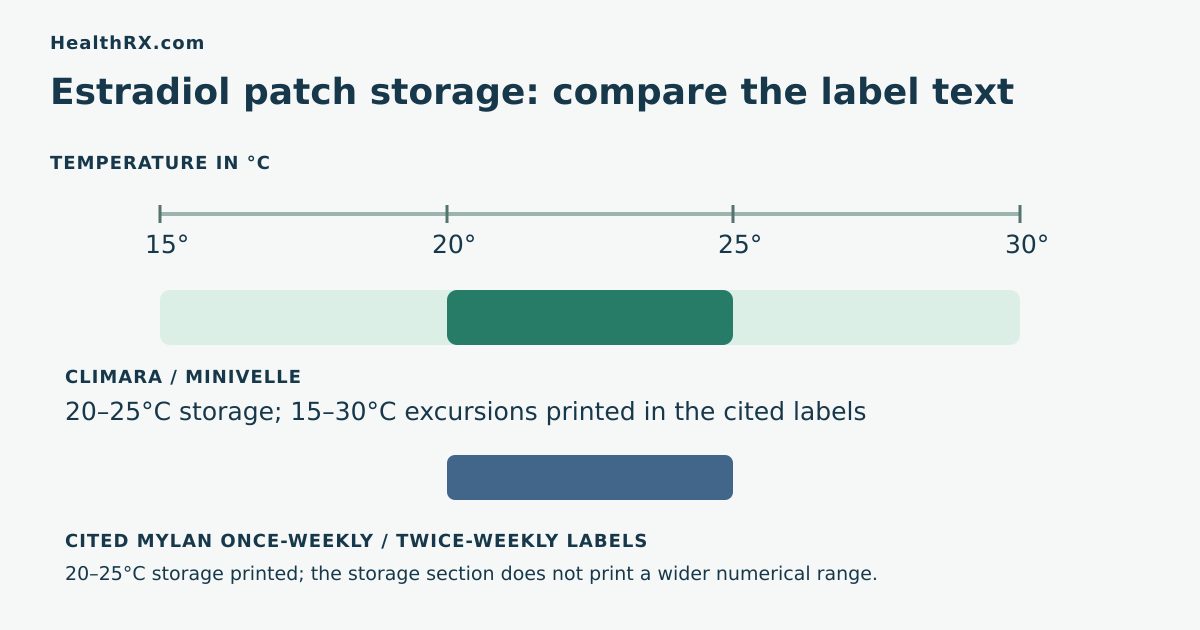
Current U.S. labeling for several estradiol transdermal systems specifies storage at 20°C to 25°C (68°F to 77°F). Some labels permit excursions between 15°C and 30°C (59°F and 86°F). Current Mylan once-weekly and twice-weekly labels specify 20°C to 25°C without stating that wider excursion range in their storage sections [1-4].
Follow the instructions for the dispensed product:
- Keep it within the range on its own carton.
- Leave each patch in its original pouch.
- Apply it immediately after opening.
- Use it before the printed expiration date.
Current Label Comparison: Storage Instructions Differ
The table shows what each cited U.S. label states. “Not stated” does not mean an excursion is known to damage the patch; it means the wider range should not be borrowed from another product.
| Product in the cited label | Application schedule | Routine storage | Excursion language | Pouch instruction |
|---|---|---|---|---|
| Climara | Once weekly | 20°C to 25°C (68°F to 77°F) | 15°C to 30°C (59°F to 86°F); do not store above 30°C | Do not store unpouched; apply immediately after removal |
| Mylan estradiol transdermal system | Once weekly | 20°C to 25°C (68°F to 77°F) | No wider range stated in the cited storage section | Do not store unpouched; apply immediately after removal |
| Mylan estradiol transdermal system | Twice weekly | 20°C to 25°C (68°F to 77°F) | No wider range stated in the cited storage section | Do not store unpouched; apply immediately after removal |
| Minivelle | Twice weekly | 20°C to 25°C (68°F to 77°F) | 15°C to 30°C (59°F to 86°F) | Do not store unpouched; apply immediately after removal |
This table compares labels; it is not a laboratory stability study. It supports checking the exact carton and manufacturer after an excursion, but it cannot estimate potency after an unknown exposure.
Why the Pouch Matters
A transdermal system is a drug-device combination, not just adhesive backing. Its formulation must deliver estradiol at a controlled rate while remaining attached to the skin.
FDA's 2019 draft guidance for transdermal-system manufacturers discusses product design, adhesion, release characteristics, packaging, and the potential impact of applied heat [5]. Current estradiol labels explicitly say not to store patches unpouched and to apply them immediately after removal [1-4].
The cited labels do not tell patients how much drug delivery an unpouched patch loses over a particular number of hours. If a pouch was opened accidentally and the patch was not applied, ask a pharmacist whether to discard it.
Shelf Life Is the Printed Expiration Date
A universal "24 months from manufacture" rule is not reliable for patients. The manufacturer assigns the expiration date to a particular lot based on the approved stability program and packaging.
Use the date printed on the carton or pouch. Do not calculate a replacement date from the day the prescription was filled, and do not assume a patch remains usable for a year after expiration.
An expired patch's drug content, delivery performance, adhesive behavior, or pouch integrity may no longer meet specifications. Appearance alone cannot prove that it will deliver the labeled dose.
What to Do After Heat Exposure
A closed vehicle, direct sun, a heater, or a package left outdoors can expose patches to temperatures above the labeled storage range. What to do depends on the product, temperature, and duration.
Do not rely on visual inspection alone. A patch that looks normal may still have been stored outside its labeled conditions. A brief excursion within the range allowed by the label, however, may not require replacement.
After an exposure:
- Keep the patch sealed.
- Note the approximate temperature and how long the exposure lasted.
- Check the storage section on the carton or current label.
- Call the dispensing pharmacy or manufacturer for product-specific advice.
The cited sources do not establish a universal temperature-and-time rule that predicts whether an exposed patch still performs as labeled. They also do not establish a specific dose burst caused by storage damage.
What to Do After Cold Exposure
Estradiol transdermal systems are labeled for room-temperature storage, not routine refrigeration or freezing. Avoid intentionally placing them in a refrigerator, freezer, cooler against an ice pack, or vehicle cargo area exposed to winter temperatures.
If a shipment froze or spent substantial time below the product's labeled range, keep it sealed and contact the pharmacy. Letting it return to room temperature does not by itself prove that performance is restored.
When traveling, carry patches where temperature is reasonably controlled, in the original labeled package. Do not place them directly against a heat source or cold pack.
Heat While Wearing the Patch
Storage before use and heat applied while wearing a patch are different questions. FDA's 2019 draft guidance for manufacturers identifies applied heat as a factor that can affect drug delivery and should be assessed during product development [5]. That does not establish that every estradiol product increases absorption by the same amount.
Avoid placing a heating pad, heated blanket, or other direct heat source over the patch unless the product's instructions specifically address it. For routine activities such as showering, swimming, or exercise, follow the Instructions for Use for the exact product. Minivelle's patient instructions, for example, state that showering should not cause the patch to fall off and explain what to do if it detaches [4].
If a patch repeatedly lifts, do not tape over it or improvise with glue. Follow the product's reapplication instructions or contact the pharmacy.
Brand and Generic Differences
Climara is generally used once weekly, while products such as Vivelle-Dot, Minivelle, and several generics are generally changed twice weekly. Frequency does not determine whether two products share identical storage or handling instructions.
When the pharmacy changes manufacturers:
- Read the new carton.
- Confirm the application schedule.
- Check the storage and excursion range.
- Review what to do if the patch falls off.
- Verify the disposal instructions.
FDA-approved generics must meet applicable approval standards, but packaging and patient instructions can still look different. Use the instructions supplied with the dispensed product.
Disposal
Used patches retain active hormone. Current labels commonly instruct patients to fold the sticky sides together, place the folded patch in a sturdy child-resistant container, and put that container in household trash. They also say not to flush used patches [1-4].
Keep new and used patches away from children and pets. A used patch is not drug-free simply because the scheduled wear period has ended.
If a local drug take-back program accepts transdermal systems, its instructions can be used instead. Do not place an uncovered sticky patch directly into an open wastebasket.
Should an Estradiol Patch Be Cut?
Do not assume that every matrix patch can be safely cut. Cutting may alter the usable dose, edge adhesion, handling, and the integrity of the product as approved. Product labels provide multiple strengths so the prescribed dose can usually be changed without modifying the patch.
If the prescribed strength is unavailable or seems too high, ask the prescriber and pharmacist for a labeled strength or alternative product. Do not cut based on a general statement about patch design.
Mail-Order and Travel Checklist
When patches arrive by mail:
- Inspect the shipping carton and individual pouches.
- Confirm that seals are intact.
- Compare the product and strength with the prescription.
- Check the expiration date.
- Contact the pharmacy if the package was unusually hot, frozen, wet, or damaged.
For travel:
- Keep the medication in original packaging.
- Carry enough for the trip plus a reasonable delay.
- Keep it in a temperature-controlled personal bag when possible.
- Avoid direct contact with hot packs, ice packs, or vehicle dashboards.
Frequently asked questions
How should I store estradiol patches?
Can the patch briefly be outside room temperature?
Can I refrigerate or freeze estradiol patches?
How long is an estradiol patch good for?
Can I use an expired patch?
What if I opened the pouch too early?
What if the package was left in a hot car?
Can I use a heating pad while wearing the patch?
Can I shower with an estradiol patch?
How do I dispose of a used patch?
Can I cut an estradiol patch?
Do all brands have the same storage rules?
References
- DailyMed. Climara (estradiol transdermal system), current labeling. Climara label
- DailyMed. Estradiol transdermal system, continuous delivery once weekly, current labeling. Once-weekly estradiol transdermal system label
- DailyMed. Estradiol transdermal system, twice weekly, current labeling. Twice-weekly estradiol transdermal system label
- DailyMed. Minivelle (estradiol transdermal system), prescribing information and Instructions for Use. Minivelle label
- U.S. Food and Drug Administration. Transdermal and Topical Delivery Systems — Product Development and Quality Considerations. Draft guidance for manufacturers, November 2019. FDA guidance