Stopping Repatha: LDL Changes and Questions Before Restarting
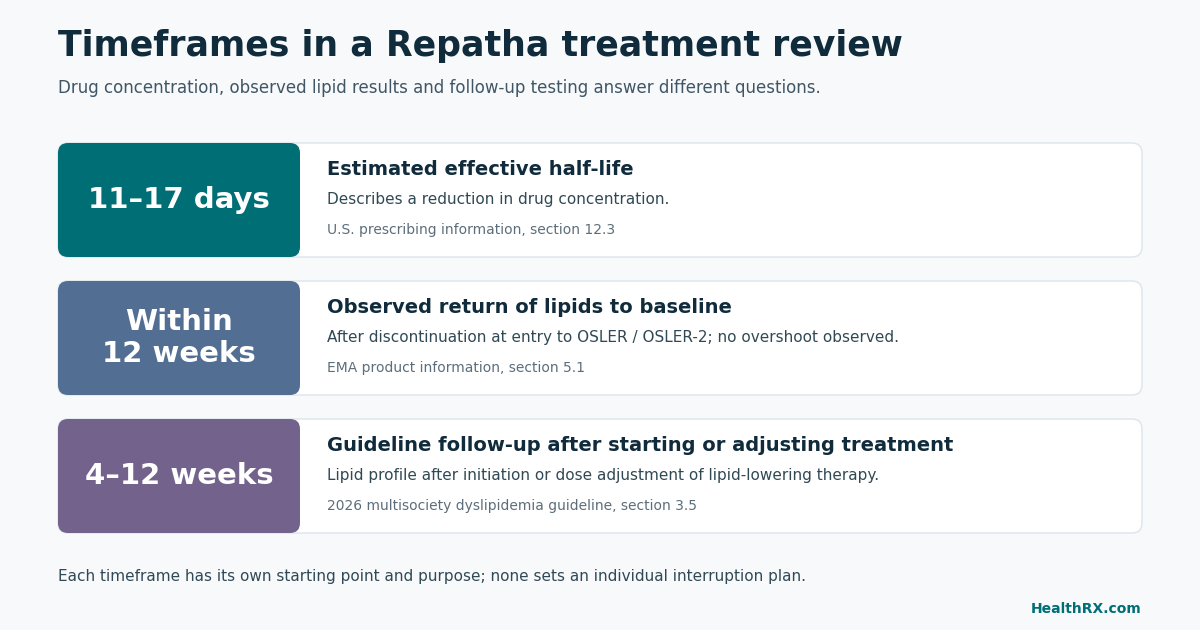
After Repatha is stopped, its cholesterol-lowering effect wears off. European product information describes LDL and other lipid measurements returning to baseline within 12 weeks after discontinuation at the beginning of OSLER or OSLER-2, without observed overshoot. This is a study observation, not a prediction of one person's next laboratory result or permission to leave treatment interrupted for 12 weeks. 2
A useful stop or restart discussion needs the actual injection dates, the reason for the interruption, other cholesterol medicines and a follow-up plan. An on-treatment LDL result alone cannot show what the result will be after one medicine is removed.
Establish which problem you are trying to solve
A single forgotten injection has schedule-specific instructions. Repeated gaps, a planned treatment change and a serious reaction require different decisions. Use the Repatha missed-dose guide for a known isolated lapse; do not extend its calendar rules into a universal restart protocol after months off treatment.
| Situation | Information to establish | Next question |
|---|---|---|
| One known missed injection | Prescribed interval and the date the dose was due | Which label instruction applies to that schedule? |
| Repeated gaps or a refill problem | Actual injection dates and when supply became unavailable | Who can resolve access and confirm the treatment plan? |
| A planned stop or switch | Reason, recent LDL results and all remaining treatment | What response and follow-up will determine whether the new plan is adequate? |
| Possible serious allergic reaction | Symptoms and timing relative to treatment | Is urgent assessment needed before any consideration of another dose? |
MedlinePlus advises discussing discontinuation with the treating clinician even when someone feels well. It also identifies breathing or swallowing difficulty and swelling of the face or throat as reasons for immediate medical attention. A suspected serious reaction changes the restart conversation. 7
Separate clearance, cholesterol change and event risk
The U.S. label estimates evolocumab's effective half-life at 11 to 17 days. A half-life describes a reduction in drug concentration; it does not mean all medicine is gone after that interval or that its effect stays constant until a particular final day. 1
The OSLER observation above addresses lipid measurements after stopping. It does not establish a fixed time at which everyone returns to an identical pretreatment LDL level. Background medicines and other changes also matter when interpreting a later measurement. 2
Cardiovascular outcome evidence answers another question. FOURIER randomized 27,564 people with established atherosclerotic cardiovascular disease receiving statins. Over median follow-up of 2.2 years, its primary cardiovascular outcome occurred in 9.8% with evolocumab and 11.3% with placebo, with a hazard ratio of 0.85. The composite included cardiovascular death, heart attack, stroke, hospitalization for unstable angina and coronary revascularization. 3
Those results compare assigned treatment groups over follow-up. They do not calculate the immediate risk from an individual's eight-week interruption or establish that a brief gap is harmless. Likewise, a later LDL rise cannot tell you that a cardiovascular event is about to occur. Discuss the treatment decision using the person's underlying risk and available alternatives.
Make the follow-up record useful
Keep the last confirmed injection date separate from the date a prescription was filled. A collected carton does not establish when its contents were used. When reviewing LDL results, record which medicines were actually being taken at each blood draw.
| Information to record | Why it matters to the review |
|---|---|
| Last confirmed injection and prescribed interval | Establishes the treatment history being discussed |
| LDL result before Repatha, with date and background medicines | Provides a documented comparison rather than a remembered number |
| Most recent on-treatment LDL and blood-draw date | Shows the result under the regimen used then |
| Other treatment changes during the gap | Helps avoid attributing every change to Repatha alone |
| Agreed follow-up test and review dates | Makes responsibility for interpreting the next result explicit |
| Next step if response is inadequate | Identifies who will reconsider treatment and what information they need |
For initiation or dose adjustment of lipid-lowering treatment, section 3.5 of the 2026 multisociety guideline recommends a lipid profile after 4 to 12 weeks, followed by monitoring every 6 to 12 months. That recommendation's scope does not establish a trial-tested, Repatha-specific rule requiring fasting tests at both week four and week eight after every stop. Agree on testing in the context of the actual treatment change. 4
If the prescriber requests a blood test, ask when to obtain it and whether fasting is needed for the particular tests ordered. Take the injection and medicine record to the review. Comparing results without their treatment context can make an apparent failure difficult to interpret.
Work through the reason for stopping
For a symptom concern, describe what happened and when, including whether another medicine changed. For help interpreting trial and patient-report evidence, use the Repatha review and side-effect guide. Symptom assessment and deciding whether a treatment is still needed are related questions; one should not substitute for the other.
For an access problem, ask the pharmacy about the actual prescription, quantity, days' supply and estimate. Clarify who is handling any coverage issue and how to contact that person before the next intended dose. Amgen lists current support options and program terms; a price quoted in an old forum post may describe a different arrangement. 6
If you are reconsidering a stop, explain what changed: a new LDL result, the problem that led to stopping, or access to treatment. Those details can support a fresh decision without assuming that everyone who stops feels regret. Ask whether an existing insurance authorization can still be used; do not assume a universal renewal rule after a particular number of days.
If another treatment is proposed, compare the intended LDL response, what will remain in the regimen and how the change will be checked. The ACC's 2026 guideline summary describes statins as the treatment foundation and identifies nonstatin options when additional lowering is needed. It does not make every available cholesterol medicine an equivalent substitute for a particular Repatha regimen. 10
For example, CLEAR Outcomes studied bempedoic acid in 13,970 statin-intolerant participants. Its primary cardiovascular outcome occurred in 11.7% versus 13.3% with placebo over median follow-up of 40.6 months. That is evidence in its own study population, not a trial establishing a universal bridge or switch schedule after evolocumab. 9
A restart review needs more than the old prescription
The current Repatha label has no separate tapering protocol for stopping and no universal reloading schedule after a long interruption. The prescriber needs to confirm the intended regimen against the reason for stopping and any changes since then. Do not infer that an instruction for one missed dose settles those questions. 1
Bring the earlier prescription and current medicine list, explain the length of the gap, and make sure any earlier suspected reaction is discussed. Check that the product available for use is the one now prescribed and that its storage history can be established. A prior prescription date, a remembered dose or an unopened carton does not resolve every part of that review.
Frequently asked questions
Can I stop Repatha cold turkey?
How long does it take for Repatha to leave your system?
Will my cholesterol spike higher than before if I stop Repatha?
Is it dangerous to stop taking Repatha?
What should I take instead of Repatha if I stop?
How does Repatha work to lower cholesterol?
Can I take Repatha every other month to save money?
Do I need blood tests after stopping Repatha?
Will stopping Repatha cause muscle pain?
Can I restart Repatha after stopping it?
Does stopping Repatha affect lipoprotein(a)?
Is there a generic version of Repatha?
References
- DailyMed. Repatha U.S. prescribing information and patient instructions, current Amgen label set. Current label.
- European Medicines Agency. Repatha product information, section 5.1: OSLER and OSLER-2 discontinuation observations. Product information.
- Sabatine MS et al. Evolocumab and clinical outcomes in patients with cardiovascular disease. New England Journal of Medicine, 2017. Primary trial abstract.
- 2026 ACC/AHA multisociety guideline on the management of dyslipidemia, section 3.5: monitoring and follow-up. Primary guideline.
- Raal FJ et al. PCSK9 inhibition-mediated reduction in Lp(a) with evolocumab: an analysis of 10 clinical trials and the LDL receptor's role. Journal of Lipid Research, 2016. Primary pooled-analysis abstract.
- Amgen. Repatha patient resources and support. Current manufacturer support information.
- MedlinePlus. Evolocumab injection: treatment continuation and symptom advice. Patient information.
- FDA. Purple Book database of licensed biological products, advanced search for evolocumab; database edition September 30, 2026. FDA product database.
- Nissen SE et al. Bempedoic acid and cardiovascular outcomes in statin-intolerant patients. New England Journal of Medicine, 2023. Primary CLEAR Outcomes abstract.
- American College of Cardiology. ACC/AHA issue updated guideline for managing lipids, cholesterol, March 13, 2026. Guideline summary.