Zetia Adult (30-49) Dosing: Ezetimibe Dose, Timing, and Clinical Evidence

Medical lab testing image for Zetia Adult (30-49) Dosing: Ezetimibe Dose, Timing, and Clinical Evidence

At a glance

  • Standard dose / 10 mg orally once daily
  • Dosage forms available / 10 mg tablet only (no other strengths exist)
  • Food requirement / none, take with or without food
  • Renal dose adjustment / not required at any eGFR level
  • Hepatic dose adjustment / not required for mild impairment; avoid in moderate-to-severe hepatic disease
  • LDL-C reduction (monotherapy) / approximately 18-20% from baseline
  • LDL-C reduction (add-on to statin) / additional 18-25 percentage points
  • IMPROVE-IT cardiovascular outcome / 6.4% relative MACE reduction vs. Simvastatin alone over 7 years
  • Mechanism / selectively inhibits NPC1L1 cholesterol transporter in small intestine
  • Drug class / cholesterol absorption inhibitor

What Is the Standard Ezetimibe Dose for Adults Aged 30 to 49?

The approved dose of ezetimibe is 10 mg once daily for all adults, including those aged 30 to 49. Only one tablet strength exists: the 10 mg oral tablet. Physicians do not titrate ezetimibe up or down based on LDL response the way they adjust statin doses, because 10 mg represents the full approved and studied dose. Taking the tablet at roughly the same time each day supports adherence, though the precise clock time has no pharmacokinetic consequence.

Why There Is Only One Dose

Ezetimibe's dose-response curve flattens sharply above 10 mg. Studies submitted to the FDA during the original New Drug Application showed that 25 mg and 50 mg doses produced only marginal additional LDL-C reductions compared with 10 mg, while adverse event rates climbed. The FDA therefore approved only the 10 mg strength. The current prescribing information confirmed by the FDA lists 10 mg once daily as the sole recommended adult dose. Ezetimibe (Zetia) prescribing information, FDA label.

Timing and Food

No meal timing restriction exists. Ezetimibe's bioavailability is not meaningfully affected by high-fat or low-fat meals. Adults who take a statin in the evening (a common practice for short-acting statins) may find it convenient to take ezetimibe at the same time, simplifying their regimen. The 2022 ACC/AHA cholesterol guideline states that adherence to lipid-lowering therapy is a key determinant of long-term cardiovascular risk reduction, so whichever time of day a patient will actually remember is the right time.


How Much Does Ezetimibe Lower LDL-C?

Ezetimibe 10 mg daily lowers LDL-C by roughly 18 to 20% as monotherapy. The effect is additive when combined with a statin, producing an extra 18 to 25 percentage-point reduction on top of the statin's effect. A 2014 meta-analysis published in the European Heart Journal (N=27,000 pooled participants) confirmed that adding ezetimibe to any statin intensity consistently produced this incremental LDL-C reduction Cannon CP et al., NEJM 2015, IMPROVE-IT, PMID 26039521.

Absolute Numbers in Real Patients

A 38-year-old with a baseline LDL-C of 160 mg/dL on moderate-intensity atorvastatin (which might bring LDL-C to 100 mg/dL) could expect ezetimibe to push LDL-C to roughly 75 to 82 mg/dL. That is often enough to meet the ACC/AHA guideline target of <70 mg/dL for high-risk patients or to avoid escalating to a more expensive PCSK9 inhibitor. For adults in their 30s and 40s who are beginning statin therapy for newly detected hypercholesterolemia, reaching that target earlier in life translates to decades of reduced atherosclerotic burden.

Monotherapy vs. Combination: When Each Applies

Ezetimibe monotherapy is appropriate when a patient cannot tolerate any statin dose. Combination with a statin is far more common in clinical practice for adults aged 30 to 49, particularly those with familial hypercholesterolemia (FH), early atherosclerotic cardiovascular disease (ASCVD), or LDL-C persistently above 100 mg/dL despite statin optimization. The 2018 AHA/ACC Multi-Society Cholesterol Guideline recommends ezetimibe as the preferred first add-on agent after a maximally tolerated statin in very-high-risk patients, specifically because of its cardiovascular outcome data and favorable cost profile Grundy SM et al., Circulation 2019, PMID 30586774.


IMPROVE-IT Trial: The Cardiovascular Outcome Evidence

IMPROVE-IT (IMProved Reduction of Outcomes: Vytorin Efficacy International Trial) is the only large cardiovascular outcomes trial for ezetimibe and remains the cornerstone of prescribing confidence for clinicians treating adults in this age group Cannon CP et al., NEJM 2015, PMID 26039521.

Trial Design and Population

IMPROVE-IT enrolled 18,144 patients who had experienced an acute coronary syndrome (ACS) within the preceding 10 days. Patients were randomized to simvastatin 40 mg plus ezetimibe 10 mg versus simvastatin 40 mg plus placebo. Median follow-up was 6 years, with some patients followed up to 7 years. The primary composite endpoint was cardiovascular death, major coronary events, or non-fatal stroke.

Key Results

The ezetimibe group achieved a mean LDL-C of 53.7 mg/dL versus 69.5 mg/dL in the placebo group. The primary endpoint occurred in 32.7% of patients in the ezetimibe arm versus 34.7% in the placebo arm, an absolute risk reduction of 2.0 percentage points and a 6.4% relative risk reduction (hazard ratio 0.936, 95% CI 0.887-0.988, P=0.016) Cannon CP et al., NEJM 2015, PMID 26039521. As the trial investigators stated in their published report: "The addition of ezetimibe to statin therapy resulted in incremental lowering of LDL cholesterol levels and improved cardiovascular outcomes."

What IMPROVE-IT Means for Adults Aged 30 to 49

IMPROVE-IT was not limited to older patients. Adults aged 30 to 49 with ACS, established ASCVD, or familial hypercholesterolemia represent a group with decades of cardiovascular exposure ahead of them. Starting ezetimibe in this decade of life compounds the benefit over time. A 10 mg/dL lower LDL-C sustained over 40 years of adult life produces substantially greater plaque-stabilization effects than the same reduction started at age 65.


Ezetimibe Dosing in Combination Regimens

With Statins

No dose modification to ezetimibe is necessary when adding it to any approved statin. The 10 mg dose is fixed. However, the statin partner may require attention. Ezetimibe combined with simvastatin should not exceed simvastatin 40 mg per day when used together (as Vytorin or co-administered generics) because of the known myopathy risk at simvastatin 80 mg. The FDA updated simvastatin labeling to reflect this restriction FDA Drug Safety Communication, simvastatin 80 mg, 2011. For adults in their 30s and 40s who need aggressive LDL reduction, atorvastatin or rosuvastatin plus ezetimibe is often a better backbone than simvastatin plus ezetimibe.

With PCSK9 Inhibitors

When a PCSK9 inhibitor (evolocumab or alirocumab) is added to background statin therapy, ezetimibe may also be continued. The three-drug combination produces LDL-C levels well below 40 mg/dL in many patients. FOURIER (N=27,564, evolocumab) and ODYSSEY OUTCOMES (N=18,924, alirocumab) both enrolled patients on background statin therapy, with a proportion also taking ezetimibe, and demonstrated safety across that combination Sabatine MS et al., NEJM 2017, PMID 28304224. No ezetimibe dose change is required in this combination.

With Bile Acid Sequestrants

Cholestyramine and colesevelam can reduce ezetimibe absorption. When co-administering a bile acid sequestrant, ezetimibe should be taken either 2 hours before or 4 hours after the sequestrant. This timing separation preserves ezetimibe's bioavailability without requiring any dose change.

With Fibrates

Co-administration with fenofibrate is acceptable and produces complementary LDL-C and triglyceride effects. Gemfibrozil co-administration is listed as a potential concern in older labeling due to theoretical increases in ezetimibe glucuronide concentrations. Clinically, gemfibrozil is rarely co-prescribed today given the availability of fenofibrate and omega-3 agents FDA ezetimibe prescribing information.


Dosing Adjustments for Special Populations in the 30-49 Age Group

Renal Impairment

No dose adjustment is required for ezetimibe in any degree of renal impairment, including patients on dialysis. This makes ezetimibe a useful lipid-lowering option for adults in their 30s and 40s who develop chronic kidney disease, a population in whom statin titration can be more constrained. A 2021 Cochrane review on lipid-lowering in CKD confirmed the safety of ezetimibe across renal function stages Cochrane Database: Lipid-lowering agents for chronic kidney disease.

Hepatic Impairment

Mild hepatic impairment (Child-Pugh score 5 to 6) does not require a dose change. Ezetimibe is not recommended for patients with moderate (Child-Pugh 7 to 9) or severe hepatic impairment because exposure to ezetimibe glucuronide increases substantially and safety data are limited. Adults in their 30s and 40s with non-alcoholic fatty liver disease (NAFLD) at mild severity can generally receive ezetimibe safely. This is clinically relevant because NAFLD prevalence peaks in the fourth and fifth decades.

Pregnancy and Lactation

Ezetimibe is contraindicated in pregnancy (FDA Category X when used with a statin, and generally avoided as monotherapy). Women in the 30 to 49 age group who are pregnant or planning pregnancy should discontinue ezetimibe. Lipid-lowering therapy in pregnancy is limited to bile acid sequestrants, which are not systemically absorbed ACOG Practice Bulletin on cardiovascular conditions in pregnancy.

Pediatric Patients Turning 18 (Lower End of Adult Range)

Adults who were on ezetimibe for heterozygous FH as adolescents transition to the same 10 mg adult dose. No pharmacokinetic bridging study is required; the dose is identical.


Mechanism of Action: Why the Dose Is Fixed at 10 mg

Ezetimibe targets the Niemann-Pick C1-Like 1 (NPC1L1) protein on the apical surface of small intestinal enterocytes. NPC1L1 mediates absorption of both dietary cholesterol and biliary cholesterol recycled from the liver. At 10 mg, ezetimibe saturates the NPC1L1 binding sites across the length of the intestinal brush border, achieving near-maximal inhibition of cholesterol transport. Doses above 10 mg do not reach additional receptor populations because NPC1L1 occupancy at 10 mg is already near ceiling Altmann SW et al., Science 2004, PMID 14976318. This receptor-saturation pharmacology explains the fixed dosing strategy and the predictable 18 to 20% LDL-C reduction across patient populations.

The liver compensates for reduced intestinal cholesterol delivery by upregulating hepatic LDL receptors. This upregulation mechanism is the same pathway statins amplify via HMG-CoA reductase inhibition, which explains why combining the two drug classes produces additive rather than merely additive-but-diminishing LDL reductions.


Starting Ezetimibe in Adults Aged 30 to 49: A Clinical Decision Framework

The following stepwise framework reflects ACC/AHA 2018 cholesterol guideline logic applied specifically to adults in the 30 to 49 age range.

Step 1. Calculate 10-year ASCVD risk. Use the Pooled Cohort Equations via the ACC ASCVD Risk Estimator. Adults aged 30 to 39 often fall below the 7.5% threshold for statin initiation on risk alone, but LDL-C above 160 mg/dL or the presence of FH typically overrides this.

Step 2. Optimize statin therapy first. Before adding ezetimibe, confirm the patient is on a maximally tolerated statin dose. Ezetimibe added to a subtherapeutic statin leaves LDL-C reduction on the table.

Step 3. Check LDL-C on statin after 6 to 12 weeks. If LDL-C remains above 70 mg/dL for very-high-risk patients or above 100 mg/dL for high-risk patients, add ezetimibe 10 mg once daily.

Step 4. Recheck LDL-C 6 weeks after adding ezetimibe. Expect an additional 18 to 25 mg/dL absolute LDL reduction. If the target is still not met and the patient has clinical ASCVD, consider referral for PCSK9 inhibitor therapy per guideline thresholds.

Step 5. Reassess annually. LDL-C, hepatic function (if any hepatic risk factors), and medication adherence should be reviewed each year Grundy SM et al., Circulation 2019, PMID 30586774.

Adults in their 30s and 40s face a particular adherence challenge. They are typically asymptomatic, professionally active, and less conditioned to daily medication habits than older adults with overt cardiovascular disease. Prescribers treating this age group may find that combination pills (e.g., ezetimibe/atorvastatin fixed-dose generics now available) improve adherence by reducing pill count.


Side Effects and Safety Profile Relevant to the 30-49 Age Group

Ezetimibe's tolerability profile is favorable. In IMPROVE-IT (N=18,144), the rates of myopathy, rhabdomyolysis, and hepatic enzyme elevations were not statistically different between the ezetimibe and placebo arms when both groups were on background simvastatin Cannon CP et al., NEJM 2015, PMID 26039521.

Musculoskeletal Symptoms

When ezetimibe is added to a statin in a patient experiencing myalgia, it is the statin rather than ezetimibe that is the more probable cause. Ezetimibe monotherapy has not been associated with significant myopathy risk in any large trial.

Liver Enzymes

Transaminase elevations above three times the upper limit of normal occurred in 1.3% of patients on ezetimibe plus simvastatin in IMPROVE-IT versus 1.1% on simvastatin alone, not a clinically significant difference. Routine LFT monitoring is not mandated by current guidelines for ezetimibe, unlike older statin labeling.

GI Symptoms

The most commonly reported adverse effects in clinical trials are GI-related: diarrhea (4.1% vs. 3.7% placebo) and abdominal pain. These are generally mild, transient, and rarely lead to discontinuation. Adults in their 30s and 40s with irritable bowel syndrome or other functional GI disorders should be informed that GI symptoms are possible.

Drug Interactions Affecting Safety

Cyclosporine substantially increases ezetimibe exposure (up to 12-fold). Adults in this age group who received kidney or liver transplants and are on cyclosporine should use ezetimibe with caution and may need closer monitoring, though a specific dose reduction is not defined in the label FDA ezetimibe prescribing information.


Ezetimibe vs. Statin Dose Doubling: Which Gets More LDL Reduction?

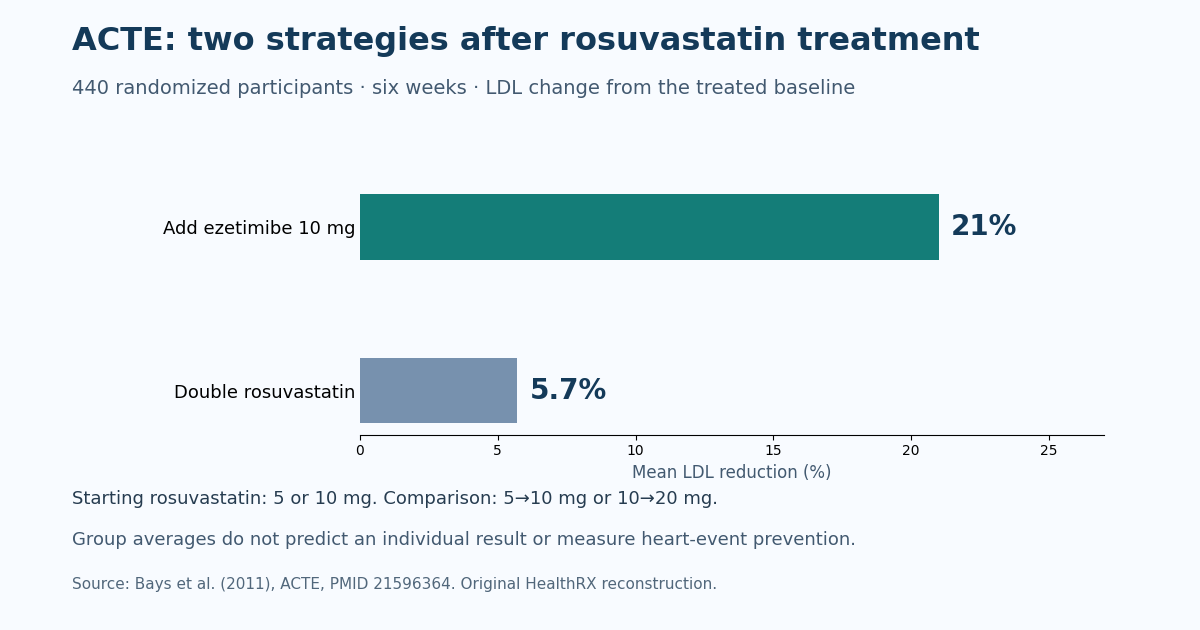
A commonly taught rule in lipid pharmacology is the "rule of sixes": doubling a statin dose produces only about a 6% additional LDL-C reduction. Adding ezetimibe to a statin produces 18 to 25% additional LDL-C reduction, three to four times the incremental benefit of statin dose doubling. For a 42-year-old on atorvastatin 40 mg with LDL-C of 95 mg/dL who needs to reach 70 mg/dL, adding ezetimibe 10 mg is both more effective and less likely to trigger statin-associated muscle symptoms than escalating to atorvastatin 80 mg Grundy SM et al., Circulation 2019, PMID 30586774. Atorvastatin 80 mg is the only statin dose for which myopathy risk rises materially above moderate doses; switching from 40 mg to ezetimibe add-on avoids that exposure.


How Ezetimibe Fits Into ACC/AHA Guideline Tiers for Adults 30-49

The 2018 AHA/ACC Multi-Society Cholesterol Guideline places ezetimibe at a defined position in the treatment cascade Grundy SM et al., Circulation 2019, PMID 30586774:

  • Tier 1: Lifestyle modification for all patients.
  • Tier 2: Maximally tolerated statin.
  • Tier 3: Ezetimibe 10 mg added to statin (Class IIa, Level of Evidence A for very-high-risk ASCVD).
  • Tier 4: PCSK9 inhibitor if LDL-C remains above 70 mg/dL on statin plus ezetimibe in very-high-risk patients.

For adults aged 30 to 49 with heterozygous FH, the European Atherosclerosis Society (EAS) 2019 guideline recommends combination therapy including ezetimibe early in treatment because LDL-C targets of <70 mg/dL or even <55 mg/dL are nearly impossible to achieve with statin monotherapy in FH. The EAS guideline states that "in FH patients at very high risk, an LDL-C reduction of at least 50% and an LDL-C goal of <1.4 mmol/L (<55 mg/dL) is recommended," which typically requires ezetimibe as part of the regimen Mach F et al., EHJ 2020, PMID 31504418.


Cost and Generic Availability

Ezetimibe went off-patent in 2017. Generic ezetimibe 10 mg tablets are now widely available at approximately $10 to $20 per month with pharmacy discount programs, making cost a minimal barrier for most adults aged 30 to 49. Fixed-dose combination tablets containing ezetimibe 10 mg plus atorvastatin (in 10, 20, 40, or 80 mg statin strengths) are also available as generics, providing a lower pill-count option. Brand-name Zetia remains on the market for patients with specific insurance coverage structures that favor it.


Frequently asked questions

What is the standard ezetimibe (Zetia) dose for adults aged 30 to 49?
The dose is 10 mg orally once daily. This is the only approved tablet strength. No titration is performed based on LDL response because 10 mg represents the full approved dose.
Can ezetimibe be taken with or without food?
Yes. Ezetimibe bioavailability is not meaningfully changed by food. Adults can take it with breakfast, dinner, or on an empty stomach, whichever is easiest to remember consistently.
How much does ezetimibe lower LDL cholesterol?
As monotherapy, ezetimibe lowers LDL-C by approximately 18 to 20% from baseline. Added to a statin, it provides an additional 18 to 25 percentage-point reduction beyond what the statin achieves alone.
Does ezetimibe reduce heart attack risk?
Yes. In IMPROVE-IT (N=18,144), ezetimibe added to simvastatin reduced the composite of cardiovascular death, major coronary events, and non-fatal stroke by 6.4% relatively and 2.0 percentage points absolutely over a median of 6 years compared with simvastatin alone.
Does ezetimibe require dose adjustment for kidney disease?
No. No dose adjustment is needed at any level of renal impairment, including patients on dialysis. This makes ezetimibe practical for adults in their 30s and 40s with chronic kidney disease.
Is ezetimibe safe in mild fatty liver disease (NAFLD)?
Ezetimibe is generally considered safe in mild hepatic impairment (Child-Pugh 5-6). It is not recommended in moderate or severe hepatic impairment. Adults with NAFLD at mild severity can usually receive it safely, though the prescriber should monitor liver function.
Can ezetimibe be taken during pregnancy?
No. Ezetimibe is contraindicated in pregnancy. Women in the 30 to 49 age group who are pregnant or planning to become pregnant should stop ezetimibe and discuss alternative lipid management with their physician.
Is adding ezetimibe better than doubling a statin dose?
For most patients, yes. The rule of sixes states that doubling a statin dose reduces LDL-C by only about 6% more. Adding ezetimibe reduces LDL-C by 18 to 25% more. Ezetimibe add-on is typically more effective and carries a lower risk of muscle side effects than statin dose escalation.
What time of day should ezetimibe be taken?
Any consistent time works. There is no pharmacokinetic reason to prefer morning or evening. Taking it at the same time as a once-daily statin can simplify adherence.
Can ezetimibe be combined with a PCSK9 inhibitor?
Yes. Ezetimibe, statin, and a PCSK9 inhibitor such as evolocumab or alirocumab can be used together. This triple combination is appropriate for very-high-risk patients with familial hypercholesterolemia or recurrent ACS who cannot reach LDL-C targets on a statin plus ezetimibe alone.
Are there generic versions of ezetimibe available?
Yes. Generic ezetimibe 10 mg became available in 2017. Monthly costs with pharmacy discount programs are typically $10 to $20. Fixed-dose combination generics with atorvastatin are also available, reducing pill count.
Does ezetimibe cause muscle pain like statins?
Ezetimibe alone is not associated with significant myopathy risk. In IMPROVE-IT, myopathy rates were similar between ezetimibe plus simvastatin and placebo plus simvastatin groups. When a patient on combination therapy has muscle symptoms, the statin is the more likely cause.

References

  1. Cannon CP, Blazing MA, Giugliano RP, et al. Ezetimibe added to statin therapy after acute coronary syndromes. N Engl J Med. 2015;372(25):2387-2397. https://pubmed.ncbi.nlm.nih.gov/26039521/
  2. Grundy SM, Stone NJ, Bailey AL, et al. 2018 AHA/ACC/AACVPR/AAPA/ABC/ACPM/ADA/AGS/APhA/ASPC/NLA/PCNA Guideline on the Management of Blood Cholesterol. Circulation. 2019;139(25):e1082-e1143. https://pubmed.ncbi.nlm.nih.gov/30586774/
  3. Sabatine MS, Giugliano RP, Keech AC, et al. Evolocumab and clinical outcomes in patients with cardiovascular disease. N Engl J Med. 2017;376(18):1713-1722. https://pubmed.ncbi.nlm.nih.gov/28304224/
  4. Altmann SW, Davis HR Jr, Zhu LJ, et al. Niemann-Pick C1 Like 1 protein is critical for intestinal cholesterol absorption. Science. 2004;303(5661):1201-1204. https://pubmed.ncbi.nlm.nih.gov/14976318/
  5. Mach F, Baigent C, Catapano AL, et al. 2019 ESC/EAS Guidelines for the management of dyslipidaemias. Eur Heart J. 2020;41(1):111-188. https://pubmed.ncbi.nlm.nih.gov/31504418/
  6. Ezetimibe (Zetia) prescribing information. US Food and Drug Administration. 2023. https://www.accessdata.fda.gov/drugsatfda_docs/label/2023/021445s047lbl.pdf
  7. FDA Drug Safety Communication: New restrictions, contraindications, and dose limitations for Zocor (simvastatin) to reduce the risk of muscle injury. US Food and Drug Administration. 2011. https://www.fda.gov/drugs/drug-safety-and-availability/fda-drug-safety-communication-new-restrictions-contraindications-and-dose-limitations-zocor
  8. Palmer SC, Navaneethan SD, Craig JC, et al. HMG CoA reductase inhibitors (statins) for people with chronic kidney disease not requiring dialysis. Cochrane Database Syst Rev. 2014. https://www.cochranelibrary.com/cdsr/doi/10.1002/14651858.CD007784.pub3/full
  9. ACOG Practice Bulletin No. 212: Pregnancy and heart disease. Obstet Gynecol. 2019;133(5):e320-e356. https://www.acog.org/clinical/clinical-guidance/practice-bulletin/articles/2019/06/pregnancy-and-heart-disease