Stopping Ezetimibe: Keep the Medicine Change and the LDL Result Separate
Stopping ezetimibe raises two separate questions: what should change in your prescription, and what happens to your cholesterol afterward? A blood test can answer part of the second question. It cannot, by itself, decide the first. A useful stopping plan records the exact medicine change, the reason for it, and how you and your prescriber will judge the result.
There is no standard ezetimibe discontinuation calendar in the prescribing information. The label gives a usual dose of 10 mg daily and does not provide a taper. That does not establish that stopping is appropriate for everyone.[1] A normal LDL result while taking treatment may mean the treatment is working; it does not establish that you no longer need it.
Start with the actual pack
Bring the medicine pack, a photo of its label, or an accurate medication list to the discussion. Check the active ingredients and strength, rather than relying only on a familiar brand name.
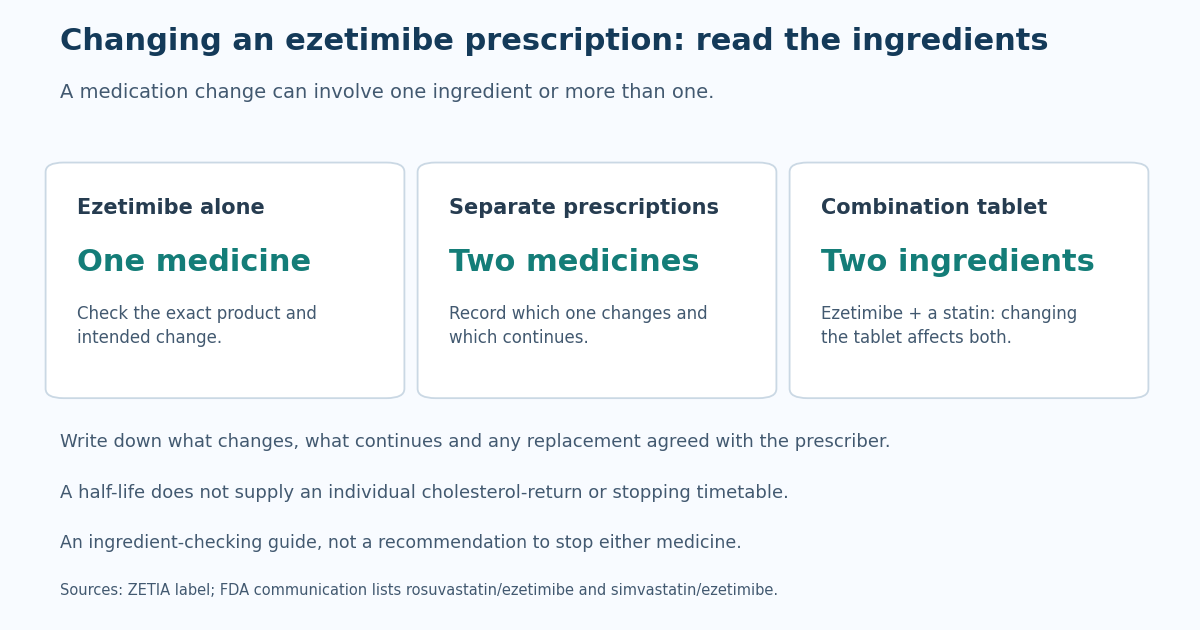
If one tablet contains ezetimibe and a statin, stopping that whole tablet changes two medicines. Continuing the statin may require a separate prescription. The subsequent LDL result would otherwise reflect withdrawal of both ingredients, making it misleading to attribute the whole change to ezetimibe.[7]
Also clarify what happens to every other lipid-lowering drug. Starting a PCSK9 inhibitor does not automatically mean ezetimibe should stop. A switch to bempedoic acid cannot be assumed to preserve the same LDL level from day one. Inclisiran does not create a standard ezetimibe “bridge” schedule. The exact regimen, treatment goals, access, tolerance, and follow-up all matter.[3,4]
Make a dated record before interpreting the result
Use one row for the agreed change and another for each reassessment. Enter actual dates and results; leave unknown information blank rather than estimating it. This record is a discussion aid, not a stopping protocol.
| Record point | What to record | Why it helps interpret the result |
|---|---|---|
| Before the agreed change | Date, exact product and ingredients, current dose, reason for review, latest on-treatment lipid panel, and symptoms with onset dates | Identifies what the current regimen achieves and the concern prompting review |
| When the change happens | Actual date and last dose, the ingredient or whole tablet changed, medicines continuing, any replacement and its actual start date | Separates the intended prescription from the regimen actually taken |
| At follow-up | Current medicines and missed doses, dated lipids with units, symptom changes, other health or treatment changes, and the next agreed review | Helps compare like-for-like results and identify what needs reassessment |
Recording what actually happened is important. A prescription change and a medicine change are not always the same event: a replacement may be delayed, an old pack may still be used, or doses may be missed.
Interpret an LDL rise as a treatment-response question
Ezetimibe reduces intestinal cholesterol absorption through NPC1L1. Its parent drug and active glucuronide have half-lives of about 22 hours, with enterohepatic recycling. These facts do not establish an exact day when its effect disappears or predict a person's LDL trajectory.[1]
After stopping, loss of the drug's LDL-lowering contribution can allow LDL to rise. The size of that rise depends on the rest of the regimen and other circumstances. Compare the new result with a dated on-treatment panel and, if available, an earlier untreated result. Note changes in adherence, diet, weight, illness, and other medicines.
A result above an old baseline does not by itself prove a withdrawal-related “overshoot.” Baselines may have been measured under different conditions. The sources here establish neither a predictable overshoot nor its universal absence. Likewise, one favorable panel after stopping does not establish a permanent cure or remove the need for later review.
Keep cardiovascular evidence in its proper role
An LDL measurement describes a lipid response. Cardiovascular outcome research addresses events over time, in defined groups receiving defined treatments.
In IMPROVE-IT, 18,144 people enrolled within 10 days of an acute coronary syndrome received simvastatin 40 mg with either ezetimibe 10 mg or placebo. Median follow-up was six years. The seven-year estimated composite event rates were 32.7% and 34.7%, respectively: a two-percentage-point absolute difference. This was an adding-treatment trial, not a withdrawal trial.[2]
Those findings support benefit in the studied setting. They do not supply a personal risk estimate for stopping ezetimibe alone, an LDL return timetable, or a rule based on an arbitrary two-year window after an event. Your medication decision also depends on your cardiovascular history, treatment tolerance, and current goals.
The 2026 dyslipidemia guideline replaces the 2018 guideline. Its official ACC summary describes statins as foundational treatment, with additional medicines selected individually. It also notes that cardiovascular outcomes with inclisiran remain under study. None of this creates an automatic stop rule when another drug is added.[3,4]
Agree on safety and follow-up
Discuss suspected adverse effects before making a routine change. Serious muscle injury can occur, and liver-enzyme abnormalities deserve assessment. Severe muscle pain or weakness, dark urine, or jaundice warrants prompt medical evaluation; do not assume the statin should simply continue or that it must be the cause.[1]
For laboratory follow-up, National Lipid Association guidance describes lipid testing generally 4–12 weeks after a treatment change. That is a monitoring framework, not an ezetimibe-withdrawal trial or a mandatory schedule. Agree on timing based on the reason for stopping and the remaining treatment.[5]
For surgery, the UKCPA perioperative handbook recommends continuing ezetimibe, including ezetimibe/simvastatin, and restarting at the next scheduled dose afterward. This is UK professional guidance; confirm your surgical team's instructions for your actual medicines.[6]
Lifestyle changes can contribute to LDL control, but whether they can replace medication is individual. Finish the discussion with a clear current regimen, a test date, and an agreed response to symptoms or an LDL result outside your intended range.
Frequently asked questions
Can you stop Zetia cold turkey?
The prescribing information does not provide a taper. That does not decide whether you should stop. Agree on an individual plan with your prescriber, especially if your tablet also contains a statin.[1]
Does stopping ezetimibe cause a cholesterol overshoot above baseline?
The sources here do not validate a predictable overshoot or prove that it never occurs. A higher result may reflect loss of treatment effect or other changes. Compare dated results and the medicines taken at each test.[1]
How long does it take for ezetimibe to leave your system?
The parent drug and active glucuronide have half-lives of about 22 hours, with enterohepatic recycling. This does not establish an exact clearance day, a day of zero effect, or a personal LDL timetable.[1]
Will my cholesterol go up if I stop ezetimibe?
LDL may rise as its treatment effect is lost, but the amount is not guaranteed. Other medicines, adherence, lifestyle, and health changes affect the result. Follow-up testing measures your response.[1]
How is Zetia different from statins?
Zetia is ezetimibe, which reduces intestinal cholesterol absorption. Statins reduce cholesterol production in the liver. They can be prescribed together, including in a combination tablet; stopping that tablet changes both treatments.[7]
Is it safe to stop ezetimibe before surgery?
Do not stop it automatically. The UKCPA handbook recommends continuation for elective and emergency surgery, including ezetimibe/simvastatin, with the next scheduled dose after surgery. Confirm your own surgical team's instructions.[6]
Can lifestyle changes replace ezetimibe after stopping?
Possibly for some people, but there is no blanket answer. The decision depends on cardiovascular risk, the LDL response to lifestyle changes, and the remaining treatment. Agree on measurable goals and reassessment rather than assuming replacement will work.[4]
Should I stop ezetimibe if I start a PCSK9 inhibitor?
Not automatically. Your prescriber may retain it or change the regimen based on LDL goals, response, tolerance, and access. Clarify which medicines continue and when the new regimen will be assessed.[4]
Does ezetimibe cause withdrawal side effects?
The sources here do not establish a specific withdrawal syndrome or prove that every symptom after stopping is unrelated. Record symptoms and their timing. Seek prompt assessment for severe muscle symptoms, dark urine, or jaundice.[1]
How often should I check cholesterol after stopping Zetia?
General NLA guidance supports lipid testing 4–12 weeks after a treatment change. This is not a drug-specific stopping schedule. Agree on the first test and subsequent reviews with your prescriber; quarterly testing is not automatically required.[5]
References
Sources checked October 14, 2026.
- Organon. ZETIA prescribing information. Revised February 2024; DailyMed updated November 25, 2025. DailyMed.
- Cannon CP, Blazing MA, Giugliano RP, et al. Ezetimibe Added to Statin Therapy after Acute Coronary Syndromes. 2015. PubMed.
- Writing Committee Members, Blumenthal RS, Morris PB, et al. 2026 Dyslipidemia Guideline. PubMed.
- American College of Cardiology. ACC/AHA Issue Updated Guideline for Managing Lipids, Cholesterol. March 13, 2026. Official summary.
- Wilson PWF, Jacobson TA, Martin SS, et al. Lipid Measurements in the Management of Cardiovascular Diseases: Practical Recommendations from the National Lipid Association Writing Group. 2021. PubMed.
- UKCPA Handbook of Perioperative Medicines. Ezetimibe. Handbook entry.
- FDA. Statin safety communication and approved combination-product list. July20,2021. FDA.