Can You Catch Up on Sleep? What It Fixes and Doesn't
At a glance
- Best-supported baseline / adults should usually obtain at least 7 hours on a regular basis [1]
- One or two short nights / allow more sleep opportunity over the following nights instead of treating one long lie-in as a reset
- Repeated workweek restriction / weekend sleep can improve how sleepy you feel, but objective performance and metabolic measures may remain abnormal [3-5]
- Hour-for-hour repayment / not supported as a precise clinical formula
- Sleep need / varies by person, health, age, recent sleep history, and sleep quality
- Safety boundary / do not drive or perform hazardous work when struggling to stay awake
- Evaluation boundary / persistent sleepiness, loud snoring, breathing pauses, or unrefreshing sleep despite enough opportunity deserves clinical assessment [2]
- Medical review / pending
Editorial evidence status: This page was rebuilt on August 30, 2026 from the AASM/Sleep Research Society adult-duration consensus, current NHLBI guidance, a recovery-sleep review, and controlled sleep-restriction studies. Medical review is pending. The historical
lastRevieweddate has not been presented as a new medical approval.
The Useful Answer Is "Partly," Not "Yes" or "No"
Sleep pressure is real: it builds during wakefulness and falls during sleep. But sleep debt is a helpful description, not a bank account with a universal conversion rate. Studies measure different outcomes - sleepiness, reaction time, mood, inflammation, appetite, glucose regulation, and sleep architecture - and those outcomes do not recover together.
That is why two familiar statements can both be misleading:
- "You can erase the week by sleeping until noon on Saturday" assumes every effect resets on the same schedule.
- "Lost sleep can never be recovered" ignores evidence that extended recovery sleep improves several short-term outcomes.
The evidence supports a more practical conclusion: recovery sleep helps, but repeated restriction followed by repeated catch-up is an inferior strategy to making sufficient sleep the usual pattern.
Recovery Outcome Map
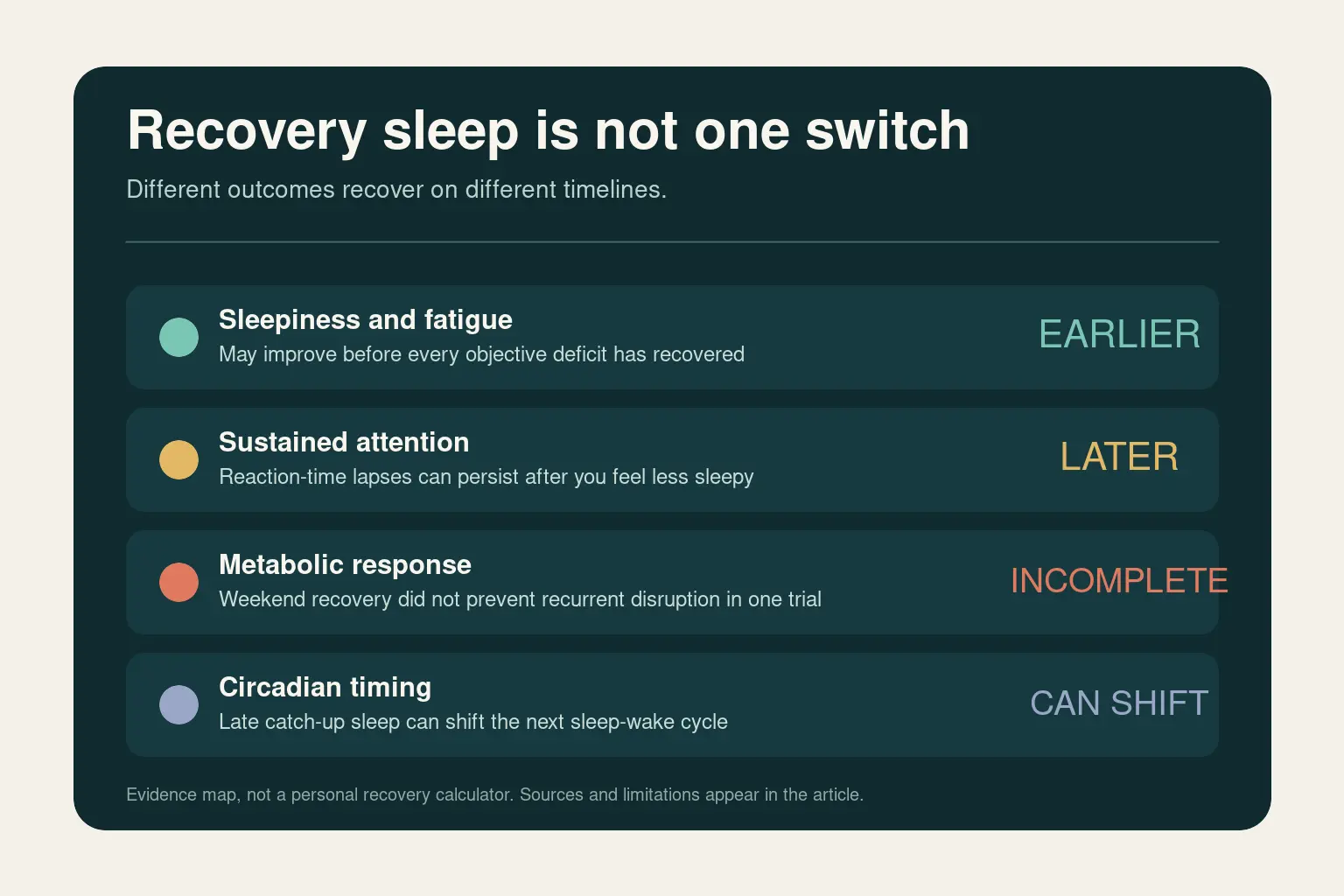
This table separates what improved from what remained impaired in controlled studies. It is not a personal recovery calculator. The protocols used small groups of mostly healthy younger adults and often imposed more restriction than ordinary life.
| Outcome | What the study tested | What recovery sleep changed | What readers can conclude |
|---|---|---|---|
| Sleepiness and fatigue | Six nights at 6 hours, followed by extended recovery in 30 healthy adults [4] | Subjective and objective sleepiness returned to baseline after recovery | Feeling better after extra sleep is a real response |
| Sustained attention | The same controlled protocol [4] | Psychomotor vigilance performance did not return to baseline | Feeling alert is not proof that reaction time has fully recovered |
| Inflammatory and stress markers | The same protocol measured IL-6 and cortisol [4] | IL-6 returned to baseline; cortisol fell below baseline | Some measured physiology can improve faster than performance |
| Insulin sensitivity and eating behavior | Five restricted nights, two weekend recovery days, then recurrent restriction in 36 healthy adults [3] | Weekend recovery did not prevent recurrent metabolic disruption | Weekend catch-up should not be sold as metabolic protection |
| Circadian timing | The same repeating restriction-recovery protocol measured circadian phase [3] | Circadian phase was delayed when insufficient sleep resumed after the recovery weekend | This protocol warns against repeating severe restriction and catch-up; it does not prove that one late wake time shifts every person's clock |
| Multiple cognitive and sleep outcomes | Review of recovery-sleep studies across acute and chronic loss [5] | Outcomes recovered at different rates and depended on prior sleep history and recovery opportunity | There is no evidence-based one-number repayment rule |
The strongest interpretation is about mismatch. Recovery can make a person less sleepy before it has restored every performance or metabolic measure. That matters for driving, machinery, clinical work, and any task where a lapse has consequences.
What a Weekend Can Realistically Do
In the Pejovic laboratory study, extended recovery sleep reversed sleepiness, fatigue, and the rise in IL-6 after a restricted workweek, but it did not correct the measured performance deficit [4]. In the Depner randomized laboratory study, weekend recovery reduced some after-dinner eating during the recovery period, but recurrent insufficient sleep still delayed circadian timing and reduced insulin sensitivity [3].
The Depner study is frequently summarized as "weekend sleep does not work." That is too broad. The study tested a specific repeating pattern in a small sample: five-hour sleep opportunities during a simulated workweek, two days of ad libitum recovery, and renewed restriction. Its authors concluded that weekend recovery was not effective for preventing the metabolic dysregulation produced by that pattern [3]. It did not show that extra sleep has no value after one late night, nor did it establish a recovery timetable for every adult.
Why an Exact Payback Formula Fails
An hour lost is not necessarily an hour that must be added later. During recovery, sleep duration, continuity, and stage distribution can change. Prior sleep history also matters. A 2023 review of recovery sleep found three consistent themes: acute and chronic sleep loss behave differently; mood, sleepiness, and cognitive performance recover at different rates; and recovery depends on both the length and number of opportunities to sleep [5].
Controlled research also shows why self-assessment is a weak gauge. In the classic Van Dongen study, people assigned to repeated sleep restriction accumulated attention failures across days even though their subjective sleepiness did not rise in parallel [6]. The finding does not mean every person sleeping six hours will perform exactly like a study participant. It does mean "I feel used to it" is not a reliable safety test.
A Practical Recovery Plan Without False Precision
1. Restore sleep opportunity
The AASM and Sleep Research Society consensus states: "Adults should sleep 7 or more hours per night on a regular basis to promote optimal health." [1] It also notes that more than nine hours may be appropriate for some people recovering from sleep debt. This is population guidance, not a personal prescription or an endorsement of HealthRX.com.
After a short night, make room for longer sleep on the next several nights if your schedule and body allow. Do not force a fixed number of extra hours or stay in bed awake solely to satisfy a debt calculation. The signal that matters is a return to adequate, regular, restorative sleep.
2. Keep timing reasonably stable
In the Depner laboratory protocol, circadian timing was delayed when severe workweek restriction resumed after a weekend recovery period [3]. That result supports avoiding a repeated restriction-catch-up cycle; it does not prove that one late wake time shifts every person's clock. If rotating or overnight work is the reason for lost sleep, the shift-work sleep disorder guide covers that distinct decision.
3. Treat sleepiness as a safety condition
Do not use caffeine, cold air, or confidence as proof that driving is safe. NHLBI notes that sleep deficiency slows reaction time and increases mistakes [2]. If you are fighting to keep your eyes open, stop the safety-critical task and arrange another option.
4. Track the pattern, not just one night
For two weeks, record bedtime, estimated sleep onset, awakenings, wake time, naps, caffeine and alcohol timing, and daytime sleepiness. NHLBI recommends a sleep diary as useful diagnostic context [2]. The record can reveal whether the problem is insufficient opportunity, irregular timing, difficulty sleeping, or poor-quality sleep despite enough time in bed.
When "Sleep Debt" May Be the Wrong Diagnosis
Persistent fatigue is not always solved by allocating more hours. Seek clinical evaluation when you continue to feel very sleepy despite a consistent adequate sleep opportunity, or when you have loud snoring, witnessed breathing pauses, gasping, morning headaches, restless legs, unexpected sleep episodes, or trouble sleeping that persists.
NHLBI explains that sleep studies can help diagnose sleep apnea, movement disorders, narcolepsy, and other causes of extreme daytime tiredness [2]. The obstructive sleep apnea overview and chronic insomnia guide describe two different pathways; neither should be self-diagnosed from tiredness alone.
What the Evidence Does Not Settle
Recovery studies are difficult to translate into a personal countdown. Many use small samples of healthy adults, controlled light and food schedules, and fixed time-in-bed protocols. Real lives include illness, caregiving, medications, alcohol, pain, shift work, sleep apnea, insomnia, and different baseline sleep needs.
The studies also use different endpoints. A person can recover on a sleepiness scale while still showing slower vigilance, or normalize one blood marker while another remains changed. No responsible source supports a universal claim such as "three nights erase one week" or "chronic sleep loss always causes permanent damage."
The decision rule is therefore simple but not simplistic: use recovery sleep after unavoidable loss, stop repeating the loss-recovery cycle when you can, protect at least seven hours as the regular adult baseline, and investigate ongoing sleepiness rather than continually adding weekend hours.
Frequently asked questions
Can one long night make up for one short night?
Is weekend catch-up sleep useless?
How many extra hours should I sleep?
Can a nap repay sleep debt?
When should persistent tiredness be evaluated?
References
- Consensus Conference Panel; Watson NF, Badr MS, Belenky G, et al. Recommended Amount of Sleep for a Healthy Adult: A Joint Consensus Statement of the American Academy of Sleep Medicine and Sleep Research Society. J Clin Sleep Med. 2015;11(6):591-592. doi:10.5664/jcsm.4758. PMID: 25979105. PMCID: PMC4442216. Consensus statement
- National Heart, Lung, and Blood Institute. Sleep Deprivation and Deficiency. Health Effects, updated June 15, 2022; Diagnosis and Treatment, updated July 30, 2026.
- Depner CM, Melanson EL, Eckel RH, et al. Ad libitum Weekend Recovery Sleep Fails to Prevent Metabolic Dysregulation during a Repeating Pattern of Insufficient Sleep and Weekend Recovery Sleep. Curr Biol. 2019;29(6):957-967.e4. doi:10.1016/j.cub.2019.01.069. PMID: 30827911. PMCID: PMC12798825. PubMed
- Pejovic S, Basta M, Vgontzas AN, et al. Effects of Recovery Sleep after One Work Week of Mild Sleep Restriction on Interleukin-6 and Cortisol Secretion and Daytime Sleepiness and Performance. Am J Physiol Endocrinol Metab. 2013;305(7):E890-E896. doi:10.1152/ajpendo.00301.2013. PMID: 23941878. PMCID: PMC3798707. PubMed
- Guzzetti JR, Banks S. Dynamics of Recovery Sleep from Chronic Sleep Restriction. Sleep Adv. Published online November 30, 2022;4(1):zpac044; eCollection 2023. doi:10.1093/sleepadvances/zpac044. PMID: 37193276. PMCID: PMC10108639. PubMed
- Van Dongen HPA, Maislin G, Mullington JM, Dinges DF. The Cumulative Cost of Additional Wakefulness: Dose-response Effects on Neurobehavioral Functions and Sleep Physiology from Chronic Sleep Restriction and Total Sleep Deprivation. Sleep. 2003;26(2):117-126. doi:10.1093/sleep/26.2.117. PMID: 12683469. PubMed