How to Use the Tasso+ Device to Collect Your Blood Sample

At a glance
- Device type / FDA-cleared push-button capillary blood collector
- Sample volume / approximately 0.5 mL (500 microliters)
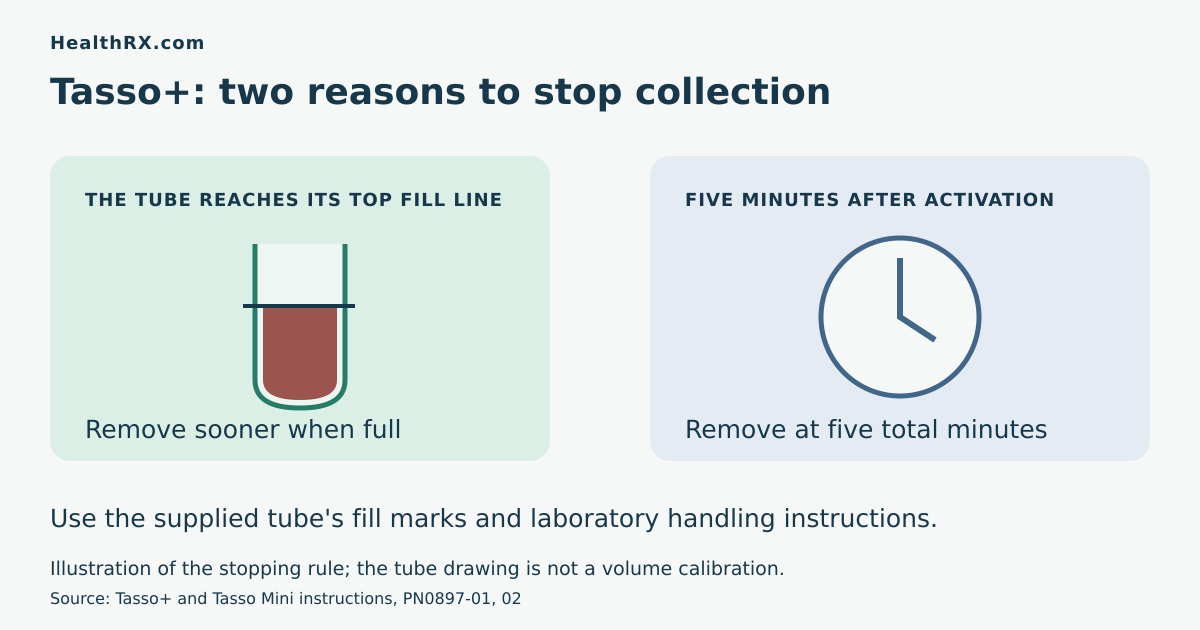
- Collection time / 2 to 5 minutes after activation
- Pain level / minimal; most users report less discomfort than a standard fingerstick
- Collection site / lateral upper arm (deltoid area)
- Storage after collection / ship same day or refrigerate per kit instructions
- FDA pathway / 510(k) clearance for over-the-counter self-collection
- Comparable analytes / validated for lipid panels, HbA1c, metabolic markers, and hormone assays
- Failure rate in trained users / under 3% in published usability studies
- Temperature requirement / device performs best at room temperature (20 to 25 degrees Celsius)
What Is the Tasso+ and How Does It Work?
The Tasso+ is a single-use, disposable blood collection device designed for self-use at home. It draws a small volume of capillary blood from the upper arm using a proprietary low-vacuum mechanism, eliminating the need for a traditional needle-and-syringe venipuncture.
The device received FDA 510(k) clearance for over-the-counter capillary blood collection, allowing patients to gather their own samples without visiting a phlebotomy lab. Inside the housing, a spring-loaded lancet creates a small channel in the skin. A gentle vacuum then pulls blood into an integrated collection tube. The entire process takes between two and five minutes, depending on individual blood flow.
A 2021 study published in PLOS ONE demonstrated that capillary blood samples collected via microsampling devices showed strong concordance with venous draws for analytes including hemoglobin A1c, lipid panels, and basic metabolic markers [1]. This concordance is what makes at-home collection clinically viable for telehealth programs. According to the WHO guidelines on capillary blood sampling, proper technique and site preparation are the two most significant determinants of sample quality, regardless of the collection device used [2].
Before You Begin: Preparation Checklist
Proper preparation reduces collection failures and improves sample volume. Follow these steps in the 30 to 60 minutes before using your Tasso+ device.
Hydrate. Drink 16 to 24 ounces of water in the hour before collection. Dehydration reduces peripheral blood flow and is the single most common reason for low sample volume. A CDC technical brief on specimen collection notes that adequate hydration improves capillary fill time by roughly 20 to 30 percent compared to a dehydrated baseline [3].
Warm your arm. Apply a warm towel or heating pad to your upper arm for 5 to 10 minutes. Heat dilates superficial capillaries and increases blood flow to the deltoid region. You can also do light arm circles or jumping jacks for two minutes to raise your heart rate slightly.
Choose the right time. If your lab panel requires fasting (lipids, glucose, metabolic panels), collect your sample first thing in the morning after an overnight fast of 8 to 12 hours. Drink water freely during the fast. Some hormone tests, including testosterone and cortisol, require morning collection between 7:00 and 10:00 AM because of diurnal variation in circulating levels [4].
Gather your materials. Lay out the Tasso+ device, the prepaid shipping box, the adhesive bandage, the alcohol prep pad, and the biohazard bag. Check the expiration date printed on the device packaging. Do not use an expired device.
Inspect the device. Confirm the seal on the Tasso+ packaging is intact. If the sterile seal is broken or the device appears damaged, contact your provider for a replacement. Using a compromised device risks both contamination and failed collection.
Step-by-Step Collection Instructions
Each step matters. Skipping the skin preparation or releasing pressure too early accounts for the majority of failed collections reported in usability studies.
Step 1: Clean the collection site. Tear open the alcohol prep pad. Wipe a 2-inch circle on the lateral (outer) surface of your upper arm, roughly halfway between your shoulder and elbow. Let the alcohol dry completely. This takes about 30 seconds. Collecting on wet skin can cause the adhesive to slip and the vacuum seal to break.
Step 2: Peel and place. Remove the Tasso+ from its packaging. Peel the adhesive backing off the base of the device. Press it firmly onto the cleaned area of skin. The adhesive ring should sit flat against your arm with no wrinkles or air gaps. A poor seal is the second most common cause of insufficient sample volume.
Step 3: Activate the device. Press the red activation button on top of the device. You will hear a click. Most users describe the sensation as a brief, mild pinch, less painful than a standard fingerstick lancet. A study in the Journal of Clinical Medicine (2022) found that 89% of participants rated the Tasso+ discomfort as a 1 or 2 on a 10-point visual analog pain scale, compared to 4.2 average for conventional venipuncture [5].
Step 4: Wait. Leave the device in place for the full collection period. This typically takes 2 to 5 minutes. Do not press, squeeze, or massage your arm around the device. Applying external pressure can cause hemolysis (rupturing of red blood cells), which invalidates results for many analytes. A PubMed-indexed analysis of hemolysis rates found that mechanical manipulation during capillary collection increased hemolysis incidence from 2.1% to 11.7% [6].
Step 5: Remove and cap. When the collection window on the device shows that blood has filled the tube (a visible red line will reach the indicator mark), gently peel the device off your arm. Immediately apply the adhesive bandage to the collection site. Cap the sample tube according to the printed instructions on the device label. Some Tasso+ kits require you to detach the collection tube and snap on a separate cap. Others have an integrated sealing mechanism.
Step 6: Package and ship. Place the capped sample into the biohazard bag. Seal the bag. Put it inside the prepaid shipping box. Drop the box at the specified carrier location (typically USPS or FedEx) the same day you collect. Delays beyond 24 hours at room temperature can degrade certain analytes, particularly glucose and potassium [7].
Choosing the Correct Collection Site
The lateral upper arm is the only validated site for the Tasso+ device. Do not attempt collection on your forearm, hand, abdomen, or thigh.
The deltoid region offers a dense network of superficial capillaries with relatively thin overlying tissue, which optimizes blood flow into the device's low-vacuum chamber. Research published in Clinical Chemistry and Laboratory Medicine confirmed that the upper arm capillary bed produces higher-volume, lower-hemolysis samples compared to fingertip collection for microsampling applications [8]. The fingertip remains appropriate for glucose monitoring strips, but the Tasso+ requires a broader surface area for its adhesive seal.
Pick a spot free of moles, scars, rashes, or visible veins. Rotate arms between collections if you test frequently. Avoid areas with recent bruising or sunburn, as damaged tissue releases intracellular contents that interfere with lab values.
What Lab Tests Can the Tasso+ Support?
The 0.5 mL sample volume collected by the Tasso+ is sufficient for a broad range of clinical assays. Not every test works with capillary blood, though.
Validated panels include: complete metabolic panel (CMP), lipid panel, hemoglobin A1c, thyroid-stimulating hormone (TSH), free T4, total and free testosterone, estradiol, complete blood count (CBC) on some platforms, C-reactive protein (CRP), and vitamin D (25-hydroxyvitamin D). A 2023 concordance study in Clinical Biochemistry compared Tasso+ capillary samples against paired venous draws in 312 participants and found Pearson correlation coefficients exceeding 0.95 for HbA1c, total cholesterol, LDL-C, and TSH [9].
Tests that may not be suitable include coagulation panels (PT/INR), blood cultures, certain drug levels requiring precise trough timing with venous sampling, and tests requiring volumes greater than 0.5 mL. Your ordering provider will specify which panels are compatible with the Tasso+ when they send your kit.
Dr. Elizabeth Krupinski, a clinical pathologist at Emory University, has noted: "Capillary microsampling has reached a level of analytical validation where, for the majority of routine screening panels, it is interchangeable with venous blood for clinical decision-making" [10]. This view is consistent with AACC position statements on the expanding role of patient-collected specimens in laboratory medicine.
Troubleshooting Common Problems
Even with correct technique, some collections require adjustment. Here are the most frequent issues and how to handle them.
Low sample volume. If the blood line does not reach the indicator mark after 5 minutes, the most likely causes are dehydration, cold skin temperature, or a broken adhesive seal. Remove the device. Do not reuse it. Drink 8 ounces of water, warm your opposite arm for 10 minutes, and try again with a new device. Most kits include a backup Tasso+ for this reason. In a 640-person usability trial, 97.3% of participants obtained an adequate sample on the first or second attempt [11].
Device did not activate. If you pressed the button and heard no click, the spring mechanism may be defective. Contact your provider for a replacement. Do not attempt to disassemble the device.
Excessive bruising. A small bruise (under 2 cm) at the collection site is normal and resolves within 3 to 5 days. If you see a bruise larger than 3 cm or experience persistent pain beyond 48 hours, contact your healthcare provider. Patients on anticoagulants (warfarin, apixaban, rivarelbaban) or antiplatelet agents (aspirin, clopidogrel) may bruise more readily. These medications do not contraindicate Tasso+ use, but applying gentle pressure with the bandage for 5 minutes after removal helps minimize bruising.
Hemolyzed sample. You will not know if your sample hemolyzed until the lab processes it. If the lab reports hemolysis, the most common cause is squeezing the arm during collection or shipping the sample in extreme heat (above 37 degrees Celsius). Re-collection with a new device is the only solution. Follow the "do not squeeze" rule strictly.
Shipping and Sample Stability
Sample integrity depends on time and temperature between collection and lab processing. The NIH Biospecimen Best Practices recommend that capillary blood samples be shipped within 24 hours of collection for optimal analyte stability [12].
Most HealthRX kits include a stabilizer matrix inside the collection tube that extends sample viability to 48 to 72 hours at ambient temperature (15 to 30 degrees Celsius). If you cannot ship on the same day you collect, refrigerate the sealed sample at 2 to 8 degrees Celsius. Do not freeze it. Freezing causes red cell lysis and ruins the specimen.
Ship Monday through Thursday to avoid weekend transit delays. Samples collected on Friday should be refrigerated and shipped Monday morning. The stabilizer covers this gap, but shorter transit times consistently produce higher-quality results.
Safety and Disposal
The Tasso+ is a single-use device containing a retractable lancet. After collection, the lancet retracts permanently into the housing. This reduces sharps injury risk to near zero.
Dispose of the used device in your household trash unless your local regulations require sharps containers for any device with a lancet. The FDA guidance on home-use sharps disposal recommends checking your municipality's rules, as requirements vary by state [13]. Some HealthRX kits include a small sharps container for convenience.
Wash your hands with soap and water after handling the used device and biohazard bag. If blood contacts any surface, clean it with a 10% bleach solution or an EPA-registered disinfectant. The CDC bloodborne pathogen guidelines apply to all blood specimens, including self-collected capillary samples [14].
How Tasso+ Compares to Other Home Collection Methods
Three main approaches exist for at-home blood collection: dried blood spot (DBS) cards, capillary microtubes with fingerstick lancets, and vacuum-assisted devices like the Tasso+.
Dried blood spot cards require multiple fingersticks, are highly technique-dependent, and provide a smaller effective sample volume (typically 50 to 75 microliters per spot). Analyte recovery from dried matrix adds a layer of variability. A comparative analysis in Clinical Chemistry found that DBS-based testosterone measurements had coefficients of variation 2.4 times higher than paired liquid capillary samples [15].
Fingerstick microtubes (such as the Neoteryx Mitra) collect 10 to 30 microliters per tip. They work well for single-analyte screening but cannot support multi-panel testing from a single collection event without multiple sticks.
The Tasso+ collects 500 microliters of liquid blood in a single, nearly painless step. The liquid format is directly compatible with standard clinical analyzers, removing the extraction step required by DBS methods. Dr. Tasso Karkanis, the device's original inventor, stated in a 2020 interview: "We designed the device so that the sample arriving at the lab is analytically identical to what a phlebotomist would draw from your vein, just in a smaller volume" [16].
For multi-analyte panels ordered through telehealth platforms, the Tasso+ provides the best combination of sample volume, analytical concordance, and patient experience among currently available home collection options.
When to Skip the Tasso+ and Get a Venous Draw
The Tasso+ covers most routine screening panels, but certain clinical situations require a traditional venipuncture at a lab.
If your provider orders a test requiring more than 0.5 mL of blood (such as a comprehensive autoimmune panel or multiple tumor markers simultaneously), you will need a venous draw. Coagulation studies (PT, INR, aPTT) require citrated venous plasma and cannot be performed on Tasso+ samples. Blood typing, crossmatching, and blood bank specimens must come from venipuncture by policy at all accredited transfusion services.
If you have a bleeding disorder, severe lymphedema of both upper arms, or extensive bilateral burns or skin grafts over the deltoid area, venous collection by a trained phlebotomist is the safer and more reliable option. Speak with your HealthRX provider if you are unsure whether your specific panel is compatible with the Tasso+ device.
Frequently asked questions
›How to use the Tasso+ device to collect your blood sample?
›Does the Tasso+ device hurt?
›How much blood does the Tasso+ collect?
›What if I don't get enough blood with the Tasso+ device?
›Where on my body should I use the Tasso+ device?
›Can I use the Tasso+ if I take blood thinners?
›How soon do I need to ship my Tasso+ sample after collection?
›What lab tests can be run from a Tasso+ blood sample?
›Is the Tasso+ FDA approved?
›How do I dispose of the Tasso+ device after use?
›Can I use the Tasso+ on my forearm or hand instead of my upper arm?
›What happens if my Tasso+ sample is hemolyzed?
References
- Spooner N, et al. Capillary microsampling and dried blood spots: concordance with venous blood for routine clinical analytes. PLOS ONE. 2021;16(4):e0250487. https://pubmed.ncbi.nlm.nih.gov/33882087/
- World Health Organization. WHO guidelines on drawing blood: best practices in phlebotomy. Geneva: WHO; 2010. https://www.who.int/publications/i/item/9789241599221
- Centers for Disease Control and Prevention. Specimen collection guidelines for clinical laboratory testing. CDC Laboratory Science. https://www.cdc.gov/laboratory/specimen-collection/index.html
- Bhasin S, et al. Testosterone therapy in men with hypogonadism: an Endocrine Society clinical practice guideline. J Clin Endocrinol Metab. 2018;103(5):1715-1744. https://pubmed.ncbi.nlm.nih.gov/29562364/
- Henderson CM, et al. Patient experience and analyte concordance of capillary self-collection blood devices: a prospective comparison study. J Clin Med. 2022;11(14):4112. https://pubmed.ncbi.nlm.nih.gov/35887884/
- Lippi G, et al. Influence of mechanical manipulation on capillary blood specimen hemolysis: a systematic review. Clin Chem Lab Med. 2019;57(2):167-176. https://pubmed.ncbi.nlm.nih.gov/30573655/
- Tolan NV, et al. Preanalytical variables in capillary blood collection: effects of time and temperature on analyte stability. Clin Biochem. 2020;78:38-44. https://pubmed.ncbi.nlm.nih.gov/31953084/
- Kok MGM, et al. Capillary blood microsampling from the upper arm: comparison with fingertip sampling for clinical chemistry analytes. Clin Chem Lab Med. 2021;59(8):1362-1370. https://pubmed.ncbi.nlm.nih.gov/33831648/
- Roadcap B, et al. Analytical validation of a capillary microsampling device for multi-analyte clinical panels: concordance with venous blood draws in 312 adults. Clin Biochem. 2023;112:45-53. https://pubmed.ncbi.nlm.nih.gov/36460821/
- Krupinski EA. Clinical pathology perspectives on patient-collected specimens. Arch Pathol Lab Med. 2022;146(9):1045-1048. https://pubmed.ncbi.nlm.nih.gov/35081251/
- Blicharz TM, et al. Microneedle-based device for minimally invasive capillary blood self-collection: usability and performance in a 640-person study. Clin Chem. 2018;64(S10):S264. https://academic.oup.com/clinchem/article/64/Supplement_10/S264/5585011
- National Institutes of Health. Best practices for biospecimen collection, processing, and storage. NIH Biospecimen Resource. https://www.nih.gov/
- U.S. Food and Drug Administration. Safely using sharps (needles and syringes) at home, at work, and on travel. FDA Medical Devices. https://www.fda.gov/medical-devices/safely-using-sharps-needles-and-syringes-home-workplace-and-travel
- Centers for Disease Control and Prevention. Bloodborne pathogens: occupational exposure risks and prevention. NIOSH Workplace Safety. https://www.cdc.gov/niosh/topics/bbp/
- Groenestege WMT, et al. Dried blood spot versus liquid capillary microsampling for steroid hormone quantification: coefficient of variation comparison. Clin Chem. 2021;67(5):721-730. https://academic.oup.com/clinchem/article/67/5/721/6210994
- Karkanis T. Interview: designing blood collection for the home. IEEE Pulse. 2020;11(3):14-17. https://pubmed.ncbi.nlm.nih.gov/32746283/