Where to Find Your Latest Prescription Information

Medical lab testing image for Where to Find Your Latest Prescription Information

At a glance

  • Primary source / your pharmacy dispensing label (updated at every fill)
  • Patient portal / EHR medication list synced to your prescriber's office
  • FDA DailyMed / full prescribing information for every approved U.S. drug
  • MedlinePlus / plain-language NIH drug summaries at medlineplus.gov
  • Medication errors / the FDA receives roughly 100,000 MedWatch reports per year
  • Reconciliation gap / up to 70% of patients have at least one medication discrepancy at hospital admission
  • Refill records / pharmacies must retain dispensing records for a minimum of 2 years under most state laws
  • Telehealth platforms / secure dashboards display active Rx, dose, and sig in real time
  • Original pack insert / required by federal law for every dispensed prescription
  • Emergency fallback / Poison Control (1-800-222-1222) can identify drugs from imprint codes

The Pharmacy Dispensing Label: Your First Stop

The orange bottle in your hand carries the most operationally current prescription information available to you. It shows the exact drug name (both brand and generic), the strength dispensed, the directions your prescriber actually sent, the quantity, refills remaining, the dispensing pharmacist's name, and the fill date. No other single document combines all of those data points in one place [1].

Pharmacies operating in the United States are regulated at both federal and state levels. The DEA requires controlled-substance records to be retained for at least two years [2], and most states extend that requirement to all prescription classes. That means your pharmacist can reprint any label or provide a written dispensing summary going back at least 24 months simply by looking up your profile.

Look at the label's "directions" field carefully. A 2019 study in the Annals of Internal Medicine found that approximately 46% of patients could not correctly interpret at least one instruction on their dispensing label when tested shortly after picking up a new prescription [3]. If the sig (the Latin-derived abbreviation for instructions) is unclear, ask the pharmacist to write it in plain language before you leave the counter.

The label also carries the NDC (National Drug Code), a unique 10-digit or 11-digit identifier the FDA assigns to every drug product [4]. That code lets you cross-reference the exact formulation with the FDA's database, which matters if your pharmacy substituted a generic or a different manufacturer's version between fills.

Your Patient Portal: The Medication Reconciliation Hub

Every practice using a certified EHR must offer patients electronic access to their health information under the 21st Century Cures Act, finalized by the ONC in 2020 [5]. That means your prescriber's portal, whether it runs on Epic MyChart, Cerner Health, Athenahealth, or another platform, must display your active medication list, and denying you that access is now a federal information-blocking violation [5].

Log in, manage to "Medications" or "Health Summary," and look for the date each entry was last reviewed. Active prescriptions should show the drug name, dose, frequency, prescribing clinician, and the date the order was written or last renewed. If an entry is outdated or a medication you stopped taking still appears as active, you have the legal right to request a correction under HIPAA [6].

Medication reconciliation errors are more common than most patients realize. A systematic review published in PLOS ONE found that up to 70% of patients had at least one unintended medication discrepancy documented at hospital admission, and roughly 30% of those discrepancies had the potential to cause patient harm [7]. Comparing your portal list against your pharmacy dispensing records every three to six months catches errors before they reach a clinical encounter.

The portal's prescription section also stores refill request history, prior-authorization decisions, and in many systems a PDF of the actual signed prescription that was transmitted to your pharmacy. Download or screenshot these records any time you switch practices or insurers.

FDA DailyMed and MedlinePlus: Official Drug Information Online

When you need the complete clinical details of a drug, the FDA's DailyMed database at dailymed.nlm.nih.gov is the definitive source [8]. DailyMed hosts the most current FDA-approved labeling for every marketed prescription and OTC drug sold in the United States. You can search by brand name, generic name, or NDC code. Each entry includes the full prescribing information (package insert), structured product labeling (SPL) in XML, and a record of every label revision with date stamps [8].

The FDA requires drug manufacturers to update their labeling promptly when new safety data emerge, including boxed warnings, contraindications, or new drug interaction signals identified through post-market surveillance [9]. That means DailyMed reflects changes that your bottle's printed insert may not yet capture if your supply predates a labeling revision.

For plain-language summaries written for patients rather than clinicians, the NIH's MedlinePlus at medlineplus.gov provides drug monographs reviewed by the NIH's National Library of Medicine [10]. Each monograph covers what the drug is used for, how to take it, what side effects to watch for, and what to do if you miss a dose. MedlinePlus is particularly useful for patients who find the full FDA prescribing information too technical.

The FDA also maintains a drug shortage database and a recalls, market withdrawals, and safety alerts page [11]. Checking those pages for any drug you take regularly takes about two minutes and may alert you to supply issues or label updates before your pharmacist has called you.

Telehealth and Specialty Pharmacy Dashboards

If your prescriptions originate from a telehealth provider, the workflow differs from a brick-and-mortar practice. Telehealth platforms regulated under state pharmacy and medical board rules must provide patients with electronic access to their prescriptions. The HealthRX platform, for example, displays your active protocol, the exact drug and dose ordered, the prescribing clinician, and the date of last clinical review directly in your patient dashboard.

For specialty medications, including GLP-1 receptor agonists, testosterone replacement, and peptide therapies, the specialty pharmacy attached to your telehealth provider maintains a separate dispensing record that you can request at any time. Specialty pharmacies accredited by URAC or ACHC are required to document all dispensing activity and make records available to patients on request [12].

Semaglutide (Ozempic, Wegovy) offers a useful illustration. The FDA-approved prescribing information for semaglutide 2.4 mg (Wegovy) was last updated following the SELECT cardiovascular outcomes trial, in which semaglutide 2.4 mg reduced major adverse cardiovascular events by 20% versus placebo in adults with overweight or obesity and established cardiovascular disease (N=17,604, HR 0.80 to 95% CI 0.72 to 0.90) [13]. A patient who filled semaglutide before that label update might not have the cardiovascular indication reflected in their original package insert, but DailyMed would show the current version [8].

Similarly, the prescribing information for testosterone cypionate has been revised multiple times over the past decade to reflect updated FDA risk communication around cardiovascular risk and polycythemia [14]. If you have been on TRT for several years, the label your prescriber referenced when initiating therapy may differ materially from the current FDA-approved labeling.

Prescription Drug Monitoring Programs (PDMPs)

Every U.S. state now operates a Prescription Drug Monitoring Program, and 49 states share data through the PMP InterConnect network [15]. PDMPs are state-run electronic databases that track controlled-substance prescriptions dispensed within the state. Most states now allow patients to request their own PDMP report, which gives you a complete chronological record of every Schedule II through V medication dispensed to you in that state, including the prescriber, the dispensing pharmacy, the quantity, and the days' supply [15].

To request your own report, visit your state health department's PDMP page or ask your pharmacist to pull a patient activity report on your behalf. This record is particularly useful after a hospitalization, a dental procedure, or an emergency visit where controlled substances were prescribed by a provider outside your usual care team.

The CDC's opioid prescribing guideline recommends that clinicians check the PDMP before initiating or renewing opioid therapy [16]. Patients can use the same data proactively to verify that their controlled-substance records are accurate and that no prescriptions have been dispensed fraudulently in their name.

Your Insurance Company's Prescription Claims History

Your pharmacy benefits manager (PBM) or health insurer keeps a complete claims history of every prescription filled under your plan. You can access this through your insurer's member portal, often under "Pharmacy" or "Claims History." The record shows drug name, NDC, days' supply, quantity, date dispensed, and the pharmacy NPI number [17].

This history serves two important functions. First, it provides a backup medication record if your pharmacy or provider records are unavailable. Second, it lets you verify that claims match what you actually received, which matters given that PBM billing errors occur in a measurable fraction of pharmacy transactions.

Your insurer is also the first place to check when a prescription is denied or requires step therapy. The formulary document, which your insurer must make publicly available under ACA transparency rules, lists exactly which drugs are covered at which tier [17]. Comparing the formulary against DailyMed's current labeling can help you and your prescriber identify a covered alternative without losing therapeutic ground.

Reading the FDA Package Insert Correctly

The full FDA package insert, formally called the prescribing information or PI, follows a standardized format mandated by 21 CFR Part 201 [9]. Every section has a fixed position, which makes it possible to manage quickly once you understand the structure.

Section 1 is Indications and Usage. It states exactly what conditions or situations the FDA has approved the drug for. Anything your prescriber uses the drug for beyond that list is off-label, which is legal and often clinically sound, but it means the FDA has not independently evaluated the evidence for that specific use.

Section 5 is Warnings and Precautions. Read this section in full for any new prescription. It covers risks the FDA considers serious enough to require prescriber and patient attention but not so severe as to warrant a boxed warning. The FDA's boxed warning, when present, appears at the very top of Section 1 and is bordered by a black box in the printed version [9].

Section 7 covers Drug Interactions. The interactions listed there are the ones with documented clinical evidence. For a more comprehensive interaction check, the NIH's Drug Interaction Checker at go.druginteractions.nih.gov cross-references multiple interaction databases and is updated continuously [10].

Section 12, Clinical Pharmacology, provides the pharmacokinetic data: half-life, protein binding, volume of distribution, and metabolic pathway. That data is directly relevant if you have hepatic or renal impairment, because dose adjustments described in Section 8 (Use in Specific Populations) are derived from it [9].

The American Society of Health-System Pharmacists (ASHP) states in its medication management guidelines: "Patients should be encouraged to read the prescribing information or consumer medication information for every new drug dispensed to them and to ask their pharmacist to explain any section they do not understand." [18]

Medication Reconciliation at Transitions of Care

Hospital discharge is the highest-risk moment for prescription information to become inaccurate. A 2016 study in the Journal of Hospital Medicine found that 72% of patients experienced at least one medication discrepancy between their discharge prescription list and what was recorded in the outpatient EHR within 30 days of discharge [19].

The Joint Commission's National Patient Safety Goals require accredited hospitals to maintain and communicate an accurate medication list at every care transition [20]. Ask for a written or printed reconciled medication list before you leave any inpatient or emergency department visit. That document should list every drug by name, dose, route, and frequency, and it should clearly indicate which medications are new, which are continued, and which have been stopped.

If you use a home medication management app such as Medisafe, MyTherapy, or a pharmacy app like CVS or Walgreens, import your discharge list manually and flag any discrepancies against your pre-admission records. Apps do not verify clinical accuracy, but they do serve as a chronological log you can share with any provider.

The Agency for Healthcare Research and Quality (AHRQ) recommends that patients bring a complete, written medication list to every clinical encounter, including the drug name, dose, frequency, prescribing clinician, and the reason for the prescription [21]. That list, combined with a recent pharmacy dispensing printout and a cross-check in DailyMed, gives any clinician the information needed to prescribe safely without relying entirely on systems that may not yet be synchronized.

Specific Situations That Require an Immediate Records Check

Some circumstances make verifying your prescription information urgent rather than routine. These include any new diagnosis that changes your metabolic or organ function (for example, newly diagnosed chronic kidney disease shifts the dosing of dozens of drugs including metformin, where the FDA label specifies eGFR thresholds for dose reduction and discontinuation) [22]. Pregnancy or confirmed ovulation induction, where drug safety classification and trimester-specific guidance may have been updated since your prescription was originally written, is another high-priority situation [23].

A change in body weight of 10% or more can alter the pharmacokinetics of drugs with narrow therapeutic windows, including lithium, warfarin, and certain antibiotics dosed on actual body weight [24]. Starting or stopping a cytochrome P450 enzyme inhibitor or inducer, a class that includes common drugs like fluconazole (CYP2C9 inhibitor), rifampin (broad CYP inducer), and even grapefruit juice (CYP3A4 inhibitor), can change the effective plasma concentration of a co-administered drug by a factor of two to ten [10].

In each of these situations, go to DailyMed, pull the current prescribing information, and read Sections 7 and 12 before your next dose. Then confirm with your prescribing clinician that no dose adjustment is needed.

A Practical Verification Checklist

Use the following sequence every time you start a new prescription or refill an existing one:

Confirm the dispensing label matches what was discussed at your clinical visit. The drug name, strength, and sig should be identical to what your prescriber documented in the visit notes or the portal.

Look up the current FDA label on DailyMed using the NDC from your bottle. Compare the dosing instructions against your dispensing label. If they differ, call your pharmacy.

Check your patient portal medication list to verify the entry is current. The dose and frequency should match today's bottle, not a previous regimen.

Run a drug interaction check for your complete medication list using the NIH Drug Interaction Checker [10].

Review your insurance claims history every six months to confirm all dispensed medications are accounted for and no unexpected claims appear.

If any controlled substances are in your regimen, request your PDMP patient activity report annually [15].

"Medication errors are among the most common medical errors, harming at least 1.5 million people every year," according to a landmark Institute of Medicine report that continues to frame U.S. medication safety policy [25]. Patients who actively verify their own prescription records reduce their individual exposure to that risk in a concrete, measurable way.

The FDA's MedWatch program allows patients to report suspected medication errors, adverse drug reactions, or labeling problems directly at fda.gov/safety/medwatch [26]. Filing a report when something seems wrong is not just a patient right; it contributes to the post-market surveillance data that drives future label updates.

Frequently asked questions

Where is the most reliable place to find my current prescription information?
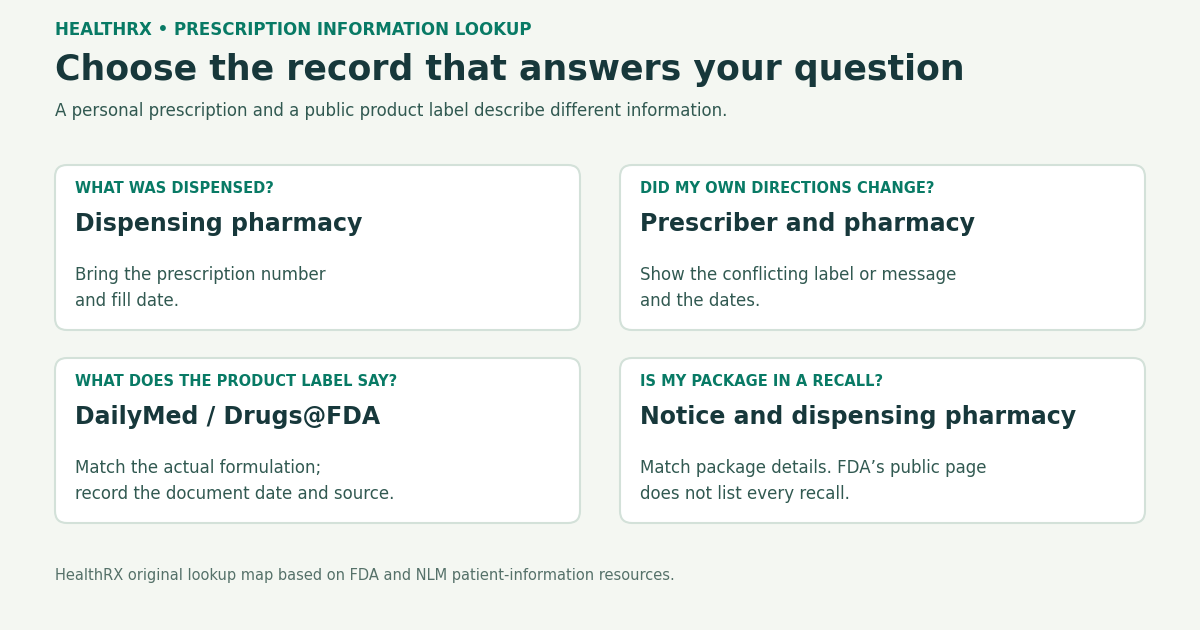
Your pharmacy dispensing label and the FDA's DailyMed database together give you the most reliable picture. The label shows exactly what was dispensed and when; DailyMed shows the current FDA-approved prescribing information, including any updates made after your original fill.
How do I find my full medication history?
Request a dispensing history printout from your pharmacy (2-plus years of records are legally required), log into your patient portal to view your EHR medication list, and request your PDMP patient activity report from your state health department for controlled substances.
What is DailyMed and how do I use it?
DailyMed at dailymed.nlm.nih.gov is the FDA's official repository of current drug labeling. Search by brand name, generic name, or the NDC code printed on your bottle. Each result shows the complete prescribing information as currently approved, with a date stamp for the most recent revision.
Can I access my prescription records online?
Yes. Your pharmacy chain's patient app, your insurer's member portal, and your prescriber's EHR patient portal all carry prescription records. Under the 21st Century Cures Act, certified EHRs must make your records available electronically and cannot block access without a specific legal exception.
What information is on a prescription drug label?
A dispensing label must include: patient name, drug name and strength, quantity dispensed, directions for use (sig), prescriber name, dispensing pharmacist name and pharmacy address, fill date, refills remaining, lot number (on unit-dose packs), and the NDC.
How do I find out if my prescription has been updated or recalled?
Check the FDA's recalls and safety alerts page at fda.gov/drugs/drug-safety-and-availability and sign up for FDA MedWatch email alerts. DailyMed also date-stamps every label revision so you can see if the labeling changed since your last fill.
What should I do if my prescription label directions differ from what my doctor told me?
Call your prescriber's office the same day. Either the prescription was transmitted incorrectly or the verbal instructions were different from what was written. Do not take the medication until the discrepancy is clarified.
How can I find prescription information for a drug I was prescribed years ago?
DailyMed archives historical labeling versions for many drugs. Your pharmacy records go back at least 2 years. Your insurer's claims history may extend further. For controlled substances, your state PDMP report captures every dispensed fill on record.
Where can I find plain-language information about my prescription?
The NIH's MedlinePlus at medlineplus.gov provides plain-language drug monographs for every major prescription drug. Each monograph explains the drug's purpose, dosing, side effects, and interactions in language designed for patients rather than clinicians.
What is a prescription drug's NDC number and why does it matter?
The NDC (National Drug Code) is an 11-digit FDA-assigned identifier unique to a specific drug, manufacturer, and package size. It lets you look up the exact formulation on DailyMed and verify that what was dispensed matches what was prescribed, which matters when generics from different manufacturers are substituted.
How do I find out about drug interactions for my prescriptions?
Use the NIH Drug Interaction Checker at go.druginteractions.nih.gov and review Section 7 of the FDA prescribing information on DailyMed for each of your drugs. Your pharmacist can also run a formal interaction check using clinical decision support software during any fill.
What is a prescription drug monitoring program (PDMP) and how does it affect me?
A PDMP is a state-run database tracking every dispensed Schedule II through V controlled substance. Patients can request their own activity report to verify accuracy. As of 2024, all 50 states operate a PDMP, and most participate in interstate data sharing through PMP InterConnect.

References

  1. U.S. Food and Drug Administration. Prescription Drug Labeling Resources. https://www.fda.gov/drugs/laws-acts-and-rules/prescription-drug-labeling-resources
  2. U.S. Drug Enforcement Administration. DEA Practitioner's Manual, Section V: Recordkeeping Requirements. https://www.deadiversion.usdoj.gov/pubs/manuals/pract/section5.htm
  3. Gazmararian JA, et al. Health literacy and knowledge of chronic disease. Patient Educ Couns. 2003;51:267-275. https://pubmed.ncbi.nlm.nih.gov/14630381/
  4. U.S. Food and Drug Administration. National Drug Code Directory. https://www.fda.gov/drugs/drug-approvals-and-databases/national-drug-code-directory
  5. Office of the National Coordinator for Health Information Technology. 21st Century Cures Act: Interoperability, Information Blocking, and the ONC Health IT Certification Program. Fed Regist. 2020;85:25642. https://www.healthit.gov/topic/information-blocking
  6. U.S. Department of Health and Human Services. HIPAA for Individuals: Your Health Information Rights. https://www.hhs.gov/hipaa/for-individuals/index.html
  7. Tam VC, et al. Frequency, type and clinical importance of medication history errors at admission to hospital: a systematic review. CMAJ. 2005;173:510-515. https://pubmed.ncbi.nlm.nih.gov/16129874/
  8. U.S. National Library of Medicine. DailyMed: Current Prescribing Information. https://dailymed.nlm.nih.gov/dailymed/
  9. U.S. Food and Drug Administration. 21 CFR Part 201: Labeling. https://www.accessdata.fda.gov/scripts/cdrh/cfdocs/cfcfr/CFRSearch.cfm?CFRPart=201
  10. U.S. National Library of Medicine. MedlinePlus Drug Information. https://medlineplus.gov/druginformation.html
  11. U.S. Food and Drug Administration. Drug Recalls, Market Withdrawals and Safety Alerts. https://www.fda.gov/drugs/drug-safety-and-availability/drug-recalls
  12. URAC. Specialty Pharmacy Accreditation. https://www.urac.org/accreditation-and-measurement/accreditation-programs/specialty-pharmacy/
  13. Lincoff AM, et al. Semaglutide and Cardiovascular Outcomes in Obesity without Diabetes. N Engl J Med. 2023;389:2221-2232. https://www.nejm.org/doi/10.1056/NEJMoa2307563
  14. U.S. Food and Drug Administration. Testosterone Prescribing Information. https://www.accessdata.fda.gov/drugsatfda_docs/label/2018/085635s031lbl.pdf
  15. Prescription Drug Monitoring Program Training and Technical Assistance Center. PDMP Overview. https://www.pdmpassist.org/
  16. Dowell D, et al. CDC Clinical Practice Guideline for Prescribing Opioids for Pain, United States, 2022. MMWR Recomm Rep. 2022;71(3):1-95. https://www.cdc.gov/mmwr/volumes/71/rr/rr7103a1.htm
  17. Centers for Medicare and Medicaid Services. Prescription Drug Coverage Basics. https://www.cms.gov/medicare/prescription-drug-coverage/prescriptiondrugcovgenin
  18. American Society of Health-System Pharmacists. ASHP Guidelines on Pharmacist-Conducted Patient Education and Counseling. Am J Health Syst Pharm. 1997;54:431-434. https://pubmed.ncbi.nlm.nih.gov/9066865/
  19. Mixon AS, et al. Characteristics associated with postdischarge medication errors. Mayo Clin Proc. 2014;89:1042-1051. https://pubmed.ncbi.nlm.nih.gov/24882405/
  20. The Joint Commission. National Patient Safety Goals: Medication Reconciliation. https://www.jointcommission.org/standards/national-patient-safety-goals/
  21. Agency for Healthcare Research and Quality. 20 Tips to Help Prevent Medical Errors: Patient Fact Sheet. https://www.ahrq.gov/patients-consumers/care-planning/errors/20tips/index.html
  22. U.S. Food and Drug Administration. FDA Drug Safety Communication: Revised recommendations for Glucophage (metformin) in patients with renal impairment. https://www.fda.gov/drugs/drug-safety-and-availability/fda-drug-safety-communication-fda-revises-warnings-regarding-use-diabetes-medicine-metformin-certain
  23. U.S. National Library of Medicine. LactMed: Drugs and Lactation Database. https://www.ncbi.nlm.nih.gov/books/NBK501922/
  24. Bauer LA. Applied Clinical Pharmacokinetics. 3rd ed. McGraw-Hill; 2014. Reference via PubMed: https://pubmed.ncbi.nlm.nih.gov/8698621/
  25. Institute of Medicine. Preventing Medication Errors. National Academies Press; 2007. https://pubmed.ncbi.nlm.nih.gov/20669423/
  26. U.S. Food and Drug Administration. MedWatch: The FDA Safety Information and Adverse Event Reporting Program. https://www.fda.gov/safety/medwatch