A High-Carb Day on Keto: What the Next Reading Can Tell You
A higher-carbohydrate day may lower ketone readings or change scale weight. Neither measurement, taken alone, tells you how much body fat changed, whether exercise adaptation changed, or what happened to months of dietary progress. Start with the question you want answered: a ketone concentration today, a weight trend, glucose management, sports performance, or a prescribed medical diet?
People often call this a “cheat day.” That label describes a departure from their eating plan; it does not make the day a moral failure. The useful question is what the change actually shows.
What a ketone reading can tell you
A blood meter measures beta-hydroxybutyrate, or BHB, at the time of testing. A result is a snapshot, not a complete assessment of your diet. Food, timing, and measurement method belong alongside the number when interpreting it.
Volek and colleagues’ endurance review describes nutritional ketosis using circulating ketones above 0.5 mmol/L and discusses adaptation over several weeks. That definition is not a universal health or weight-loss target, and the review did not test recovery after one higher-carb day.[1]
The reviewed studies do not establish one carbohydrate amount that switches everyone out of ketosis. Likewise, the studies below cannot supply a personal countdown for returning to a previous reading. A trial’s diet definition should not become an individual “knockout” threshold.
What the evidence actually measured
These studies answer different questions. Keeping their populations and outcomes visible helps prevent an isolated finding from becoming a promise about your next meal.
| Evidence | Measured population and outcome | Question it cannot answer |
|---|---|---|
| Endurance review [1] | Reviewed nutritional ketosis and adaptation in an endurance-exercise context. | When will this person return to ketosis after today’s food? |
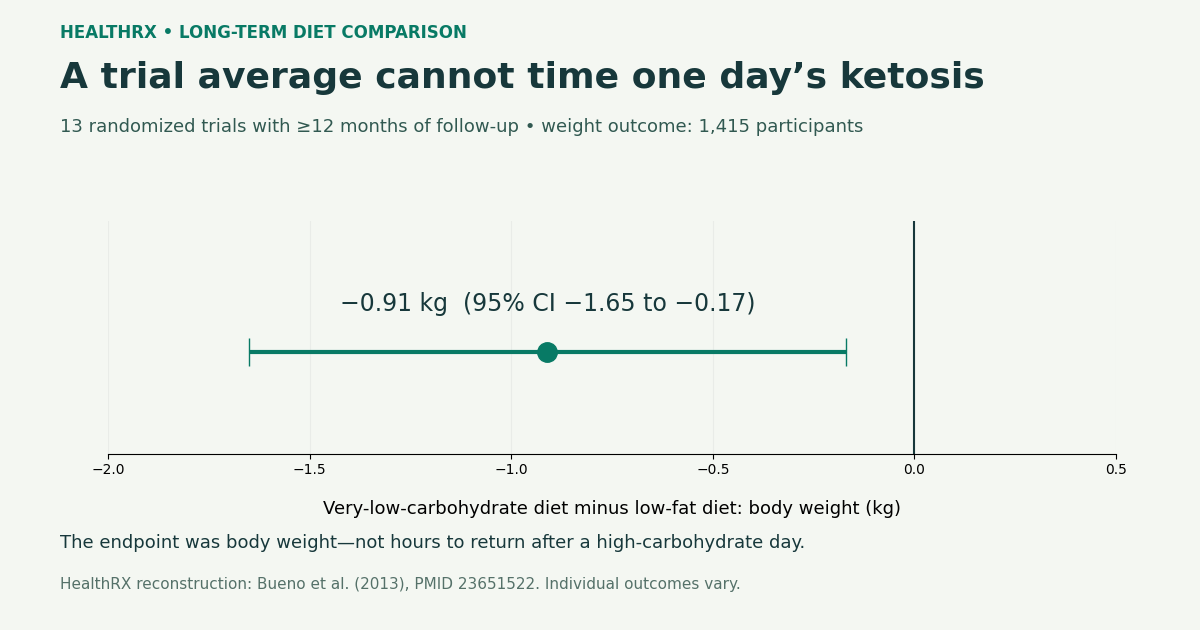
| Long-term diet meta-analysis [2] | Thirteen randomized trials with at least 12 months’ follow-up; 1,415 participants contributed to the weight comparison. Very-low-carbohydrate diets averaged 0.91 kg greater weight loss than low-fat diets. | How much fat did one higher-carb day add, or how will one individual progress? |
| Exercise-recovery study [3] | Nine aerobically trained people underwent prolonged cycling in heat with substantial dehydration; muscle biopsies assessed glycogen and water during recovery. | Is a particular scale increase entirely water, and exactly when will it disappear? |
| MCT diet-induction trial [4] | Twenty-eight healthy adults starting a ketogenic diet had higher BHB with MCT than sunflower oil; faster ketosis onset was not statistically significant, and abdominal pain was more frequent and severe. | Will MCT restore ketosis after a higher-carb day? |
| Acute oil crossover study [5] | Nine healthy adults had plasma ketones measured over eight hours after different oils. | Did higher ketones improve fat loss, establish adaptation, or negate carbohydrates? |
| Urine-strip study [6] | Fifty postmenopausal women with obesity provided 263 paired fasting urine and blood samples during and after a severely energy-restricted diet; urine strips inadequately detected mild ketosis. | Can urine strips reliably track this reader’s return to ketosis? |
| Exploratory vascular study [7] | Nine healthy young men received glucose challenges before and after seven days of a high-fat, low-carbohydrate diet; researchers assessed endothelial markers and vascular function. | Does a higher-carb meal cause a heart attack, permanent artery injury, or the same response in everyone? |
Separate scale weight from longer-term progress
A scale measures total mass. A change alone cannot partition water, body fat, and gastrointestinal contents. The glycogen-recovery study supports a relationship between glycogen and muscle water in its specific exercise setting; it does not establish that every post-carbohydrate increase is “just water.”[3]
Your individual amounts remain unknown from scale weight alone. For a weight-related goal, evaluate the subsequent trend and eating pattern rather than treating the next weigh-in as a verdict. Long-term trial averages also cannot guarantee that progress was unaffected or prove that everything was erased.[2]
Keep a useful record, without chasing numbers
If you need to interpret a change, one concise entry can preserve the relevant context:
- What changed: the date, foods and amounts you actually know.
- What was measured: the reading, device or test type and measurement time, if you took a measurement.
- What needs explaining: symptoms or a change that concerns you, alongside the goal you are following.
- What plan applies: current medicines, any prescribed dietary instructions and the actual follow-up decision.
Leave unmeasured values blank rather than guessing. This record does not require everyone to test ketones or adopt a universal testing schedule.
Fasting, extra exercise, water loading, or ketone supplements are not established repair plans in these studies. Ketone-raising products can change the measured endpoint without answering whether fat loss or adaptation changed. The MCT findings also do not establish outcomes for ketone-salt products.[4,5]
When the medical plan takes priority
If your diet is part of a prescribed treatment, use the treating team’s instructions for departures from it. Very-low-carbohydrate eating may require clinician-led adjustments to insulin or other diabetes medicines to prevent hypoglycemia; do not improvise dose changes to repair a day’s eating.[8]
The ADA’s 2026 guidance discourages ketogenic eating patterns in SGLT inhibitor-treated people at risk of ketoacidosis and calls for education about ketone measurement and symptoms.[8] A reassuring weight or ketone reading cannot replace that safety plan. If concerning symptoms occur, seek medical assessment rather than waiting for your usual number to return.
Frequently asked questions
Will one cheat day ruin ketosis?
A higher-carb day may lower ketones enough that you no longer meet a study’s definition of nutritional ketosis. One reading cannot establish what happened to longer-term adaptation, weight loss, or health goals.
How many carbs does it take to get knocked out of ketosis?
These sources do not establish a universal amount. The carbohydrate limit used to classify diets in the long-term meta-analysis was a trial category, not a personal knockout threshold.[2]
How long does it take to get back into ketosis after a cheat day?
These studies do not provide a reliable individual timetable. Initial diet adaptation and recovery after a higher-carb day are different questions; neither the endurance review nor the MCT induction trial supplies a reentry countdown.[1,4]
Does a cheat day erase all my keto progress?
A ketone reading cannot show that all progress was erased. It also cannot guarantee that the day had no effect. Assess the relevant goal over time, including your eating pattern, weight trend, performance, or clinical measurements.
Will I gain weight after a cheat day on keto?
The scale may rise, but that result cannot identify how much came from water, gastrointestinal contents, or fat. Glycogen and water are related in the studied exercise setting; that does not make every increase entirely water.[3]
Is it better to have one cheat meal or a whole cheat day?
The cited studies do not directly compare those choices. Duration alone leaves out the foods, amounts, and goal involved. For a prescribed medical diet, use the treating team’s guidance about any departure.
Can exercise help me get back into ketosis faster after cheating?
These sources do not establish an exercise routine that reliably shortens reentry. The exercise-recovery study measured muscle glycogen and water, not a post-cheat ketosis timetable.[3] Extra exercise is not required as a repair response.
Are keto cheat days bad for your blood sugar?
Your glucose response cannot be predicted from a ketone reading. The small exploratory glucose-challenge study assessed vascular markers in healthy young men, not everyday meals across different populations.[7] With diabetes, follow your glucose and medication plan.
Do urine strips accurately show when I'm back in ketosis?
They measure urine acetoacetate rather than blood BHB. In the severely energy-restricted diet study, they inadequately detected mild ketosis.[6] That finding does not make every urine test useless in every population or emergency context.
Can MCT oil help maintain ketosis during a cheat day?
MCT raised measured ketones in the cited studies, but neither tested maintaining ketosis through a higher-carb day. Higher readings do not prove carbohydrates were negated, and the induction trial reported more abdominal pain with MCT.[4,5]
How often can I have cheat days on keto without losing adaptation?
These studies do not establish a safe frequency or a schedule that preserves adaptation. Decisions should reflect your goal and sustained eating pattern; a recurring high ketone reading does not verify preserved adaptation.
Should people with diabetes do keto cheat days?
Use an individualized plan with your diabetes team rather than alternating diets or changing medicines independently. Very-low-carbohydrate plans can require medication adjustment, and ADA guidance specifically discourages ketogenic patterns in SGLT inhibitor-treated people at ketoacidosis risk.[8]
References
- Volek JS et al. Rethinking fat as a fuel for endurance exercise. 2015. PubMed
- Bueno NB et al. Very-low-carbohydrate ketogenic diet v. low-fat diet for long-term weight loss: a meta-analysis of randomised controlled trials. 2013. PubMed
- Fernández-Elías VE et al. Relationship between muscle water and glycogen recovery after prolonged exercise in the heat in humans. 2015. PubMed
- Harvey CJDC et al. The effect of medium chain triglycerides on time to nutritional ketosis and symptoms of keto-induction in healthy adults: a randomised controlled clinical trial. 2018. PubMed
- Vandenberghe C et al. Tricaprylin Alone Increases Plasma Ketone Response More Than Coconut Oil or Other Medium-Chain Triglycerides: An Acute Crossover Study in Healthy Adults. 2017. PubMed
- Gibson AA et al. Urine dipsticks are not accurate for detecting mild ketosis during a severely energy restricted diet. 2020. PubMed
- Durrer C et al. Short-Term Low-Carbohydrate High-Fat Diet in Healthy Young Males Renders the Endothelium Susceptible to Hyperglycemia-Induced Damage, an Exploratory Analysis. 2019. PubMed
- American Diabetes Association Professional Practice Committee for Diabetes. 5. Facilitating Positive Health Behaviors and Well-being to Improve Health Outcomes: Standards of Care in Diabetes—2026. 2026. Diabetes Care