Rosuvastatin and ApoB: What a Lower Result Can Tell You
A lower ApoB result after starting rosuvastatin usually means fewer circulating particles that can contribute to atherosclerosis. That adds useful information to your cholesterol panel, especially when LDL cholesterol, or LDL-C, and particle burden do not move together. The size of the change still needs context: your starting value, prescribed dose, time on treatment, and cardiovascular risk all matter.
A useful review starts with your actual change from baseline and the level that remains. The studies below explain what those measurements capture and why the result alone cannot select the next medicine.
What ApoB measures during rosuvastatin treatment
LDL-C measures the amount of cholesterol carried in LDL particles. ApoB reflects the number of circulating atherogenic particles, including LDL and triglyceride-rich particles. Each of these particles carries one ApoB molecule, making the blood concentration a useful measure of particle burden.[3]
The cholesterol carried per particle varies. As a result, a substantial LDL-C reduction does not necessarily mean an equally large percentage reduction in ApoB. Rosuvastatin can improve both measurements while leaving a difference between cholesterol content and particle number.
That distinction matters when reviewing a response. A lower LDL-C with a relatively less favorable ApoB may suggest more particles remain than the LDL-C result alone would imply. It does not, by itself, establish that rosuvastatin has failed or identify the next medication to use.
How much did ApoB fall in comparative trials?
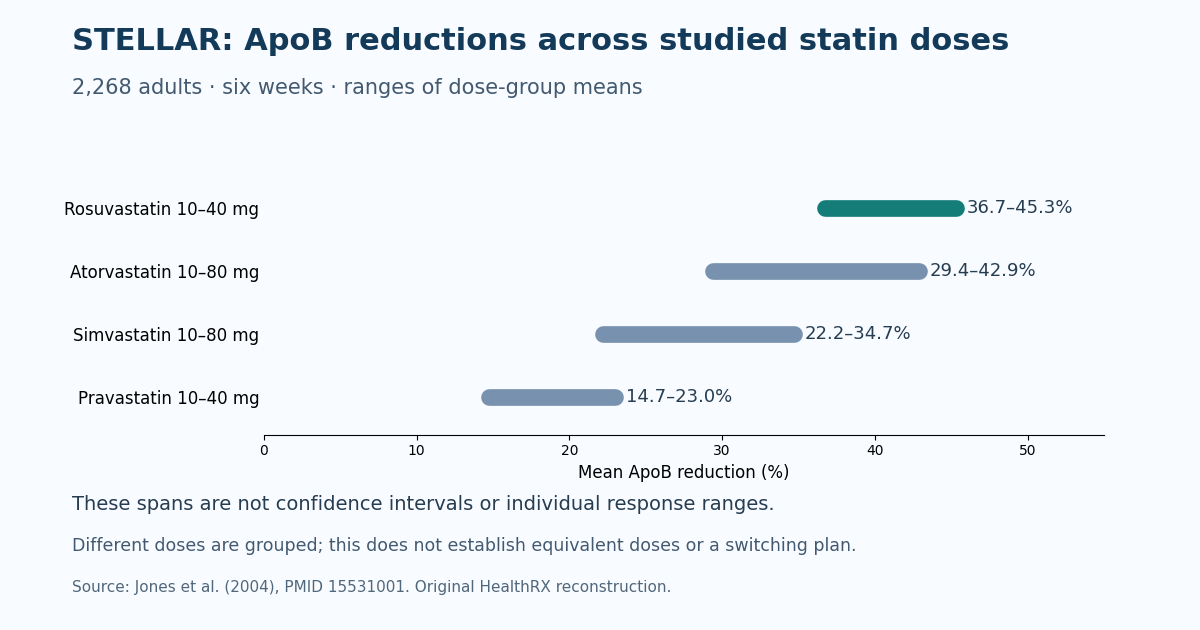
The STELLAR analysis compared lipid responses after six weeks in 2,268 adults with hypercholesterolemia. Participants had starting LDL-C of 160 to less than 250 mg/dL and triglycerides below 400 mg/dL. Their mean age was 57 years.[1]
| Treatment and doses in the reported comparison | Mean ApoB reductions across dose groups |
|---|---|
| Rosuvastatin 10–40 mg | 36.7%–45.3% |
| Atorvastatin 10–80 mg | 29.4%–42.9% |
| Simvastatin 10–80 mg | 22.2%–34.7% |
| Pravastatin 10–40 mg | 14.7%–23.0% |
These ranges span dose-group averages. They are not confidence intervals or the range of responses an individual patient should expect. They also do not establish equivalent doses between drugs. The table cannot provide a precise prediction for your dose, and it does not supply an estimate for rosuvastatin 5 mg.
Across the studied dose groups, rosuvastatin produced larger mean ApoB reductions than the other listed statins, although the ranges overlap. Atorvastatin also produced substantial reductions. Comparing the low end of one range with the high end of another would not be a fair matched-dose comparison.
For your own results, calculate percentage change as the starting ApoB minus the follow-up ApoB, divided by the starting ApoB, multiplied by 100. Then consider the remaining level separately: a large percentage reduction can still leave substantial particle burden when the starting value was high.
When ApoB and LDL-C tell different stories
ApoB complements a standard lipid panel rather than replacing it. Non-HDL cholesterol, which includes cholesterol carried in atherogenic particles beyond LDL, also helps interpret the overall response.[3]
| Follow-up pattern | What it may tell you |
|---|---|
| LDL-C and ApoB both decrease substantially | Cholesterol content and atherogenic particle burden have both improved. |
| LDL-C appears favorable, but ApoB remains relatively elevated | LDL-C may understate the remaining particle burden. |
| ApoB decreases, but the LDL-C response seems smaller | Particle number and cholesterol content may be changing by different proportions; review the full panel. |
| ApoB unexpectedly increases | Confirm the testing and treatment context before drawing conclusions. |
The National Lipid Association consensus notes that when measurements are discordant, risk often aligns more closely with ApoB or non-HDL cholesterol than with LDL-C. That supports selective ApoB testing when the standard panel leaves an important question unresolved. It does not establish that ApoB is superior for every patient or that routine testing for everyone improves outcomes.[3]
Put the repeat test in context
A lipid reassessment about 4–12 weeks after starting or changing treatment is a common monitoring interval. An ApoB measurement may be included when it will help guide care. This timing is a clinical follow-up recommendation, not proof that everyone reaches a full ApoB response at a particular week.[4]
For a useful comparison, record when you started the current dose and whether you were taking it consistently before each test. Check the units and, where practical, use the same laboratory. ApoB generally does not require fasting, although another test ordered at the same visit may have different instructions.
An unexpected increase deserves review rather than an immediate conclusion that rosuvastatin raised ApoB. Trial averages showed reductions, but an individual result requires checking actual medication timing, missed doses, comparable sampling conditions, and other health changes with the prescriber. A repeat measurement may help clarify the pattern; the number alone cannot diagnose its cause.
What a lower ApoB says about cardiovascular outcomes
JUPITER provides evidence about on-treatment measurements in a specific population. Participants had no cardiovascular disease or diabetes, LDL-C below 130 mg/dL, and elevated high-sensitivity C-reactive protein. The rosuvastatin dose was 20 mg.[2]
Among treated participants, higher on-treatment ApoB and LDL-C were each associated with residual vascular risk in separate statistical models. Per standard-deviation increase, the hazard ratio was 1.27 for ApoB and 1.31 for LDL-C. These results support the relevance of both measurements in that setting. They do not show that ApoB predicted risk independently after adjustment for LDL-C or that changing treatment to a particular ApoB target would improve outcomes.
JUPITER also shows why a near-normal starting LDL-C does not rule out a useful ApoB response. However, its selected population should not be used to conclude that everyone with normal LDL-C needs medication.
Use the result to inform the next decision
There is no single ApoB target appropriate for everyone taking rosuvastatin. The 2026 ACC/AHA guideline summary supports selective ApoB measurement to assess residual risk, including in certain people with diabetes, high triglycerides, or known cardiovascular disease despite reaching LDL-C and non-HDL cholesterol goals.[5][6]
If ApoB remains above an agreed goal, review the actual response and treatment consistency before discussing dose changes or additional therapy. Conversely, a very low result does not automatically call for a dose reduction. These sources establish neither a universal harmful lower threshold nor zero individual risk. The reason for treatment, full lipid profile, dose, and symptoms remain important; ApoB alone cannot assess statin adverse effects.
Frequently asked questions
Does Crestor raise ApoB?
Crestor is the brand name for rosuvastatin, which lowered ApoB on average in comparative trials. If your result rises, review the timing of the tests, actual medication use, sampling conditions, and other health changes with your prescriber. An unexpected result alone does not establish that Crestor caused the increase.[1]
Does Crestor lower ApoB?
Yes. In the six-week STELLAR analysis, rosuvastatin 10–40 mg produced mean ApoB reductions ranging from 36.7% to 45.3% across dose groups. Those are group averages, not a guaranteed personal response or an exact estimate for each dose.[1]
When should I check ApoB on rosuvastatin?
When ApoB will help guide treatment, it can be checked alongside a lipid panel about 4–12 weeks after starting rosuvastatin or changing the dose. Your clinician may choose a different schedule based on the situation. This monitoring interval does not establish an exact time to full ApoB effect.[4]
Is ApoB a better marker than LDL-C for tracking statin therapy?
ApoB can be especially helpful when particle burden and LDL-C are discordant. In that situation, risk often aligns more closely with ApoB or non-HDL cholesterol. It complements the standard lipid panel, but these studies does not establish that it is better for tracking every patient's treatment.[3]
What ApoB level should I target on rosuvastatin?
There is no universal ApoB target for everyone taking rosuvastatin. An appropriate goal depends on your cardiovascular risk, medical history, and the rest of your lipid profile. Ask your prescriber what goal applies to you and whether a result above it would change treatment.[6]
How does rosuvastatin compare to atorvastatin for lowering ApoB?
In STELLAR, mean ApoB reductions across rosuvastatin 10–40 mg dose groups were 36.7%–45.3%, compared with 29.4%–42.9% across atorvastatin 10–80 mg groups. These ranges overlap and are not an equivalent-dose comparison. They should not be used to choose or switch a dose without an individualized review.[1]
Can ApoB be lowered further if rosuvastatin alone is not enough?
Yes. Depending on your response and risk, options may include adjusting rosuvastatin or adding another lipid-lowering medication. Current guidance includes individualized use of add-on treatments, including ezetimibe, bempedoic acid and PCSK9 inhibitors. The choice depends on the overall lipid profile, treatment tolerance, and clinical goals.[6]
Does a very low ApoB cause harm?
These sources do not establish a universal ApoB level below which harm occurs, and they do not prove zero individual risk. A very low result alone cannot tell whether rosuvastatin is causing adverse effects. Review the dose, reason for treatment, full lipid profile, and any symptoms rather than automatically reducing the dose.[3]
Does rosuvastatin lower ApoB even when LDL-C is already close to normal?
Yes, it can. JUPITER studied rosuvastatin 20 mg in a selected primary-prevention population with LDL-C below 130 mg/dL and elevated high-sensitivity C-reactive protein. That evidence does not mean everyone with near-normal LDL-C needs rosuvastatin; treatment decisions depend on overall risk.[2]
Do I need to fast before an ApoB blood test?
ApoB testing generally does not require fasting. Follow your laboratory's instructions, especially if other tests ordered at the same visit require fasting.[4]
References
Sources checked October 14, 2026.
-
Jones PH, Hunninghake DB, Ferdinand KC, et al. Effects of rosuvastatin versus atorvastatin, simvastatin, and pravastatin on non-high-density lipoprotein cholesterol, apolipoproteins, and lipid ratios in patients with hypercholesterolemia: additional results from the STELLAR trial. 2004. PubMed
-
Mora S, Glynn RJ, Boekholdt SM, et al. On-treatment non-high-density lipoprotein cholesterol, apolipoprotein B, triglycerides, and lipid ratios in relation to residual vascular risk after treatment with potent statin therapy: JUPITER (justification for the use of statins in prevention: an intervention trial evaluating rosuvastatin). 2012. PubMed
-
Soffer DE, Marston NA, Maki KC, et al. Role of apolipoprotein B in the clinical management of cardiovascular risk in adults: An Expert Clinical Consensus from the National Lipid Association. 2024. PubMed
-
Wilson PWF, Jacobson TA, Martin SS, et al. Lipid measurements in the management of cardiovascular diseases: Practical recommendations a scientific statement from the national lipid association writing group. 2021. PubMed
-
Writing Committee Members, Blumenthal RS, Morris PB, et al. 2026 ACC/AHA Dyslipidemia Guideline. 2026. PubMed
-
American College of Cardiology. ACC, AHA Issue Updated Guideline for Managing Lipids, Cholesterol. March 13, 2026. Official summary