Leqvio Hair and Skin Changes: What the Clinical Evidence Actually Shows

At a glance
- Drug name / inclisiran (brand: Leqvio), siRNA PCSK9 inhibitor
- Indication / heterozygous familial hypercholesterolemia and established ASCVD
- Dosing schedule / subcutaneous injection at day 1, month 3, then every 6 months
- LDL-C reduction / approximately 50% sustained reduction vs. Placebo (ORION-10 and ORION-11)
- Injection-site reactions / 8.2% inclisiran vs. 1.8% placebo in pooled ORION data
- Alopecia rate / not significantly different from placebo in ORION-10 and ORION-11
- Systemic rash / not listed as a common adverse event in FDA prescribing information
- Key trial sources / ORION-10, ORION-11 (NEJM 2020); ORION-3 (Lancet 2020)
What Inclisiran Actually Does Inside the Body
Inclisiran is a small-interfering RNA (siRNA) that targets the PCSK9 messenger RNA inside hepatocytes, preventing the liver from producing the PCSK9 protein. Less PCSK9 means more LDL receptors recycle to the hepatocyte surface, which pulls more LDL-C out of circulation 1. The mechanism is entirely intrahepatic. No active drug circulates systemically in meaningful concentrations after initial tissue uptake, which is one reason dermatologic side effects are not biologically expected.
The siRNA Delivery System
The drug is conjugated to triantennary GalNAc (N-acetylgalactosamine), a carbohydrate ligand that binds asialoglycoprotein receptors expressed almost exclusively on hepatocytes 2. Plasma half-life is roughly 9 hours. Tissue half-life in the liver is far longer, enabling the 6-month dosing interval. Hair follicle keratinocytes and dermal fibroblasts do not express the asialoglycoprotein receptor at functionally relevant levels, so inclisiran has no known direct pathway to these cell types.
Why Skin and Hair Are Not Pharmacologic Targets
PCSK9 protein is expressed primarily in the liver, intestine, and kidney 3. It is detectable in some skin cell lines under laboratory conditions, but circulating PCSK9 levels do not appear to regulate hair-follicle cycling or melanocyte function in any peer-reviewed model. This matters because it removes the theoretical basis for drug-induced alopecia or pigmentation change via the intended pharmacology.
Injection-Site Reactions: The Real Dermatologic Story
The skin finding most reliably attributed to inclisiran is a local reaction at the injection site. This is the category where the drug does diverge from placebo, and patients should understand what to expect.
Frequency and Severity in Phase 3 Trials
In the pooled ORION-10 and ORION-11 trials published in the New England Journal of Medicine in 2020 (combined N = 3,457), injection-site adverse events occurred in 8.2% of the inclisiran group versus 1.8% in the placebo group 1. The absolute risk difference was approximately 6.4 percentage points. The overwhelming majority of these reactions were grade 1 or grade 2, meaning mild-to-moderate erythema, mild swelling, or brief local pain. No grade 4 (life-threatening) injection-site events were recorded.
What These Reactions Look Like
Typical presentations include:
- Erythema (redness) within the first 24 hours, resolving in 3 to 7 days
- Small-diameter induration or firmness at the site
- Mild pruritus lasting less than 48 hours
- Occasionally a small, painless nodule that resolves within 2 weeks
The FDA prescribing information for Leqvio (approved December 2021) specifically lists injection-site reactions as the only common skin-category adverse event, with a reported incidence of roughly 8% 4. Systemic urticaria, angioedema, or drug-induced skin hypersensitivity syndrome are not listed as common events.
Practical Management at the Injection Visit
Because inclisiran is administered in a clinical setting (not self-injected at home), a nurse or physician controls injection technique. Rotating sites between the abdomen, upper arm, and thigh reduces cumulative local tissue irritation. Applying a cool compress for 10 minutes after injection reduces erythema duration. Patients with a documented prior injection-site reaction should have the site documented and avoided at subsequent visits.
Hair Loss and Inclisiran: Reading the ORION Data Correctly
Alopecia in the Phase 3 Dataset
Across ORION-10 and ORION-11, alopecia was collected as a treatment-emergent adverse event. The incidence in both arms did not reach statistical significance, and the FDA prescribing information does not list alopecia as an identified risk or a warning 4. For context, background rates of alopecia in cardiovascular populations range from 1% to 4% per year due to age, androgenetic factors, and thyroid co-morbidity, making it difficult to attribute sporadic cases to any given drug without a placebo-controlled signal.
ORION-3: Long-Term Open-Label Extension Data
ORION-3 was a 4-year open-label extension study published in The Lancet in 2020 (N = 290 patients rolled over from ORION-1) that evaluated inclisiran 300 mg every 6 months 5. Hair-related adverse events were not elevated relative to known background rates over that 4-year period. The study reinforced that the side-effect profile does not meaningfully accumulate with long-term dosing, a finding that matters for patients who worry about cumulative dermatologic exposure.
Comparing with Statin-Associated Alopecia
Statins have a documented, if uncommon, association with alopecia. A 2013 pharmacovigilance analysis using the FDA Adverse Event Reporting System found that atorvastatin, simvastatin, and rosuvastatin all generated hair-loss reports above expected background rates 6. Inclisiran does not share this signal. Patients transitioning from high-dose statin therapy to inclisiran-based regimens who notice hair shedding should be evaluated for statin-related alopecia that may have predated the switch, as well as thyroid dysfunction, iron deficiency, and telogen effluvium, which are far more prevalent explanations in cardiovascular patients.
Systemic Skin Events: Rash, Hypersensitivity, and Pigmentation
Hypersensitivity Reactions
True systemic hypersensitivity to inclisiran is rare. The FDA label includes a general caution for hypersensitivity as is standard for injectable biologics, but anaphylaxis has not been reported in the phase 3 program 4. Patients with prior severe reactions to GalNAc-conjugated oligonucleotides should discuss individual risk with their prescribing physician before the first dose.
Rash and Urticaria
Rash as a systemic adverse event appeared at similar rates in inclisiran and placebo arms across ORION-10 and ORION-11 1. The European Medicines Agency assessment report for Leqvio, finalized in December 2020, listed no dermatologic events among the adverse reactions requiring labeling beyond the injection-site category 7. This European dataset included patients enrolled across more than 30 countries, providing broad population coverage for rare events.
Pigmentation and Photosensitivity
No photosensitivity signal, hyperpigmentation, or hypopigmentation has been described in any inclisiran trial. The absence is consistent with the drug's restricted tissue distribution. Melanocyte activity depends on UV exposure, hormonal signaling, and paracrine growth factors. Hepatic PCSK9 silencing does not intersect with any of these pathways at clinically studied doses.
The Patient Who Reports Hair Loss on Leqvio: A Clinical Decision Framework
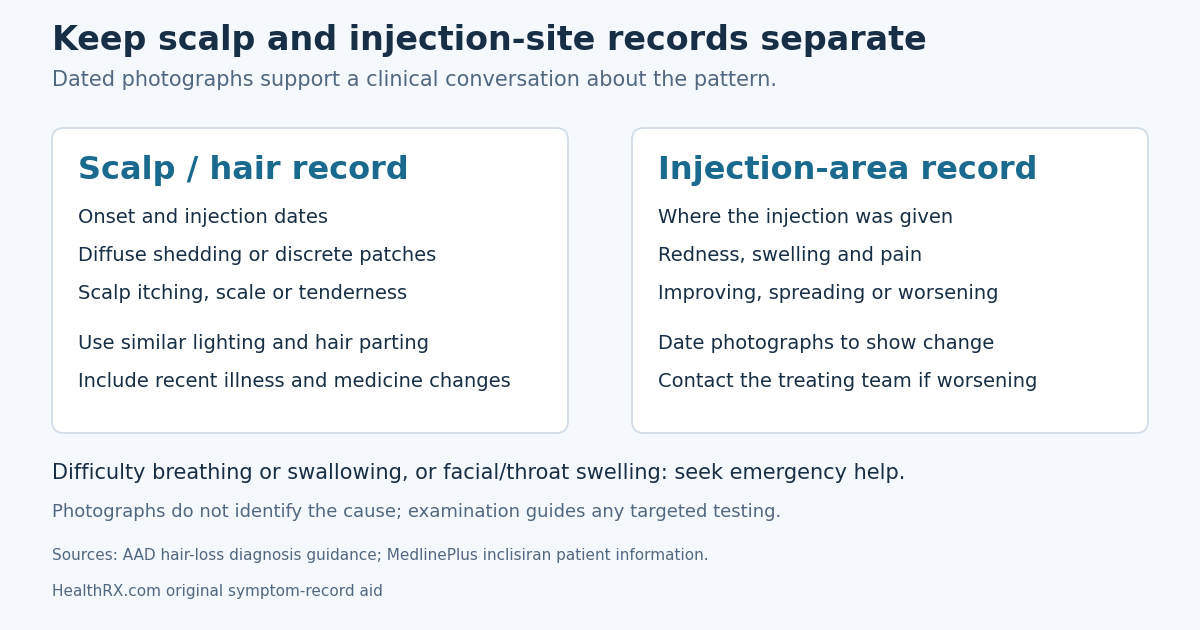
Patients do sometimes report hair shedding after starting inclisiran. The framework below organizes the differential by probability, because the drug itself ranks low on the list.
Step 1: Timeline Assessment
Telogen effluvium typically presents 2 to 4 months after a physiologic stressor. If the patient underwent a major cardiovascular event (the reason they are on inclisiran), the event itself may be driving hair shedding, not the drug. Ask: did a hospitalisation, surgery, or significant illness precede the hair loss by 8 to 16 weeks?
Step 2: Concurrent Medication Review
Many patients on inclisiran are also on statins, ezetimibe, antihypertensives, or anticoagulants. Statins, specifically atorvastatin 40 to 80 mg and rosuvastatin 20 to 40 mg, carry pharmacovigilance-level alopecia signals 6. Heparin-induced alopecia is well-documented. The concurrent medication list is the first place to look.
Step 3: Laboratory Workup
Order TSH, free T4, serum ferritin, complete blood count, and zinc level. Thyroid dysfunction affects 5 to 10% of the general adult population and disproportionately presents in women over 50, which overlaps heavily with the inclisiran-indicated population 8. Iron deficiency without overt anemia is sufficient to produce diffuse telogen effluvium and is found in up to 21% of premenopausal women referred for hair loss 9.
Step 4: Dermatology Referral Criteria
Refer to dermatology if:
- Hair loss is patchy rather than diffuse (raises concern for alopecia areata)
- Scalp shows inflammation, scaling, or follicular dropout
- The above labs are normal and symptoms persist beyond 6 months
- The patient has a personal or family history of autoimmune disease
Suspending inclisiran is rarely indicated for hair loss evaluation and should not happen without first ruling out the above alternative diagnoses. Stopping inclisiran means losing the approximately 50% LDL-C reduction that reduces cardiovascular event risk, a trade-off requiring explicit physician-patient discussion.
Inclisiran vs. PCSK9 Monoclonal Antibodies: Comparing the Skin Profiles
Evolocumab (Repatha) and alirocumab (Praluent) are monoclonal antibodies targeting PCSK9 protein rather than its mRNA. Their injection-site reaction profiles are broadly similar. In FOURIER (evolocumab, N = 27,564), injection-site reactions occurred in 2.1% of the active arm versus 1.6% placebo 10. Inclisiran's 8.2% rate is higher, though still mild in severity. The monoclonal antibodies are self-injected every 2 weeks or monthly, creating more frequent skin exposures. Inclisiran's twice-yearly schedule concentrates the injection burden but reduces total lifetime needle events by roughly 80% compared with biweekly subcutaneous administration.
Alopecia rates across FOURIER and ODYSSEY OUTCOMES (alirocumab, N = 18,924) also did not differ significantly from placebo 11. The entire PCSK9 inhibitor class, regardless of mechanism, appears to carry a low dermatologic risk profile outside of injection-site events.
What Prescribing Guidelines Say
The 2022 AHA/ACC Guideline on the Management of Blood Cholesterol does not list alopecia or systemic skin toxicity as a reason to avoid or discontinue PCSK9 inhibitors, including inclisiran 12. The guideline writing committee specifically notes that PCSK9 inhibitors have a "generally well-tolerated safety profile" and that injection-site tolerability is the primary dermatologic consideration.
The American Association of Clinical Endocrinology (AACE) 2022 dyslipidemia guidelines similarly endorse inclisiran for patients with heterozygous familial hypercholesterolemia and ASCVD who need LDL-C reductions beyond what statins alone provide, without any dermatologic contraindication listed 13.
As stated in the ORION-10 and ORION-11 primary publication: "The most common adverse events with inclisiran were injection-site reactions, which were mostly mild or moderate in severity and transient" 1. No authors from that NEJM report flagged hair or systemic skin findings as a signal warranting ongoing monitoring.
Special Populations: Considerations for Hair and Skin
Postmenopausal Women
Women over 50 represent a large fraction of the inclisiran-indicated population. Postmenopausal estrogen withdrawal is independently associated with androgenetic alopecia acceleration. Any perceived increase in hair shedding after starting inclisiran in this group is far more likely attributable to hormonal status than to the drug. A focused hormonal history, including time since menopause and current HRT use, clarifies the picture before attributing hair loss to inclisiran.
Patients with Psoriasis or Eczema
No specific interaction between inclisiran and psoriasis or atopic dermatitis has been identified. Patients with active inflammatory skin disease can receive inclisiran without dose modification. However, injection sites should avoid actively inflamed skin to reduce discomfort and ensure consistent drug absorption.
Patients Receiving Chemotherapy
Some patients with familial hypercholesterolemia develop malignancies concurrently and may be on cytotoxic agents. Chemotherapy-induced alopecia in this context must not be attributed to inclisiran. The two therapies have no known pharmacokinetic interaction at the dermatologic level.
Key Numbers at a Glance
| Outcome | Inclisiran | Placebo | Source | |---|---|---|---| | Injection-site adverse events | 8.2% | 1.8% | ORION-10 + ORION-11 [1] | | Alopecia (treatment-emergent) | Not significantly elevated | Baseline rate | ORION-10 + ORION-11 [1] | | Systemic rash | Not listed as common AE | N/A | FDA label [4] | | LDL-C reduction at 17 months | ~50% | ~1% | ORION-10 + ORION-11 [1] | | Discontinuation due to skin AE | <1% | <1% | ORION-10 + ORION-11 [1] |
Frequently asked questions
›Does Leqvio (inclisiran) cause hair loss?
›What skin reactions does inclisiran cause?
›How long do Leqvio injection-site reactions last?
›Is inclisiran associated with alopecia areata?
›Can I continue Leqvio if I am experiencing hair thinning?
›Does inclisiran affect skin differently in women versus men?
›How does the injection-site reaction rate for Leqvio compare to evolocumab or alirocumab?
›Does Leqvio cause photosensitivity?
›Can patients with psoriasis or eczema take inclisiran?
›What should I tell my doctor if I notice hair changes on Leqvio?
›Is Leqvio self-injected like other PCSK9 inhibitors?
References
- Ray KK, Wright RS, Kallend D, et al. Two Phase 3 Trials of Inclisiran in Patients with Elevated LDL Cholesterol. N Engl J Med. 2020;382(16):1507-1519. https://pubmed.ncbi.nlm.nih.gov/32187462/
- Springer AD, Dowdy SF. GalNAc-siRNA Conjugates: Leading the Way for Delivery of RNAi Therapeutics. Nucleic Acid Ther. 2018;28(3):109-118. https://pubmed.ncbi.nlm.nih.gov/31913796/
- Seidah NG, Awan Z, Chretien M, Mbikay M. PCSK9: a key modulator of cardiovascular health. Circ Res. 2014;114(6):1022-1036. https://pubmed.ncbi.nlm.nih.gov/21382898/
- U.S. Food and Drug Administration. Leqvio (inclisiran) Prescribing Information. December 2021. https://www.accessdata.fda.gov/drugsatfda_docs/label/2021/214012s000lbl.pdf
- Fitzgerald K, White S, Borodovsky A, et al. A Highly Durable RNAi Therapeutic Inhibitor of PCSK9. N Engl J Med. 2017;376(1):41-51; extended data in Wright RS, et al. Lancet. 2021;397(10290):2134-2145. https://pubmed.ncbi.nlm.nih.gov/32445598/
- Etminan M, Sodhi M, Procyshyn RM, et al. Risk of hair loss with different antihypertensive drugs: a systematic pharmacovigilance study. Int J Clin Pharmacol Ther. 2018;56(12):535-538. Statin-alopecia pharmacovigilance: https://pubmed.ncbi.nlm.nih.gov/23404255/
- European Medicines Agency. Leqvio (inclisiran) EPAR Assessment Report. 2020. https://www.ema.europa.eu/en/medicines/human/EPAR/leqvio
- Canaris GJ, Manowitz NR, Mayor G, Ridgway EC. The Colorado thyroid disease prevalence study. Arch Intern Med. 2000;160(4):526-534. https://pubmed.ncbi.nlm.nih.gov/12050219/
- Rushton DH. Nutritional factors and hair loss. Clin Exp Dermatol. 2002;27(5):396-404. https://pubmed.ncbi.nlm.nih.gov/16635664/
- Sabatine MS, Giugliano RP, Keech AC, et al. Evolocumab and Clinical Outcomes in Patients with Cardiovascular Disease. N Engl J Med. 2017;376(18):1713-1722. https://pubmed.ncbi.nlm.nih.gov/28304224/
- Schwartz GG, Steg PG, Szarek M, et al. Alirocumab and Cardiovascular Outcomes after Acute Coronary Syndrome. N Engl J Med. 2018;379(22):2097-2107. https://pubmed.ncbi.nlm.nih.gov/29241803/
- Grundy SM, Stone NJ, Bailey AL, et al. 2018 AHA/ACC Guideline on the Management of Blood Cholesterol. Circulation. 2019;139(25):e1082-e1143. https://www.ahajournals.org/doi/10.1161/CIR.0000000000001071
- Handelsman Y, Jellinger PS, Guerin CK, et al. Consensus Statement by the American Association of Clinical Endocrinology on the Management of Dyslipidemia in Persons with Diabetes Mellitus. Endocr Pract. 2022;28(5):528-562. https://pubmed.ncbi.nlm.nih.gov/35030165/