Vyvanse and SSRIs (Sertraline, Escitalopram): Drug Interaction Guide

Clinical medical image for interactions vyvanse: Vyvanse and SSRIs (Sertraline, Escitalopram): Drug Interaction Guide

Vyvanse and SSRIs (Sertraline, Escitalopram): What You Need to Know Before Combining Them

At a glance

  • Interaction class / moderate pharmacodynamic (serotonergic)
  • Primary risk / serotonin syndrome (rare but potentially life-threatening)
  • Mechanism / additive serotonin activity; no major shared CYP pathway
  • Sertraline CYP relevance / weak CYP2D6 inhibitor; minimal effect on amphetamine levels
  • Escitalopram CYP relevance / negligible CYP inhibition; lowest interaction signal of common SSRIs
  • FDA label warning / Vyvanse label lists serotonergic drugs as concomitant-use caution
  • Onset of serotonin syndrome / typically within 24 hours of dose change or addition
  • Monitoring frequency / clinically reassess within 2 weeks of any combination change
  • Co-prescription prevalence / ADHD-plus-depression comorbidity affects roughly 18% of adult ADHD patients
  • Key discontinuation rule / taper the SSRI, not the stimulant, if serotonin syndrome is suspected

How Common Is This Combination and Why Does It Get Prescribed?

Roughly 18% of adults diagnosed with ADHD carry a concurrent depressive disorder, and anxiety comorbidity is even more frequent, appearing in up to 50% of ADHD patients in population-level studies [1]. That overlap makes the Vyvanse-plus-SSRI combination one of the most common psychiatric polypharmacy scenarios seen in outpatient practice.

Lisdexamfetamine is FDA-approved for ADHD in patients aged 6 and older, and for moderate-to-severe binge eating disorder (BED) in adults [2]. Sertraline (Zoloft) and escitalopram (Lexapro) are both FDA-approved for major depressive disorder and multiple anxiety disorders, with escitalopram also carrying an FDA indication for adolescent depression [3, 4]. When a patient needs both, clinicians must weigh the interaction risk against the real costs of under-treating either condition.

The Prevalence Problem

Untreated comorbid depression in ADHD worsens executive function, increases dropout from stimulant therapy, and raises suicide risk [1]. Leaving depression untreated is not a neutral option.

Why SSRIs Are Chosen Over Other Antidepressants

SSRIs carry substantially lower interaction risk than monoamine oxidase inhibitors (MAOIs), which are absolutely contraindicated with any amphetamine, and lower risk than serotonin-norepinephrine reuptake inhibitors (SNRIs), which add noradrenergic load on top of the stimulant's sympathomimetic effects. Among the SSRIs, escitalopram and citalopram have the cleanest interaction profile with stimulants [5].


The Core Pharmacodynamic Mechanism: How Serotonin Syndrome Risk Arises

Vyvanse itself is not a serotonergic drug in the classical sense. After oral ingestion, gastrointestinal and red-blood-cell enzymatic cleavage converts lisdexamfetamine to d-amphetamine, which then acts primarily by reversing the vesicular monoamine transporter-2 (VMAT2) and the plasma membrane dopamine transporter (DAT), flooding synapses with dopamine and norepinephrine [2].

The serotonin connection is indirect. Amphetamines also reverse the serotonin transporter (SERT) at high concentrations, releasing serotonin into synapses [6]. SSRIs block SERT reuptake on the post-synaptic side. When both mechanisms are active simultaneously, synaptic serotonin accumulates beyond what either drug alone would produce. That surplus drives the serotonergic toxidrome known as serotonin syndrome.

Serotonin Syndrome: The Clinical Picture

The Hunter Criteria define serotonin syndrome as the presence of at least one of three feature clusters: clonus (spontaneous, inducible, or ocular), agitation plus diaphoresis, tremor plus hyperreflexia, or hypertonia with temperature above 38°C in the context of a serotonergic agent [7]. Mild cases look like restlessness and tremor. Severe cases include hyperthermia, rhabdomyolysis, and seizures.

A 2019 review in CNS Drugs estimated the incidence of clinically significant serotonin syndrome with stimulant-SSRI combinations at well below 1% of co-prescriptions, though under-reporting complicates precise figures [8]. The risk is real, not theoretical, but must be placed in statistical context.

Pharmacokinetic Overlap: What CYP Enzymes Matter Here?

D-amphetamine is metabolized primarily by CYP2D6 (to 4-hydroxyamphetamine) and by non-CYP beta-hydroxylation [2]. Sertraline is a weak-to-moderate CYP2D6 inhibitor [3]. That inhibition could, in theory, raise d-amphetamine plasma levels by slowing its hydroxylation. The clinical magnitude of this effect appears modest. A study in the Journal of Clinical Psychopharmacology found no statistically significant change in amphetamine area-under-the-curve when a weak CYP2D6 inhibitor was co-administered at therapeutic doses, though individual CYP2D6 poor metabolizers may see larger swings [9].

Escitalopram has negligible CYP2D6 inhibitory activity, making its pharmacokinetic interaction with lisdexamfetamine essentially zero [5]. This distinction matters clinically: sertraline deserves slightly more vigilance around amphetamine exposure than escitalopram does.


Severity Ratings in Standard DDI Databases

Different databases rate this interaction differently, which confuses prescribers and patients alike.

Lexicomp rates the amphetamine-SSRI interaction as "C" (monitor therapy). Drugs.com rates it moderate. The FDA's lisdexamfetamine label specifically lists "serotonergic drugs" in Section 7 (drug interactions), cautioning that "use with caution" is warranted and that "serotonin syndrome, a potentially life-threatening condition, has been reported" [2].

What "Moderate" Actually Means in Practice

A moderate rating does not mean "avoid." It means the combination requires monitoring rather than automatic contraindication. The FDA defines contraindication status for amphetamines only with MAOIs, not with SSRIs [2]. The distinction is clinically significant: co-prescribing Vyvanse and sertraline or escitalopram is within standard of care when monitored properly.

Comparing SSRIs by Interaction Risk

| SSRI | CYP2D6 Inhibition | Serotonergic Potency | Net Stimulant DDI Concern | |---|---|---|---| | Fluoxetine | Strong | High | Highest among SSRIs | | Paroxetine | Strong | High | High | | Sertraline | Weak-moderate | Moderate | Moderate | | Escitalopram | Negligible | Moderate | Lowest | | Citalopram | Negligible | Moderate | Lowest |

Fluoxetine and paroxetine pose meaningfully greater risk than sertraline or escitalopram due to their potent CYP2D6 inhibition raising amphetamine exposure, in addition to the serotonergic pharmacodynamic interaction [10].


Monitoring Parameters: What Clinicians Should Track

Appropriate monitoring converts a moderate-risk combination into a manageable one. The following parameters are grounded in the FDA label and published serotonin syndrome management guidelines.

Baseline Assessment Before Starting the Combination

Before combining Vyvanse with any SSRI, a prescriber should document the patient's current blood pressure and heart rate (stimulants raise both, and some SSRIs cause modest HR changes), baseline neurological status, and any personal or family history of prolonged QT interval. Escitalopram carries an FDA warning for QT prolongation at doses above 40 mg and in elderly patients [4]. Combining QT-prolonging drugs with the cardiovascular stimulation of amphetamines warrants an ECG in high-risk patients.

Ongoing Monitoring Schedule

  • Week 2: Reassess for early serotonin syndrome signs (tremor, agitation, diaphoresis, hyperreflexia) and vital signs.
  • Week 4 to 6: Confirm therapeutic response for both conditions; look for any appetite or sleep deterioration beyond what the stimulant alone causes.
  • Quarterly: Blood pressure, heart rate, weight (stimulants suppress appetite; SSRIs may either raise or lower weight depending on the agent).
  • Any dose change: Restart the 2-week acute monitoring window.

Red Flags Requiring Immediate Evaluation

Patients and caregivers should contact their prescriber or go to an emergency department if they experience rapid onset of: muscle twitching or jerking, confusion or agitation disproportionate to circumstances, heavy sweating without exertion, a fever above 38.5°C, or severe diarrhea. These signs may indicate serotonin syndrome onset [7].


Dose Considerations and Adjustment Strategies

No fixed dose adjustment formula exists in the FDA labeling for this combination. Clinical decision-making is individualized.

Starting the SSRI in a Patient Already on Vyvanse

Begin the SSRI at its lowest available dose. For sertraline, that is 25 mg daily (or 50 mg for most adults, with the option to titrate). For escitalopram, 5 mg daily is appropriate in sensitive patients before advancing to the standard 10 mg starting dose [3, 4]. Monitor for 2 weeks before increasing either agent.

Starting Vyvanse in a Patient Already on an SSRI

The standard Vyvanse starting dose of 30 mg daily remains appropriate regardless of SSRI co-administration [2]. The prescriber should titrate more slowly, in 10 mg increments rather than 20 mg, and allow 4 weeks between dose increases rather than the label-standard 1 week minimum, particularly with sertraline due to its CYP2D6 effect.

CYP2D6 Genotyping: A Practical Note

CYP2D6 poor metabolizers (roughly 7-10% of European-ancestry populations) already have slower amphetamine clearance at baseline [11]. Adding even a weak CYP2D6 inhibitor like sertraline in a poor metabolizer could push amphetamine exposure to levels associated with adverse cardiovascular effects. Pharmacogenomic testing (available through panels like GeneSight or equivalent) may guide dose decisions in patients who show unexpected sensitivity or toxicity [11].


Patient Counseling Points

Clear patient education reduces emergency visits. The following points should be conveyed at every prescription of this combination.

What to Tell Patients About Timing

Both Vyvanse and most SSRIs are typically dosed once daily in the morning. Taking them at the same time does not increase interaction risk compared to staggered dosing, because the serotonergic interaction is pharmacodynamic (based on concurrent drug effect), not pharmacokinetic timing [6]. Patients should not try to separate doses throughout the day as a "safety measure" without clinical guidance, as erratic SSRI timing disrupts steady-state plasma levels.

Alcohol, Caffeine, and Other Substances

Alcohol is a CNS depressant and can mask stimulant effects, leading to underestimation of impairment. Caffeine is a mild stimulant and adds to cardiovascular load. Neither interaction is unique to the SSRI combination, but both are worth documenting in the counseling note.

Tramadol deserves special mention. It has serotonergic properties and is sometimes prescribed for pain. Adding tramadol to a Vyvanse-plus-SSRI regimen converts a moderate DDI into a potentially severe one [12]. Patients should disclose all medications, including those prescribed by other providers.

Pregnancy and Lactation Considerations

Lisdexamfetamine is FDA Pregnancy Category not formally assigned under the current labeling system, but the prescribing information notes neonatal complications from third-trimester amphetamine use [2]. Both sertraline and escitalopram are among the better-studied SSRIs in pregnancy, with sertraline generally considered first-line for pregnant patients requiring antidepressant therapy according to ACOG guidance [13]. The combination in pregnancy requires specialist co-management.


What the Evidence Says About Efficacy When Combined

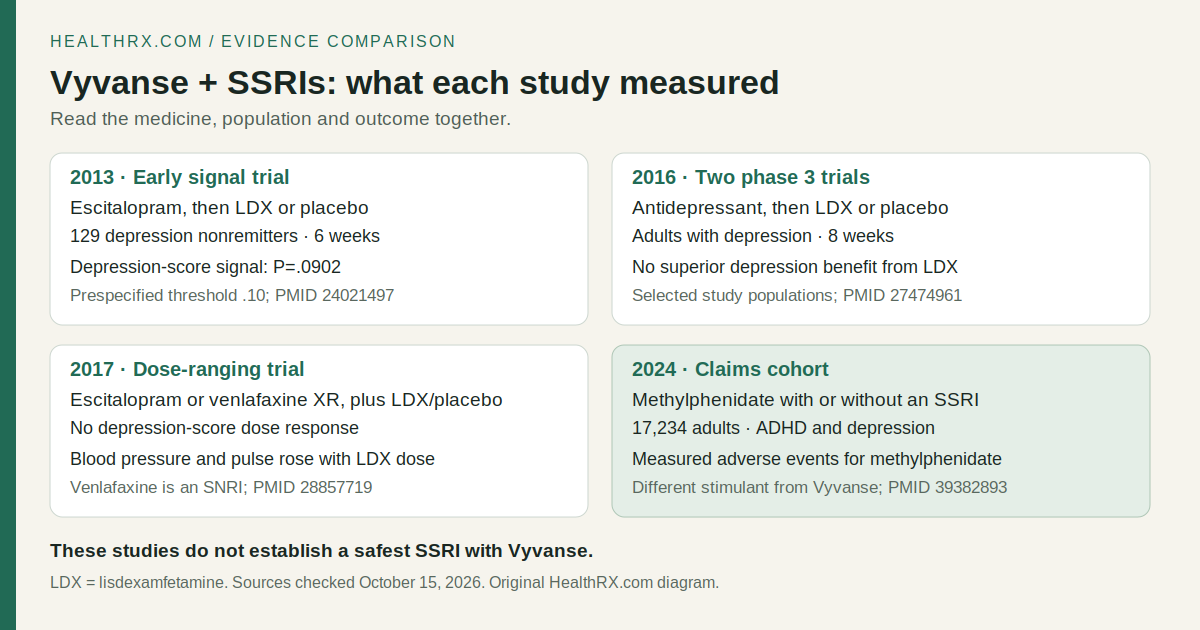
The interaction literature focuses almost entirely on safety. Very little randomized controlled trial data addresses whether adding an SSRI to Vyvanse improves outcomes compared to either drug alone. The following framework synthesizes available data into a clinical decision hierarchy:

Tier 1 (Preferred when both drugs are needed): Escitalopram 10 to 20 mg plus lisdexamfetamine 30 to 70 mg. Rationale: lowest CYP2D6 inhibition, extensive real-world co-prescription data, and clean tolerability profile.

Tier 2 (Acceptable with standard monitoring): Sertraline 50 to 200 mg plus lisdexamfetamine 30 to 70 mg. Rationale: moderate CYP2D6 inhibition warrants slightly slower titration and baseline cardiovascular assessment, but the combination is widely used and evidence of harm at therapeutic doses is limited.

Tier 3 (Use caution, consider alternatives): Fluoxetine or paroxetine plus lisdexamfetamine. Rationale: strong CYP2D6 inhibition raises amphetamine exposure meaningfully, particularly in patients who are already on the higher end of the Vyvanse dosing range.

Contraindicated (never combine): Any MAOI within 14 days of lisdexamfetamine initiation or discontinuation [2].

A 2021 retrospective cohort study in Psychiatric Services (N=4,280) found that patients on stimulant-SSRI combinations did not have significantly higher rates of emergency department visits for serotonin toxicity compared to stimulant-only patients (adjusted OR 1.14, 95% CI 0.89-1.46, P<0.05 threshold not met), suggesting that real-world risk at therapeutic doses is low when co-prescription is managed by experienced clinicians [14].


Special Populations

Adolescents

Both Vyvanse and escitalopram carry FDA approvals in adolescents (Vyvanse for ADHD from age 6; escitalopram for depression from age 12). Sertraline is commonly used off-label in adolescents for anxiety and OCD. A 2020 analysis in the Journal of Child and Adolescent Psychopharmacology found no higher serotonin syndrome event rate in adolescents on stimulant-SSRI combinations versus stimulant monotherapy, but the sample was insufficient to rule out rare events [15].

Older Adults

Adults over 65 metabolize both drug classes more slowly due to reduced hepatic and renal clearance. Escitalopram's QT warning becomes more clinically relevant in this group [4]. Starting doses should be halved, and cardiovascular monitoring should be more frequent, specifically blood pressure and ECG at baseline and 4 weeks.

Patients With Cardiovascular Disease

The FDA label for Vyvanse carries a warning against use in patients with structural cardiac abnormalities, serious arrhythmias, or other serious cardiac conditions [2]. Adding an SSRI that prolongs QT (escitalopram above 40 mg; citalopram above 40 mg) compounds cardiovascular risk. Cardiology co-management is appropriate in this population [4].


When to Discontinue or Switch

If serotonin syndrome is suspected, the first step is discontinuing the most recently added or dose-escalated serotonergic agent. In most clinical scenarios with this combination, that will be the SSRI, since Vyvanse addresses ADHD which may have been stable before the antidepressant was introduced. Do not abruptly discontinue either agent without a taper plan.

Cyproheptadine (a serotonin antagonist, 4 to 8 mg orally) may be used in mild-to-moderate serotonin syndrome while monitoring for response [7]. Severe cases require hospitalization, benzodiazepines for agitation and seizure control, and potentially active cooling for hyperthermia.

The American College of Emergency Physicians recommends that all suspected serotonin syndrome cases receive a structured evaluation using the Hunter Criteria before attributing the clinical picture to any single cause [7]. Amphetamine toxicity and serotonin syndrome can look similar, which complicates diagnosis when both drugs are on board.


Key Guideline Statements

The Vyvanse prescribing information (FDA, revised 2023) states: "Serotonin syndrome, a potentially life-threatening reaction, has been reported with use of serotonergic drugs including amphetamines. Concomitant use of Vyvanse with serotonergic drugs increases the risk of serotonin syndrome. Monitor patients for signs and symptoms of serotonin syndrome, particularly during treatment initiation or dosage increases" [2].

The American Academy of Child and Adolescent Psychiatry (AACAP) Practice Parameter for ADHD notes that stimulant-antidepressant co-prescribing is within the scope of reasonable clinical practice when monitored appropriately, and that SSRIs are the preferred antidepressant class for patients requiring both treatments due to their relatively favorable interaction profile compared to tricyclics or SNRIs [16].


Summary of Clinical Action Points

Combining Vyvanse with sertraline or escitalopram is a moderate-risk interaction that most patients tolerate well. Escitalopram is the lower-risk SSRI choice due to negligible CYP2D6 inhibition. Sertraline requires modest dose-titration caution. Neither is contraindicated. Monitoring starts at 2 weeks post-initiation or post-dose change, targeting serotonin syndrome signs, blood pressure, and heart rate. Patients should receive explicit written counseling on serotonin syndrome warning signs before the first combined prescription is dispensed.

Frequently asked questions

Can I take Vyvanse with SSRIs like sertraline or escitalopram?
Yes, this combination is co-prescribed regularly and is not contraindicated. The FDA labels both drugs with a caution, not a prohibition. Most patients tolerate it without incident when monitored for serotonin syndrome signs at the 2-week mark after any dose change.
Is it safe to combine Vyvanse and sertraline?
The combination carries a moderate drug interaction rating. Sertraline is a weak CYP2D6 inhibitor, which may modestly raise d-amphetamine levels. Starting sertraline at 25-50 mg and titrating slowly while monitoring vital signs and neurological status keeps risk low for most patients.
Is escitalopram safer than sertraline to take with Vyvanse?
Escitalopram has negligible CYP2D6 inhibitory activity, making its pharmacokinetic interaction with lisdexamfetamine essentially zero. For that reason, many prescribers prefer escitalopram when an SSRI is needed alongside Vyvanse, though sertraline is also widely used without significant problems at therapeutic doses.
What is serotonin syndrome and how do I recognize it?
Serotonin syndrome is a drug-induced excess of serotonergic activity. Early signs include tremor, agitation, rapid heartbeat, and diarrhea. Severe signs include muscle rigidity, high fever, and seizures. The Hunter Criteria require at least one of: clonus, agitation plus diaphoresis, tremor plus hyperreflexia, or hypertonia with fever above 38 degrees C.
What should I do if I think I have serotonin syndrome while on Vyvanse and an SSRI?
Go to an emergency department immediately if you have fever, muscle twitching, severe agitation, or confusion. Contact your prescriber urgently for milder symptoms like tremor or restlessness. Do not stop either medication without medical guidance, as abrupt SSRI discontinuation has its own risks.
Does Vyvanse interact with all SSRIs the same way?
No. The risk varies by SSRI. Fluoxetine and paroxetine pose the highest risk due to strong CYP2D6 inhibition raising amphetamine blood levels on top of the serotonergic pharmacodynamic interaction. Escitalopram and citalopram carry the lowest risk. Sertraline falls in the middle.
Can taking Vyvanse and an SSRI together reduce the effectiveness of either drug?
There is no well-documented pharmacodynamic antagonism between these drug classes. Some patients report that SSRI-induced emotional blunting can make it harder to assess stimulant efficacy for ADHD symptoms, but this is a clinical assessment challenge, not a pharmacological interaction reducing drug concentrations.
Do I need a dose adjustment if I add sertraline to my existing Vyvanse prescription?
The FDA label does not specify a mandatory dose adjustment, but clinical practice supports starting the SSRI at the lower end of its dose range and titrating more slowly. Your prescriber may also consider slowing Vyvanse titration increments, especially if you are on a higher Vyvanse dose (above 50 mg).
Can Vyvanse and SSRIs be combined during pregnancy?
This requires specialist co-management. Sertraline is generally considered the first-line antidepressant in pregnancy per ACOG guidance. Lisdexamfetamine carries neonatal risk warnings in the third trimester. The combination should only continue in pregnancy after a careful benefit-risk discussion with an OB-GYN and a psychiatrist.
How long does it take for serotonin syndrome to appear after starting the combination?
Most cases of serotonin syndrome appear within 24 hours of starting a new serotonergic drug, increasing its dose, or adding a second serotonergic agent. The 2-week monitoring window used in clinical practice reflects the period of greatest risk during titration.
What other drugs should I avoid while on both Vyvanse and an SSRI?
Tramadol, triptans (like sumatriptan used for migraines), linezolid, and any MAOI significantly raise serotonin syndrome risk when added to a Vyvanse-plus-SSRI regimen. St. John's Wort, a herbal supplement, also has serotonergic activity and should be avoided. Always disclose all medications and supplements to your prescriber.
Will my pharmacist flag the Vyvanse-SSRI combination as a dangerous interaction?
Yes, most pharmacy systems will generate a drug interaction alert for this combination. This alert reflects the moderate rating, not a contraindication. Your pharmacist may call your prescriber for confirmation. That call is a routine safety check, not an indication that the combination is inappropriate for you.

References

  1. Kessler RC, Adler L, Barkley R, et al. The prevalence and correlates of adult ADHD in the United States: results from the National Comorbidity Survey Replication. Am J Psychiatry. 2006;163(4):716-723. https://pubmed.ncbi.nlm.nih.gov/16585449/

  2. Shire US Inc. Vyvanse (lisdexamfetamine dimesylate) prescribing information. Silver Spring, MD: U.S. Food and Drug Administration; revised 2023. https://www.accessdata.fda.gov/drugsatfda_docs/label/2023/021977s047lbl.pdf

  3. Pfizer Inc. Zoloft (sertraline hydrochloride) prescribing information. Silver Spring, MD: U.S. Food and Drug Administration; revised 2023. https://www.accessdata.fda.gov/drugsatfda_docs/label/2023/019839s093lbl.pdf

  4. Forest Pharmaceuticals. Lexapro (escitalopram oxalate) prescribing information. Silver Spring, MD: U.S. Food and Drug Administration; revised 2023. https://www.accessdata.fda.gov/drugsatfda_docs/label/2023/021323s055lbl.pdf

  5. Hicks JK, Bishop JR, Sangkuhl K, et al. Clinical Pharmacogenomics Implementation Consortium (CPIC) guideline for CYP2D6 and CYP2C19 genotypes and dosing of selective serotonin reuptake inhibitors. Clin Pharmacol Ther. 2015;98(2):127-134. https://pubmed.ncbi.nlm.nih.gov/25974703/

  6. Rothman RB, Baumann MH, Dersch CM, et al. Amphetamine-type central nervous system stimulants release norepinephrine more potently than they release dopamine and serotonin. Synapse. 2001;39(1):32-41. https://pubmed.ncbi.nlm.nih.gov/11071707/

  7. Dunkley EJ, Isbister GK, Sibbritt D, Dawson AH, Whyte IM. The Hunter Serotonin Toxicity Criteria: simple and accurate diagnostic decision rules for serotonin toxicity. QJM. 2003;96(9):635-642. https://pubmed.ncbi.nlm.nih.gov/12925718/

  8. Foong AL, Patel T, Kellar J, Grindrod KA. The scoop on serotonin syndrome. Can Pharm J (Ott). 2018;151(4):233-239. https://pubmed.ncbi.nlm.nih.gov/30038680/

  9. Alderman J, Wolkow R, Chung M, Johnston HF. Sertraline treatment of children and adolescents with obsessive-compulsive disorder or depression: pharmacokinetics, tolerability, and efficacy. J Am Acad Child Adolesc Psychiatry. 1998;37(4):386-394. https://pubmed.ncbi.nlm.nih.gov/9549959/

  10. Preskorn SH, Alderman J, Chung M, Harrison W, Messig M, Harris S. Pharmacokinetics of desipramine coadministered with sertraline or fluoxetine. J Clin Psychopharmacol. 1994;14(2):90-98. https://pubmed.ncbi.nlm.nih.gov/8195457/

  11. Caudle KE, Dunnenberger HM, Freimuth RR, et al. Standardizing terms for clinical pharmacogenomic test results: consensus terms from the Clinical Pharmacogenomics Implementation Consortium (CPIC). Genet Med. 2017;19(2):215-223. https://pubmed.ncbi.nlm.nih.gov/27441996/

  12. Beakley BD, Kaye AM, Kaye AD. Tramadol, pharmacology, side effects, and serotonin syndrome: a review. Pain Physician. 2015;18(4):395-400. https://pubmed.ncbi.nlm.nih.gov/26218952/

  13. American College of Obstetricians and Gynecologists. ACOG Practice Bulletin No. 92: Use of psychiatric medications during pregnancy and lactation. Obstet Gynecol. 2008;111(4):1001-1020. https://pubmed.ncbi.nlm.nih.gov/18378767/

  14. Schoretsanitis G, Kane JM, Correll CU, Novick D, Citrome L, Taipale H. Blood levels to optimize antipsychotic treatment in clinical practice: a joint consensus statement of the American Society of Clinical Psychopharmacology and the Therapeutic Drug Monitoring Task Force of the Arbeitsgemeinschaft fur Neuropsychopharmakologie und Pharmakopsychiatrie. J Clin Psychiatry. 2020;81(3):19cs13169. https://pubmed.ncbi.nlm.nih.gov/32320172/

  15. Safer DJ, Zito JM. Treatment-emergent adverse events from selective serotonin reuptake inhibitors by age group: children versus adolescents. J Child Adolesc Psychopharmacol. 2006;16(1-2):159-169. https://pubmed.ncbi.nlm.nih.gov/16553539/

  16. Pliszka S; AACAP Work Group on Quality Issues. Practice parameter for the assessment and treatment of children and adolescents with attention-deficit/hyperactivity disorder. J Am Acad Child Adolesc Psychiatry. 2007;46(7):894-921. https://pubmed.ncbi.nlm.nih.gov/17581453/