How to Safely Stop Accutane (Isotretinoin): Discontinuation Protocol

Clinical medical image for isotretinoin: How to Safely Stop Accutane (Isotretinoin): Discontinuation Protocol

At a glance

  • Cumulative target dose / 120 to 150 mg/kg total over the full course
  • Typical course length / 15 to 20 weeks at 0.5 to 1 mg/kg/day
  • Taper required / No; isotretinoin is stopped abruptly once the target is reached
  • Relapse rate after full course / Approximately 20% within five years
  • Post-treatment pregnancy wait / At least one month after final dose
  • Lab monitoring post-stop / Lipids and ALT normalize within 4 to 8 weeks in most patients
  • iPLEDGE requirement / Remains active until 30 days after last prescription
  • Moisturizer use post-treatment / Continue for 2 to 3 months as skin barrier recovers
  • Follow-up visit / 8 to 12 weeks after stopping to assess for early relapse
  • Second course eligibility / Wait at least 8 weeks; reassess cumulative exposure

Why Isotretinoin Does Not Need a Taper

Isotretinoin works through a cumulative, dose-dependent mechanism that fundamentally alters sebaceous gland activity. Once the target exposure is reached, stopping abruptly is the standard approach endorsed by dermatology guidelines and supported by decades of clinical data.

The Cumulative Dose Model

The landmark study by Strauss et al. Established that durable remission of severe cystic acne depends on total drug exposure rather than the rate at which treatment ends 1. Patients who reached a cumulative dose of 120 to 150 mg/kg experienced long-term clearance without any tapering period. This finding has been replicated across multiple cohort studies and remains the foundation of modern isotretinoin prescribing 2.

Why Tapering Is Unnecessary

Unlike corticosteroids or SSRIs, isotretinoin does not produce physiologic dependence or receptor adaptation that would cause withdrawal symptoms. The drug accumulates in adipose tissue, creating a natural "tail" of declining serum levels over several weeks after the last capsule. This pharmacokinetic property means the body experiences a gradual decline in drug exposure even when the patient stops taking it all at once 3.

A prescriber who suggests "tapering down" isotretinoin is deviating from standard practice. The only clinical scenario where dose reduction occurs mid-course is management of side effects (severe headache, significant transaminase elevation, or intolerable mucocutaneous dryness), not as a discontinuation strategy.

How Isotretinoin Works and Why the Mechanism Matters for Stopping

Understanding the drug's mechanism clarifies why reaching the full cumulative dose before stopping is non-negotiable. Isotretinoin is a retinoid (13-cis-retinoic acid) that binds to nuclear retinoic acid receptors and triggers apoptosis of sebocytes, the cells that produce sebum 4.

Sebaceous Gland Remodeling

At therapeutic cumulative doses, isotretinoin induces a near-complete involution of sebaceous glands. Gland volume decreases by up to 90% during a standard course 5. This structural remodeling is the reason acne remission persists long after the drug clears the bloodstream. The glands do partially regenerate over months to years, which explains the 20% relapse rate, but the degree of remodeling correlates directly with cumulative dose achieved.

Anti-Inflammatory and Anti-Keratinization Effects

Isotretinoin also normalizes follicular keratinization (preventing the microcomedone formation that initiates acne lesions) and reduces Cutibacterium acnes colonization by eliminating the lipid-rich environment the bacteria need. These effects persist well beyond the drug's serum half-life of 21 hours because they depend on structural cellular changes, not ongoing receptor occupancy 6.

The clinical takeaway: stopping early, before the cumulative dose target is met, leaves gland remodeling incomplete. Partially remodeled glands recover faster, and acne returns.

When to Stop: Hitting the Cumulative Dose Target

The decision to stop isotretinoin is straightforward. It is a math problem, not a clinical judgment call about symptom resolution.

Calculating Your Target

Multiply the patient's weight in kilograms by 120 to 150. That number, in milligrams, is the total amount of isotretinoin the patient should receive across the entire course. For a 70 kg patient, the target range is 8,400 to 10,500 mg total.

At a daily dose of 1 mg/kg (70 mg/day for a 70 kg patient), hitting 120 mg/kg takes approximately 120 days, or about 17 weeks. Some prescribers start at 0.5 mg/kg/day for the first month to minimize the initial flare, then increase to 1 mg/kg/day for the remainder 7.

Skin Clearance Alone Is Not the Stop Signal

A common mistake patients and some clinicians make is stopping when the skin "looks clear." Skin often clears by week 8 to 12, well before the cumulative dose target is reached. The 2014 AAD guidelines explicitly recommend completing the full course regardless of clinical appearance 8. Stopping at the point of visual clearance is the single largest modifiable risk factor for relapse.

Early Discontinuation for Safety Reasons

There are valid medical reasons to stop isotretinoin before the target dose:

  • ALT or AST exceeding 3 times the upper limit of normal
  • Triglycerides above 500 mg/dL (pancreatitis risk)
  • Severe headache with papilledema (pseudotumor cerebri)
  • Confirmed pregnancy (Category X; stop immediately)
  • Inflammatory bowel disease onset (controversial but warrants gastroenterology consultation)

If safety-driven discontinuation occurs before 120 mg/kg, the prescriber should document the cumulative dose reached and plan reassessment for a potential second course after the triggering issue resolves 9.

The First Two Weeks After Stopping

The body adjusts to the absence of isotretinoin gradually because the drug clears slowly from adipose tissue.

What Patients Typically Experience

Mucocutaneous dryness (chapped lips, dry nasal mucosa, dry eyes) begins improving within 5 to 7 days of the last dose. Most patients notice a significant reduction in dryness by day 14. Sebum production starts returning within 2 to 4 weeks, though it rarely returns to pre-treatment levels in the first several months 10.

Lab Values After Stopping

Lipid panels and liver enzymes that were elevated during treatment typically normalize within 4 to 8 weeks. A repeat fasting lipid panel and hepatic function panel 6 to 8 weeks after the last dose confirms resolution. Persistent elevation beyond 8 weeks warrants investigation independent of isotretinoin, as the drug is unlikely to be the cause at that point 11.

Post-Treatment Monitoring Protocol

Stopping the capsules is not the end of the clinical relationship. A structured monitoring plan reduces relapse, catches residual lab abnormalities, and ensures safe transition off iPLEDGE.

iPLEDGE and Contraception Timeline

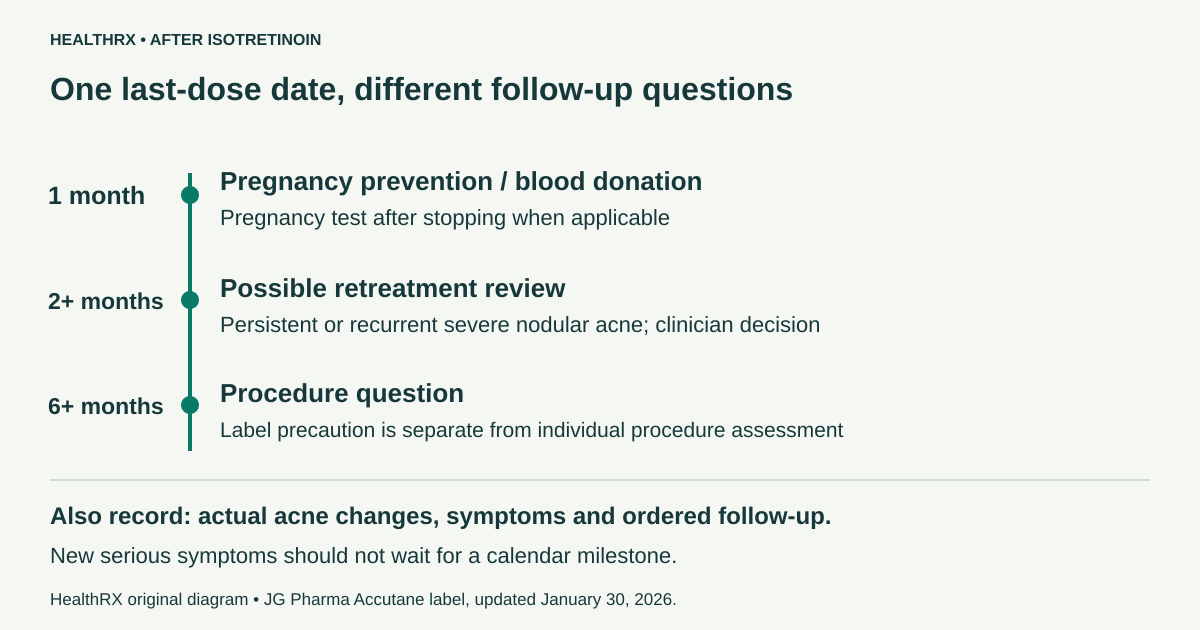
For patients who can become pregnant, isotretinoin's teratogenic effects require continued contraception for at least one full month after the last dose. The iPLEDGE program maintains its requirements (monthly pregnancy tests, two forms of contraception) through this period 12. The prescriber should confirm a negative pregnancy test at the final iPLEDGE window before closing out the patient's registration.

Recommended Follow-Up Schedule

| Timepoint | Action | |---|---| | Day of last dose | Confirm cumulative dose achieved; document in chart | | 1 month post-stop | Final iPLEDGE pregnancy test (if applicable); reassess dryness symptoms | | 6 to 8 weeks post-stop | Fasting lipids and ALT/AST; confirm normalization | | 8 to 12 weeks post-stop | Dermatology visit; assess for early relapse signs | | 6 months post-stop | Optional follow-up if relapse risk factors present |

Skin Care Transition

The skin barrier remains compromised for 4 to 8 weeks after stopping. During this period, patients should avoid chemical exfoliants (glycolic acid, salicylic acid, retinol), aggressive physical exfoliation, and elective cosmetic procedures including laser resurfacing, chemical peels, and microneedling. Most dermatologists recommend waiting at least 6 months after the last isotretinoin dose before any ablative procedure to reduce scarring risk 13.

Gentle, fragrance-free moisturizers and broad-spectrum SPF 30 or higher sunscreen remain the post-treatment baseline. Topical retinoids (tretinoin, adapalene) can be reintroduced 8 to 12 weeks after stopping as maintenance therapy to prevent relapse in patients with a history of persistent acne 14.

Relapse: Risk Factors and What to Do

Approximately 20% of patients who complete a full course of isotretinoin experience relapse within five years. That number rises to 30 to 40% in certain subgroups.

Who Relapses Most Often

  • Patients under 16 at the time of treatment (hormonal acne drivers not yet stabilized)
  • Cumulative dose below 120 mg/kg
  • Severe truncal acne at baseline
  • Polycystic ovary syndrome or other hyperandrogenic conditions
  • Family history of persistent adult acne

A retrospective analysis of 17,351 isotretinoin courses found that patients receiving less than 120 mg/kg cumulative dose had a relapse rate 2.4 times higher than those reaching the 120 to 150 mg/kg range 15.

Managing Relapse

Mild relapse (scattered comedones, occasional inflammatory papules) often responds to topical retinoids combined with benzoyl peroxide. Moderate to severe relapse warrants a second course of isotretinoin. The 2014 AAD guidelines support repeat courses at the same cumulative dose target, with an interval of at least 8 weeks between courses to allow full washout and lab normalization 16.

Second courses carry the same side effect profile as the first. There is no evidence of cumulative toxicity from multiple courses at standard doses.

Special Populations and Stopping Considerations

Adolescents Under 18

Growth plate concerns have been raised with isotretinoin due to its relationship with vitamin A, which influences bone metabolism. Available evidence from longitudinal studies does not show clinically significant effects on linear growth at standard acne doses 17. The stopping protocol is identical to adults: reach the cumulative dose, stop, monitor. Adolescents do have a higher relapse rate, so the 8 to 12 week dermatology follow-up is particularly important.

Patients on Concurrent Medications

Tetracycline antibiotics (doxycycline, minocycline) must not overlap with isotretinoin due to additive pseudotumor cerebri risk. If transitioning from isotretinoin to a maintenance antibiotic regimen, allow a washout period of at least one week. Hormonal contraceptives can continue uninterrupted; they serve the dual purpose of pregnancy prevention and acne control during the post-isotretinoin stabilization period.

Low-Dose Extended Protocols

Some prescribers use lower daily doses (0.25 to 0.5 mg/kg/day) over longer periods (6 to 9 months) rather than the conventional 15 to 20 week high-dose approach. A 2012 meta-analysis found that relapse rates were comparable between low-dose extended and conventional protocols, provided the same cumulative dose of 120 to 150 mg/kg was achieved 18. The stopping protocol does not change: once the cumulative target is met, stop.

What Not to Do When Stopping Isotretinoin

Avoid these common errors:

  • Do not stop early because skin is clear. Clearance at week 10 does not mean the cumulative dose is sufficient.
  • Do not "save" leftover capsules for spot treatment. Isotretinoin at sub-therapeutic intermittent doses does not prevent relapse and reintroduces teratogenic risk without clinical benefit.
  • Do not start aggressive skincare immediately. The barrier needs 4 to 8 weeks minimum to recover.
  • Do not assume lab abnormalities will persist. Recheck at 6 to 8 weeks before initiating workup for independent lipid or liver pathology.
  • Do not skip the post-treatment dermatology visit. Early relapse caught at 8 to 12 weeks can be managed with topical therapy rather than a full second course.

The 8 to 12 week post-treatment dermatology appointment is the single most underutilized intervention in isotretinoin care. Patients who attend it have better outcomes because early, mild relapse is intercepted before it progresses to cystic disease requiring retreatment 19.

Frequently asked questions

Can I stop isotretinoin cold turkey?
Yes. Isotretinoin does not require tapering. The standard protocol is to stop abruptly once the cumulative dose of 120 to 150 mg/kg is reached. The drug clears gradually from fat tissue over several weeks, creating a natural decline in blood levels.
What happens if I stop isotretinoin early?
Stopping before the cumulative dose target of 120 mg/kg significantly increases relapse risk. A study of over 17,000 courses found patients below 120 mg/kg relapsed 2.4 times more often. If you must stop early for medical reasons, document your cumulative dose so a second course can be planned.
How long do side effects last after stopping Accutane?
Dry lips and skin improve within 5 to 14 days. Joint and muscle aches resolve within 1 to 2 weeks. Elevated triglycerides and liver enzymes typically normalize within 4 to 8 weeks. Night vision changes, if present, usually resolve within 2 to 4 weeks.
How does Accutane (isotretinoin) work?
Isotretinoin is a retinoid that triggers apoptosis (programmed cell death) in sebocytes, the oil-producing cells in skin. It shrinks sebaceous glands by up to 90%, normalizes follicular keratinization to prevent pore clogging, and reduces the skin bacteria Cutibacterium acnes by eliminating its lipid-rich habitat.
How long after stopping isotretinoin can I get pregnant?
You must wait at least one full month after your last dose. The iPLEDGE program requires a negative pregnancy test during this window. Isotretinoin is Category X, meaning it causes severe birth defects. Most dermatologists recommend confirming a negative test before discontinuing contraception.
Can I drink alcohol after stopping isotretinoin?
Alcohol restrictions during isotretinoin relate to additive liver stress. Once your post-treatment liver enzymes normalize (typically 4 to 8 weeks after stopping), moderate alcohol consumption is generally considered safe. Confirm with your prescriber based on your specific lab results.
When can I get a chemical peel or laser treatment after Accutane?
Most dermatologists recommend waiting at least 6 months after the last isotretinoin dose before ablative procedures (laser resurfacing, deep chemical peels, microneedling). The impaired skin barrier and altered wound healing during this period increase scarring risk.
Will my acne come back after stopping isotretinoin?
About 20% of patients who complete a full course relapse within five years. Risk factors include being under 16 at treatment, not reaching 120 mg/kg cumulative dose, having truncal acne, and hormonal conditions like PCOS. Mild relapse often responds to topical retinoids without needing a second course.
Do I need blood tests after finishing isotretinoin?
Yes. A fasting lipid panel and liver function tests (ALT, AST) should be repeated 6 to 8 weeks after your last dose to confirm values have returned to normal. Persistent abnormalities beyond 8 weeks should be investigated independently of isotretinoin.
Can I take a second course of isotretinoin if acne returns?
Yes. The AAD guidelines support repeat courses at the same 120 to 150 mg/kg cumulative dose target. Wait at least 8 weeks between courses. Second courses have the same side effect profile and no evidence of cumulative toxicity.
Should I use any acne products after stopping Accutane?
Wait 8 to 12 weeks before reintroducing active ingredients like tretinoin, adapalene, or salicylic acid. During the initial recovery period, use only gentle fragrance-free moisturizer and SPF 30+ sunscreen. Topical retinoids after this window can serve as effective maintenance therapy.
Is isotretinoin the same as Accutane?
Accutane was the original brand name for isotretinoin, manufactured by Roche. It was discontinued in 2009 due to generic competition and litigation costs. The same drug is now available as generics including Absorica, Claravis, Myorisan, and Zenatane. The active ingredient and dosing protocols are identical.

References

  1. Strauss JS, Rapini RP, Shalita AR, et al. Isotretinoin therapy for acne: results of a multicenter dose-response study. Arch Dermatol. 1984;120(11):1505-1509. PubMed
  2. Blasiak RC, Stamey CR, Burkhart CN, Lugo-Somolinos A. High-dose isotretinoin treatment and the rate of retrial, relapse, and adverse effects in patients with acne vulgaris. JAMA Dermatol. 2013;149(12):1392-1398. PubMed
  3. Brazzell RK, Colburn WA. Pharmacokinetics of the retinoids isotretinoin and etretinate. J Am Acad Dermatol. 1986;15(4 Pt 2):842-846. PubMed
  4. Nelson AM, Gilliland KL, Cong Z, Thiboutot DM. 13-cis retinoic acid induces apoptosis and cell cycle arrest in human SEB-1 sebocytes. J Invest Dermatol. 2006;126(10):2178-2189. PubMed
  5. Strauss JS, Stranieri AM. Changes in long-term sebum production from isotretinoin therapy. J Am Acad Dermatol. 1982;6(4 Pt 2 Suppl):751-756. PubMed
  6. Zouboulis CC. Isotretinoin revisited: pluripotent effects on human sebaceous gland cells. J Invest Dermatol. 2006;126(10):2154-2156. PubMed
  7. Blasiak RC, et al. JAMA Dermatol. 2013;149(12):1392-1398. PubMed
  8. Zaenglein AL, Pathy AL, Schlosser BJ, et al. Guidelines of care for the management of acne vulgaris. J Am Acad Dermatol. 2016;74(5):945-973. PubMed
  9. Zaenglein AL, et al. J Am Acad Dermatol. 2016;74(5):945-973. PubMed
  10. Strauss JS, Stranieri AM. J Am Acad Dermatol. 1982;6(4 Pt 2 Suppl):751-756. PubMed
  11. Zaenglein AL, et al. J Am Acad Dermatol. 2016;74(5):945-973. PubMed
  12. U.S. Food and Drug Administration. IPLEDGE Program Information. FDA.gov
  13. Spring LK, Krakowski AC, Alam M, et al. Isotretinoin and timing of procedural interventions: a systematic review with consensus recommendations. JAMA Dermatol. 2017;153(8):802-809. PubMed
  14. Zaenglein AL, et al. J Am Acad Dermatol. 2016;74(5):945-973. PubMed
  15. Blasiak RC, et al. JAMA Dermatol. 2013;149(12):1392-1398. PubMed
  16. Zaenglein AL, et al. J Am Acad Dermatol. 2016;74(5):945-973. PubMed
  17. DiGiovanna JJ. Isotretinoin effects on bone. J Am Acad Dermatol. 2001;45(5):S176-S182. PubMed
  18. Blasiak RC, et al. JAMA Dermatol. 2013;149(12):1392-1398. PubMed
  19. Zaenglein AL, et al. J Am Acad Dermatol. 2016;74(5):945-973. PubMed