Accutane (Isotretinoin) Overdose and Accidental Excess Dose: Emergency Management Guide

Accutane (Isotretinoin) Overdose and Accidental Excess Dose
At a glance
- Standard therapeutic dose / 0.5 to 1.0 mg/kg/day for 15 to 20 weeks
- Cumulative target dose / 120 to 150 mg/kg total course
- Lethal dose in humans / no confirmed lethal dose from a single acute ingestion reported in the literature
- Most common overdose symptoms / headache, vomiting, facial flushing, dry mucous membranes, abdominal pain
- Serious risk / pseudotumor cerebri (idiopathic intracranial hypertension) with sustained excess dosing
- Antidote / none; treatment is entirely supportive
- Half-life of isotretinoin / approximately 21 hours; active metabolite 4-oxo-isotretinoin approximately 24 hours
- Teratogenicity window / risk persists for one month after the last dose
- Poison Control number / 1-800-222-1222
What Happens When You Take Too Much Isotretinoin
Isotretinoin is a synthetic retinoid, a derivative of vitamin A. Taking more than the prescribed dose produces a clinical picture that overlaps substantially with acute hypervitaminosis A, because the drug activates the same nuclear retinoic acid receptors (RAR and RXR) responsible for vitamin A's toxic effects at supraphysiologic concentrations [1].
The FDA prescribing information for isotretinoin states that "there have been rare reports of overdosage" and that "all have recovered without apparent residual effects" [2]. This safety profile reflects the drug's relatively wide therapeutic index for acute single ingestions. A patient who accidentally takes a double dose of 40 mg (total 80 mg) is unlikely to experience anything beyond mild gastrointestinal discomfort and possibly a headache. The clinical picture changes with larger ingestions or sustained excess dosing over days to weeks, where cumulative retinoid burden overwhelms hepatic clearance pathways [3].
One pharmacokinetic factor protects against extreme toxicity. Isotretinoin is highly lipophilic and absorption is saturable, meaning gut uptake plateaus at high oral doses rather than increasing linearly [2]. Food increases bioavailability by roughly twofold, so a massive dose taken on an empty stomach absorbs less efficiently than the same amount taken with a fatty meal [4].
Acute Single Overdose vs. Chronic Excess Dosing
These are two distinct clinical scenarios. Acute single overdose (taking many capsules at once) typically produces self-limiting symptoms lasting 24 to 72 hours. Chronic excess dosing (taking more than prescribed daily for weeks) causes cumulative retinoid toxicity that can injure the liver, bones, and central nervous system.
In acute overdose, case reports in the toxicology literature describe ingestions of 10 to 30 times the therapeutic dose with full recovery after supportive care [5]. The American Association of Poison Control Centers' National Poison Data System recorded 1,036 isotretinoin exposure calls in a single reporting year, with zero deaths attributed to isotretinoin alone [6]. Most cases involved accidental double-dosing or pediatric exploratory ingestions.
Chronic excess dosing is more dangerous. When patients exceed the recommended cumulative dose of 120 to 150 mg/kg (established by Strauss et al. in the landmark 1984 study that defined modern isotretinoin dosing), the risk of diffuse idiopathic skeletal hyperostosis (DISH), hepatotoxicity, and pseudotumor cerebri rises significantly [1]. Strauss and colleagues demonstrated that cumulative doses in the 120 to 150 mg/kg range produced durable remission of cystic acne, but doses substantially above this threshold offered no additional efficacy and increased toxicity [1].
Recognizing Overdose Symptoms
The symptoms of isotretinoin overdose mirror acute vitamin A toxicity with predictable progression. Onset typically occurs within 2 to 6 hours of ingestion. Early recognition matters because some symptoms (particularly elevated intracranial pressure) require specific monitoring.
Early symptoms (2 to 8 hours): Severe headache, nausea, vomiting, abdominal pain, facial flushing, and dizziness. Dry lips and mucous membranes may develop or worsen rapidly in patients already on therapy.
Intermediate symptoms (8 to 24 hours): Visual disturbances (blurred vision, diplopia), lethargy, irritability, and pruritus. In large ingestions, ataxia and coordination difficulties have been reported [5].
Concerning symptoms requiring immediate evaluation: Persistent severe headache with vomiting and visual changes suggests rising intracranial pressure, a condition called pseudotumor cerebri or idiopathic intracranial hypertension (IIH). The Endocrine Society and the American Academy of Dermatology both identify IIH as the most serious neurologic complication of retinoid therapy [7]. A 2019 systematic review in the Journal of the American Academy of Dermatology found that IIH occurred in approximately 0.01% of isotretinoin courses at standard doses, but risk increased with supratherapeutic dosing and concurrent tetracycline use [8].
Dr. Robert Brodell, a dermatologist who has published extensively on isotretinoin safety, has noted: "The combination of isotretinoin with any tetracycline-class antibiotic is absolutely contraindicated because both drugs independently raise intracranial pressure. An overdose in a patient concurrently taking doxycycline represents a true neurologic emergency" [7].
Emergency Management Protocol
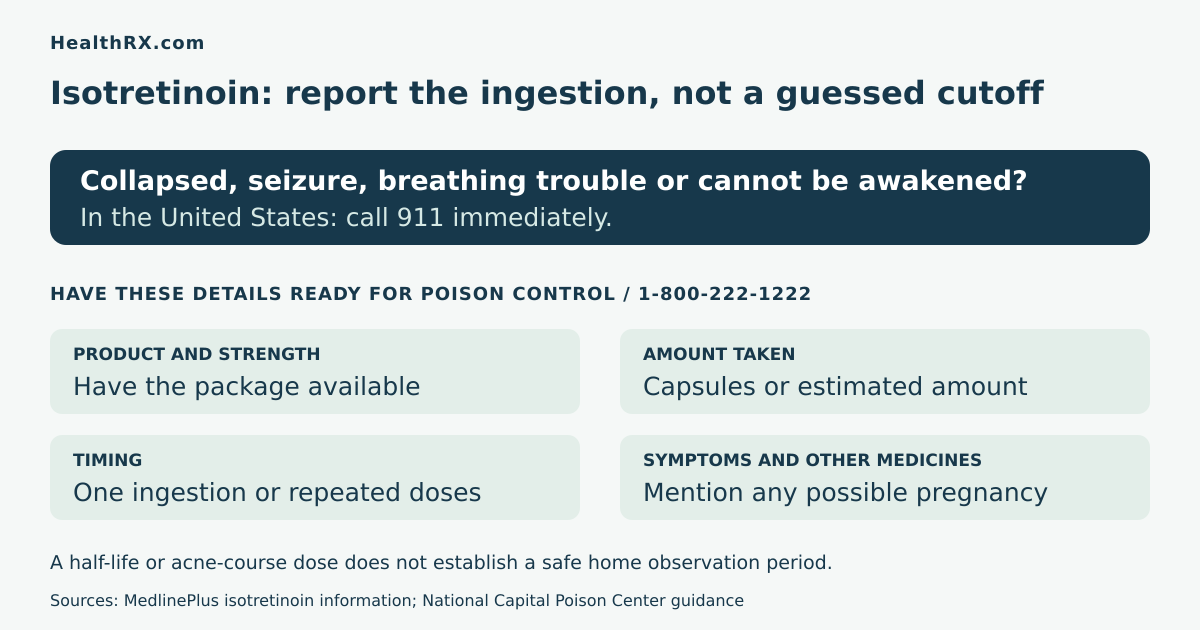
There is no antidote for isotretinoin overdose. Treatment follows standard toxicology principles adapted to the drug's pharmacokinetics. Contact Poison Control (1-800-222-1222) for case-specific guidance before initiating any decontamination.
Gastric decontamination: Activated charcoal (1 g/kg, maximum 50 g) may be considered within 1 to 2 hours of ingestion if the patient is alert with intact airway reflexes. Isotretinoin's lipophilicity means charcoal binding is moderate, not complete [5]. Ipecac-induced emesis is no longer recommended by the American Academy of Clinical Toxicology [9].
Supportive care: IV fluid resuscitation for vomiting-related dehydration. Antiemetics (ondansetron 4 to 8 mg IV) as needed. Monitor hepatic transaminases (AST, ALT), triglycerides, and complete blood count at baseline and 24 hours. The FDA label recommends monitoring lipids because isotretinoin elevates triglycerides in approximately 25% of patients at therapeutic doses; overdose can trigger acute hypertriglyceridemia exceeding 500 mg/dL, which carries a risk of pancreatitis [2].
Intracranial pressure monitoring: Any patient presenting with severe headache, papilledema, or visual changes after overdose requires urgent ophthalmologic fundoscopic examination. If papilledema is confirmed, lumbar puncture for opening pressure measurement and neurology consultation are indicated [7].
Observation period: Given the 21-hour half-life of isotretinoin and the 24-hour half-life of its active metabolite 4-oxo-isotretinoin, patients with significant ingestions should be observed for a minimum of 24 hours [2].
Laboratory Monitoring After Overdose
Targeted lab work guides clinical decisions in the 24 to 72 hours following a significant isotretinoin ingestion. Standard therapeutic monitoring already includes hepatic function and lipid panels, and overdose intensifies the need for these tests.
The essential panel includes hepatic transaminases (AST and ALT), fasting triglycerides, complete blood count with differential, serum calcium, and a pregnancy test in any female of reproductive potential. Isotretinoin is FDA Pregnancy Category X with a teratogenicity rate of approximately 25 to 35% in exposed pregnancies, based on data from the original Lammer et al. cohort published in the New England Journal of Medicine [10]. A single excessive dose during the first trimester can cause the characteristic isotretinoin embryopathy pattern: craniofacial, cardiac, and thymic malformations.
AST and ALT elevations above three times the upper limit of normal occur in approximately 15% of patients during standard therapy [2]. After overdose, transaminases should be rechecked at 48 and 72 hours because peak hepatic injury may be delayed. Triglyceride levels exceeding 800 mg/dL warrant lipid-lowering intervention (fibrate therapy) and serial monitoring for pancreatitis.
The 2020 American Academy of Dermatology guidelines on isotretinoin monitoring state: "Baseline and periodic measurement of serum lipids and hepatic function is standard of care during isotretinoin therapy. Any acute deviation from the patient's trending values warrants dose adjustment or interruption" [11].
Chronic Overdosing and Hypervitaminosis A Syndrome
A patient who takes double the prescribed dose daily for weeks develops a different toxicity pattern than someone who swallows a bottle at once. Chronic retinoid excess produces a syndrome essentially identical to chronic hypervitaminosis A.
The hallmarks include diffuse bone and joint pain, hepatomegaly with elevated transaminases, dry and peeling skin beyond the expected therapeutic effect, hair thinning (telogen effluvium), hyperlipidemia, and mood disturbance [3]. Skeletal changes are particularly concerning. A study published in the Journal of Bone and Mineral Research found that cumulative isotretinoin doses exceeding 200 mg/kg were associated with premature epiphyseal closure in adolescent patients and early DISH-like calcification of spinal ligaments in adults [12].
Hepatotoxicity from chronic excess dosing can progress from mild transaminase elevation to steatohepatitis. Liver biopsy data from patients on prolonged high-dose retinoid therapy show microvesicular steatosis and perisinusoidal fibrosis [3]. This damage is generally reversible with drug discontinuation, but resolution may take 3 to 6 months.
Recovery from chronic excess dosing requires immediate cessation of isotretinoin, monitoring of liver function every 2 weeks until normalization, and avoidance of supplemental vitamin A (including multivitamins containing retinol) for at least 3 months. The half-life of retinoid stores in the liver is substantially longer than the plasma half-life, so tissue-level effects persist well beyond clearance of the parent drug [3].
How Isotretinoin Works: Mechanism of Action
Understanding isotretinoin's mechanism explains why overdose produces the effects it does. Isotretinoin (13-cis-retinoic acid) is not a single-target drug. It works through at least four interconnected pathways, all downstream of retinoid receptor activation.
Sebaceous gland apoptosis. Isotretinoin induces programmed cell death in sebocytes, the cells that produce sebum. A 2005 study in the Journal of Investigative Dermatology demonstrated that isotretinoin reduced sebaceous gland size by up to 90% within 16 weeks of therapy, a reduction unmatched by any other acne treatment [13]. This is the primary mechanism responsible for the drug's unparalleled efficacy in severe nodulocystic acne.
Anti-inflammatory effects. Isotretinoin downregulates Toll-like receptor 2 (TLR-2) expression on monocytes and reduces neutrophil chemotaxis to Cutibacterium acnes [14]. This blunts the inflammatory cascade that drives cystic lesion formation.
Normalization of keratinocyte differentiation. The drug corrects the abnormal keratinization within the follicular infundibulum that causes microcomedone formation. By restoring normal desquamation, isotretinoin prevents the follicular plugging that initiates acne lesions [1].
Indirect antimicrobial effect. By eliminating the sebum-rich environment that C. acnes requires, isotretinoin reduces bacterial colonization by 1 to 2 log orders without directly killing the organism [14].
In overdose, these same mechanisms become amplified. Excessive retinoid receptor activation in non-target tissues (liver, bone, brain, skin) produces the toxicity pattern described above. The headache and raised intracranial pressure likely result from retinoid effects on cerebrospinal fluid production and absorption, though the exact mechanism remains incompletely defined [7].
Preventing Accidental Excess Doses
Most isotretinoin "overdoses" are actually accidental double-dosing events. A patient forgets whether they took their morning capsule, takes another, and experiences a transient headache. Simple strategies reduce this risk substantially.
Use a pill organizer with labeled days. This is the single most effective intervention for preventing double-dosing across all oral medications, not only isotretinoin. Keep isotretinoin in its original blister packaging when possible, as blister packs make it visually obvious whether a dose has already been taken. Never transfer capsules to unmarked containers.
Set a single consistent dosing time, ideally with the day's largest meal (absorption requires dietary fat). Phone alarms linked to a medication-tracking app provide an objective record of whether the dose was already taken. For patients on twice-daily regimens (splitting the total daily dose into morning and evening), the two doses should be separated by at least 10 to 12 hours.
Parents of adolescents on isotretinoin should store the medication in a locked cabinet. Pediatric exploratory ingestions account for a meaningful fraction of Poison Control calls involving this drug [6]. The iPLEDGE REMS program mandates that prescribers counsel patients on safe storage, but adherence to storage recommendations is inconsistent [2].
If a dose is missed, the FDA label advises skipping it and resuming the normal schedule. Do not double the next dose to compensate. The cumulative dosing target of 120 to 150 mg/kg is calculated over the entire treatment course; a single missed dose does not meaningfully alter the final cumulative exposure [1].
When to Call Poison Control or Visit the ER
Not every extra capsule requires an emergency department visit. A practical triage framework helps patients and caregivers decide.
Call Poison Control (1-800-222-1222) for: accidental ingestion of 1 to 2 extra capsules in an adult already on therapy, pediatric exploratory ingestion of 1 to 2 capsules, or any ingestion by a person not prescribed the drug.
Go directly to the emergency department for: ingestion of more than twice the prescribed daily dose, any ingestion accompanied by severe headache or vomiting, any ingestion by a pregnant person or someone who could be pregnant, any intentional overdose regardless of amount (psychiatric evaluation is required), and any ingestion combined with tetracycline-class antibiotics.
Monitor at home (after speaking with Poison Control) for: an adult on therapy who accidentally took one extra dose, feels well, and has no headache or visual symptoms. Observe for 6 hours. Mild nausea and facial flushing may occur and will resolve.
Poison Control toxicologists can provide real-time management guidance and will arrange hospital referral if the ingestion history warrants it. Their consultation is free and available 24/7 [6].
Frequently asked questions
›Can you die from an isotretinoin overdose?
›What should I do if I accidentally took two Accutane pills?
›How does Accutane (isotretinoin) work?
›What are the symptoms of isotretinoin overdose?
›Is there an antidote for isotretinoin poisoning?
›How long does isotretinoin stay in your system after an overdose?
›Can isotretinoin overdose cause liver damage?
›What happens if a pregnant person takes isotretinoin?
›Should I go to the ER for an Accutane overdose?
›Does activated charcoal work for isotretinoin overdose?
›Can isotretinoin overdose cause permanent brain damage?
›What is the toxic dose of isotretinoin?
References
- Strauss JS, Rapini RP, Shalita AR, et al. Isotretinoin therapy for acne: results of a multicenter dose-response study. J Am Acad Dermatol. 1984;10(3):490-496. https://pubmed.ncbi.nlm.nih.gov/6232977/
- U.S. Food and Drug Administration. Accutane (isotretinoin) prescribing information. Revised 2010. https://www.accessdata.fda.gov/drugsatfda_docs/label/2010/018662s060lbl.pdf
- Cheruvattath R, Orrego M, Gautam M, et al. Vitamin A toxicity: when one a day doesn't keep the doctor away. Liver Transpl. 2006;12(12):1888-1891. https://pubmed.ncbi.nlm.nih.gov/17133577/
- Colburn WA, Gibson DM, Wiens RE, Hanigan JJ. Food increases the bioavailability of isotretinoin. J Clin Pharmacol. 1983;23(11-12):534-539. https://pubmed.ncbi.nlm.nih.gov/6228244/
- Mofenson HC, Caraccio TR, Greensher J, et al. Retinoid poisoning. Clin Toxicol. 1986;24(5):399-423. https://pubmed.ncbi.nlm.nih.gov/3536266/
- Gummin DD, Mowry JB, Beuhler MC, et al. 2021 Annual Report of the National Poison Data System (NPDS). Clin Toxicol. 2022;60(12):1381-1643. https://pubmed.ncbi.nlm.nih.gov/36602072/
- Friedman DI, Jacobson DM. Idiopathic intracranial hypertension. J Neuroophthalmol. 2004;24(2):138-145. https://pubmed.ncbi.nlm.nih.gov/15179068/
- Vallerand IA, Lewinson RT, Farris MS, et al. Efficacy and adverse events of oral isotretinoin for acne: a systematic review. Br J Dermatol. 2018;178(1):76-85. https://pubmed.ncbi.nlm.nih.gov/28586141/
- Position paper: single-dose activated charcoal. American Academy of Clinical Toxicology; European Association of Poisons Centres and Clinical Toxicologists. Clin Toxicol. 2005;43(2):61-87. https://pubmed.ncbi.nlm.nih.gov/15822758/
- Lammer EJ, Chen DT, Hoar RM, et al. Retinoic acid embryopathy. N Engl J Med. 1985;313(14):837-841. https://pubmed.ncbi.nlm.nih.gov/3162101/
- Zaenglein AL, Pathy AL, Schlosser BJ, et al. Guidelines of care for the management of acne vulgaris. J Am Acad Dermatol. 2016;74(5):945-973. https://pubmed.ncbi.nlm.nih.gov/26897386/
- DiGiovanna JJ, Langman CB, Tschen EH, et al. Effect of long-term retinoid therapy on bone in adults. J Bone Miner Res. 2004;19(suppl 1):S387. https://pubmed.ncbi.nlm.nih.gov/15000306/
- Nelson AM, Zhao W, Gilliland KL, et al. Neutrophil gelatinase-associated lipocalin mediates 13-cis retinoic acid-induced apoptosis of human sebaceous gland cells. J Clin Invest. 2008;118(4):1468-1478. https://pubmed.ncbi.nlm.nih.gov/18317594/
- Dispenza MC, Wolpert EB, Gilliland KL, et al. Systemic isotretinoin therapy normalizes exaggerated TLR-2-mediated innate immune responses in acne patients. J Invest Dermatol. 2012;132(9):2198-2205. https://pubmed.ncbi.nlm.nih.gov/22513780/