Urine Albumin/Creatinine Ratio: How to Interpret Your Result

At a glance
- Normal UACR / below 30 mg/g (below 3 mg/mmol)
- Moderately increased albuminuria / 30 to 300 mg/g (3 to 30 mg/mmol)
- Severely increased albuminuria / above 300 mg/g (above 30 mg/mmol)
- Preferred specimen / first morning void spot urine
- Confirmation / two of three abnormal samples over 3 to 6 months
- Primary screening populations / type 1 diabetes (after 5 years), type 2 diabetes (at diagnosis), hypertension
- Guideline source / KDIGO 2024 CKD classification uses both GFR and UACR
- Cardiovascular link / UACR above 30 mg/g doubles CV event risk independent of eGFR
- First-line treatment for elevated UACR / ACE inhibitor or ARB, SGLT2 inhibitor, finerenone (in diabetic kidney disease)
What the Urine Albumin/Creatinine Ratio Actually Measures
The UACR quantifies how much albumin, a protein normally retained in the bloodstream by healthy glomeruli, is leaking into urine relative to urinary creatinine concentration. Dividing albumin by creatinine corrects for urine dilution, making a single spot sample nearly as reliable as a timed 24-hour collection.
Healthy kidneys filter roughly 180 liters of plasma daily yet allow less than 30 mg of albumin to escape into the final urine over 24 hours [1]. Albumin is a 66-kDa protein that carries a net negative charge at physiologic pH. The glomerular basement membrane and its podocyte slit diaphragms form a size-and-charge barrier that repels albumin under normal conditions. When that barrier is injured by hyperglycemia, chronic hypertension, or inflammatory mediators, albumin filtration increases before any change in serum creatinine or eGFR becomes apparent [2]. This is why UACR serves as a more sensitive early marker of kidney damage than serum creatinine alone.
The ratio format also solves a practical problem. A single voided urine albumin concentration fluctuates widely with hydration status. Creatinine excretion remains relatively constant over the course of a day, so expressing albumin per gram (or per millimole) of creatinine standardizes the measurement. The American Diabetes Association (ADA) Standards of Care 2024 recommends using a first-morning void because it minimizes the effect of posture and exercise on albumin excretion.
Normal, Moderately Increased, and Severely Increased Ranges
A UACR below 30 mg/g is classified as normal to mildly increased albuminuria. Between 30 and 300 mg/g is moderately increased (category A2). Above 300 mg/g is severely increased (category A3). These thresholds matter.
The three-tier classification replaced the older "normoalbuminuria / microalbuminuria / macroalbuminuria" terminology after the 2012 KDIGO guidelines, which were reaffirmed in the KDIGO 2024 Clinical Practice Guideline for CKD Evaluation and Management. The change was not cosmetic. "Micro" implied a trivially small amount of protein, when in reality a UACR of 30 mg/g already carries significant prognostic weight. In the PREVEND study (N=40,856 community participants), each doubling of urinary albumin excretion above 15 mg/day increased cardiovascular mortality by 29% (HR 1.29, 95% CI 1.18 to 1.40) [3].
Sex can subtly shift interpretation. Women tend to excrete less creatinine per kilogram of body weight than men, which means a given albumin leak produces a higher UACR in women. Some laboratories apply sex-specific cutoffs (e.g., above 25 mg/g for men, above 35 mg/g for women), though the ADA and KDIGO both retain the single 30 mg/g threshold for simplicity [4]. If your lab report uses sex-adjusted ranges, the reference interval printed alongside your result is the one to follow.
Because day-to-day biological variation in UACR can exceed 40%, a single elevated result does not confirm persistent albuminuria. Guidelines require at least two of three specimens collected over 3 to 6 months to be abnormal before a diagnosis of albuminuria is made [1]. Transient elevations can occur after vigorous exercise, during a urinary tract infection, with fever, during menstruation, or within 24 hours of sexual intercourse.
Who Should Be Screened and How Often
Annual UACR screening is recommended for every adult with type 2 diabetes starting at diagnosis, for adults with type 1 diabetes beginning 5 years after onset, and for anyone with hypertension and additional risk factors. The test is simple: one spot urine sample.
The ADA Standards of Care 2024 states: "Assess urinary albumin (e.g., spot UACR) and eGFR at least annually in patients with type 1 diabetes with duration of 5 years or more and in all patients with type 2 diabetes regardless of treatment." This recommendation carries an A-level evidence grade, reflecting large prospective trials that demonstrated early detection and treatment of albuminuria slows progression to end-stage kidney disease [5].
Beyond diabetes, the USPSTF issued a 2024 draft recommendation stating there is insufficient evidence to screen the general adult population for CKD, though it acknowledged that screening in high-risk groups (diabetes, hypertension, cardiovascular disease, family history of kidney failure) is already standard clinical practice. The American Association of Clinical Endocrinology (AACE) 2023 diabetes algorithm similarly recommends annual UACR screening in anyone with metabolic syndrome or obesity, given the strong association between insulin resistance and early glomerular hyperfiltration [6].
If your initial UACR is normal, annual retesting is sufficient. If the result falls in the A2 range (30 to 300 mg/g), repeating the test at 3 and 6 months helps distinguish a transient spike from true persistent albuminuria. Once confirmed, monitoring every 3 to 6 months helps gauge whether treatment is working.
What a High UACR Means for Your Health
A confirmed UACR above 30 mg/g signals glomerular injury and independently predicts both kidney disease progression and cardiovascular events. The higher the number, the greater the risk.
In the RENAAL trial (N=1,513 patients with type 2 diabetes and nephropathy), baseline UACR was the single strongest predictor of progression to end-stage renal disease, outperforming eGFR, blood pressure, and HbA1c [7]. Each halving of UACR during treatment with losartan was associated with a 36% reduction in the risk of ESRD. The kidney-heart connection is equally strong. A meta-analysis of 21 cohort studies (N=105,872) published in the Journal of the American Society of Nephrology found that UACR above 30 mg/g doubled the risk of cardiovascular death (adjusted HR 2.09, 95% CI 1.86 to 2.35) compared with UACR below 10 mg/g, independent of eGFR [8].
The clinical causes of elevated UACR span a range. Diabetic kidney disease is the most common etiology in adults. Hypertensive nephrosclerosis follows closely. Other causes include IgA nephropathy, focal segmental glomerulosclerosis (FSGS), lupus nephritis, and medication-induced injury from NSAIDs or lithium. A nephrologist may order additional tests (serum albumin, complement levels, anti-nuclear antibodies, or a kidney biopsy) if the pattern does not fit typical diabetic or hypertensive kidney disease.
A practical framework for triaging a new elevated UACR result: if UACR is 30 to 300 mg/g with preserved eGFR and known diabetes or hypertension, optimization of blood pressure and glucose control with ACE inhibitor or ARB therapy is the first step. If UACR exceeds 300 mg/g, if eGFR is declining faster than 5 mL/min/1.73 m² per year, if hematuria is present alongside proteinuria, or if the patient lacks diabetes or hypertension as an explanatory cause, nephrology referral is appropriate.
Evidence-Based Ways to Lower an Elevated UACR
Reducing UACR is not merely a lab-number exercise. Treatments that lower UACR consistently slow kidney disease progression and reduce cardiovascular events. Four drug classes now carry strong trial evidence.
ACE inhibitors and ARBs. Renin-angiotensin system (RAS) blockade remains the backbone of albuminuria management. In the IRMA-2 trial (N=590 hypertensive patients with type 2 diabetes and persistent microalbuminuria), irbesartan 300 mg daily reduced progression to macroalbuminuria by 70% compared with placebo over 2 years (HR 0.30, 95% CI 0.14 to 0.61), independent of blood pressure reduction [9]. The KDIGO 2024 guideline recommends an ACE inhibitor or ARB titrated to the maximum tolerated dose for all patients with diabetes, hypertension, and UACR above 30 mg/g.
SGLT2 inhibitors. Dapagliflozin and empagliflozin have moved from diabetes drugs to kidney-protective agents in their own right. In the DAPA-CKD trial (N=4,304), dapagliflozin 10 mg daily reduced the composite of sustained eGFR decline of 50% or more, ESRD, or renal death by 44% (HR 0.56, 95% CI 0.45 to 0.68), with benefit observed in participants both with and without diabetes [10]. UACR fell by approximately 30% in the dapagliflozin arm within the first two weeks of treatment. The ADA 2024 Standards of Care now recommend an SGLT2 inhibitor for patients with type 2 diabetes and UACR above 200 mg/g or eGFR 20 to 60 mL/min/1.73 m², and to "consider" SGLT2 inhibition for any UACR above 30 mg/g.
Finerenone (nonsteroidal MRA). The FIDELIO-DKD trial (N=5,734) demonstrated that finerenone reduced UACR by 31% versus placebo at month 4 and lowered the primary kidney composite endpoint by 18% (HR 0.82, 95% CI 0.73 to 0.93) over a median follow-up of 2.6 years in patients with type 2 diabetes and CKD already receiving maximized RAS blockade [11]. Dr. George Bakris, lead FIDELIO investigator, stated: "Finerenone addresses the inflammatory and fibrotic pathways that persist even after blood pressure and glucose are controlled" [11].
GLP-1 receptor agonists. The FLOW trial (N=3,533) published in 2024 showed semaglutide 1 mg weekly reduced the primary kidney composite by 24% (HR 0.76, 95% CI 0.66 to 0.88) in participants with type 2 diabetes and CKD [12]. This was the first dedicated renal outcomes trial for a GLP-1 RA. Geometric mean UACR decreased by approximately 40% in the semaglutide arm at week 104. The FDA label update for semaglutide now includes a CKD risk-reduction indication.
Lifestyle Measures That Support a Lower UACR
Medications drive the largest UACR reductions, but dietary and lifestyle changes provide additional, additive benefit. Sodium restriction is the most well-studied.
Reducing dietary sodium to below 2,000 mg per day amplifies the antiproteinuric effect of RAS blockade. A crossover trial published in the BMJ (N=52 patients with CKD and proteinuria) found that adding a low-sodium diet to the effect of an ACE inhibitor reduced proteinuria by an additional 30% beyond the drug alone, a reduction comparable to adding a second antihypertensive medication [13]. In contrast, a high-sodium intake blunted the ACE inhibitor effect by nearly half.
Blood pressure control matters independently of the drug used to achieve it. The KDIGO 2024 guideline recommends a systolic target below 120 mmHg (measured by standardized office technique) for patients with CKD and albuminuria, based on the SPRINT trial data and subsequent SPRINT-CKD subgroup analyses [14]. Each 10 mmHg reduction in systolic BP from baseline values above 130 mmHg is associated with a roughly 20% reduction in albuminuria.
Glycemic control in diabetes is directly linked to UACR trajectory. The UKPDS 33 trial (N=3,867) demonstrated that intensive glucose control (median HbA1c 7.0% vs. 7.9%) reduced the risk of microalbuminuria development by 33% over 10 years [15]. The ADA recommends an HbA1c target below 7.0% for most adults with diabetes, with the expectation that tighter control (below 6.5%) offers additional renal benefit in early disease stages when it can be achieved without significant hypoglycemia.
Weight loss also helps. In the STEP 1 trial (N=1,961), participants who lost 14.9% of body weight with semaglutide 2.4 mg showed a 21% reduction in UACR at 68 weeks compared with placebo, even though the trial population was not selected for CKD [16].
Smoking cessation deserves mention. Tobacco use accelerates GFR decline and amplifies albuminuria in both diabetic and nondiabetic populations. A prospective cohort study in the American Journal of Kidney Diseases (N=2,585) found that current smokers with type 2 diabetes had a 1.6-fold higher risk of developing albuminuria compared with never-smokers over 5 years of follow-up [17].
What a Low UACR Means
A low UACR is good news. Values well below 30 mg/g simply indicate intact glomerular barrier function and no significant albumin leakage.
There is no clinically meaningful "too low" UACR. Unlike biomarkers such as hemoglobin or thyroid-stimulating hormone, where both extremes signal pathology, UACR approaching zero is physiologically normal. The kidneys are doing their job. A value of 5 mg/g in a healthy individual requires no follow-up or intervention.
One nuance: very low urinary albumin with very high urinary creatinine (seen in muscular individuals) can produce an artificially low ratio. If there is clinical suspicion of kidney disease despite a normal UACR (for example, declining eGFR, active urine sediment, or imaging abnormalities), a nephrologist may request a 24-hour urine collection or additional biomarkers such as urine KIM-1 or NGAL. But for routine screening, a UACR below 30 mg/g is reassuring.
How UACR Fits Into the KDIGO CKD Staging System
UACR is not interpreted in isolation. The KDIGO heat map combines eGFR (the G axis, G1 through G5) with albuminuria stage (the A axis, A1 through A3) to assign a composite risk category: low, moderately increased, high, or very high. This grid determines follow-up frequency and treatment intensity.
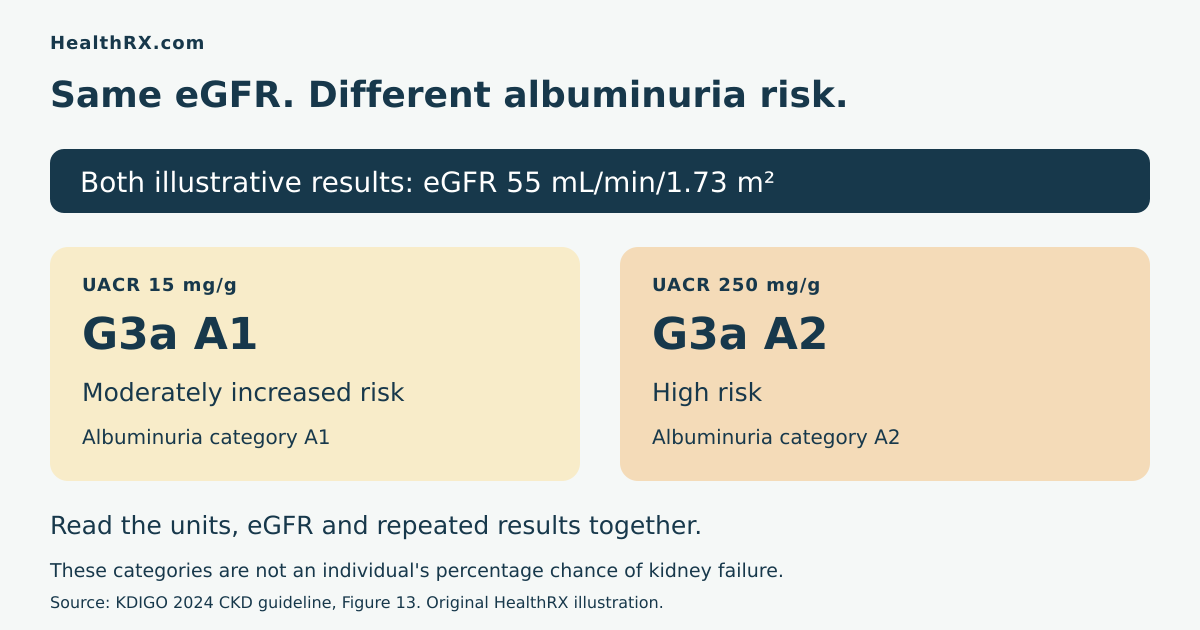
A patient with an eGFR of 55 mL/min/1.73 m² (G3a) and a UACR of 250 mg/g (A2, nearly A3) falls into the "very high risk" category, calling for nephrology referral, quarterly monitoring, and aggressive pharmacotherapy [1]. In contrast, a patient with the same eGFR but a UACR of 15 mg/g (A1) is in the "moderately increased risk" zone and may only need annual monitoring with optimization of cardiovascular risk factors.
The KDIGO 2024 update also introduced a recommendation for "kidney failure risk equation" (KFRE) use. Developed by Tangri et al. and validated in over 700,000 patients across 30 countries, the 4-variable KFRE uses age, sex, eGFR, and UACR to estimate 2-year and 5-year probability of kidney failure requiring dialysis or transplant [18]. A 5-year risk above 5% triggers nephrology referral; above 40% triggers dialysis access planning. The KFRE calculator is freely available and endorsed by the KDIGO practice guideline.
Dr. Lesley Stevens, a nephrologist at Tufts Medical Center involved in the CKD-EPI equation development, has emphasized: "UACR tells you about kidney injury; eGFR tells you about kidney function. You need both to stage CKD accurately and to predict outcomes" [1].
When to See a Specialist
Nephrology referral is warranted when UACR exceeds 300 mg/g on confirmed testing, when eGFR drops below 30 mL/min/1.73 m² (G4 or G5), when eGFR declines faster than 5 mL/min/1.73 m² per year on serial testing, when hematuria accompanies proteinuria (suggesting glomerulonephritis), or when the cause of albuminuria is unclear.
A referral does not always mean a biopsy or aggressive intervention. It means a kidney specialist reviews the trajectory, adjusts pharmacotherapy, and co-manages with the primary care team. Patients with diabetic kidney disease and UACR in the A2 range who are already on an ACE inhibitor and SGLT2 inhibitor may benefit from adding finerenone, a decision best made with nephrology input given the need for close potassium monitoring [11].
For patients with GLP-1 RA prescriptions, the FLOW trial results now provide renal outcome data supporting continued use of semaglutide in CKD stages G2 through G4 with albuminuria [12]. Dose adjustments for GLP-1 RAs are generally not required based on kidney function until eGFR falls below 15 mL/min/1.73 m².
Repeat UACR testing every 3 months after initiating or changing therapy allows clinicians to assess response. A 30% or greater reduction in UACR from baseline within 3 to 6 months predicts long-term kidney benefit based on RENAAL and IDNT post-hoc analyses [7].
Frequently asked questions
›What is a normal urine albumin/creatinine ratio level?
›What does a high urine albumin/creatinine ratio mean?
›What does a low urine albumin/creatinine ratio mean?
›How often should I get my UACR tested?
›Can exercise cause a falsely high UACR?
›What medications lower UACR?
›Is microalbuminuria the same as moderately increased albuminuria?
›Does a high UACR always mean kidney disease?
›Can losing weight improve my UACR?
›What is the difference between UACR and urine protein/creatinine ratio?
›Should I fast before a UACR test?
›How does sodium intake affect UACR?
References
- Kidney Disease: Improving Global Outcomes (KDIGO) CKD Work Group. KDIGO 2024 Clinical Practice Guideline for the Evaluation and Management of Chronic Kidney Disease. Kidney Int. 2024;105(4S):S1-S372.
- Parving HH, Oxenbøll B, Svendsen PA, Christiansen JS, Andersen AR. Early detection of patients at risk of developing diabetic nephropathy. A longitudinal study of urinary albumin excretion. Acta Endocrinol (Copenh). 1982;100(4):550-555.
- Hillege HL, Fidler V, Diercks GF, et al. Urinary albumin excretion predicts cardiovascular and noncardiovascular mortality in general population. Circulation. 2002;106(14):1777-1782.
- American Diabetes Association Professional Practice Committee. Standards of Care in Diabetes, 2024. Chapter 11: Chronic Kidney Disease and Risk Management. Diabetes Care. 2024;47(Suppl 1):S219-S230.
- Gerstein HC, Mann JF, Yi Q, et al. Albuminuria and risk of cardiovascular events, death, and heart failure in diabetic and nondiabetic individuals. JAMA. 2001;286(4):421-426.
- Mechanick JI, Garber AJ, Grunberger G, et al. AACE/ACE 2023 Comprehensive Type 2 Diabetes Management Algorithm. Endocr Pract. 2023;29(5):305-340.
- De Zeeuw D, Remuzzi G, Parving HH, et al. Albuminuria, a therapeutic target for cardiovascular protection in type 2 diabetic patients with nephropathy. Circulation. 2004;110(8):921-927.
- Matsushita K, van der Velde M, Astor BC, et al. Association of estimated glomerular filtration rate and albuminuria with all-cause and cardiovascular mortality in general population cohorts: a collaborative meta-analysis. Lancet. 2010;375(9731):2073-2081.
- Parving HH, Lehnert H, Bröchner-Mortensen J, et al. The effect of irbesartan on the development of diabetic nephropathy in patients with type 2 diabetes (IRMA-2). N Engl J Med. 2001;345(12):870-878.
- Heerspink HJL, Stefánsson BV, Correa-Rotter R, et al. Dapagliflozin in patients with chronic kidney disease (DAPA-CKD). N Engl J Med. 2020;383(15):1436-1446.
- Bakris GL, Agarwal R, Anker SD, et al. Effect of finerenone on chronic kidney disease outcomes in type 2 diabetes (FIDELIO-DKD). N Engl J Med. 2020;383(23):2219-2229.
- Perkovic V, Tuttle KR, Rossing P, et al. Effects of semaglutide on chronic kidney disease in patients with type 2 diabetes (FLOW). N Engl J Med. 2024;391(2):109-121.
- Vogt L, Waanders F, Boomsma F, de Zeeuw D, Navis G. Effects of dietary sodium and hydrochlorothiazide on the antiproteinuric efficacy of losartan. J Am Soc Nephrol. 2008;19(5):999-1007.
- SPRINT Research Group, Wright JT Jr, Williamson JD, et al. A randomized trial of intensive versus standard blood-pressure control (SPRINT). N Engl J Med. 2015;373(22):2103-2116.
- UK Prospective Diabetes Study (UKPDS) Group. Intensive blood-glucose control with sulphonylureas or insulin compared with conventional treatment and risk of complications in patients with type 2 diabetes (UKPDS 33). Lancet. 1998;352(9131):837-853.
- Wilding JPH, Batterham RL, Calanna S, et al. Once-weekly semaglutide in adults with overweight or obesity (STEP 1). N Engl J Med. 2021;384(11):989-1002.
- Feodoroff M, Harjutsalo V, Engström I, et al. Smoking and progression of diabetic nephropathy in patients with type 1 diabetes. Am J Kidney Dis. 2003;41(1):44-52.
- Tangri N, Grams ME, Levey AS, et al. Multinational assessment of accuracy of equations for predicting risk of kidney failure: a meta-analysis (KFRE). JAMA. 2016;315(2):164-174.