Traveling With Adderall XR: Borders, Storage and Time Changes
At a glance
- Check the exact medicine at every destination and transit stop.
- Confirm dispensing dates, available quantity and stock before departure.
- Keep the label, medicine list and any required entry documents accessible.
- Record actual dose timestamps and the next time agreed for the itinerary.
Check the border rules before booking
A U.S. prescription does not authorize entry into another country. Ask the destination and transit authorities about the exact active ingredients, extended-release formulation, quantity and required documents. Airport screening and permission to import a controlled medicine are separate matters.[3]
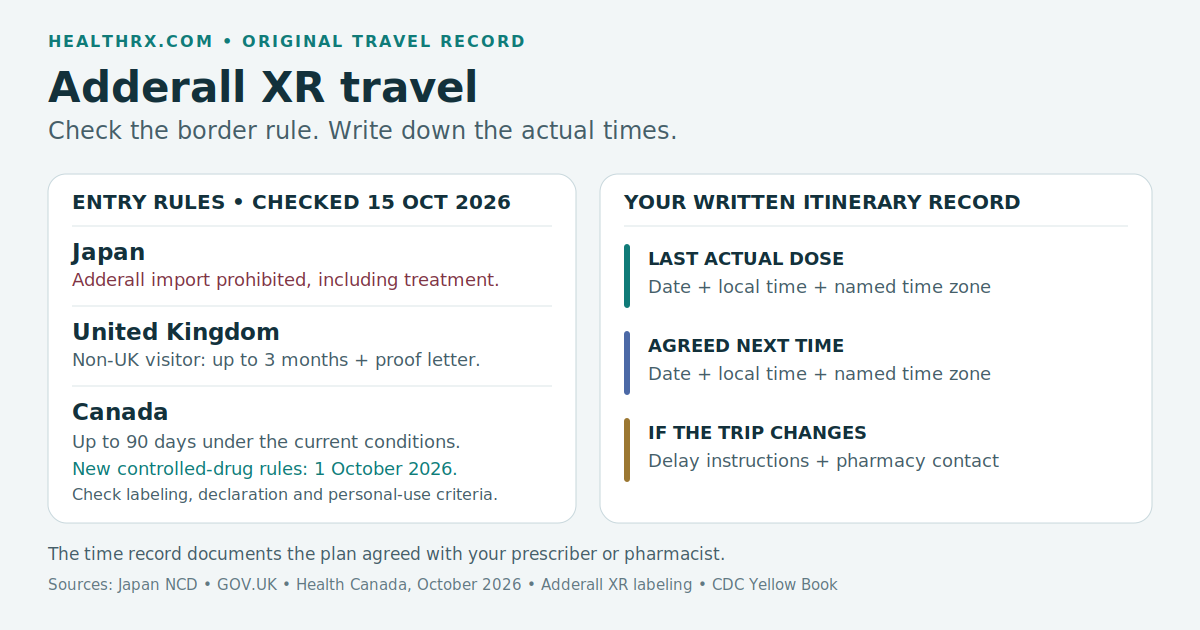
The comparison below was checked October 15, 2026. Recheck the applicable authority before departure, especially if your route or length of stay changes.
| Country | Entry rule for Adderall XR | What to arrange |
|---|---|---|
| Japan | Amphetamine, including Adderall, cannot be imported, even for personal treatment. | A physician’s letter does not create an exception. Discuss a lawful treatment alternative with your prescriber and confirm its classification with Japan’s authority.[4] |
| United Kingdom | A non-UK resident may bring up to three months of controlled medicine with a proof letter. | Carry it in hand luggage. The letter needs patient and travel details, dose, strength, quantity and prescriber signature. UK residents with foreign prescriptions should contact DFLU.[5] |
| Canada | New rules effective October 1, 2026 allow up to 90 days at the usual daily dose under the controlled-drug conditions. | Medicine must be prescribed, obtained from a provider and correctly labeled for you or an accompanying dependent. Declare it to customs; do not mail it. A doctor’s letter is optional. Contact Health Canada for more than 90 days.[6] |
Canada’s required label identifies the patient, prescriber, drug, daily dose, form, quantity, strength and DIN, if any. The former 30-day class exemption was revoked October 1, 2026. Permission to bring medicine across a border does not establish whether a local pharmacy can supply it.[6]
U.S. rules do not create a worldwide export allowance. Section 1301.26’s additional 50-dosage-unit limit concerns U.S. residents importing controlled medicines obtained abroad; lawfully obtained U.S. prescriptions from DEA registrants are excluded from that additional limit. It is not a 50-day rule or another country’s entry permission.[7]
Arrange the supply you can actually obtain
Give your prescriber and pharmacist your departure date, return date and remaining capsule count before booking. Ask which dispensing dates and quantities are available, then confirm insurance coverage and stock separately. An authorized prescription does not guarantee either.
Adderall XR is Schedule II and has no refills. Federal rules permit multiple new prescriptions totaling up to a 90-day supply when the required conditions and state law are met, including appropriate earliest-fill dates. That is not an automatic entitlement to one 90-day bottle or an early fill.[8]
Keep an accessible medicine list and carry the original labeled container in secure hand luggage.[3] Keep identification and contact details available without leaving the medicine exposed in a shared bag or hotel room.
Write the time-zone plan in timestamps
Adderall XR’s label directs dosing upon awakening and advises avoiding afternoon doses because of insomnia. It does not supply a universal clock cutoff or a formula for crossing time zones.[1] Bring your itinerary to your prescriber or pharmacist and record the agreed plan before departure.
Use a record like this rather than a calculated flight-day schedule:
| Record item | What to write |
|---|---|
| Home and destination time zones | Home: America/New_York; destination: Europe/London. Include the dates because daylight-saving offsets can change. |
| Last actual dose | Actual date, local clock time, named time zone and amount taken—not the time you intended to take it. |
| Agreed next dose | Exact date, clock time and named time zone confirmed with your prescriber or pharmacist. |
| Delays and contact instructions | Record what to do if departure, arrival or sleep changes; list the pharmacy and prescriber contact details and after-hours instructions. |
Keep this record where you can read it offline. Update the actual-dose entry when you take your medicine. Sleep, meal and symptom notes can make a follow-up conversation clearer; they do not establish a reason to change the dose yourself.
A missed morning XR dose calls for the specific missed-dose instruction below.[2] Ask for clarification if your written travel plan no longer matches what happened.
Protect the capsules during the trip
Store Adderall XR at 68–77°F (20–25°C); permitted excursions are 59–86°F (15–30°C). Keep it secure in a tight, light-resistant container. Avoid hot cars and unmeasured heat. If an exposure occurs, tell the pharmacist the known temperature and duration rather than guessing whether potency changed.[1]
Leave capsules whole unless using the labeled applesauce method: sprinkle the entire contents, consume immediately without chewing, and do not save or divide the contents.[1] Splitting capsule contents is not a way to improvise a time-zone adjustment.
Plan for disrupted access
Before leaving, save your original pharmacy and prescriber contacts alongside the medicine record. If capsules disappear or are confiscated, document the exact product, formulation, quantity and last actual dose. Contact those professionals and the relevant local authority about lawful local care. Do not share someone else’s medication, buy an unverified replacement or conceal medicine at a border.
Allow room in the itinerary for sleep, meals and ordinary access to fluids. These practical measures may make travel easier, but they are not a pharmacokinetic correction or a substitute for an agreed medication plan.
Frequently asked questions
How does Adderall XR affect daily life while traveling?
Changes in sleep, meals and daily demands can make it harder to judge how your usual treatment fits the trip. Record sleep, appetite, symptoms and actual dose times if useful. These observations can guide a conversation with your prescriber, but they do not establish that you need a different dose.
Can I bring Adderall XR on a plane?
Whether you may carry it depends on the route and applicable entry rules. Keep it in its original labeled container in secure hand luggage, with an accessible medicine list. Passing airport security does not mean the destination or a transit country permits importation.[3]
Is Adderall XR legal in other countries?
There is no worldwide permission. Japan prohibits Adderall imports, including for treatment; a physician’s letter does not override that prohibition.[4] The UK and Canada permit qualifying personal supplies under different conditions.[5,6] Check the exact ingredients, formulation and quantity with destination and transit authorities before departure.[3]
What if I miss my morning Adderall XR dose while traveling?
MedlinePlus gives a specific instruction for a missed morning extended-release dose: skip it, then take the next dose at the usual time the following day. Avoid a late catch-up or double dose.[2]
How should I store Adderall XR during a trip?
Keep it secure within the labeled temperature range, away from hot cars, direct heat and light.[1] Carry it where you can control access and conditions. For a known temperature excursion, give your pharmacist the temperature and duration; there is no reliable percentage-of-potency calculation for an unknown exposure.
Can I get an early fill or a 90-day supply before traveling?
Possibly, but arrange actual dates and quantities with your prescriber and pharmacist. Schedule II prescriptions have no refills. Multiple new prescriptions totaling up to 90 days may be allowed under federal conditions and state law.[8] Neither that rule nor travel plans guarantee an early insurance payment, pharmacy stock or a single 90-day bottle.
Do I need a doctor’s letter to travel with Adderall XR?
It depends on the country. Non-UK visitors bringing controlled medicine need the specified proof letter.[5] Canada makes a doctor’s letter optional under its current controlled-substance travel rules.[6] A letter does not permit Adderall importation into Japan.[4] Confirm requirements for your itinerary rather than treating a letter as universal permission.
What should I do if Adderall XR is lost, stolen or confiscated?
Record the exact name, formulation, missing quantity and last dose time. Contact your original prescriber and pharmacy, and ask the relevant local authority about lawful care or recovery procedures. Keep any confiscation paperwork. Do not borrow medication, buy unverified capsules or expect a consulate to supply a prescription or special waiver.
How do I plan Adderall XR across time zones?
Give your prescriber or pharmacist the full itinerary, named home and destination time zones, and expected sleep times. Write down your last actual dose and the exact agreed next timestamp. Include delay instructions. There is no established universal 22-hour interval, clock-time cutoff or stepwise time-zone recipe for XR.
Do long flights or high altitude require a different Adderall XR dose?
The cited evidence does not establish a flight-length or altitude-based dose adjustment. The cardiovascular meta-analysis involved children and adolescents, not adults taking XR at altitude.[14] The travel clot review was not Adderall-specific and does not establish a stimulant-based clot-risk multiplier or compression-stocking requirement.[15]
Does dehydration on a plane change Adderall XR clearance?
The evidence does not establish a flight-dehydration effect that can be translated into a clearance or dose adjustment. The XR pharmacokinetic study examined formulations, food and applesauce—not cabin dehydration.[11] Maintain ordinary access to fluids and meals; a fixed hourly water target is not a proven way to correct XR pharmacokinetics.
Which cardiovascular symptoms matter during travel?
Chest pain, shortness of breath or fainting warrant urgent medical assessment.[2] If you have a heart condition, arrange a personal care plan before departure. The pediatric cardiovascular evidence does not establish a universal preflight ECG or blood-pressure cutoff for adult travelers.[14]
Does jet lag change how Adderall XR works?
Jet lag can disrupt sleep and make concentration or fatigue harder to interpret. The cited XR pharmacokinetic study was not a jet-lag, flight or dose-interval trial, so it cannot supply a revised travel schedule.[11] Record sleep and actual dose times, and use your agreed plan rather than increasing medication to counter travel fatigue.
What if I run out of Adderall XR abroad?
Contact your original prescriber and pharmacy and seek lawful local care; foreign prescription acceptance is separate from import permission. A qualifying initial electronic prescription may be transferred once between registered retail pharmacies under applicable state law, directly between pharmacists in electronic form.[9] That rule does not create an international dispensing right.
What if I already took Adderall XR late in the new time zone?
Record the amount, date, local time and named time zone. Do not add a compensating dose. Ask the pharmacist how the actual late dose affects the next time in your itinerary; report any new symptoms.[1,2]
Should I skip Adderall XR on a travel day?
Do not assume every travel day calls for skipping. Agree on a plan based on your itinerary and treatment needs before leaving. If you actually miss the morning XR dose, the missed-dose instruction is to skip it and resume at the regular time the next day—not take a late catch-up dose.[2]
Does the MTA Study establish an Adderall XR travel schedule?
No. The MTA Study followed 579 children ages 7–9.9 for 14 months across four treatment groups. It examined treatment-program effects, not adult Adderall XR use during flights or time-zone changes.[12] Its results cannot establish a travel-day dose interval, clock cutoff or adjustment schedule.
Can I use melatonin with Adderall XR for jet lag?
The Cochrane review examined 10 melatonin jet-lag trials, not melatonin combined with Adderall XR.[13] It therefore does not prove that combination safe or establish a universal dose. Ask a pharmacist or prescriber about your actual medicines and proposed timing. Sleep routines and light planning can also support adjustment without guaranteeing relief.
Can telehealth arrange an Adderall XR prescription before travel?
Potentially. The DEA’s fourth temporary extension runs through December 31, 2026 and allows qualifying Schedule II–V prescribing by audio-video visit without a prior in-person examination, subject to federal and state conditions.[10] It does not guarantee a vacation replacement, authorize audio-only ADHD prescribing or require a foreign pharmacy to accept the prescription.
References
- Takeda: Adderall XR prescribing information, April 2026
- MedlinePlus: Dextroamphetamine and amphetamine
- CDC Yellow Book: Traveling with prohibited or restricted medications
- Japan Narcotics Control Department: Traveler medication questions
- UK government: Taking medicine into or out of the UK
- Health Canada: Traveling with medication containing controlled substances, October 2026
- 21 CFR 1301.26: Personal medical use and import/export exemptions
- 21 CFR 1306.12: Schedule II prescriptions
- 21 CFR 1306.08: Electronic prescriptions and initial transfer
- DEA: Telemedicine flexibilities extended through December 2026
- Tulloch et al.: Adderall XR pharmacokinetics and bioavailability
- MTA Cooperative Group: A 14-month randomized clinical trial
- Herxheimer and Petrie: Melatonin for jet lag
- Hennissen et al.: Cardiovascular effects of ADHD medication in children and adolescents
- Philbrick et al.: Air travel and venous thromboembolism systematic review