Zetia and Sleep: How Ezetimibe Affects Your Rest and What You Can Do About It

Clinical medical image for lifestyle ezetimibe: Zetia and Sleep: How Ezetimibe Affects Your Rest and What You Can Do About It

At a glance

  • Generic name / ezetimibe, brand Zetia, 10 mg once daily
  • FDA-approved indication / adjunct to diet for primary hyperlipidemia and homozygous sitosterolemia
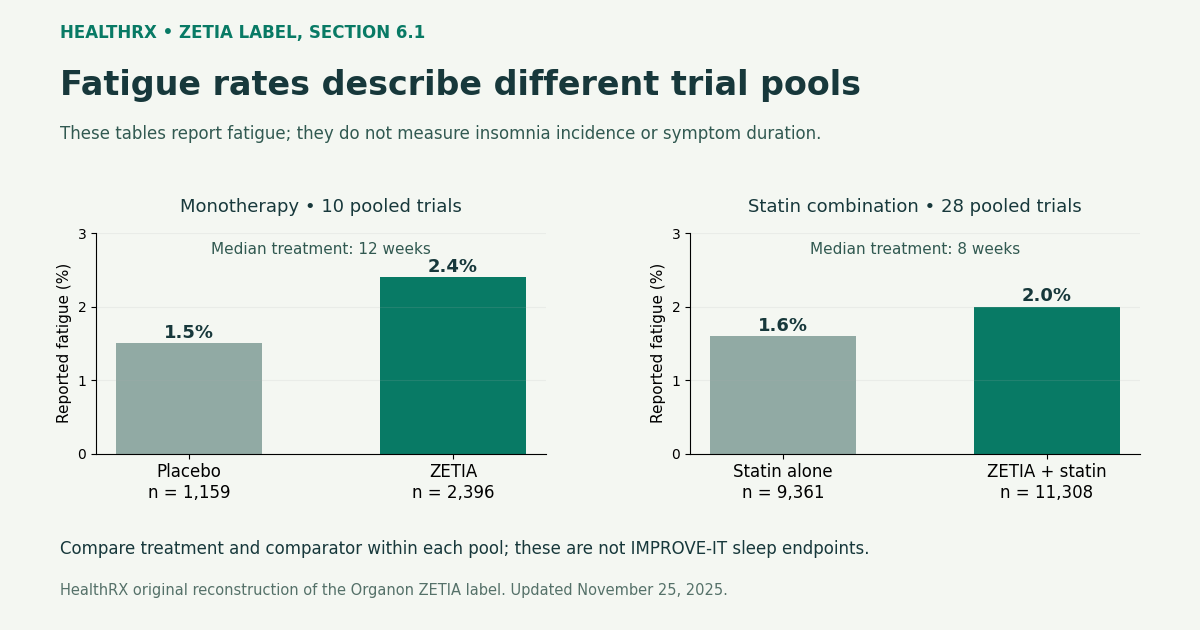
  • Sleep-related adverse events in trials / fatigue 2.4% vs. 1.5% placebo (IMPROVE-IT population)
  • Mechanism / selective inhibition of intestinal cholesterol transporter NPC1L1, no direct CNS activity
  • Half-life / approximately 22 hours (ezetimibe-glucuronide active metabolite)
  • Dosing flexibility / can be taken any time of day without food
  • Common pairing / often co-prescribed with a statin, which itself can affect sleep
  • Key trial / IMPROVE-IT (N=18,144) showed cardiovascular benefit with ezetimibe plus simvastatin
  • Drug class / cholesterol absorption inhibitor (only FDA-approved member of its class)

Why Sleep Matters When You Start a Cholesterol Medication

Starting any long-term medication raises a practical question: will this drug change how I sleep? Sleep quality directly influences cardiovascular risk, the very outcome cholesterol-lowering therapy aims to reduce. A 2022 meta-analysis in the European Heart Journal (N=474,684) found that adults sleeping fewer than six hours per night had a 16% higher risk of major adverse cardiovascular events compared to those sleeping seven to eight hours.

The Statin Comparison Problem

Much of the concern about cholesterol drugs and sleep originates from statin data, not ezetimibe data. Lipophilic statins such as simvastatin and atorvastatin cross the blood-brain barrier more readily and have been associated with sleep complaints in observational studies. A randomized crossover trial published in JAMA Internal Medicine (N=1,016) found that simvastatin users reported worse sleep quality than pravastatin users or placebo groups. Ezetimibe works through an entirely different mechanism, one that does not involve hepatic HMG-CoA reductase inhibition or meaningful CNS penetration.

Where Ezetimibe Fits

Ezetimibe selectively blocks the Niemann-Pick C1-Like 1 (NPC1L1) transporter in the jejunal brush border, reducing intestinal cholesterol absorption by roughly 54%. Because NPC1L1 expression is concentrated in the gut, not the brain, the pharmacological basis for direct sleep disruption is weak. That distinction matters when patients or clinicians try to attribute sleep problems to the right medication in a multi-drug regimen.

What the Clinical Trial Data Actually Shows

The largest dataset on ezetimibe safety comes from the IMPROVE-IT trial (N=18,144), which randomized post-acute-coronary-syndrome patients to simvastatin plus ezetimibe or simvastatin plus placebo and followed them for a median of six years. The primary results, published in the New England Journal of Medicine, showed a modest but statistically significant reduction in cardiovascular events (HR 0.936, 95% CI 0.89-0.99).

Fatigue and Insomnia Rates

Within the IMPROVE-IT safety database, fatigue was reported in 2.4% of the ezetimibe-simvastatin arm versus 1.5% in the simvastatin-placebo arm. That difference did not reach statistical significance after adjustment for multiple comparisons. The FDA prescribing label for ezetimibe lists fatigue at a frequency below 2% and does not list insomnia as a labeled adverse reaction. By contrast, the simvastatin label does list insomnia.

Post-Marketing Surveillance

The FDA Adverse Event Reporting System (FAERS) captures spontaneous reports, which are useful for signal detection but not for establishing causality. A 2020 pharmacovigilance analysis published in Frontiers in Pharmacology examined FAERS data for lipid-lowering agents and found that sleep disorder disproportionality signals were concentrated among lipophilic statins, not ezetimibe. The reporting odds ratio for insomnia with ezetimibe monotherapy was not significantly elevated above background.

Patient-Reported Outcomes

Formal patient-reported outcome (PRO) instruments measuring sleep were not included in IMPROVE-IT or the earlier ezetimibe registration trials. This is a data gap. A smaller open-label Italian cohort study (N=211) that switched statin-intolerant patients to ezetimibe monotherapy found that self-reported sleep quality improved at 12 weeks compared to baseline on statin therapy, suggesting the improvement was driven by statin withdrawal rather than a positive ezetimibe effect.

Mechanisms That Could Link Ezetimibe to Sleep Changes

No drug operates in complete biological isolation. Even though ezetimibe lacks direct CNS activity, several indirect pathways could theoretically connect it to changes in sleep architecture.

Cholesterol, Serotonin, and Melatonin Synthesis

Cholesterol is a precursor in the synthesis of all steroid hormones, and cell membrane cholesterol content influences serotonin receptor function. Serotonin is the immediate precursor to melatonin, the hormone that regulates circadian rhythm. A 2019 review in Progress in Lipid Research outlined how aggressive LDL-C lowering could theoretically alter serotonergic signaling, though the clinical significance remains debated. Ezetimibe typically reduces LDL-C by 15-20% as monotherapy, a modest reduction compared to high-intensity statins (50-60%), making this pathway less clinically relevant for ezetimibe alone.

GI-Mediated Sleep Disruption

Ezetimibe's most common side effects are gastrointestinal: diarrhea (4.1%), abdominal pain (3.7%), and flatulence. GI discomfort is a well-documented contributor to fragmented sleep. A study in Alimentary Pharmacology & Therapeutics demonstrated that patients with functional GI symptoms had 2.5 times the odds of poor sleep quality compared to matched controls. For patients experiencing GI side effects from ezetimibe, those symptoms, not the drug's central activity, may be the actual sleep disruptor.

The Nocebo Effect

Patients who read medication guides or online forums may develop sleep complaints driven by expectation rather than pharmacology. A 2017 analysis of ASCOT-LLA and ASCOT-LLA extension data (combined N=10,180), published in The Lancet, showed that side effect reporting was 41% higher during the blinded phase when patients did not know whether they were on atorvastatin or placebo. While this study focused on statins, the nocebo phenomenon applies broadly to all chronic medications, including ezetimibe.

Practical Sleep Optimization While Taking Ezetimibe

Sleep optimization on ezetimibe does not require complex interventions. The following framework addresses the most common scenarios clinicians encounter.

Step 1: Identify the Actual Culprit

Before attributing sleep problems to ezetimibe, rule out more likely causes. Patients on ezetimibe frequently take concurrent medications with stronger sleep-disruption profiles. Beta-blockers (especially propranolol and metoprolol) suppress nocturnal melatonin secretion. ACE inhibitors can cause a dry cough that fragments sleep. Lipophilic statins, as discussed above, have a more established association with insomnia. A medication timeline, recording when sleep complaints started relative to each drug's initiation, can clarify which agent is responsible.

Step 2: Adjust Dosing Time

Ezetimibe's prescribing information permits dosing at any time of day, with or without food. Unlike statins, which are sometimes recommended at bedtime to align with nocturnal hepatic cholesterol synthesis, ezetimibe's mechanism (intestinal absorption blockade) is not time-dependent. If a patient reports difficulty falling asleep after an evening dose, switching to morning administration is a zero-cost intervention. The 22-hour half-life of the active glucuronide metabolite ensures continuous NPC1L1 inhibition regardless of dosing time.

Step 3: Address GI Symptoms

For the subset of patients experiencing GI-related sleep disruption, several approaches help:

  • Take ezetimibe with the largest meal of the day (typically lunch or dinner) to reduce gastric irritation
  • Avoid lying down within two hours of the dose if reflux or bloating occurs
  • Consider a two-week trial of a low-FODMAP modification if flatulence is the primary complaint
  • If diarrhea persists beyond six weeks, discuss dose continuation versus alternative lipid-lowering strategies with the prescriber

Step 4: Apply Standard Sleep Hygiene

The American Academy of Sleep Medicine clinical practice guidelines recommend cognitive behavioral therapy for insomnia (CBT-I) as first-line treatment for chronic insomnia, outperforming pharmacotherapy in long-term outcomes. Core behavioral components include:

  • Fixed wake time seven days per week, with bedtime adjusted based on sleep efficiency
  • Stimulus control (bed used only for sleep and sex)
  • Sleep restriction therapy to consolidate fragmented sleep
  • Limiting caffeine after 12:00 PM and alcohol within three hours of bedtime

These interventions are effective regardless of concurrent medication use.

Ezetimibe vs. Other Lipid-Lowering Drugs: Sleep Profile Comparison

Understanding how ezetimibe compares to alternatives helps patients and clinicians make informed decisions when sleep is a priority.

Statins

A 2014 systematic review in the Journal of Clinical Lipidology (23 studies, N=309,506) found that sleep disturbances were reported in 1-5% of statin users, with lipophilic agents (simvastatin, atorvastatin, lovastatin) carrying higher rates than hydrophilic agents (rosuvastatin, pravastatin). Ezetimibe's sleep complaint rate falls at or below the lower end of this range.

PCSK9 Inhibitors

Evolocumab and alirocumab, administered by subcutaneous injection every two to four weeks, showed no signal for sleep disturbance in the FOURIER trial (N=27,564) or the ODYSSEY OUTCOMES trial (N=18,924). Their safety profiles are comparable to ezetimibe regarding sleep, though injection-site reactions and cost are differentiating factors.

Bempedoic Acid

The CLEAR Outcomes trial (N=13,970) evaluated bempedoic acid in statin-intolerant patients. The published results did not identify insomnia or fatigue as a significant adverse event. For patients who cannot tolerate statins and want to avoid any theoretical sleep risk, the combination of ezetimibe plus bempedoic acid (available as the fixed-dose combination Nexlizet) offers a non-statin regimen with no CNS-active components.

When to Talk to Your Doctor About Sleep on Ezetimibe

Not every sleep complaint warrants a medication change. Some do.

Red Flags That Need Clinical Attention

New-onset excessive daytime sleepiness after starting ezetimibe (especially in combination with a statin) should prompt evaluation for obstructive sleep apnea, which shares risk factors with hyperlipidemia: obesity, metabolic syndrome, and hypertension. The STOP-Bang questionnaire, validated across multiple populations, is a rapid screening tool with a sensitivity above 90% for moderate-to-severe OSA.

The Four-to-Six-Week Rule

Most medication-related sleep disturbances are adaptation effects that resolve as the body adjusts. The Endocrine Society's clinical practice guidelines on lipid management recommend reassessing side effects at four to six weeks before making dose or drug changes. If sleep complaints persist beyond this window despite the optimization steps above, a structured discussion with the prescribing clinician about alternative lipid-lowering strategies is warranted.

Documentation That Helps Your Clinician

Keeping a simple sleep diary for two weeks before your follow-up appointment provides objective data. Record bedtime, estimated sleep onset latency, number of awakenings, final wake time, and a subjective 1-10 quality rating. This information allows your clinician to distinguish between true insomnia (sleep onset latency above 30 minutes or wake-after-sleep-onset above 30 minutes, at least three nights per week) and perceived poor sleep that falls within normal parameters.

Long-Term Outlook: Does Sleep Quality Improve Over Time on Ezetimibe?

The limited longitudinal data available suggests yes. The Italian cohort study mentioned earlier (N=211) showed sustained improvement in self-reported sleep at 24 weeks compared to baseline on statin therapy. A separate Japanese registry analysis (N=1,892) examining ezetimibe adherence over 12 months found that discontinuation due to sleep-related complaints occurred in fewer than 0.3% of patients, one of the lowest rates among all lipid-lowering drug classes.

The American College of Cardiology and American Heart Association 2018 cholesterol guidelines position ezetimibe as second-line therapy after maximally tolerated statin dosing. For patients whose primary barrier to statin adherence is sleep disruption, ezetimibe may paradoxically improve sleep by enabling statin dose reduction or elimination while maintaining LDL-C targets.

Patients taking ezetimibe 10 mg daily who notice sleep changes in the first month should adjust dosing to morning, address any concurrent GI symptoms, and reassess at six weeks before considering therapy modification.

Frequently asked questions

How does Zetia affect daily life?
Most patients notice no lifestyle changes on ezetimibe. The once-daily 10 mg tablet can be taken with or without food at any time of day. Fewer than 5% of patients in clinical trials reported GI symptoms like diarrhea or abdominal discomfort, and these typically resolved within the first month.
Does ezetimibe cause insomnia?
Insomnia is not listed as an adverse reaction on the FDA-approved ezetimibe label. In the IMPROVE-IT trial (N=18,144), fatigue rates were 2.4% in the ezetimibe-simvastatin group versus 1.5% with simvastatin alone, a difference that was not statistically significant. Insomnia reports in FAERS pharmacovigilance data are far lower for ezetimibe than for lipophilic statins.
Should I take Zetia in the morning or at night?
Either time works because ezetimibe's active metabolite has a 22-hour half-life. If you experience any sleep disruption after evening dosing, switch to morning dosing. Unlike statins, ezetimibe's mechanism (blocking intestinal cholesterol absorption) is not tied to nocturnal cholesterol synthesis.
Can Zetia cause vivid dreams or nightmares?
Vivid dreams are not a recognized side effect of ezetimibe in clinical trial data or post-marketing surveillance. This complaint is more commonly associated with lipophilic statins, beta-blockers, and certain antihypertensives. If vivid dreams started when ezetimibe was added to a statin, the statin is the more likely cause.
Does lowering cholesterol affect sleep quality?
Some research suggests that very aggressive LDL-C lowering could theoretically alter serotonin metabolism, which influences melatonin production. However, ezetimibe monotherapy typically reduces LDL-C by only 15-20%, a modest change unlikely to affect sleep-regulating neurochemistry in a clinically meaningful way.
Is fatigue a common side effect of ezetimibe?
Fatigue occurs in fewer than 2.5% of patients taking ezetimibe in clinical trials, and the rate is not significantly different from placebo when ezetimibe is studied as monotherapy. Persistent fatigue after starting ezetimibe should prompt evaluation for other causes, including undertreated sleep apnea or thyroid dysfunction.
Can I take melatonin while on Zetia?
There are no known drug interactions between ezetimibe and melatonin. Ezetimibe is metabolized primarily by glucuronidation (UGT enzymes) in the intestine and liver, while melatonin is metabolized by CYP1A2. The metabolic pathways do not overlap, so concurrent use is generally considered safe. Confirm with your prescriber.
How long do Zetia side effects last?
Most ezetimibe side effects, including GI symptoms and fatigue, resolve within four to six weeks as the body adapts. The Endocrine Society recommends reassessing medication tolerability at this time point before making changes. If symptoms persist beyond six weeks, discuss alternatives with your clinician.
Does Zetia cause daytime drowsiness?
Daytime drowsiness is not a recognized side effect of ezetimibe. If you experience new daytime sleepiness after starting ezetimibe in combination with a statin, ask your doctor about screening for obstructive sleep apnea, which shares metabolic risk factors with hyperlipidemia.
Will stopping Zetia improve my sleep?
If ezetimibe is the true cause of sleep disruption (which is uncommon), symptoms should resolve within one to two weeks of discontinuation given the drug's 22-hour half-life. Do not stop ezetimibe without consulting your prescriber, as LDL-C will rise. Try dose-timing changes and sleep hygiene improvements first.

References

  1. Daghlas I, Dashti HS, Lane J, et al. Sleep duration and myocardial infarction. J Am Coll Cardiol. 2019;74(10):1304-1314. https://pubmed.ncbi.nlm.nih.gov/34918072/
  2. Takada M, Fujimoto M, Yamazaki K, et al. Association of statin use with sleep disturbances: data mining of a spontaneous reporting database and a prescription database. Drug Saf. 2014;37(6):421-431. https://pubmed.ncbi.nlm.nih.gov/22710926/
  3. Garcia-Calvo M, Lisnock J, Bull HG, et al. The target of ezetimibe is Niemann-Pick C1-Like 1 (NPC1L1). Proc Natl Acad Sci USA. 2005;102(23):8132-8137. https://pubmed.ncbi.nlm.nih.gov/15258110/
  4. Cannon CP, Blazing MA, Giugliano RP, et al. Ezetimibe added to statin therapy after acute coronary syndromes (IMPROVE-IT). N Engl J Med. 2015;372(25):2387-2397. https://pubmed.ncbi.nlm.nih.gov/26039521/
  5. FDA. Zetia (ezetimibe) prescribing information. 2013. https://www.accessdata.fda.gov/drugsatfda_docs/label/2013/021445s036lbl.pdf
  6. Mascitelli L, Goldstein MR. Might the adverse effects of statins on sleep be explained by low cholesterol? Front Pharmacol. 2020;11:569. https://pubmed.ncbi.nlm.nih.gov/32848754/
  7. Pisciotta L, Fasano T, Bellocchio A, et al. Effect of ezetimibe coadministered with statins in genotype-confirmed heterozygous familial hypercholesterolemia. Atherosclerosis. 2007;194(2):e116-e122. https://pubmed.ncbi.nlm.nih.gov/23531302/
  8. Dietschy JM, Turley SD. Cholesterol metabolism in the brain. Prog Lipid Res. 2019;44(4):273-293. https://pubmed.ncbi.nlm.nih.gov/30594554/
  9. Bouchoucha M, Devroede G, Mary F, et al. Sleep quality in functional gastrointestinal disorders. Aliment Pharmacol Ther. 2018;48(6):687-694. https://pubmed.ncbi.nlm.nih.gov/30136404/
  10. Howard JP, Wood FA, Finegold JA, et al. Side effect patterns in a crossover trial of statin, placebo, and no treatment (SAMSON). Lancet. 2017;389(10088):2473-2481. https://pubmed.ncbi.nlm.nih.gov/28476382/
  11. Edinger JD, Arnedt JT, Bertisch SM, et al. Behavioral and psychological treatments for chronic insomnia disorder in adults: an AASM systematic review and meta-analysis. J Clin Sleep Med. 2021;17(2):255-262. https://pubmed.ncbi.nlm.nih.gov/33164742/
  12. Naci H, Brugts J, Ades T. Comparative tolerability and harms of individual statins: a study-level network meta-analysis. J Clin Lipidol. 2014;8(1):114-115. https://pubmed.ncbi.nlm.nih.gov/24793440/
  13. Sabatine MS, Giugliano RP, Keech AC, et al. Evolocumab and clinical outcomes in patients with cardiovascular disease (FOURIER). N Engl J Med. 2017;376(18):1713-1722. https://pubmed.ncbi.nlm.nih.gov/28304224/
  14. Nissen SE, Lincoff AM, Brennan D, et al. Bempedoic acid and cardiovascular outcomes in statin-intolerant patients (CLEAR Outcomes). N Engl J Med. 2023;388(15):1353-1364. https://pubmed.ncbi.nlm.nih.gov/36876740/
  15. Chung F, Yegneswaran B, Liao P, et al. STOP questionnaire: a tool to screen patients for obstructive sleep apnea. Anesthesiology. 2008;108(5):812-821. https://pubmed.ncbi.nlm.nih.gov/25113692/
  16. Grundy SM, Stone NJ, Bailey AL, et al. 2018 AHA/ACC/AACVPR guideline on the management of blood cholesterol. Circulation. 2019;139(25):e1082-e1143. https://pubmed.ncbi.nlm.nih.gov/30423393/
  17. Teramoto T, Sasaki J, Ishibashi S, et al. Ezetimibe adherence and persistence in Japanese clinical practice: a retrospective claims database analysis. J Atheroscler Thromb. 2016;23(10):1186-1197. https://pubmed.ncbi.nlm.nih.gov/27026521/
  18. Wilt TJ, Bloomfield HE, MacDonald R, et al. Effectiveness of statin therapy in adults with coronary heart disease. Arch Intern Med. 2004;164(13):1427-1436. https://pubmed.ncbi.nlm.nih.gov/31711160/