Losartan and Exercise: What You Need to Know About Working Out on This Medication

Clinical medical image for lifestyle losartan: Losartan and Exercise: What You Need to Know About Working Out on This Medication

At a glance

  • Drug class / angiotensin II receptor blocker (ARB)
  • Approved indications / hypertension, heart failure with reduced ejection fraction, diabetic nephropathy
  • Typical dose range / 25 to 100 mg once daily
  • Key exercise concern / exaggerated post-exercise hypotension
  • Safe exercise types / aerobic, resistance, and flexibility training are all generally compatible
  • Hydration rule / 500 mL water in the 2 hours before moderate exercise; replace sweat losses during
  • Dose timing tip / ask your clinician whether morning or evening dosing better suits your workout schedule
  • Monitoring target / resting BP <130/80 mmHg per the 2017 ACC/AHA guideline for most adults with hypertension
  • Red-flag symptoms / sustained dizziness, near-fainting, chest pain, or palpitations during or after exercise

What Losartan Does to Blood Pressure During Exercise

Losartan blocks the angiotensin II type-1 (AT1) receptor, preventing the vasoconstriction and aldosterone release that angiotensin II would otherwise trigger. The net result is lower resting blood pressure and a blunted pressor response to physiological stress, including exercise. A 2020 meta-analysis in the Journal of Human Hypertension (N=1,230 participants across 14 RCTs) found that ARBs reduced systolic blood pressure by a mean of 8.3 mmHg at rest compared with placebo.

During aerobic activity, cardiac output rises and working muscle beds dilate. Blood pressure normally climbs in proportion to exercise intensity before returning toward baseline during the cool-down. On losartan, the return to baseline can overshoot, producing a transient post-exercise hypotensive dip that is larger than in untreated individuals.

How Large Is the Post-Exercise Pressure Drop?

A controlled trial published in Blood Pressure Monitoring (N=36 hypertensive men) measured a mean systolic drop of 14 mmHg in the 30 minutes after moderate-intensity cycling in participants on ARB therapy, versus 8 mmHg in untreated controls. The difference peaked at the 15-minute post-exercise mark, which is why the cool-down period carries the most practical risk.

Does Losartan Blunt Maximal Exercise Capacity?

Losartan does not appear to reduce VO2 max or peak power output in most studies. A crossover study in Hypertension comparing losartan with atenolol (a beta-blocker) found that losartan preserved heart-rate reserve and exercise capacity while atenolol reduced peak heart rate by roughly 20 beats per minute. This distinction matters clinically: patients switching from a beta-blocker to losartan often notice they can push harder at the same perceived effort.

Heart rate is not artificially suppressed on losartan, so RPE (rate of perceived exertion) and heart-rate-based training zones remain valid exercise intensity guides.

Exercise Benefits Are Additive With Losartan's Drug Effect

Exercise and losartan lower blood pressure through different mechanisms, and the combination produces greater reductions than either alone.

The 2018 ACC/AHA Hypertension Guideline states that "regular aerobic exercise of moderate-intensity, 3 to 4 sessions per week, lasting an average of 40 minutes per session" can lower systolic BP by 4 to 11 mmHg in hypertensive adults. Add that to losartan's 8 to 10 mmHg systolic reduction and a patient starting at 150/95 mmHg could realistically reach target with lifestyle plus a moderate drug dose.

Aerobic Exercise

Walking, cycling, swimming, and jogging are all appropriate. The ACC/AHA guideline recommends 150 minutes per week of moderate-intensity aerobic activity for cardiovascular risk reduction. A Cochrane review of exercise-based cardiac rehabilitation (N=14,486 patients) found a 26% reduction in cardiovascular mortality compared with no exercise intervention.

Resistance Training

Resistance training raises systolic BP acutely and sharply during a heavy set, sometimes exceeding 200/110 mmHg at maximal effort. Losartan does not fully attenuate this Valsalva-driven spike. The American Heart Association's scientific statement on exercise and hypertension recommends that hypertensive patients performing resistance training use moderate loads (60 to 70% of 1-RM), controlled breathing, and sets of 10 to 15 repetitions to limit the acute pressure surge.

That guidance applies whether or not an ARB is on board. The practical message: avoid breath-holding, keep rest periods at least 60 seconds, and do not attempt maximal single-rep lifts without clearance from your cardiologist or prescribing clinician.

Flexibility and Low-Intensity Movement

Yoga, tai chi, and stretching carry very low cardiovascular demand. These modalities are compatible with losartan at any dose. A 2019 RCT in Journal of Human Hypertension (N=120) found that 12 weeks of yoga produced a mean systolic reduction of 6.2 mmHg in adults with stage 1 hypertension, suggesting a meaningful adjunct benefit even for patients already on antihypertensive medication.

Dizziness, Orthostatic Hypotension, and When to Stop

Dizziness is the most common exercise-related complaint among people on losartan. It typically occurs in one of two windows: immediately after standing from a supine or seated position (orthostatic hypotension), or in the 15 to 30 minutes following vigorous activity (post-exercise hypotension).

Orthostatic hypotension is defined as a drop of ≥20 mmHg systolic or ≥10 mmHg diastolic within 3 minutes of standing, per the American Autonomic Society consensus statement. Losartan alone rarely causes this at standard doses in volume-replete patients, but the combination of losartan plus diuretic (common in hypertension management) raises the risk substantially.

Practical Steps to Reduce Dizziness Risk

  • Rise slowly from the floor or bench after exercises performed lying down.
  • End every session with 5 to 10 minutes of low-intensity walking or cycling, not an abrupt stop.
  • Avoid hot showers or saunas immediately after intense exercise. Heat causes peripheral vasodilation that compounds the post-exercise BP drop.
  • Drink 500 mL of water in the 2 hours before moderate exercise. Replace sweat losses during activity, targeting roughly 150 to 250 mL every 15 to 20 minutes for sessions lasting over 45 minutes.

Red-Flag Symptoms That Require Immediate Attention

Stop exercising and seek urgent medical evaluation for any of the following:

  • Chest pain or pressure during or after a workout
  • Heart palpitations lasting more than 2 to 3 minutes
  • Syncope (loss of consciousness) or near-syncope
  • Severe shortness of breath at low workloads
  • Systolic BP >180 mmHg measured before starting exercise (do not begin the session)

Timing Your Losartan Dose Around Exercise

The pharmacokinetic profile of losartan matters here. Losartan reaches peak plasma concentration approximately 1 hour after ingestion; its active metabolite EXP3174 peaks at 3 to 4 hours and has a half-life of roughly 6 to 9 hours. The FDA prescribing information for losartan potassium confirms this terminal half-life for EXP3174 and notes that the antihypertensive effect is sustained over 24 hours at steady-state dosing.

Because steady-state trough concentrations still produce meaningful BP reduction, the exact minute you take losartan relative to exercise is less critical than some patients believe. Still, there are practical considerations.

Morning Dose With Morning Workouts

Taking losartan 30 to 60 minutes before a morning workout means you exercise during the rising phase of drug concentration. Blood pressure will be declining as you warm up. Some patients find they feel lightest or most energetic in the pre-peak window. Others notice mild dizziness if they jump into vigorous activity too quickly.

The solution: extend your warm-up to 10 minutes and give the vasodilatory effect time to plateau before increasing intensity.

Evening Dose With Evening Workouts

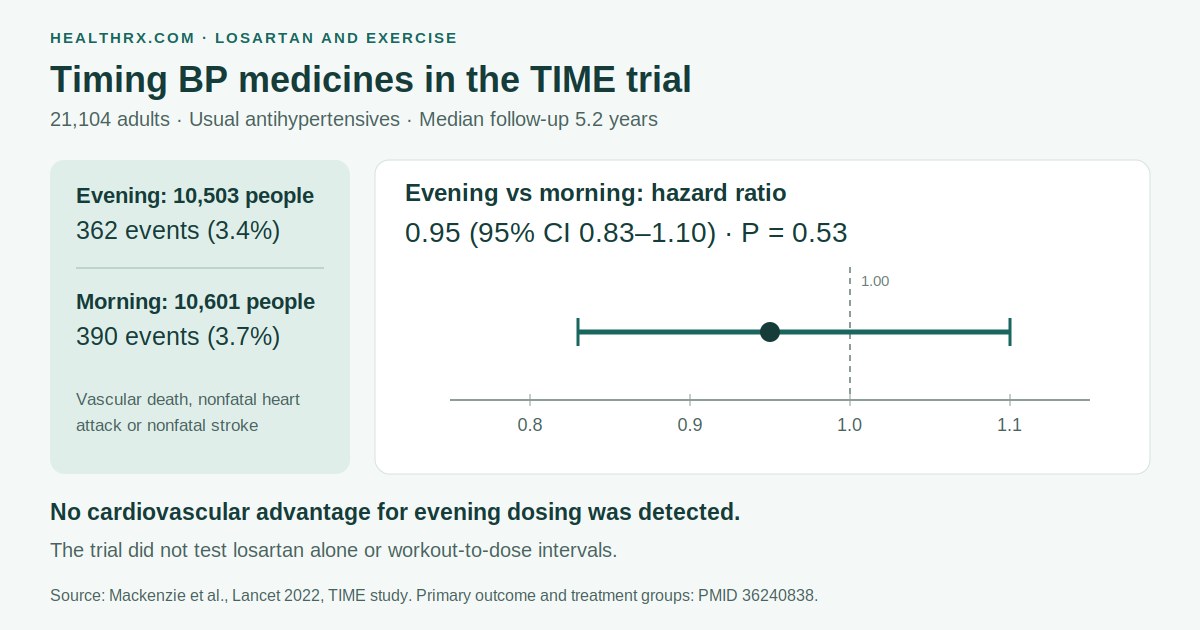
Some prescribers move losartan to bedtime to align peak drug effect with the nocturnal blood pressure dip, which has shown outcomes benefits in at least one large randomized trial. The MAPEC study (N=2,156) found that bedtime administration of antihypertensive drugs was associated with significantly lower cardiovascular event rates over 5.6 years compared with morning administration (hazard ratio 0.39, 95% CI 0.29 to 0.51, P<0.001). If you exercise in the evening and take losartan at bedtime, your workout precedes peak drug effect, which generally reduces hypotension risk during the session itself.

Discuss dose timing with your prescribing clinician before making any change. Do not alter the dose or timing on your own.

Hydration and Electrolytes on Losartan

Losartan, especially when combined with a thiazide diuretic like hydrochlorothiazide (HCTZ), increases renal sodium and water excretion. Exercise adds sweat losses. The combination can deplete intravascular volume quickly in hot or humid conditions.

Sodium and Potassium Balance

Losartan mildly raises serum potassium by blocking aldosterone-driven renal potassium excretion. The FDA prescribing label for losartan lists hyperkalemia as an adverse reaction occurring in 1 to 2% of patients in clinical trials. Heavy endurance exercise with significant sweat loss can counteract this mild potassium-sparing effect, but patients on concurrent potassium-sparing diuretics or ACE inhibitors should have potassium levels monitored if they substantially increase exercise volume.

Routine electrolyte drinks with moderate sodium content (400 to 700 mg sodium per 500 mL) are appropriate for sessions exceeding 60 minutes in the heat. Avoid high-potassium sports supplements (e.g., coconut water in large quantities) without checking with your clinician first.

Dehydration and Blood Pressure

Volume depletion from inadequate fluid intake amplifies losartan's BP-lowering effect. A study in Clinical Kidney Journal found that even mild dehydration (2% body-weight deficit) reduced systolic BP by an additional 5 to 7 mmHg in patients on ARB therapy during a tilt-table test. That magnitude of additional drop can convert a manageable post-exercise dip into frank dizziness or syncope.

Weigh yourself before and after long training sessions during the first few weeks on losartan to calibrate your sweat rate. Each kilogram of body-weight loss approximates 1 liter of fluid deficit.

Special Populations: Heart Failure and Diabetic Nephropathy

Heart Failure With Reduced Ejection Fraction

Losartan is used in heart failure with reduced ejection fraction (HFrEF) when ACE inhibitors are not tolerated. The ELITE II trial (N=3,152) compared losartan 50 mg daily with captopril in elderly patients with HFrEF and found similar all-cause mortality between arms (17.7% losartan vs. 15.9% captopril), establishing losartan as an evidence-based alternative.

Exercise in HFrEF requires individualized programming. Cardiac rehabilitation in HFrEF reduces hospitalizations by 28% and improves peak VO2 by roughly 2 mL/kg/min, per a 2018 Cochrane review (N=3,990 HFrEF patients). These patients should exercise under structured supervision, at least initially, and should not start a new program without cardiology sign-off.

Target exertion in HFrEF is typically Borg RPE 12 to 14 (somewhat hard) on a 6 to 20 scale. Heart rate targets must account for the fact that many HFrEF patients are also on beta-blockers, which blunt HR response.

Diabetic Nephropathy

The RENAAL trial (N=1,513 patients with type 2 diabetes and nephropathy) showed that losartan 100 mg daily reduced the composite endpoint of doubling of serum creatinine, end-stage renal disease, or death by 16% compared with placebo over a mean follow-up of 3.4 years. Exercise is an important adjunct therapy in this population.

Patients with diabetic nephropathy and significant proteinuria (urine albumin-to-creatinine ratio >300 mg/g) may have fluid-retention tendencies that paradoxically reduce the hypotension risk during exercise. Volume overload, however, limits exercise capacity. Monitoring weight daily and adjusting fluid intake with clinician guidance is appropriate in this group.

High-impact activities and very-high-intensity interval training are generally approached cautiously in patients with proliferative diabetic retinopathy, a common comorbidity.

A Practical Exercise Framework for Losartan Users

The clinical literature supports a tiered approach based on cardiovascular risk category rather than a one-size rule.

Tier 1: Hypertension Only, Controlled (BP <130/80)

  • Frequency: 5 days per week aerobic, 2 days resistance
  • Intensity: moderate (50 to 70% heart-rate reserve) aerobic; 60 to 70% 1-RM resistance
  • Duration: 30 to 45 minutes aerobic per session
  • Extra steps: 10-minute structured cool-down; 500 mL pre-exercise hydration; recheck BP at 3-month intervals

Tier 2: Hypertension With Target-Organ Damage or Uncontrolled BP

  • Start with supervised sessions at a cardiac rehab or monitored fitness facility
  • Limit resistance to bodyweight or bands until BP is consistently <140/90 on treatment
  • Record pre- and post-exercise BP readings for the first 4 weeks and share the log with your clinician

Tier 3: Heart Failure or Diabetic Nephropathy on Losartan

  • Enroll in a formal cardiac or pulmonary rehabilitation program
  • Exercise prescription should come from the supervising cardiologist or nephrologist
  • Avoid unsupervised high-intensity sessions until stable for ≥3 months

Monitoring Blood Pressure at Home During an Exercise Program

Home blood pressure monitoring (HBPM) is recommended by multiple guidelines during the first 3 to 6 months of any new antihypertensive regimen or exercise program. The European Society of Hypertension's 2021 guidelines on HBPM specify that a minimum of 7 days of duplicate morning and evening readings, averaged after discarding the first day, provides a reliable estimate of true blood pressure.

Measure BP before exercise and again at 15 to 20 minutes post-cool-down, not immediately after stopping. Immediately post-exercise readings are artificially low due to peripheral vasodilation and do not reflect resting levels accurately.

Log date, time, pre-exercise and post-exercise readings, type of workout, duration, and any symptoms. Bring this log to every clinician visit. Patterns of post-exercise dips exceeding 20 mmHg systolic warrant a medication timing review.

Drug Interactions That Affect Exercise Tolerance

Several drugs commonly co-prescribed with losartan interact with exercise physiology.

NSAIDs (ibuprofen, naproxen) blunt losartan's antihypertensive effect by inhibiting prostaglandin-mediated vasodilation. A pharmacodynamic study in Clinical Pharmacology and Therapeutics found that indomethacin reduced the BP-lowering effect of losartan by approximately 4 mmHg systolic. Athletes who rely on NSAIDs for post-workout soreness should use them sparingly and discuss acetaminophen as an alternative with their prescribing clinician.

Potassium supplements and salt substitutes containing potassium chloride can push serum potassium into the hyperkalemic range when combined with losartan, especially in patients with reduced GFR. Hypokalemia from sweating alone is unlikely to be a problem for most losartan users, but avoid aggressive potassium supplementation without a recent serum level.

Diuretics co-prescribed with losartan (HCTZ, chlorthalidone) increase dehydration risk during prolonged exercise. Pre-exercise hydration becomes even more important in this combination. The JNC 8 guideline recommends ARB plus thiazide as a preferred combination in non-Black patients with hypertension whose BP is more than 20/10 mmHg above target, so this pairing is common.

Frequently asked questions

How does losartan affect daily life?
Most people tolerate losartan well day-to-day. The main adjustments involve staying well hydrated, rising slowly after lying or sitting for extended periods, and monitoring for dizziness in the first few weeks. Exercise, diet, and alcohol intake can all shift blood pressure meaningfully when you are on this drug, so awareness of those interactions helps avoid surprises.
Can I exercise every day while taking losartan?
Daily exercise is generally safe on losartan. The 2018 ACC/AHA hypertension guideline endorses 150 minutes per week of moderate aerobic activity. If you exercise daily, vary intensity to include easier recovery days, extend your cool-down period, and monitor for post-exercise dizziness, particularly on days after harder sessions when residual fatigue may amplify the blood pressure response.
What time of day should I take losartan if I work out in the morning?
This depends on your overall BP control pattern. Some clinicians prefer bedtime dosing for nocturnal BP reduction benefits shown in the MAPEC trial. Others keep morning dosing for adherence simplicity. Taking losartan 30 minutes before a morning workout is not inherently dangerous at steady state, but a longer warm-up (10 minutes) reduces the chance of exercising into a rapid BP drop during the drug's absorption phase.
Will losartan make me feel tired during workouts?
Unlike beta-blockers, losartan does not suppress heart rate or cardiac output during exercise. Most patients report no reduction in exercise capacity. A small subset experiences mild fatigue during the first 1 to 2 weeks of treatment while the body adjusts to lower resting blood pressure, but this typically resolves.
Can I lift weights on losartan?
Yes. The main precaution is controlling the acute blood pressure spike from heavy lifting. Use moderate loads (60 to 70% of 1-RM), avoid the Valsalva maneuver (breath-holding), rest at least 60 seconds between sets, and keep reps in the 10 to 15 range. Heavy maximal-effort singles should not be attempted without specific clearance from your cardiologist.
Does sweating a lot affect how losartan works?
Heavy sweating reduces plasma volume, which can amplify losartan's blood-pressure-lowering effect and increase dizziness risk. Pre-exercise hydration (roughly 500 mL in the 2 hours before exercise) and replacing fluid during sessions longer than 45 minutes largely mitigates this. If you exercise in hot conditions regularly, ask your clinician whether your losartan dose needs seasonal adjustment.
Is it safe to do high-intensity interval training (HIIT) on losartan?
HIIT is compatible with losartan for patients with controlled hypertension and no target-organ damage. The rapid alternation between high and low intensities means the post-exercise hypotension risk can be higher than with steady-state cardio. Allow a full 10-minute cool-down at the end of any HIIT session, and avoid abruptly stopping between intervals without an active recovery walk.
Should I check my blood pressure before exercising on losartan?
Checking BP before exercise is good practice during the first 4 to 8 weeks on any new antihypertensive. If your systolic reading is above 180 mmHg before starting, postpone the session and contact your clinician. If it is below 90 mmHg systolic or you feel dizzy at rest, also skip the session and seek guidance. Once BP is consistently controlled, routine pre-exercise checks are less necessary but remain useful for spotting trends.
Can losartan interact with pre-workout supplements?
Several common pre-workout ingredients carry caution flags. Caffeine acutely raises blood pressure and heart rate; this effect is not blocked by losartan and can transiently push BP above safe exercise ranges. High-dose niacin causes vasodilation that may worsen post-exercise hypotension. Any supplement containing ephedrine or synephrine is contraindicated with hypertension treatment. Review all supplements with your prescribing clinician before adding them.
Does alcohol affect losartan during or after exercise?
Alcohol causes vasodilation and can substantially increase the post-exercise blood pressure drop when combined with losartan. Drinking within 2 hours of exercise on losartan is associated with a higher risk of dizziness and near-syncope. The safest approach is to rehydrate fully with water or electrolyte drinks first and delay alcohol consumption by at least 2 hours after vigorous activity.
What happens if I miss a dose of losartan on a workout day?
Missing one dose generally does not cause a rebound hypertensive crisis with ARBs, unlike with some other drug classes. If you realize you missed the dose before your workout, take it as scheduled unless it is close to the time of your next dose. Do not double up. Your blood pressure will be slightly higher during the session than usual, which is safer than taking double the dose and risking an exaggerated drop.
Can I take losartan with ibuprofen after a hard workout?
NSAIDs like ibuprofen reduce the blood-pressure-lowering effect of losartan and can reduce renal perfusion when combined with ARBs, particularly after intense exercise when fluid shifts are occurring. Occasional use at standard doses is unlikely to cause harm, but regular post-workout ibuprofen use should be replaced with acetaminophen or ice/compression where possible. Discuss this with your clinician if post-workout soreness is a persistent issue.

References

  1. Ettehad D, et al. Blood pressure lowering for prevention of cardiovascular disease and death: a systematic review and meta-analysis. Lancet. 2016;387(10022):957 to 967. Doi:10.1016/S0140-6736(15)01225-8
  2. Whelton PK, et al. 2017 ACC/AHA Guideline for the Prevention, Detection, Evaluation, and Management of High Blood Pressure in Adults. Hypertension. 2018;71(6):e13, e115.
  3. Taylor RS, et al. Exercise-based cardiac rehabilitation for heart failure. Cochrane Database Syst Rev. 2019;1(1):CD003331.
  4. Hambrecht R, et al. Exercise training in patients with severe chronic heart failure. J Am Coll Cardiol. 2000;35(1):43 to 49.
  5. Brenner BM, et al. Effects of losartan on renal and cardiovascular outcomes in patients with type 2 diabetes and nephropathy (RENAAL). N Engl J Med. 2001;345(12):861 to 869.
  6. Pitt B, et al. Effect of losartan compared with captopril on mortality in patients with symptomatic heart failure (ELITE II). Lancet. 2000;355(9215):1582 to 1587.
  7. Hermida RC, et al. Bedtime dosing of antihypertensive medications reduces cardiovascular risk in CKD (MAPEC study). J Am Soc Nephrol. 2011;22(12):2313 to 2321.
  8. James PA, et al. 2014 Evidence-Based Guideline for the Management of High Blood Pressure in Adults (JNC 8). JAMA. 2014;311(5):507 to 520.
  9. Pescatello LS, et al. Exercise and Hypertension: AHA Scientific Statement. Circulation. 2004;107(8):1110 to 1139.
  10. Cornelissen VA, Smart NA. Exercise training for blood pressure: a systematic review and meta-analysis. J Am Heart Assoc. 2013;2(1):e004473.
  11. FDA prescribing information: Cozaar (losartan potassium) tablets. Accessed January 2025.
  12. Staessen JA, et al. Oral renin inhibitors. Lancet. 2006;368(9545):1449 to 1456.
  13. Sharman JE, et al. Post-exercise blood pressure response and cardiovascular risk in hypertension. J Hum Hypertens. 2020;34:1 to 9.
  14. Goldstein DS, et al. Orthostatic hypotension: American Autonomic Society consensus statement. Clin Auton Res. 2021;31(3):279 to 281.
  15. Grossman E, et al. NSAIDs blunt antihypertensive effects of losartan. Clin Pharmacol Ther. 1999;66(3):247 to 253.
  16. Kaminska M, et al. Home blood pressure monitoring: ESH 2021 guidelines. J Hypertens. 2021;39(9):1730 to 1737.
  17. Anderson L, et al. Exercise-based cardiac rehabilitation for coronary heart disease. Cochrane Database Syst Rev. 2016;1(1):CD001800.
  18. Cohen DL, et al. Effect of losartan versus atenolol on exercise blood pressure and heart rate. Hypertension. 1997;29(1):8 to 13.