Losartan and Food: Distinguish Lower Sodium From Added Potassium
Eating less sodium and adding potassium are not interchangeable decisions when you take losartan. A lower-sodium eating pattern can support blood-pressure management. A potassium-containing salt substitute introduces a separate safety question. Start with food choices you can compare, rather than assuming every product advertised as heart-friendly suits your medication regimen.
Food timing is flexible
Losartan can be taken with or without food. A meal slows absorption and lowers the peak losartan concentration, but changes overall exposure only modestly—about a 10% decrease. Food therefore affects some pharmacokinetic measurements without requiring an empty stomach. The name “losartan potassium” does not mean you should add dietary potassium supplements.[1]
Grapefruit needs a separate interaction review
A randomized crossover study gave losartan with and without grapefruit juice to nine healthy volunteers. Grapefruit changed several pharmacokinetic measures and reduced exposure to the active metabolite E3174.[6] This small study did not measure long-term blood-pressure control or establish a safe amount of grapefruit for every patient.
The permission to take losartan with or without food cannot be treated as blanket clearance for grapefruit. Review regular grapefruit use against the actual products and your other medicines; the cited trial does not establish a protective spacing interval.
What DASH actually measured
DASH emphasizes vegetables, fruit, low-fat dairy, and a broader pattern with less saturated fat. Its evidence comes from controlled dietary comparisons, not trials establishing a fixed extra blood-pressure reduction for people already taking losartan.
The original DASH trial enrolled 459 adults. After a three-week control-diet run-in, participants followed one of three assigned patterns for eight weeks. Sodium intake and body weight stayed constant. The combination pattern lowered average systolic blood pressure by 5.5 mmHg compared with the control pattern; the difference was 11.4 mmHg in the 133 participants with hypertension.[3]
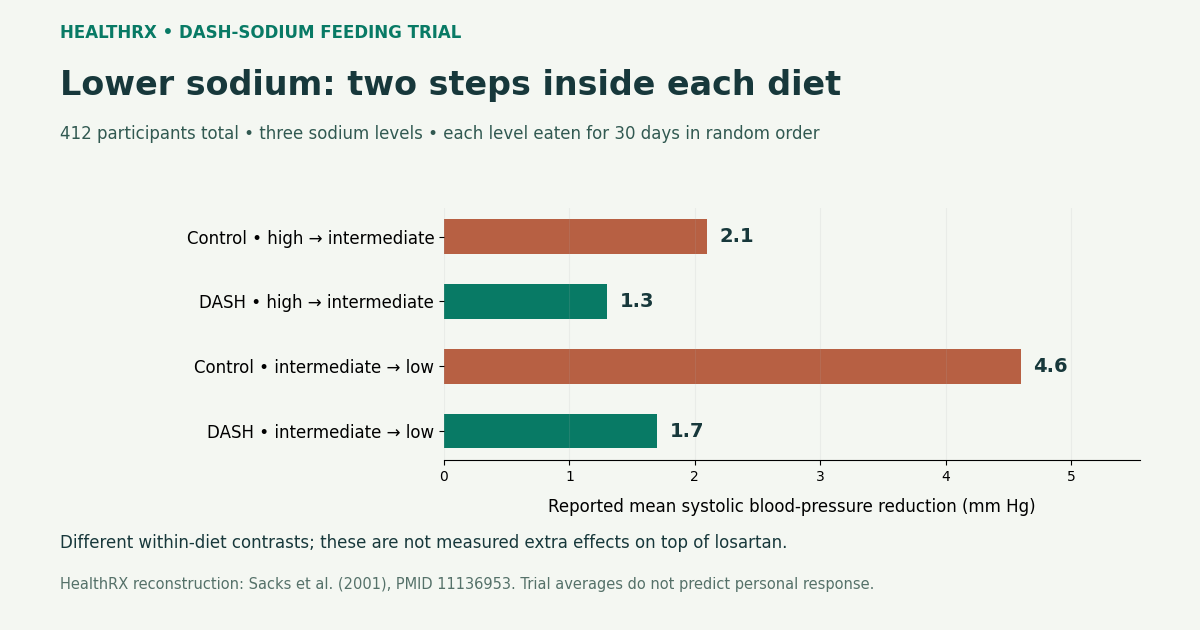
DASH-Sodium asked a different question. Its 412 participants were assigned to DASH or a control diet, then ate high, intermediate, and low sodium levels within their assigned diet, each for 30 days in random order.[2]
| Study | Dietary variable tested | Systolic measurement and comparator | Meaning for a losartan user |
|---|---|---|---|
| Original DASH, 1997 | Overall eating pattern; sodium and weight held constant | Combination versus control: 5.5 mmHg lower overall; 11.4 lower in the hypertension subgroup | Supports the pattern, not a quantified medication add-on effect |
| DASH-Sodium, 2001 | Three sodium levels within DASH or control | High to intermediate: 2.1 mmHg lower on control, 1.3 on DASH; intermediate to low: 4.6 lower on control, 1.7 on DASH | Measures sodium changes within each assigned diet, not losartan effects |
| DASH-Sodium combined comparison | Low-sodium DASH versus high-sodium control | 7.1 mmHg lower without hypertension; 11.5 lower with hypertension | Combines pattern and sodium differences; not a personal prediction |
These are averages over specified feeding periods. The original DASH hypertension result of 11.4 and the DASH-Sodium result of 11.5 describe different studies and comparisons. Neither establishes an extra, guaranteed reduction on losartan.
Compare the foods you actually buy
Put two soup containers, bread packages, or pasta sauces side by side. Read the sodium amount and the serving size on each. Then account for what you actually eat: a whole container may represent several labeled servings, and your usual bread portion may differ between products.
Compare sodium for equivalent portions, not merely the numbers printed beside different serving sizes. A lower-sodium soup can be a useful swap, but the total still depends on how much you consume and what accompanies it. Check canned beans, frozen meals, deli foods, and condiments in the same way. No brand ranking or universal per-food cutoff replaces that comparison.
If a reduced-sodium product uses potassium chloride, note that separately. Reducing sodium by choosing a different food is not the same as replacing sodium chloride with potassium chloride.
Potassium needs context, not a fruit ban
A potassium review found blood-pressure benefits chiefly applicable to people without impaired kidney handling of potassium.[4] That boundary matters: population nutrition findings cannot establish that potassium supplements or potassium-based salt substitutes are safe for an individual taking an angiotensin receptor blocker.
Do not use potassium supplements or potassium-containing salt substitutes without healthcare-provider consultation. Kidney problems and medicines that raise potassium make review particularly important; potassium and kidney-function monitoring should reflect individual risk.[1]
This is not a blanket instruction to avoid bananas, avocado, or vegetables. Nor is it a reason to deliberately load up on them. Bring the actual salt substitute, supplement, and relevant food packages to your pharmacist, together with your medication list.
Review unusual ingredients and symptoms
Real liquorice deserves attention. A small volunteer study found increased blood pressure with liquorice consumption; it was not a losartan trial and cannot establish an equivalent effect across candies, teas, or extracts.[5] Check ingredients and flag regular use for review.
Routine food changes and missed medication doses have different implications: improving meals does not replace prescribed treatment. If you feel faint or dizzy, lie down and call your doctor right away rather than trying to correct it with salt or electrolyte products.[1]
Frequently asked questions
How does losartan affect daily life?
Food timing is usually flexible, but daily life may include medication routines, symptom awareness, and individualized monitoring. Keep your medication list current, including supplements and salt substitutes. Improving your diet does not make missed doses equivalent to taking treatment.
What foods should I avoid while taking losartan?
There is no universal prohibited-food list. Focus on reducing sodium in foods you regularly eat and reviewing potassium-containing supplements or substitutes before use. Products containing real liquorice also deserve attention because a small volunteer study found blood-pressure increases, although it did not test losartan.
Can I eat bananas or avocado on losartan?
Taking losartan does not automatically require avoiding either food. Whether potassium-rich foods need limits depends on kidney function, potassium results, other medicines, and your overall diet. General evidence favoring potassium intake is not a reason to increase these foods deliberately when your potassium handling is uncertain.
Does losartan work better if I reduce salt?
Reducing sodium can support blood-pressure control, but DASH-Sodium did not measure a fixed increase in losartan's effectiveness. It measured dietary comparisons during 30-day feeding periods. Treat lower-sodium choices as part of management, not as proof that your medication dose should change.
Can I drink alcohol while taking losartan?
The nutrition trials discussed here did not establish a safe alcohol amount with losartan. They cannot provide personal clearance or an interaction estimate. Ask your pharmacist to review your actual regimen and drinking pattern, especially if you have dizziness or take other medicines that affect blood pressure.
Does grapefruit interact with losartan?
Yes, a small randomized crossover study in nine healthy volunteers found pharmacokinetic changes, including reduced exposure to the active metabolite E3174 with grapefruit juice.[6] It did not establish the long-term blood-pressure effect or a safe amount or spacing interval. Have your pharmacist review regular grapefruit use and your complete regimen.
Should I take losartan with food or on an empty stomach?
Either is permitted by the prescribing information. Food slows absorption and lowers the peak concentration, with only a modest change in overall exposure. Follow your prescribed instructions rather than choosing an empty stomach to try to strengthen the effect.
Is the DASH diet recommended for people on losartan?
DASH is an evidence-supported eating pattern worth discussing as part of blood-pressure management. Its original trial tested the pattern while keeping sodium and weight constant. For someone taking losartan, potassium-related risks may require tailoring; DASH does not mean adding potassium supplements.
Can I use a salt substitute if I am on losartan?
Check the ingredient list for potassium chloride. The losartan label advises consultation before using potassium-containing salt substitutes. Bring the actual product to your pharmacist; a front-label claim such as “less sodium” does not settle its suitability.
How much water should I drink while on losartan?
There is no single water amount appropriate for everyone taking losartan. Needs depend on health conditions, activity, weather, and any fluid restrictions. Ask for individualized guidance if illness or poor intake changes your usual hydration; do not assume salt or potassium drinks are the solution.
Does losing weight make losartan more effective?
Weight loss can influence blood pressure, but it does not automatically make losartan more effective or allow a dose reduction. The original DASH trial maintained body weight, so its results were not weight-loss effects. Any medication change requires a separate assessment of your treatment and health.
Does caffeine interfere with losartan?
These dietary trials did not test whether caffeine changes losartan's absorption or treatment effect. They do not establish a personal caffeine limit. Review your usual coffee, tea, energy drinks, and other caffeine sources with your pharmacist in the context of your actual regimen and symptoms.
References
Sources checked October 14, 2026.
- Organon. COZAAR (losartan potassium) tablets: prescribing information and patient information. Revised June 2025; DailyMed updated January 20, 2026. DailyMed.
- Sacks FM, Svetkey LP, Vollmer WM, et al. Effects on blood pressure of reduced dietary sodium and the Dietary Approaches to Stop Hypertension (DASH) diet. 2001. PubMed abstract, PMID 11136953.
- Appel LJ, Moore TJ, Obarzanek E, et al. A clinical trial of the effects of dietary patterns on blood pressure. 1997. PubMed abstract, PMID 9099655.
- Aburto NJ, Hanson S, Gutierrez H, et al. Effect of increased potassium intake on cardiovascular risk factors and disease: systematic review and meta-analyses. 2013. PubMed abstract, PMID 23558164.
- Sigurjonsdottir HA, Ragnarsson J, Franzson L, Sigurdsson G. Is blood pressure commonly raised by moderate consumption of liquorice? 1995. PubMed abstract, PMID 7623371.
- Zaidenstein R, Soback S, Gips M, et al. Effect of grapefruit juice on the pharmacokinetics of losartan and its active metabolite E3174 in healthy volunteers. 2001. PubMed abstract, PMID 11477318.