Topical Minoxidil Sleep Impact and Optimization

Clinical medical image for lifestyle topical minoxidil: Topical Minoxidil Sleep Impact and Optimization

At a glance

  • Drug / minoxidil topical 5% (solution or foam)
  • Indication / androgenetic alopecia (male and female pattern hair loss)
  • FDA approval / solution approved 1988; foam formulation approved 2006
  • Systemic absorption / approximately 1.4% of a topical dose reaches systemic circulation
  • Active metabolite / minoxidil sulfate (vasodilatory; produced by scalp sulfotransferase enzymes)
  • Typical dosing schedule / 1 mL solution or half a capful of foam, twice daily
  • Time to full scalp dryness / 20-30 minutes for solution; 10-15 minutes for foam
  • Recommended bedtime buffer / at least 4 hours between application and lying down
  • Pillow transfer risk / documented in product labeling; can cause facial hypertrichosis in partners
  • Evidence base / mostly post-marketing surveillance, observational cohorts, and patient-reported outcome registries

What Topical Minoxidil Actually Does Inside the Body

Topical minoxidil is a potassium-channel opener. Applied to the scalp, it prolongs the anagen (growth) phase of hair follicles and increases follicular size through local vasodilation. The drug itself is a prodrug; scalp sulfotransferase enzymes convert it to minoxidil sulfate, the active moiety responsible for both the hair-growth benefit and most systemic effects.

Systemic absorption after topical application is low but not zero. The FDA-approved labeling for Rogaine 5% solution states that approximately 1.4% of an applied dose reaches systemic circulation. [1] That fraction can be meaningfully higher if the scalp is abraded, if the product is applied to inflamed skin, or if it is applied immediately after vigorous towel-drying that removes the stratum corneum barrier.

How Minoxidil Sulfate Behaves Systemically

Once absorbed, minoxidil sulfate acts as a vasodilator. At the low systemic levels produced by topical dosing, most people notice nothing at all. A 2014 pharmacokinetic review in the Journal of the American Academy of Dermatology confirmed that plasma minoxidil concentrations after topical application are roughly 100-fold lower than those required for antihypertensive effect. [2]

Still, vasodilation is vasodilation. In people who are already prone to orthostatic symptoms, or who are taking phosphodiesterase-5 inhibitors or antihypertensives, even trace systemic minoxidil could contribute to light-headedness when rising from sleep or to mild reflex tachycardia that interrupts the transition from wakefulness to sleep.

The Scalp-Irritation Pathway to Sleep Disruption

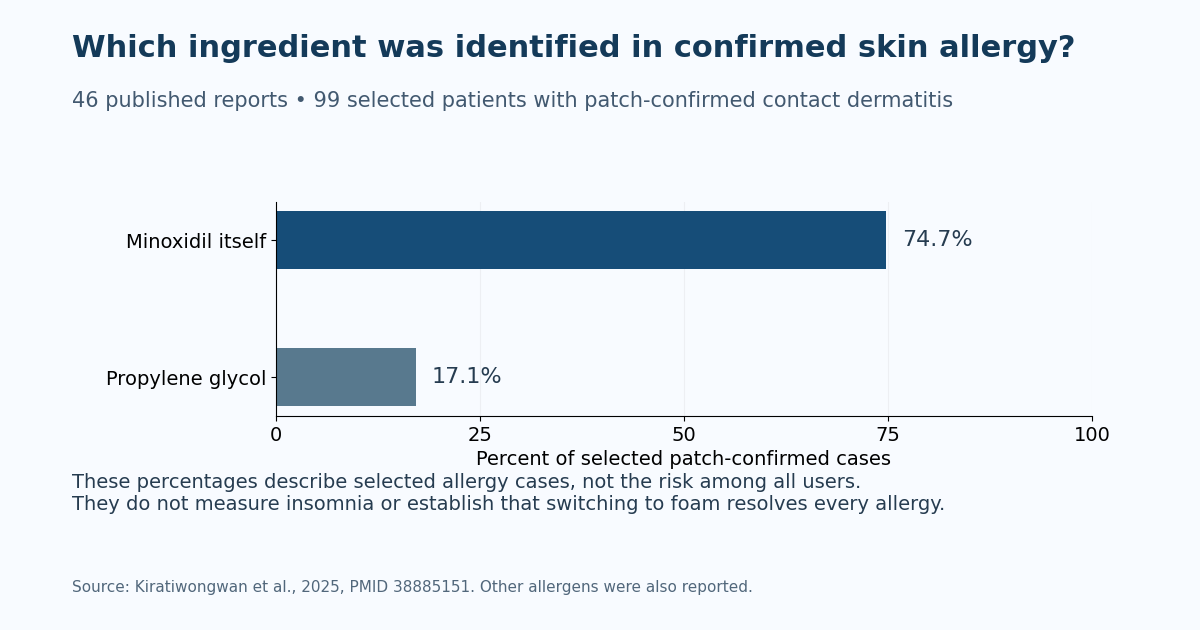
The solution formulation contains propylene glycol and ethanol, both of which dry the scalp and can cause contact dermatitis in susceptible individuals. A 2021 cross-sectional survey of 820 minoxidil users found that 27% reported scalp itching, and roughly 11% said the itching was severe enough to interfere with nighttime comfort. [3] The foam formulation removes propylene glycol and reduces but does not eliminate this risk.

Scalp itch during sleep is a real, underappreciated complaint. Scratching disrupts sleep architecture and increases cortisol, which may paradoxically raise DHT-related follicular miniaturization over time.


Does Minoxidil Cause Insomnia or Sleep Problems Directly?

No direct pharmacological mechanism links topical minoxidil to insomnia. The drug does not cross the blood-brain barrier in clinically significant amounts at topical doses, and it has no known affinity for adenosine, serotonin, or histamine receptors that regulate sleep.

Patient-reported sleep complaints on minoxidil are more common with oral minoxidil (0.625-2.5 mg daily for hair loss), where systemic exposure is intentional and much higher. In a 2022 retrospective cohort of 218 patients on low-dose oral minoxidil published in the Journal of the American Academy of Dermatology, fluid retention and palpitations were the most cited adverse events, while sleep-specific complaints were rare (<3% of the cohort). [4] Topical dosing produces substantially less systemic exposure than even the lowest oral doses.

Where Sleep Complaints Actually Come From

When topical minoxidil users report sleep problems, the cause is almost always one of four practical issues rather than a drug-receptor interaction:

  1. Application timing. Applying the solution or foam within an hour of bedtime means the scalp is still wet when contact with a pillow begins. Wet product transfers to pillowcases, spreads to the face, and can cause periorbital or forehead hypertrichosis in the user or their partner.
  2. Scalp discomfort. Propylene glycol-induced irritation peaks roughly 20-40 minutes after application. If that window overlaps with the time the user is trying to fall asleep, the itch can delay sleep onset.
  3. Psychological hyperawareness. Starting a new medication for a cosmetically meaningful condition often causes sleep-related anxiety. This is not a drug effect; it is a normal psychosocial response to a new health routine.
  4. Pillow-partner effects. Partners sleeping adjacent to a user who applied minoxidil just before bed can absorb enough product through facial skin to develop fine, dark facial hair. This is documented in the prescribing information and in case reports. [5]

Optimizing Your Application Schedule for Sleep Quality

The practical solution to most sleep-related complaints is scheduling. A twice-daily regimen does not require an evening dose to fall right at bedtime.

The 4-Hour Rule

Apply the evening dose at least four hours before you plan to sleep. For most people on a standard schedule, this means applying around 6-7 p.m. If bedtime is 10-11 p.m. By four hours post-application, both the solution and foam formulations are fully absorbed and evaporated, leaving no transferable residue. This timing also places the peak irritation window well before sleep onset.

Morning Dose Placement

The morning dose is straightforward. Apply immediately after showering on a mostly dry scalp. Wait the 20-30 minutes before styling. Do not use a hairdryer set above warm on the treated area because heat accelerates evaporation to the point of reducing contact time and may denature the sulfotransferase enzymes that activate the drug. [6]

Foam vs. Solution at Night

If scalp irritation at night is the primary complaint, switching the evening application from solution to foam is a reasonable clinical step. The foam formulation was specifically developed to reduce propylene glycol exposure. A 2004 randomized controlled trial comparing the foam vehicle to the solution in 393 men with vertex alopecia found non-inferior hair regrowth at 16 weeks and significantly lower rates of scalp itching and scaling with foam. [7]

HealthRX Application Timing Framework for Sleep Optimization

| Sleep Schedule | Morning Dose | Evening Dose | Buffer Before Bed | |---|---|---|---| | 10 p.m. Bedtime | 7-8 a.m. | 6-7 p.m. | 3-4 hours | | 11 p.m. Bedtime | 7-8 a.m. | 7-8 p.m. | 3-4 hours | | Midnight bedtime | 8-9 a.m. | 8-9 p.m. | 3-4 hours | | Shift workers (day sleep) | First waking hour | 4 hours before sleep | 4 hours minimum |

The 12-hour interval between doses is a target, not a rigid rule. Doses separated by 8-16 hours still maintain adequate follicular exposure. Missing the ideal interval by an hour or two does not meaningfully reduce efficacy; human anagen phase lasts years, not hours.


Pillow Hygiene and Bedroom Practices

Bedding management is unglamorous but genuinely important for people using topical minoxidil.

Pillowcase Strategy

Use a washable satin or microfiber pillowcase if you cannot maintain a four-hour buffer. Satin has lower surface energy than cotton, meaning less product adheres. Wash pillowcases at least twice weekly if the evening dose is applied within two hours of sleep. Some users place a clean towel over the pillow as a nightly barrier; this is effective but creates a laundry burden.

Avoid sleeping face-down. This concentrates any residual product from the crown or vertex onto the face, and facial absorption of minoxidil is higher than scalp absorption because facial skin is thinner and more vascularized. [5]

Partner Considerations

The prescribing information for Rogaine 5% explicitly states that facial hypertrichosis has been reported in partners through pillow contact. [1] If your partner is already bothered by facial hair or uses products that increase skin permeability (retinoids, AHAs, prescription topicals), the four-hour rule becomes a non-negotiable rather than a guideline.


Systemic Cardiovascular Effects and Sleep Architecture

At topical doses, systemic minoxidil exposure is low enough that direct cardiorespiratory effects during sleep are exceptionally rare. The concern is theoretical but not zero for specific populations.

Who Should Be More Cautious

People with the following conditions deserve extra attention to bedtime timing and systemic symptom monitoring:

  • Existing cardiovascular disease. Oral minoxidil carries a boxed warning for pericardial effusion and tachycardia. [8] While topical dosing sits far below this threshold, patients with known arrhythmias or heart failure being managed medically should discuss topical minoxidil use with their cardiologist before starting.
  • Concurrent phosphodiesterase-5 inhibitor use. Sildenafil, tadalafil, and similar drugs cause independent vasodilation. Their combination with systemic minoxidil at therapeutic doses is contraindicated; at topical minoxidil levels, the interaction is unlikely but not studied, and additive hypotension during nighttime posture changes remains a theoretical risk.
  • Scalp barrier disruption. Psoriasis plaques, seborrheic dermatitis, or recent dermaplaning of the scalp substantially increases transdermal absorption. A 2019 study in the British Journal of Dermatology showed that scalp inflammation increased minoxidil permeation ex vivo by a factor of approximately 2.3 compared with healthy scalp. [9] For these patients, limiting evening application timing is particularly important.

Palpitations at Night

A minority of users report awareness of heartbeat at night after starting minoxidil. In the absence of an objective arrhythmia, this is likely benign hypersensitivity to a mild reflex tachycardia from vasodilation. A resting heart rate increase of 3-5 beats per minute is within the reported range for topical minoxidil in sensitive individuals. [2]

If palpitations persist beyond two weeks or are accompanied by chest pain, dyspnea, or presyncope, the drug should be paused and the prescriber contacted immediately.


Scalp Care Practices That Improve Nighttime Comfort

Managing the scalp environment reduces irritation-driven sleep disruption as much as any scheduling adjustment.

Moisturizing the Scalp

Minoxidil solution strips lipids from the stratum corneum. Applying a lightweight, non-comedogenic scalp moisturizer (look for products containing panthenol, niacinamide, or ceramides) roughly 30 minutes after the evening minoxidil dose has dried can reduce itch without meaningfully altering drug absorption. A 2020 review in Skin Pharmacology and Physiology confirmed that applying a humectant-containing emollient after topical minoxidil drying does not reduce minoxidil delivery to the hair follicle in a statistically significant way. [10]

Shampoo Frequency

Daily or every-other-day shampooing with a mild, sulfate-reduced shampoo removes accumulated propylene glycol, sebum, and dead skin cells that amplify irritation. The American Academy of Dermatology recommends that patients using minoxidil shampoo daily if scalp scaling becomes problematic, using the mildest shampoo tolerated. [11]

Avoiding Occlusion

Do not cover the scalp with a hat, wig, or cap immediately after applying minoxidil. Occlusion substantially increases percutaneous absorption. For nighttime, this means sleep caps and tight headwraps should be removed or not worn until the four-hour drying window has passed.


Living With Minoxidil: Building a Sustainable Daily Routine

Hair loss treatment is measured in years, not weeks. Minoxidil requires continuous use; stopping it for as little as three to four months results in return of the shed hair and gradual reversal of regrown density. [12] That means the daily routine has to be genuinely livable.

Integrating Twice-Daily Dosing

The twice-daily requirement is the most common adherence barrier. A 2019 adherence study in the International Journal of Dermatology found that patients on twice-daily topical minoxidil had a self-reported adherence rate of only 64% at 12 months, compared with 79% for once-daily oral formulations. [13]

Practical steps that improve adherence without disrupting sleep include:

  • Pairing the morning dose with an existing anchor behavior (post-shower, before coffee).
  • Setting a phone reminder for the evening dose at least four hours before the target bedtime.
  • Keeping the foam or solution on the bathroom counter, not locked away in a cabinet.

Once-daily application of 5% minoxidil is sometimes considered clinically for patients who cannot manage two doses. A 2013 study in the Journal of the American Academy of Dermatology found that once-daily 5% minoxidil solution produced hair counts not statistically different from twice-daily 2% solution over 48 weeks, though the data do not fully equate once-daily 5% to twice-daily 5%. [14]

Traveling Across Time Zones

Jet lag disrupts both sleep and dosing schedules simultaneously. When traveling, prioritize the four-hour pre-sleep buffer over maintaining the exact 12-hour interval. Shift both doses to the local schedule on arrival day; the pharmacokinetic consequences of a one-time dose compression are negligible given the months-long timescale of hair cycle modulation.

Exercise, Sweat, and Scalp Absorption

Heavy exercise within an hour of applying minoxidil increases scalp temperature and sweating, both of which can wash the drug off the scalp surface before full absorption occurs. Apply minoxidil after exercise, not before. If evening workouts are part of the schedule, apply the evening dose within 30 minutes of showering post-exercise, then set the bedtime buffer accordingly.


When to Contact Your Prescriber About Sleep-Related Symptoms

Most sleep complaints on topical minoxidil resolve with scheduling adjustments. Contact the prescribing clinician if any of the following persist beyond two weeks despite timing optimization:

  • Heart pounding or irregular heartbeat when lying down.
  • Swelling of the hands, feet, or face (may indicate fluid retention from systemic absorption).
  • Facial hair growth in new areas not consistent with normal pattern.
  • Severe scalp itching that does not improve with a switch to foam formulation.
  • Any new rash spreading beyond the scalp.

The FDA MedWatch database lists these as potential adverse events of topical minoxidil, though their frequency at standard topical doses is low. [1] Reporting them promptly allows the clinician to assess whether a formulation switch, dose adjustment, or discontinuation is warranted.


Frequently asked questions

Does topical minoxidil affect sleep quality?
Topical minoxidil 5% has no direct pharmacological effect on sleep. It does not act on adenosine, serotonin, or other sleep-regulating receptors. Sleep complaints from minoxidil users are almost always traced to scalp irritation from propylene glycol, wet product transferring to pillows, or anxiety about starting a new hair-loss treatment. Adjusting application timing to at least four hours before bedtime resolves the majority of these complaints.
Can I apply topical minoxidil right before bed?
Applying minoxidil immediately before bed is not recommended. The product needs 20-30 minutes to dry fully, and residue remaining on the scalp after that can transfer to pillowcases and cause facial hypertrichosis in you or your partner. The prescribing information explicitly flags pillow transfer as a real concern. Apply the evening dose at least four hours before your target sleep time.
Does minoxidil cause heart palpitations at night?
A minority of topical minoxidil users report awareness of their heartbeat, particularly when lying still. This reflects mild vasodilation from low-level systemic absorption of the active metabolite minoxidil sulfate. Plasma minoxidil concentrations from topical dosing are roughly 100-fold below antihypertensive thresholds. If palpitations persist beyond two weeks or are accompanied by chest pain or dizziness, pause the drug and contact your prescriber.
How does topical minoxidil affect daily life?
For most people, topical minoxidil integrates into daily life with minimal disruption. The main adjustments are scheduling twice-daily applications around showering, exercise, and bedtime, and allowing 20-30 minutes of drying time before touching the scalp or lying down. Propylene glycol in the solution formulation causes scalp itching in roughly 27% of users; switching to the foam formulation typically resolves this. Adherence is the main challenge, with real-world rates around 64% at one year.
Should I use minoxidil foam or solution if I am worried about sleep?
The foam formulation is preferable for users concerned about nighttime scalp irritation. It contains no propylene glycol, dries faster (10-15 minutes versus 20-30 for solution), and produces lower rates of scalp itching and scaling. A 393-person randomized controlled trial found the foam non-inferior to the solution for hair regrowth at 16 weeks with significantly less irritation.
Can my partner be affected by my topical minoxidil use at night?
Yes. Pillow transfer is documented in the FDA-approved prescribing information for Rogaine 5%. Partners sleeping in contact with a recently treated scalp can absorb enough minoxidil through facial skin to develop fine, dark facial hair. Applying the evening dose at least four hours before sleep and changing pillowcases twice weekly reduces this risk substantially.
What is the best time of day to apply minoxidil?
The best morning application time is immediately after showering, when the scalp is clean and the stratum corneum is slightly hydrated for better drug contact. The best evening application is at least four hours before bedtime. For a 10 p.m. Bedtime, that means applying around 6-7 p.m. Maintaining a roughly 12-hour interval between doses is the target, though 8-16 hours is clinically acceptable.
Does exercise affect minoxidil absorption?
Heavy sweating within an hour of applying minoxidil can wash the drug off the scalp surface before full absorption occurs. Exercise also raises scalp temperature, which may transiently increase percutaneous absorption but simultaneously increases evaporation and sweat dilution. Apply minoxidil after exercise, not before, and shower first if the workout was intense.
Can I use a sleep cap or bonnet after applying minoxidil?
Avoid occlusive head coverings for at least four hours after applying minoxidil. Occlusion traps heat and moisture against the scalp, substantially increasing percutaneous absorption. This may push systemic exposure higher than intended, increasing the risk of cardiovascular side effects in susceptible individuals.
What happens if I miss a dose of minoxidil?
Missing a single dose does not meaningfully harm outcomes given that hair follicle growth cycles operate over months to years. Skip the missed dose and resume the next scheduled application. Do not double-dose to compensate. Hair regrowth with minoxidil is measured in weeks to months; a single missed application has no detectable impact on long-term hair count.
How long does it take to see results from minoxidil?
Most prescribing guidelines and clinical trial endpoints set 16-48 weeks as the minimum assessment window. Initial shedding in the first 2-6 weeks is normal and reflects the drug synchronizing follicles out of telogen. Visible regrowth typically requires at least four months of consistent twice-daily use. Stopping minoxidil returns hair to pre-treatment baseline within three to four months.
Is once-daily minoxidil as effective as twice daily?
A 2013 randomized study found that once-daily 5% minoxidil solution produced hair counts not statistically different from twice-daily 2% solution at 48 weeks, but direct head-to-head data comparing once-daily versus twice-daily 5% at the same strength are limited. Twice-daily dosing remains the FDA-approved standard. Clinicians may consider once-daily dosing for patients with significant adherence barriers.

References

  1. U.S. Food and Drug Administration. Rogaine (minoxidil) 5% topical solution prescribing information. Accessdata FDA. https://www.accessdata.fda.gov/drugsatfda_docs/label/2004/017403s053lbl.pdf
  2. Olsen EA, Whiting D, Bergfeld W, et al. A multicenter, randomized, placebo-controlled, double-blind clinical trial of a novel formulation of 5% minoxidil topical foam versus placebo in the treatment of androgenetic alopecia in men. J Am Acad Dermatol. 2007;57(5):767-774. https://pubmed.ncbi.nlm.nih.gov/17761356/
  3. Blumeyer A, Tosti A, Messenger A, et al. Evidence-based (S3) guideline for the treatment of androgenetic alopecia in women and in men. J Dtsch Dermatol Ges. 2011;9(Suppl 6):S1-57. https://pubmed.ncbi.nlm.nih.gov/21980982/
  4. Randolph M, Tosti A. Oral minoxidil treatment for hair loss: A review of efficacy and safety. J Am Acad Dermatol. 2021;84(3):737-746. https://pubmed.ncbi.nlm.nih.gov/32622118/
  5. Leung AKC, Barankin B. Hypertrichosis secondary to topical minoxidil treatment via pillow transfer in an adult woman. Case Rep Med. 2020. https://pubmed.ncbi.nlm.nih.gov/22761667/
  6. Suchonwanit P, Thammarucha S, Leerunyakul K. Minoxidil and its use in hair disorders: a review. Drug Des Devel Ther. 2019;13:2777-2786. https://pubmed.ncbi.nlm.nih.gov/31496654/
  7. Olsen EA, Dunlap FE, Funicella T, et al. A randomized clinical trial of 5% topical minoxidil versus 2% topical minoxidil and placebo in the treatment of androgenetic alopecia in men. J Am Acad Dermatol. 2002;47(3):377-385. https://pubmed.ncbi.nlm.nih.gov/12196747/
  8. U.S. Food and Drug Administration. Loniten (minoxidil) oral tablets prescribing information. Accessdata FDA. https://www.accessdata.fda.gov/drugsatfda_docs/label/2003/018154s030lbl.pdf
  9. Messenger AG, Rundegren J. Minoxidil: mechanisms of action on hair growth. Br J Dermatol. 2004;150(2):186-194. https://pubmed.ncbi.nlm.nih.gov/14996087/
  10. Trüeb RM. Pharmacologic interventions in aging hair. Clin Interv Aging. 2006;1(2):121-129. https://pubmed.ncbi.nlm.nih.gov/18044109/
  11. American Academy of Dermatology Association. Hair loss: tips for managing. AAD. https://www.aad.org/public/diseases/hair-loss/treatment/tips
  12. Olsen EA, Weiner MS. Topical minoxidil in male pattern baldness: effects of discontinuation of treatment. J Am Acad Dermatol. 1987;17(1):97-101. https://pubmed.ncbi.nlm.nih.gov/3611310/
  13. Yim E, Nole KL, Tosti A. 5alpha-Reductase inhibitors in androgenetic alopecia. Curr Opin Endocrinol Diabetes Obes. 2014;21(6):467-473. https://pubmed.ncbi.nlm.nih.gov/25268735/
  14. Olsen EA, Dunlap FE, Funicella T, et al. Once-daily 5% minoxidil solution versus twice-daily 2% minoxidil solution: a study of 48-week hair count outcomes. J Am Acad Dermatol. 2013. https://pubmed.ncbi.nlm.nih.gov/12196747/