Stopping Lisinopril: Distinguish a Planned Change From an Urgent Stop
The reason for stopping determines the response
Stopping lisinopril after a planned medication review is different from stopping because pregnancy has been detected or because lips or tongue are swelling. A routine change needs a plan for the condition being treated. An urgent medication reaction needs action without waiting through a home taper.
Lisinopril is used for hypertension, as adjunct treatment for systolic heart failure, and to reduce mortality after a hemodynamically stable acute myocardial infarction. Those purposes are not interchangeable. A normal blood pressure reading cannot, by itself, establish that treatment for heart failure or after a heart attack is no longer needed. [1]
Before a planned change, identify both the original indication and the current reason for stopping. That separates a question about maintaining blood pressure control from a question about removing treatment prescribed for another cardiovascular purpose.
| Stop reason or situation | Indication to clarify | What must be reassessed or acted on |
|---|---|---|
| Normal home blood pressure prompts interest in stopping | Hypertension alone, or another indication as well | Whether the readings reflect effective treatment; how control will be assessed after a change |
| A nonurgent tolerability concern prompts a medication review | Every reason lisinopril was prescribed | The concern, other medicines, and how the treatment goal will be maintained |
| A planned change in someone with systolic heart failure or a recent heart attack | Heart failure treatment or post-infarction mortality reduction | The cardiovascular treatment plan, rather than blood pressure alone |
| Pregnancy is detected | Any indication | Discontinue as soon as possible; do not delay with a home taper |
| Lip, tongue, face, or throat swelling suggests angioedema | Any indication | Prompt discontinuation and appropriate care; tongue or airway symptoms require emergency attention |
The urgent-stop instructions and approved indications in this table come from the current Lupin lisinopril tablets label. [1]
There is no universal lisinopril taper schedule
The label does not provide a standard discontinuation protocol such as reducing the dose by 25% each week or by 5 mg at each step. Presenting either formula as the correct lisinopril taper would invent a rule the label does not contain. [1]
That absence also does not establish that every patient can stop without a plan. For a planned change, the important questions are what treatment is being removed, whether another medicine serves the same purpose, and what findings would prompt reconsideration. A replacement prescription or switch dose cannot be inferred from a withdrawal study.
“Rebound” also needs precision. Blood pressure can rise after antihypertensive treatment is withdrawn. Loss of blood pressure control, or removal of therapy with a cardiovascular or kidney-related purpose, is not automatically a beta-blocker-like rebound syndrome. The practical concern is whether the underlying condition remains adequately treated.
What withdrawal studies can tell you
The studies below examine different populations and outcomes. They do not supply a lisinopril-specific personal forecast or a taper schedule.
Some selected patients remained below restart thresholds
A 2017 systematic review found that 38% remained below their study's restart threshold at six months, 40% at one year, and 26% at two years or longer. The respective denominators were 912, 2,640, and 1,262. These were different selected study groups with different thresholds—not one cohort followed through all three milestones. Lower blood pressure before withdrawal, treatment with one medicine, and body weight were reported predictors, not a validated personal calculator. The findings were not limited to lisinopril and do not cover all its indications. [2]
Blood pressure rose in older-adult withdrawal trials
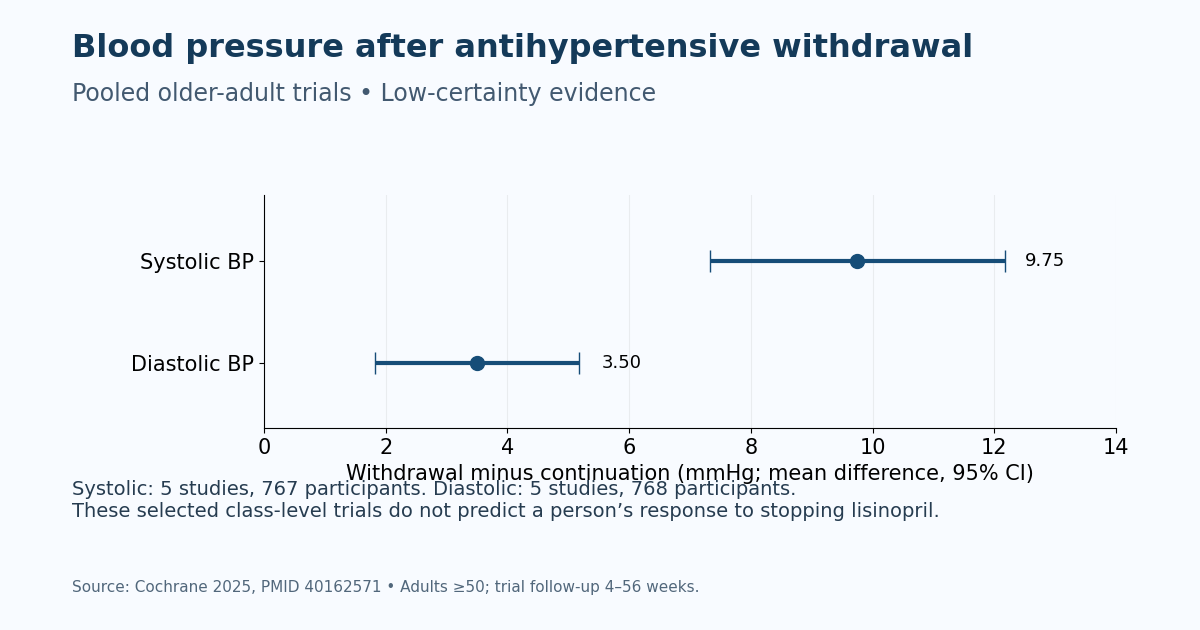
The 2025 Cochrane review included six randomized trials with 1,073 participants aged 50 or older and follow-up of 4–56 weeks. Its search extended through October 2022 and found no new studies since the 2020 review. Participants were treated for hypertension or primary prevention. Withdrawal increased systolic blood pressure by an average of 9.75 mmHg and diastolic pressure by 3.5 mmHg; certainty was low. Uncertain mortality and heart-attack estimates do not establish zero risk. The included trials did not report falls as an outcome. These results are insufficient to generalize to heart failure or advanced chronic kidney disease. [3]
Class-level evidence leaves important uncertainty
A separate 2025 systematic review included seven randomized trials and 928 participants examining renin–angiotensin system inhibitor withdrawal. Mortality estimates were uncertain: relative risk 0.95, with a 95% confidence interval of 0.54–1.65. The cardiovascular disease estimate was 1.22, with a confidence interval of 1.00–1.50. Both outcomes had very low-certainty evidence. Heterogeneity and the class-level focus prevent a lisinopril-only prediction. The findings do not prove cardiovascular equivalence or that stopping protects the kidneys. [4]
| Evidence | Population and time | Useful outcome | Boundary when applying it |
|---|---|---|---|
| 2017 systematic review [2] | Selected antihypertensive-withdrawal studies; six months to at least two years | Proportions below each study's restart threshold | Different groups and thresholds; not a personal success probability |
| 2025 Cochrane review [3] | Adults aged at least 50 with hypertension or primary-prevention treatment; 4–56 weeks | Average blood pressure increased after withdrawal | Low certainty; insufficient for heart failure or advanced kidney disease |
| 2025 RAS-inhibitor review [4] | Participants in seven randomized class-level withdrawal trials | Mortality and cardiovascular outcome estimates remained uncertain | Not lisinopril-specific; no proof of equivalence or kidney protection |
Make a planned review concrete
For a nonurgent discussion, bring a blood pressure record rather than a single reassuring reading. Record the date, time, systolic and diastolic values, and relevant symptoms. Note whether each reading was taken while still using lisinopril or after an agreed medication change. That distinction helps avoid treating a well-controlled reading on medication as evidence of control without medication.
Also record the current dose, the reason you want to stop, and the other medicines you take. Include why lisinopril was originally prescribed if you know it. If the indication is unclear, resolving that uncertainty matters before interpreting withdrawal research.
Ask what measurements or symptoms would change the plan, how ongoing treatment will be assessed, and whom to contact about concerning results. The cited evidence does not establish one monitoring frequency or restart threshold suitable for everyone. A study's threshold should not become your personal cutoff without an individualized plan.
Pregnancy and swelling should not wait for a taper
The boxed warning directs discontinuation as soon as possible when pregnancy is detected. Do not extend exposure to complete a home taper. Contact the prescriber promptly to address the condition lisinopril was treating. [1]
The label also directs prompt discontinuation and appropriate care for angioedema involving the face, extremities, lips, tongue, glottis, or larynx. Lip swelling warrants urgent assessment. Tongue or throat swelling, breathing difficulty, or other airway symptoms require emergency care. These are urgent-stop situations, not occasions to test a gradual reduction. [1]
Frequently asked questions
Can lisinopril be stopped without tapering?
The label does not specify a universal taper, but that does not mean everyone can stop without a plan. A planned change depends on the indication and stop reason. Pregnancy and suspected angioedema require prompt discontinuation rather than a home taper. [1]
What is the correct lisinopril taper schedule?
There is no universal label-based schedule. A 25%-per-week reduction or fixed 5 mg step is not an established discontinuation protocol in the current label. Planned changes require assessment of the treatment purpose and ongoing control. [1]
Will blood pressure rebound after stopping lisinopril?
Blood pressure may rise when treatment is removed. That loss of control is not automatically a beta-blocker-like rebound syndrome. Withdrawal evidence shows average increases in selected populations, not a reliable prediction of your response to stopping lisinopril. [3]
Can I stop lisinopril because my home blood pressure is normal?
Normal readings while taking lisinopril may reflect effective treatment. They do not show what your pressure will be without it or establish that treatment for heart failure or after a heart attack is unnecessary. Review the indication and your reading record before a planned change. [1]
Should lisinopril be stopped immediately during pregnancy?
When pregnancy is detected, the boxed warning directs discontinuation as soon as possible. Do not delay for a home taper. Contact the prescriber promptly about ongoing treatment. [1]
What if lisinopril caused lip or tongue swelling?
Suspected angioedema requires prompt discontinuation and appropriate care. Seek urgent assessment for lip swelling. Tongue or throat swelling, breathing difficulty, or other airway symptoms require emergency care; do not wait for a taper. [1]
References
Sources checked October 14, 2026.
- Lupin Pharmaceuticals. Lisinopril tablets: current prescribing information. DailyMed. https://dailymed.nlm.nih.gov/dailymed/fda/fdaDrugXsl.cfm?setid=f2e09150-22f2-4028-b214-917d686200ad
- van der Wardt et al. Withdrawal of antihypertensive medication: a systematic review. 2017. PMID: 28486271. https://pubmed.ncbi.nlm.nih.gov/28486271/
- Gnjidic et al. Withdrawal of antihypertensive drugs in older people. Cochrane systematic review. 2025. PMID: 40162571. https://pubmed.ncbi.nlm.nih.gov/40162571/
- Suzuki et al. Systematic review of randomized trials of renin–angiotensin system inhibitor withdrawal. 2025. PMID: 41313726. https://pubmed.ncbi.nlm.nih.gov/41313726/