Lisinopril Food & Supplement Interactions: What to Avoid and Why

At a glance
- Drug class / ACE inhibitor (angiotensin-converting enzyme inhibitor)
- FDA-approved uses / hypertension, heart failure, post-MI survival
- Primary interaction risk / hyperkalemia (elevated blood potassium)
- Mechanism / blocks angiotensin II production, reduces aldosterone secretion
- Biggest food hazard / potassium-based salt substitutes (e.g., Nu-Salt, Morton Lite Salt)
- Supplement red flags / potassium pills, St. John's wort, licorice root, high-dose fish oil
- NSAID concern / ibuprofen and naproxen blunt antihypertensive effect and raise kidney injury risk
- Monitoring interval / serum potassium and creatinine checked within 1-2 weeks of dose changes
- Alcohol note / additive hypotension, especially in the first weeks of therapy
- Grapefruit / no clinically significant interaction with lisinopril specifically
How Lisinopril Works: The Mechanism Behind the Interactions
Lisinopril inhibits angiotensin-converting enzyme (ACE), the enzyme that converts angiotensin I into angiotensin II. Angiotensin II is a potent vasoconstrictor that also triggers the adrenal glands to release aldosterone. Blocking this pathway lowers blood pressure through two simultaneous effects: blood vessels relax, and the kidneys excrete more sodium and water.
The interaction profile of lisinopril flows directly from this mechanism. Because aldosterone normally drives potassium excretion in the distal nephron, less aldosterone means the kidneys retain more potassium [1]. A 2003 retrospective cohort published in the Archives of Internal Medicine found that 11% of hospitalized patients on ACE inhibitors developed hyperkalemia (serum K+ ≥5.1 mEq/L), with rates climbing to 26% among those with baseline eGFR <30 mL/min/1.73 m² [2]. That retained-potassium baseline is what makes every food, supplement, and drug interaction below clinically relevant. Anything that adds potassium or further impairs its excretion can tip the balance from therapeutic benefit to cardiac risk.
Lisinopril also increases bradykinin levels by preventing its degradation. This contributes to its blood pressure-lowering effect but also explains the dry cough that affects roughly 5-20% of users [3]. Bradykinin accumulation has separate interaction implications with certain anti-inflammatory agents, discussed below.
Potassium-Rich Foods: The Interaction Most Patients Underestimate
The single most common dangerous interaction with lisinopril involves potassium. You do not need to avoid all potassium-containing foods, but you do need to avoid concentrated sources and keep intake consistent.
Salt substitutes are the most dangerous offender. Products like Nu-Salt and Morton Lite Salt replace sodium chloride with potassium chloride. A single teaspoon of a potassium-based salt substitute delivers approximately 2,500-3 to 000 mg of potassium. For context, the adequate intake for potassium is 2 to 600 mg/day for women and 3 to 400 mg/day for men [4]. One generous shake over dinner can deliver an entire day's worth in minutes.
The FDA's prescribing information for lisinopril explicitly warns against potassium supplements and salt substitutes containing potassium [5]. A case series in the American Journal of Emergency Medicine documented six patients on ACE inhibitors who presented with severe hyperkalemia (K+ >7.0 mEq/L) after regular use of salt substitutes, with three requiring emergent dialysis [6].
Whole foods with high potassium density deserve awareness but not fear. A medium banana contains about 422 mg of potassium. A cup of cooked spinach has roughly 840 mg. Coconut water packs approximately 600 mg per cup [4]. None of these amounts are dangerous in isolation for a patient with normal kidney function, but stacking multiple high-potassium foods in a single meal while on lisinopril can produce transient spikes.
Practical guidance: eat a varied diet, keep potassium intake reasonably consistent day to day, and avoid salt substitutes entirely unless your prescriber has explicitly approved them with monitoring.
Supplements That Clash With Lisinopril
Several over-the-counter supplements interact with lisinopril through distinct pharmacologic pathways. The interactions range from mild blood pressure changes to life-threatening electrolyte disturbances.
Potassium supplements. Supplemental potassium (tablets, powders, effervescent forms) combined with an ACE inhibitor raises hyperkalemia risk in a dose-dependent fashion. The RALES trial, which studied spironolactone (another potassium-sparing agent) in heart failure patients already on ACE inhibitors, reported a subsequent population-level spike in hyperkalemia-related hospitalizations and deaths after the trial's publication led to widespread co-prescribing [7]. The same additive logic applies to potassium supplements.
St. John's wort (Hypericum perforatum). This herbal induces cytochrome P450 3A4 and P-glycoprotein. Lisinopril itself is not metabolized by cytochrome P450 enzymes and is excreted unchanged by the kidneys [5], so the direct pharmacokinetic interaction is minimal. The concern is indirect: St. John's wort can alter the metabolism of other cardiovascular medications a patient takes alongside lisinopril (statins, calcium channel blockers, anticoagulants), destabilizing an otherwise balanced regimen [8].
Licorice root (glycyrrhizin). Glycyrrhizin inhibits 11-beta-hydroxysteroid dehydrogenase type 2, causing cortisol to activate mineralocorticoid receptors. The result mimics aldosterone excess: sodium retention, potassium wasting, and hypertension [9]. This directly opposes lisinopril's mechanism. A patient taking lisinopril for blood pressure control who also consumes licorice supplements (or large quantities of real licorice candy, not the anise-flavored American version) may find their blood pressure rising despite adherence to the medication. The European Journal of Clinical Pharmacology documented cases of licorice-induced hypertension requiring dose escalation of antihypertensives [9].
High-dose fish oil (omega-3 fatty acids). At doses above 3 g/day, fish oil has a modest blood pressure-lowering effect (approximately 2-3 mmHg systolic reduction per a meta-analysis of 70 RCTs, N=4,973) [10]. This additive hypotension is rarely clinically significant, but patients who combine high-dose fish oil with lisinopril and a diuretic may notice increased dizziness on standing.
Iron supplements. A small pharmacokinetic study in healthy volunteers found that co-administration of ferrous sulfate reduced lisinopril absorption by approximately 17%, though this finding has not been replicated in larger trials [11]. Separating doses by two hours is a reasonable precaution.
NSAIDs: The Over-the-Counter Drug That Undermines Treatment
Nonsteroidal anti-inflammatory drugs deserve their own section because the interaction is so common and so poorly recognized by patients. Ibuprofen (Advil, Motrin), naproxen (Aleve), and other NSAIDs inhibit renal prostaglandin synthesis. Prostaglandins maintain afferent arteriolar dilation in the kidney, which preserves glomerular filtration and supports sodium and water excretion.
When prostaglandin production drops, three things happen simultaneously. Lisinopril's blood pressure-lowering effect is blunted. Sodium and water retention increase. Renal perfusion decreases, raising the risk of acute kidney injury [12].
The PRECISION trial (N=24,081) compared cardiovascular safety among NSAIDs in arthritis patients, many of whom were on ACE inhibitors. While the trial focused on cardiovascular events, subgroup analyses confirmed significant rates of blood pressure destabilization and renal adverse events in NSAID-treated patients on renin-angiotensin system blockers [13].
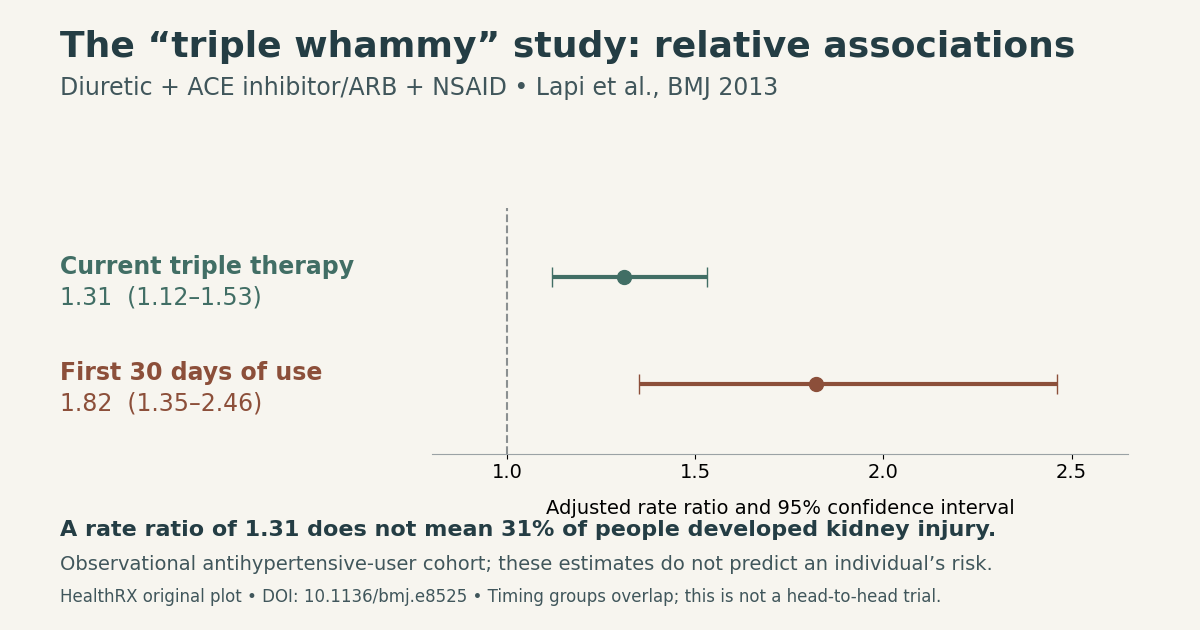
Dr. Raymond Townsend, a hypertension specialist at the University of Pennsylvania, has noted: "The combination of an ACE inhibitor, a diuretic, and an NSAID is sometimes called the 'triple whammy' because each drug independently stresses renal hemodynamics, and together they can precipitate acute kidney injury in days" [12].
A population-based study in BMJ (N=487,372) found that the triple combination of a renin-angiotensin blocker, a diuretic, and an NSAID increased acute kidney injury risk by 31% compared to the renin-angiotensin blocker alone (adjusted rate ratio 1.31 to 95% CI 1.12-1.53) [14].
Acetaminophen (Tylenol) does not share this interaction and remains the preferred analgesic for patients on lisinopril.
Alcohol and Lisinopril: Additive Blood Pressure Drops
Alcohol causes vasodilation. Lisinopril causes vasodilation. The combination produces additive hypotension, particularly during the first few weeks of treatment or after a dose increase.
The clinical effect is most pronounced with positional changes. Standing up quickly after drinking two or more alcoholic beverages while on lisinopril can produce significant orthostatic hypotension: lightheadedness, blurred vision, and in some cases syncope. The FDA label includes alcohol as a factor that may potentiate hypotension [5].
This is not an absolute contraindication. Moderate alcohol intake (one drink per day for women, up to two for men per AHA guidelines) is generally tolerable for patients on stable lisinopril doses with normal blood pressure readings [15]. The concern is binge-pattern drinking or heavy daily consumption, which also independently raises blood pressure through sympathetic activation and cortisol release during withdrawal periods.
Grapefruit, Caffeine, and Other Common Questions
Grapefruit juice inhibits intestinal CYP3A4, which affects the metabolism of many cardiovascular drugs including certain calcium channel blockers, statins, and some ARBs. Lisinopril, however, is not metabolized by CYP3A4. It is absorbed from the GI tract as-is and excreted unchanged by the kidneys [5]. There is no clinically meaningful grapefruit-lisinopril interaction, and patients do not need to avoid grapefruit.
Caffeine can transiently raise blood pressure by 5-10 mmHg in non-habitual drinkers, but tolerance develops within days of regular consumption [16]. A 2012 meta-analysis in the American Journal of Clinical Nutrition (5 RCTs, N=343 hypertensive patients) found no significant long-term blood pressure increase with habitual coffee consumption [16]. Patients on lisinopril do not need to restrict coffee intake, though those who notice blood pressure spikes may benefit from keeping consumption consistent rather than intermittent.
High-sodium diets do not directly interact with lisinopril pharmacokinetically, but they do blunt its antihypertensive efficacy. The DASH-Sodium trial demonstrated that reducing sodium from 3 to 300 mg/day to 1 to 500 mg/day produced an additional 7.1 mmHg systolic reduction in hypertensive participants [17]. For patients on lisinopril who are not reaching goal blood pressure, dietary sodium reduction is a more effective adjunct than dose escalation in many cases.
Monitoring: When and What to Check
The American College of Cardiology/American Heart Association (ACC/AHA) 2017 hypertension guideline recommends checking serum potassium and creatinine within 2-4 weeks of initiating or up-titrating an ACE inhibitor [18]. The Kidney Disease: Improving Global Outcomes (KDIGO) guidelines recommend more frequent monitoring (within 1 week) for patients with eGFR <45 or baseline potassium above 4.5 mEq/L [19].
In ALLHAT (N=33,357), the largest antihypertensive outcomes trial, lisinopril demonstrated equivalent cardiovascular outcomes to chlorthalidone over 4.9 years, though it showed a higher stroke incidence in Black participants (RR 1.40 to 95% CI 1.17-1.68) [1]. Metabolic monitoring in the trial showed that lisinopril-treated patients had lower rates of new-onset hypokalemia but higher rates of serum potassium exceeding 5.5 mEq/L compared to the diuretic arm, reinforcing the importance of potassium surveillance.
Patients should request a basic metabolic panel any time they start a new supplement, change their dietary pattern significantly, or begin a new medication (including over-the-counter NSAIDs) while on lisinopril.
Who Is at Highest Risk for Interactions
Not every patient on lisinopril faces equal interaction risk. Three populations require extra vigilance.
Patients with chronic kidney disease. Reduced GFR means reduced potassium clearance. The combination of impaired excretion and ACE inhibitor-mediated aldosterone suppression makes these patients exquisitely sensitive to dietary potassium loads and potassium-sparing supplements [19].
Older adults on polypharmacy. A patient over 65 taking lisinopril, hydrochlorothiazide, a potassium supplement "for leg cramps," ibuprofen for arthritis, and a licorice herbal tea in the evening has five simultaneous vectors pushing electrolytes and renal function in different directions. The BMJ triple-whammy data showed that patients over 75 had the highest absolute risk of acute kidney injury from NSAID-ACE inhibitor-diuretic combinations [14].
Heart failure patients on spironolactone. After the RALES trial showed a mortality benefit for adding spironolactone to ACE inhibitors in severe heart failure [7], hyperkalemia hospitalizations increased by 4-fold in one Ontario-based study (from 2.4 to 11.0 per 1,000 patients) [7]. These patients need the most careful dietary counseling and the most frequent lab monitoring.
The ACC/AHA 2022 heart failure guideline states: "Serum potassium and renal function should be checked within 1 week of initiation and after every dose change when combining RAAS inhibitors with mineralocorticoid receptor antagonists" [20].
Frequently asked questions
›Can I eat bananas while taking lisinopril?
›Does grapefruit interact with lisinopril?
›Can I take ibuprofen with lisinopril?
›What is the triple whammy drug interaction?
›Is it safe to take potassium supplements with lisinopril?
›Can I drink alcohol on lisinopril?
›Does lisinopril interact with coffee or caffeine?
›Should I avoid salt substitutes while on lisinopril?
›Does licorice interact with lisinopril?
›How does lisinopril work to lower blood pressure?
›What supplements should I avoid with lisinopril?
›How often should I get blood work on lisinopril?
References
- ALLHAT Officers and Coordinators. Major outcomes in high-risk hypertensive patients randomized to angiotensin-converting enzyme inhibitor or calcium channel blocker vs diuretic. JAMA. 2002;288(23):2981-2997. PubMed
- Reardon LC, Macpherson DS. Hyperkalemia in outpatients using angiotensin-converting enzyme inhibitors. Arch Intern Med. 1998;158(1):26-32. PubMed
- Dicpinigaitis PV. Angiotensin-converting enzyme inhibitor-induced cough: ACCP evidence-based clinical practice guidelines. Chest. 2006;129(1 Suppl):169S-173S. PubMed
- National Institutes of Health Office of Dietary Supplements. Potassium: Fact Sheet for Health Professionals. NIH
- U.S. Food and Drug Administration. Lisinopril prescribing information. FDA
- Doorenbos CJ, Vermeij CG. Danger of salt substitutes that contain potassium in patients with renal failure. BMJ. 2003;326(7379):35-36. PubMed
- Juurlink DN, Mamdani MM, Lee DS, et al. Rates of hyperkalemia after publication of the Randomized Aldactone Evaluation Study. N Engl J Med. 2004;351(6):543-551. PubMed
- Henderson L, Yue QY, Bergquist C, et al. St John's wort (Hypericum perforatum): drug interactions and clinical outcomes. Br J Clin Pharmacol. 2002;54(4):349-356. PubMed
- Farese RV Jr, Biglieri EG, Shackleton CHL, et al. Licorice-induced hypermineralocorticoidism. N Engl J Med. 1991;325(17):1223-1227. PubMed
- Miller PE, Van Elswyk M, Alexander DD. Long-chain omega-3 fatty acids eicosapentaenoic acid and docosahexaenoic acid and blood pressure: a meta-analysis of randomized controlled trials. Am J Hypertens. 2014;27(7):885-896. PubMed
- Ajayi AA, Sokomba EN, Ukponmwan OE. Possible interaction between iron and angiotensin-converting enzyme inhibitors. Afr J Med Med Sci. 2001;30(3):203-206. PubMed
- Thomas MC. Diuretics, ACE inhibitors and NSAIDs, the triple whammy. Med J Aust. 2000;172(4):184-185. PubMed
- Nissen SE, Yeomans ND, Solomon DH, et al. Cardiovascular safety of celecoxib, naproxen, or ibuprofen for arthritis. N Engl J Med. 2016;375(26):2519-2529. PubMed
- Lapi F, Azoulay L, Yin H, et al. Concurrent use of diuretics, angiotensin converting enzyme inhibitors, and angiotensin receptor blockers with non-steroidal anti-inflammatory drugs and risk of acute kidney injury: nested case-control study. BMJ. 2013;346:e8525. PubMed
- American Heart Association. Alcohol and Heart Health. AHA
- Steffen M, Kuhle C, Hensrud D, et al. The effect of coffee consumption on blood pressure and the development of hypertension: a systematic review and meta-analysis. J Hypertens. 2012;30(12):2245-2254. PubMed
- Sacks FM, Svetkey LP, Vollmer WM, et al. Effects on blood pressure of reduced dietary sodium and the Dietary Approaches to Stop Hypertension (DASH) diet. N Engl J Med. 2001;344(1):3-10. PubMed
- Whelton PK, Carey RM, Aronow WS, et al. 2017 ACC/AHA/AAPA/ABC/ACPM/AGS/APhA/ASH/ASPC/NMA/PCNA guideline for the prevention, detection, evaluation, and management of high blood pressure in adults. J Am Coll Cardiol. 2018;71(19):e127-e248. PubMed
- Kidney Disease: Improving Global Outcomes (KDIGO) Blood Pressure Work Group. KDIGO 2021 clinical practice guideline for the management of blood pressure in chronic kidney disease. Kidney Int. 2021;99(3S):S1-S87. PubMed
- Heidenreich PA, Bozkurt B, Aguilar D, et al. 2022 AHA/ACC/HFSA guideline for the management of heart failure. J Am Coll Cardiol. 2022;79(17):e263-e421. PubMed