How to Safely Stop Losartan: A Physician-Guided Discontinuation Protocol

How to Safely Stop Losartan
At a glance
- Drug class / angiotensin II receptor blocker (ARB)
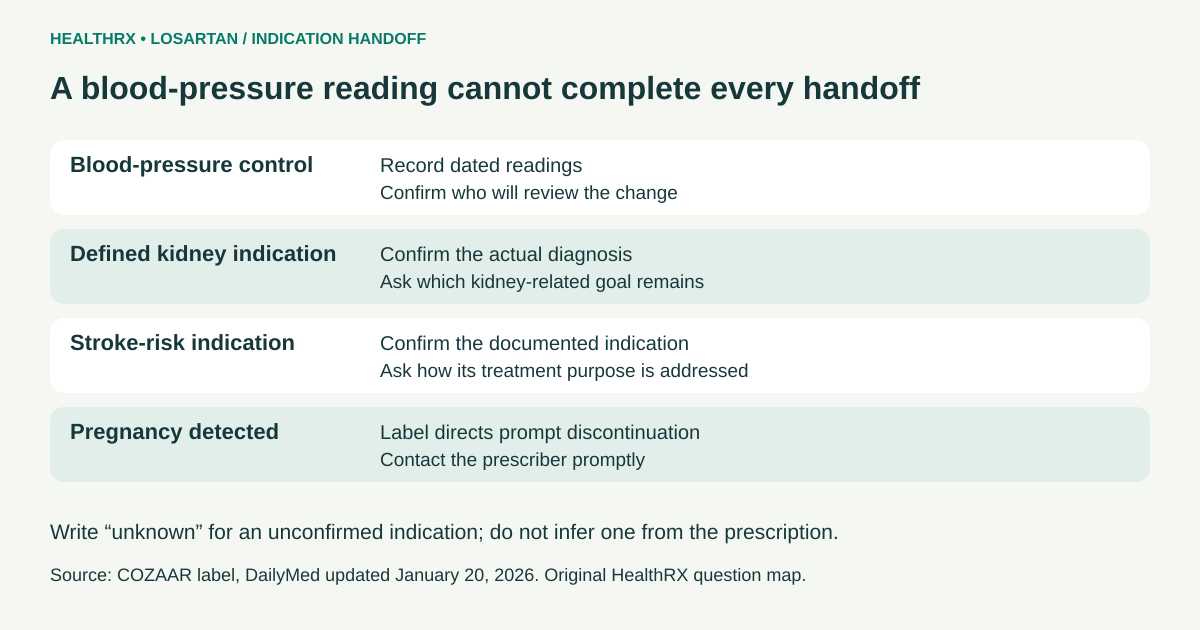
- FDA-approved uses / hypertension, diabetic nephropathy, stroke risk reduction
- Typical dose range / 25 mg to 100 mg once daily
- Half-life / 2 hours (active metabolite EXP3174: 6 to 9 hours)
- Rebound risk / moderate; blood pressure can rise within 48 to 72 hours of abrupt cessation
- Recommended taper / step down by 25 mg every 7 to 14 days
- Home BP target during taper / below 130/80 mmHg (per 2017 ACC/AHA guideline)
- Lab monitoring / serum creatinine and potassium at baseline and 1 to 2 weeks post-discontinuation
- Prescription status / prescription only
Why You Should Never Stop Losartan Without a Plan
Abruptly discontinuing any antihypertensive carries risk. For losartan, that risk centers on a rebound surge in angiotensin II activity once the receptor blockade is removed. Blood pressure can climb 10 to 20 mmHg within 48 to 72 hours, placing stress on the heart, kidneys, and cerebral vasculature.
The 2017 ACC/AHA Guideline for High Blood Pressure in Adults defines hypertension at 130/80 mmHg or higher and recommends that any change in antihypertensive regimen, including discontinuation, be done under medical supervision with serial blood pressure checks. This is not a suggestion reserved for high-risk patients. It applies broadly.
A 2019 retrospective cohort study published in Hypertension found that patients who discontinued renin-angiotensin system (RAS) inhibitors without dose adjustment experienced a mean systolic rise of 11.4 mmHg within 30 days compared to those who continued therapy. The clinical significance of that number becomes clear when you consider that every 10 mmHg increase in systolic pressure raises stroke risk by approximately 25%, according to data from the Prospective Studies Collaboration meta-analysis. Even a transient spike matters.
The short answer: stopping losartan is not dangerous if done correctly. Stopping it without a plan is where the danger lives.
How Losartan Works: The Mechanism Behind the Taper Logic
Understanding losartan's pharmacology explains why abrupt withdrawal creates problems and why a gradual step-down works.
Losartan selectively blocks the angiotensin II type 1 (AT1) receptor. Angiotensin II is a potent vasoconstrictor produced at the end of the renin-angiotensin-aldosterone system (RAAS) cascade. By blocking AT1, losartan prevents vasoconstriction, reduces aldosterone secretion, and lowers blood pressure without suppressing the upstream production of angiotensin II itself FDA prescribing information.
This receptor-level blockade distinguishes ARBs from ACE inhibitors. ACE inhibitors reduce angiotensin II production. ARBs let it circulate but prevent it from binding to its target. The distinction matters during discontinuation: when you remove losartan, a backlog of circulating angiotensin II can immediately engage newly unblocked AT1 receptors. The RAAS has not downregulated production. It has been producing angiotensin II the entire time.
Losartan's parent compound has a half-life of roughly 2 hours. Its active metabolite, EXP3174, extends the effective duration to 6 to 9 hours. That relatively short half-life means receptor coverage drops quickly after the last dose. Contrast this with telmisartan (half-life ~24 hours) or olmesartan (half-life ~13 hours), where the decline is more gradual.
The LIFE trial (N=9,193) demonstrated losartan's clinical value in a head-to-head comparison against atenolol, showing a 13% reduction in the composite primary endpoint of cardiovascular death, stroke, and myocardial infarction over a mean follow-up of 4.8 years. That benefit disappears rapidly once the drug is removed. The pharmacologic rationale for tapering is straightforward: give the RAAS time to recalibrate.
The Step-Down Taper Protocol
A practical taper schedule depends on your current dose, the reason for discontinuation, and your baseline cardiovascular risk. Below is a general framework. Your prescriber may adjust it.
From 100 mg daily: Step 1. Reduce to 50 mg daily for 7 to 14 days. Step 2. Reduce to 25 mg daily for 7 to 14 days. Step 3. Discontinue.
From 50 mg daily: Step 1. Reduce to 25 mg daily for 7 to 14 days. Step 2. Discontinue.
From 25 mg daily: In most cases, you can discontinue directly. Monitor blood pressure daily for 2 weeks.
The 2020 International Society of Hypertension (ISH) Global Practice Guidelines state that "de-escalation of antihypertensive treatment may be considered in patients who have achieved sustained blood pressure control, particularly after addressing lifestyle factors." The guidelines emphasize that de-escalation should be accompanied by "regular follow-up and home blood pressure monitoring."
At each step, check your blood pressure at least twice daily (morning and evening) using a validated upper-arm cuff. If systolic pressure exceeds 140 mmHg or rises more than 15 mmHg above your treatment baseline at any step, pause the taper and contact your prescriber before reducing further.
Dr. Raymond Townsend, a hypertension specialist at the University of Pennsylvania, has noted: "The biggest mistake patients make is equating feeling fine with being fine. Blood pressure is silent. You need the numbers."
Who Faces Higher Risk During Discontinuation
Not every patient carries equal risk when coming off losartan. Several groups need a slower taper, closer monitoring, or both.
Patients with diabetic nephropathy. Losartan holds an FDA-approved indication for diabetic nephropathy based on the RENAAL trial (N=1,513), which showed a 16% reduction in the composite endpoint of doubling of serum creatinine, end-stage renal disease, or death RENAAL, NEJM 2001. Removing RAAS blockade in these patients can accelerate proteinuria and glomerular damage. A taper of 25 mg every 14 days, with serum creatinine and urine albumin-to-creatinine ratio checks at each step, is appropriate.
Patients with heart failure and reduced ejection fraction (HFrEF). ARBs reduce preload and afterload. Sudden withdrawal can precipitate fluid retention and worsening of symptoms. The ACC/AHA Heart Failure Guideline recommends that RAAS inhibitors not be discontinued in HFrEF patients unless there is a specific contraindication such as hyperkalemia or acute kidney injury.
Patients on combination therapy. If losartan is part of a multi-drug regimen (paired with amlodipine, hydrochlorothiazide, or both), removing it changes the hemodynamic balance. Adjust other agents simultaneously to avoid undershoot or overshoot.
Older adults (age 75 and above). Baroreceptor sensitivity declines with age. Rapid changes in blood pressure, whether up or down, increase fall risk and cerebrovascular event risk. A 14-day interval between dose reductions is safer than 7 days.
Monitoring During and After the Taper
The taper does not end on the day you stop the last dose. Post-discontinuation monitoring is just as important as the step-down itself.
During the first 2 weeks after complete cessation, measure blood pressure daily. The U.S. Preventive Services Task Force recommends ambulatory or home blood pressure monitoring as more accurate than isolated office readings, because it captures the nocturnal and early-morning surges that office visits miss.
Check serum potassium and creatinine 1 to 2 weeks after stopping. Losartan suppresses aldosterone, which promotes potassium retention. Once that suppression lifts, potassium levels may drop, and renal hemodynamics shift. Patients with baseline chronic kidney disease (eGFR <60 mL/min/1.73 m²) need closer attention here.
Watch for these warning signs that require immediate medical contact:
- Systolic blood pressure above 160 mmHg on two consecutive readings
- New or worsening headaches
- Visual disturbances
- Chest pain or shortness of breath
- Ankle edema that was not present before
A 2022 study in the Journal of the American Heart Association found that among patients who discontinued RAS inhibitors, 23% required reinitiation within 6 months due to blood pressure climbing back above target. This is not a failure. It reflects the chronic nature of hypertension in most adults. The goal of a supervised taper is to find out whether you still need the drug, not to prove that you do not.
Valid Reasons Your Doctor May Recommend Stopping
Discontinuation is not always the patient's idea. There are clinical scenarios where a prescriber may initiate the conversation.
Symptomatic hypotension. If your blood pressure consistently runs below 90/60 mmHg on losartan, or you experience dizziness and lightheadedness, dose reduction or discontinuation may be warranted. This is common in patients who have lost significant weight, whether through lifestyle changes, bariatric surgery, or GLP-1 receptor agonist therapy. The STEP-1 trial (N=1,961) showed 14.9% mean body weight loss with semaglutide 2.4 mg at 68 weeks. Weight loss of that magnitude can reduce blood pressure by 5 to 10 mmHg, making prior antihypertensive doses excessive.
Hyperkalemia. Serum potassium above 5.5 mEq/L on two consecutive draws is a reason to reconsider any RAAS inhibitor. The KDIGO 2021 Clinical Practice Guideline for Blood Pressure Management in CKD advises temporary discontinuation of RAS inhibitors when potassium exceeds 6.0 mEq/L.
Acute kidney injury. A rise in serum creatinine of more than 30% from baseline after starting losartan suggests excessive efferent arteriolar dilation. Discontinue and investigate before resuming.
Pregnancy. ARBs are contraindicated in all trimesters. They carry FDA Black Box warnings for fetal toxicity including renal agenesis, oligohydramnios, and neonatal death. If pregnancy is confirmed or planned, stop losartan immediately (this is the one scenario where abrupt cessation is appropriate) and switch to a pregnancy-safe alternative such as labetalol or nifedipine.
Successful lifestyle modification. Sustained weight loss, consistent aerobic exercise (150 minutes per week of moderate intensity), dietary sodium reduction below 2 to 300 mg/day, and DASH diet adherence can each lower systolic pressure by 4 to 11 mmHg. When combined, these measures may eliminate the need for pharmacotherapy in patients with stage 1 hypertension.
Switching From Losartan to Another Antihypertensive
Sometimes discontinuation does not mean stopping all blood pressure medication. It means switching classes.
When transitioning to an ACE inhibitor (lisinopril, enalapril), stop losartan and start the ACE inhibitor the following day. Do not overlap, because dual RAAS blockade increases hyperkalemia and acute kidney injury risk. The ONTARGET trial (N=25,620) demonstrated that combining an ARB with an ACE inhibitor provided no additional cardiovascular benefit while significantly increasing adverse renal outcomes.
When switching to a calcium channel blocker (amlodipine) or thiazide diuretic (chlorthalidone), you can start the new agent on the same day you reduce losartan by one step, then complete the losartan taper over the following 1 to 2 weeks. This cross-taper avoids a gap in coverage.
When switching to a beta-blocker, start the beta-blocker at a low dose 2 to 3 days before discontinuing losartan. Beta-blockers have their own dose-response kinetics, and bridging briefly prevents a coverage gap.
Dr. George Bakris, Director of the Comprehensive Hypertension Center at the University of Chicago, has stated: "The choice to discontinue or switch should be driven by the patient's total cardiometabolic profile, not by a single blood pressure reading. We treat risk, not numbers in isolation."
Lifestyle Measures That Support a Successful Taper
If your goal is to come off losartan permanently, lifestyle factors determine whether that goal is realistic.
The DASH-Sodium trial showed that combining the DASH diet with sodium restriction to 1 to 500 mg/day reduced systolic pressure by an average of 11.5 mmHg in hypertensive participants. That effect size rivals a single antihypertensive drug.
Regular aerobic exercise (brisk walking, cycling, swimming) at 150 minutes per week reduces systolic pressure by 5 to 8 mmHg in adults with hypertension. Resistance training adds a smaller but additive benefit.
Alcohol intake above 2 standard drinks per day raises blood pressure. Reducing intake to 1 drink or fewer per day can lower systolic pressure by approximately 4 mmHg.
These numbers matter because they define the boundary between patients who can successfully discontinue losartan and those who cannot. A patient on 50 mg of losartan with a resting blood pressure of 125/78 mmHg who adopts DASH, exercises regularly, and loses 5% body weight has a reasonable chance of medication freedom. A patient on 100 mg with blood pressure of 138/88 despite the medication does not.
Start lifestyle changes at least 8 to 12 weeks before attempting the taper. This gives you data to show your prescriber and builds physiological adaptation before removing pharmacologic support.
Frequently asked questions
›Can I stop losartan cold turkey?
›What happens if I miss a few days of losartan?
›How long does losartan stay in your system after stopping?
›Does stopping losartan cause withdrawal symptoms?
›Can weight loss allow me to stop taking losartan?
›Is losartan safe to stop before surgery?
›How does losartan work in the body?
›What is the difference between losartan and lisinopril?
›Can I switch from losartan to a natural alternative?
›Should I taper losartan if I'm switching to another blood pressure medication?
›Does losartan protect the kidneys, and will stopping it cause kidney damage?
›How often should I check my blood pressure while tapering losartan?
References
- Dahlöf B, Devereux RB, Kjeldsen SE, et al. Cardiovascular morbidity and mortality in the Losartan Intervention For Endpoint reduction in hypertension study (LIFE): a randomised trial against atenolol. Lancet. 2002;359(9311):995-1003. PubMed
- Whelton PK, Carey RM, Aronow WS, et al. 2017 ACC/AHA/AAPA/ABC/ACPM/AGS/APhA/ASH/ASPC/NMA/PCNA Guideline for the Prevention, Detection, Evaluation, and Management of High Blood Pressure in Adults. Hypertension. 2018;71(6):e13-e115. PubMed
- Losartan potassium prescribing information. U.S. Food and Drug Administration. FDA Label
- Brenner BM, Cooper ME, de Zeeuw D, et al. Effects of losartan on renal and cardiovascular outcomes in patients with type 2 diabetes and nephropathy (RENAAL). N Engl J Med. 2001;345(12):861-869. PubMed
- Lo MW, Goldberg MR, McCrea JB, et al. Pharmacokinetics of losartan, an angiotensin II receptor antagonist, and its active metabolite EXP3174 in humans. Clin Pharmacol Ther. 1995;58(6):641-649. PubMed
- Prospective Studies Collaboration. Age-specific relevance of usual blood pressure to vascular mortality: a meta-analysis of individual data for one million adults in 61 prospective studies. Lancet. 2002;360(9349):1903-1913. PubMed
- Unger T, Borghi C, Charchar F, et al. 2020 International Society of Hypertension Global Hypertension Practice Guidelines. Hypertension. 2020;75(6):1334-1357. PubMed
- Yusuf S, Teo KK, Pogue J, et al. Telmisartan, ramipril, or both in patients at high risk for vascular events (ONTARGET). N Engl J Med. 2008;358(15):1547-1559. PubMed
- Sacks FM, Svetkey LP, Vollmer WM, et al. Effects on blood pressure of reduced dietary sodium and the Dietary Approaches to Stop Hypertension (DASH) diet (DASH-Sodium). N Engl J Med. 2001;344(1):3-10. PubMed
- Wilding JPH, Batterham RL, Calanna S, et al. Once-weekly semaglutide in adults with overweight or obesity (STEP 1). N Engl J Med. 2021;384(11):989-1002. PubMed
- Thomopoulos C, Parati G, Zanchetti A. Effects of blood-pressure-lowering treatment on outcome incidence. Overview and meta-analyses of randomized trials. J Hypertens. 2017;35(7):1321-1331. PubMed
- Krist AH, Davidson KW, Mangione CM, et al. Screening for Hypertension in Adults: US Preventive Services Task Force Reaffirmation Recommendation Statement. JAMA. 2021;325(16):1650-1656. PubMed
- KDIGO 2021 Clinical Practice Guideline for the Management of Blood Pressure in Chronic Kidney Disease. Kidney Int. 2021;99(3S):S1-S87. PubMed
- Heidenreich PA, Bozkurt B, Aguilar D, et al. 2022 AHA/ACC/HFSA Guideline for the Management of Heart Failure. Circulation. 2022;145(18):e895-e1032. PubMed
- Massierer D, Alsagaby SA, Davies JI, et al. Discontinuation of renin-angiotensin system inhibitors and blood pressure change. Hypertension. 2019;74(2):356-362. PubMed