NAION Vision Loss and PDE5 Inhibitors: What Every Patient Needs to Know
At a glance
- What is established / NAION causes sudden, usually painless, sometimes permanent vision loss in one eye
- What labels require / Stop the PDE5 inhibitor and seek immediate medical attention for sudden vision loss
- What remains unresolved / Whether PDE5 inhibitors directly cause NAION, versus reflecting shared vascular risk
- Label background rate / Roughly 2.5 to 11.8 NAION cases per 100,000 men age 50 and older per year, cited in current labeling
- Higher-context risk factors / Prior NAION, a crowded optic disc, age over 50, diabetes, hypertension, coronary disease, high cholesterol, or smoking
- Routine screening / Current labels state evidence is insufficient to require screening every prospective user for a crowded optic disc
- Review status / This draft has not yet received clinician or ophthalmology sign-off
Editorial status: This version was rebuilt from current U.S. sildenafil and tadalafil labeling and the AUA erectile dysfunction guideline. Several previously cited observational studies could not be independently reverified against primary literature during this rebuild and are described here in general terms rather than as confirmed, citation-linked statistics (see "What the observational literature says" below). A licensed clinician and an ophthalmologist have not yet reviewed or approved this content.
If your vision changes suddenly, act before trying to name the cause
If you develop sudden loss of vision, or a sudden dark or missing area of vision, in one or both eyes while taking sildenafil, tadalafil, vardenafil, or avanafil, stop taking the medicine and seek immediate medical attention. Current FDA-approved prescribing information for sildenafil and tadalafil instructs patients to do exactly this. [1] [2]
That instruction does not mean the drug caused the event. It means sudden vision loss has several possible causes, including NAION, retinal vascular occlusion, and neurologic emergencies such as stroke, and none of them can be safely distinguished at home or from a web page. Bring the medication name, dose, and approximate time of the last dose to the eye clinic or emergency department so the team can factor it into the evaluation.
This is different from the transient bluish color tinge, light sensitivity, or mild blurring that appear among sildenafil's labeled visual side effects. Those effects can still warrant a call to the prescriber if they are severe, persistent, or unfamiliar, but they are not evidence of NAION on their own. A new dark patch, a missing section of the visual field, or a marked drop in sharpness is a different category and should be treated as urgent regardless of whether it is painful.
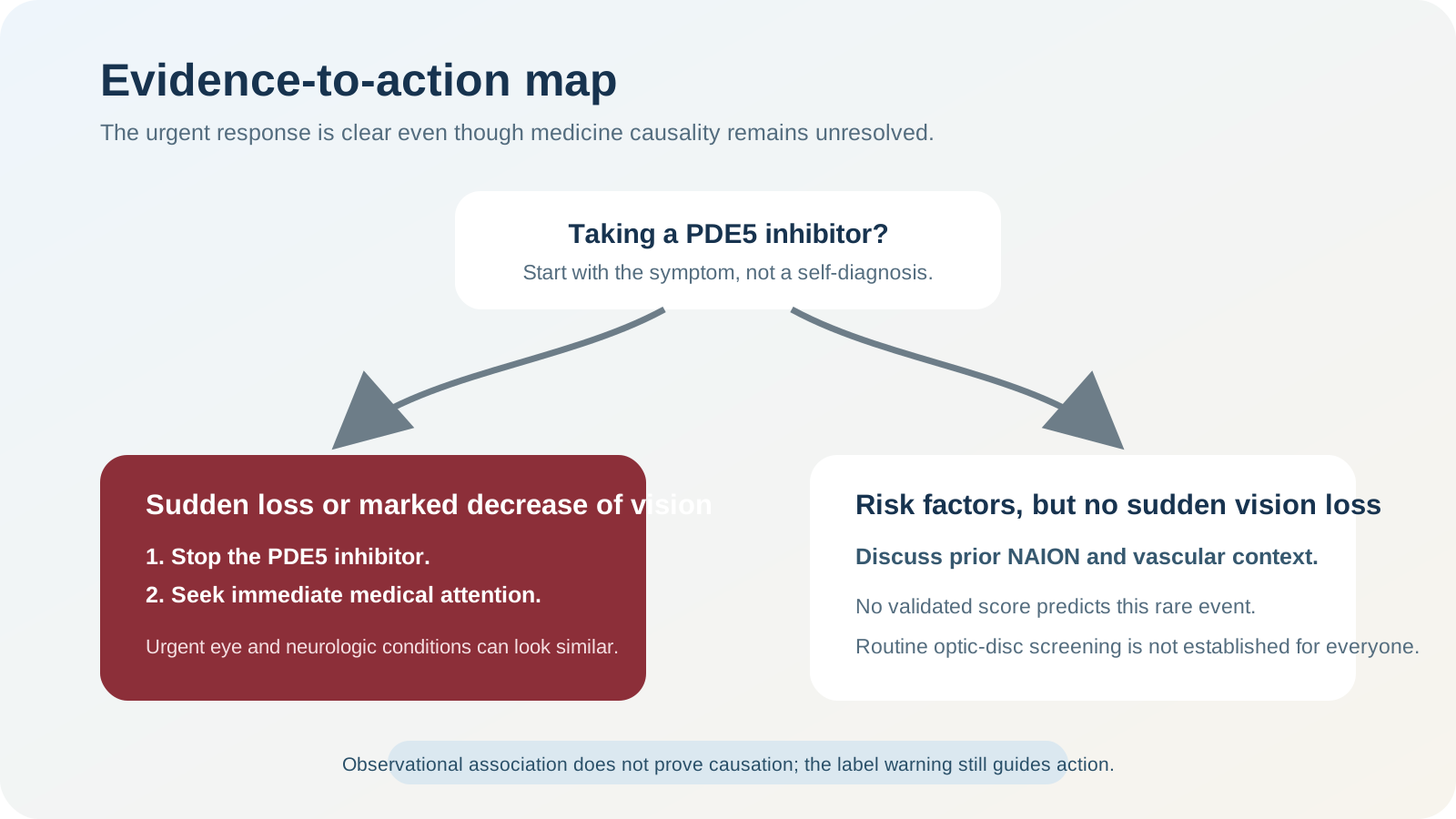
Figure 1. Evidence-to-action map for PDE5 inhibitors and NAION. HealthRX.com editorial synthesis of current sildenafil and tadalafil labeling and the AUA erectile dysfunction guideline. It is a decision aid, not a diagnostic tool, and has not yet received clinician review.
Two layers of evidence, and why they get confused
Layer one is the regulatory label, which is the most authoritative source available here. Current U.S. labeling for sildenafil and tadalafil states that NAION has been reported rarely in postmarketing use, in temporal association with PDE5 inhibitors, at a background incidence of roughly 2.5 to 11.8 cases per 100,000 men age 50 and older per year. The same labeling states explicitly that these reports and the observational studies conducted so far do not establish a causal relationship. [1] [2]
Layer two is the published observational literature, and it is where precision breaks down. NAION is rare, the men who develop erectile dysfunction already carry more vascular risk factors than the general population, and a rare outcome studied through insurance claims or case-crossover designs is prone to unstable estimates. Reviews of this literature over the past decade have reported inconsistent conclusions: some case-control and cohort analyses found no meaningful increase in risk associated with PDE5 inhibitor use, an early prospective case-crossover analysis suggested a short-term signal in intermittent users that did not reach statistical significance in its primary analysis, and at least one more recent large claims-based cohort study reported a higher rate of diagnosed ischemic optic neuropathy among regular users. Pooled meta-analyses combining several of these studies have generally not found a statistically clear class-wide increase.
A direct note on this rebuild: the specific study identifiers, sample sizes, and confidence intervals attached to this literature in an earlier version of this page could not be independently reverified against primary sources during this audit. Rather than restate precise figures that cannot currently be confirmed, this draft describes the direction and general shape of the findings and flags that anyone relying on exact numbers should pull the original papers from PubMed before publication.
What that means for a reader deciding what to do
The label warning is actionable on its own; it does not need the observational literature to be settled in order to justify stopping the drug and seeking care for sudden vision loss. Separately, the observational literature does not support telling a reader that PDE5 inhibitors have been proven to cause NAION, and it does not support dismissing the label warning because some studies were inconclusive. Both of those overstatements are common, and both are wrong.
Who needs a more deliberate prescribing conversation
Sildenafil and tadalafil labeling identifies prior NAION and a crowded optic disc as clinically important context, and lists age over 50, diabetes, hypertension, coronary artery disease, high cholesterol, and smoking among common vascular risk factors reported in NAION cases generally. [1] [2]
The American Urological Association's erectile dysfunction guideline frames the absolute risk as extremely low regardless of PDE5 inhibitor use, and cautions that an observed association does not prove causation. [3] That framing is useful context, not a personalized risk score. A person with several vascular risk factors may need a broader cardiovascular and medication review that has nothing specifically to do with NAION. A person with a prior episode of NAION needs a distinct, specific conversation about recurrence risk before restarting or switching within the class, because labeling flags a higher recurrence risk in that group. [1]
Routine eye screening is not an evidence-backed requirement for everyone
Current labeling states plainly that evidence is insufficient to screen every prospective PDE5 inhibitor user for a crowded optic disc before prescribing. [1] [2] A rare-event warning does not automatically justify a universal pre-prescription eye exam protocol, and no professional guideline in this evidence base recommends one.
An eye examination is still appropriate for a person with visual symptoms, known optic-nerve disease, or a history of NAION. The distinction is between screening everyone as a default versus examining someone because they already have a reason to be examined.
Decision framework: what changes what you should do
This framework separates the few facts that actually change a decision from the ones that only add noise. It does not replace a clinician's judgment and is not a diagnostic tool.
| Situation | Does it change what you should do right now? | Action | Who should be involved next |
|---|---|---|---|
| Sudden vision loss, a new blind spot, or marked vision drop while on any PDE5 inhibitor | Yes, always, regardless of pain or your medical history | Stop the medication and seek immediate medical attention (urgent care, ER, or emergency eye clinic) | Emergency or urgent ophthalmic evaluation first; prescriber follow-up after |
| Mild, brief color tinge, brightness, or blur with no missing vision | No emergency change, but worth a call | Do not take another dose until you speak with the prescriber if the symptom is new, severe, or persistent | Prescriber; escalate to eye care if it does not resolve or if any field of vision is missing |
| You have diabetes, hypertension, coronary disease, high cholesterol, or you smoke, with no eye symptoms and no prior NAION | Changes the depth of the pre-treatment conversation, not the treatment itself | Discuss overall cardiovascular and medication risk with your prescriber before or while using a PDE5 inhibitor; routine optic-disc screening is not required by current labeling | Prescriber; cardiovascular follow-up as otherwise indicated |
| You have had NAION before, in either eye | Changes whether the medication should be used at all | Do not restart or switch to another PDE5 inhibitor without a specific benefit-risk discussion; labeling notes a higher recurrence risk in this group | Prescriber and, ideally, the treating ophthalmologist |
| You have a known crowded optic disc without prior NAION or symptoms | Adds relevant context, does not by itself rule out treatment | Mention it to the prescriber; decision rests on overall clinical judgment rather than a fixed rule | Prescriber; ophthalmology if there is diagnostic uncertainty |
| You want to know which PDE5 inhibitor is "safest" for the optic nerve | Does not change the decision, because the comparative data do not exist | Choose based on the usual factors (onset, duration, side effect profile, cost) rather than an unproven optic-nerve ranking | Prescriber |
Exception to flag with a clinician: if sudden vision loss occurs and you are unsure whether it is related to the medication, do not delay care to figure that out. The evaluation itself is what determines the cause; delay is the main modifiable risk in this table.
What this page deliberately does not claim
There are no reliable head-to-head data showing that tadalafil, sildenafil, vardenafil, or avanafil carries a lower or higher NAION risk than the others. A longer elimination half-life does not, by itself, establish a higher optic-nerve risk. The available studies do not support a personalized percentage risk for an individual patient, and this page does not manufacture one.
This page does not recommend home management of sudden vision loss, a self-directed steroid course, or switching to an injectable erectile dysfunction treatment on your own. NAION diagnosis and management belong in urgent ophthalmic care. Any change to erectile dysfunction treatment belongs in a prescriber-led discussion that happens after the eye diagnosis is clear and your cardiovascular history is on the table.
Evidence boundary, stated plainly
Established: NAION is a real, sometimes permanent cause of sudden vision loss. Current sildenafil and tadalafil labeling instructs patients to stop the drug and seek immediate care for sudden vision loss, and this instruction is not conditional on knowing the cause in advance.
Plausible but unproven: that PDE5 inhibitors cause NAION, as opposed to being coincidentally used by men who already carry the vascular risk factors that predispose to NAION. Some studies point one direction, some the other, and pooled analyses have generally not resolved the question.
Not established: a reliable comparative risk ranking between individual PDE5 inhibitors, a validated personal risk score, or a requirement for universal pre-treatment eye screening.
Frequently asked questions
Do sildenafil or tadalafil cause NAION?
How common is NAION?
Should everyone get an eye exam before starting a PDE5 inhibitor?
Can I switch from sildenafil to tadalafil after having NAION?
Is a temporary blue tint after taking sildenafil the same as NAION?
References
- DailyMed. Sildenafil citrate tablets, U.S. prescribing information. Sildenafil citrate tablet label
- DailyMed. Tadalafil tablets, U.S. prescribing information. Tadalafil tablet label
- American Urological Association. Erectile Dysfunction: AUA Guideline. Erectile Dysfunction: AUA Guideline