Daily Testosterone Injections: What Weekly Studies Can Actually Tell Us
Daily testosterone injections are sometimes presented as a way to achieve steadier levels. Smaller, more frequent injections may alter fluctuations, but that possibility does not establish better symptoms, fewer adverse effects, or an ideal daily dose. The evidence discussed here includes weekly studies and one retrospective report combining daily testosterone with two other medications. Those designs answer different questions.[3–5]
The central issue is attribution: did an outcome reflect injection frequency, the route, the testosterone ester, total exposure, or another medication? Lab timing also matters. A weekly trough measurement cannot describe every level during that week.
What the product labels establish
Depo-Testosterone is labeled for intramuscular testosterone cypionate. Its broad labeled replacement range is 50–400 mg every two to four weeks. That range is product-label information, not a personal starting recommendation. The label does not establish daily subcutaneous dosing.[1]
Xyosted is a single-dose testosterone enanthate autoinjector for once-weekly subcutaneous injection into the abdomen. Its instructions explicitly specify weekly use; the device is not intended for reuse or division into daily injections. These device-specific instructions should not be treated as instructions for every testosterone vial.[2]
Neither label validates a universal daily microdosing schedule. Product, ester, route, and delivery device need to remain distinct when interpreting claims about daily treatment.[1,2]
Map the study before interpreting the result
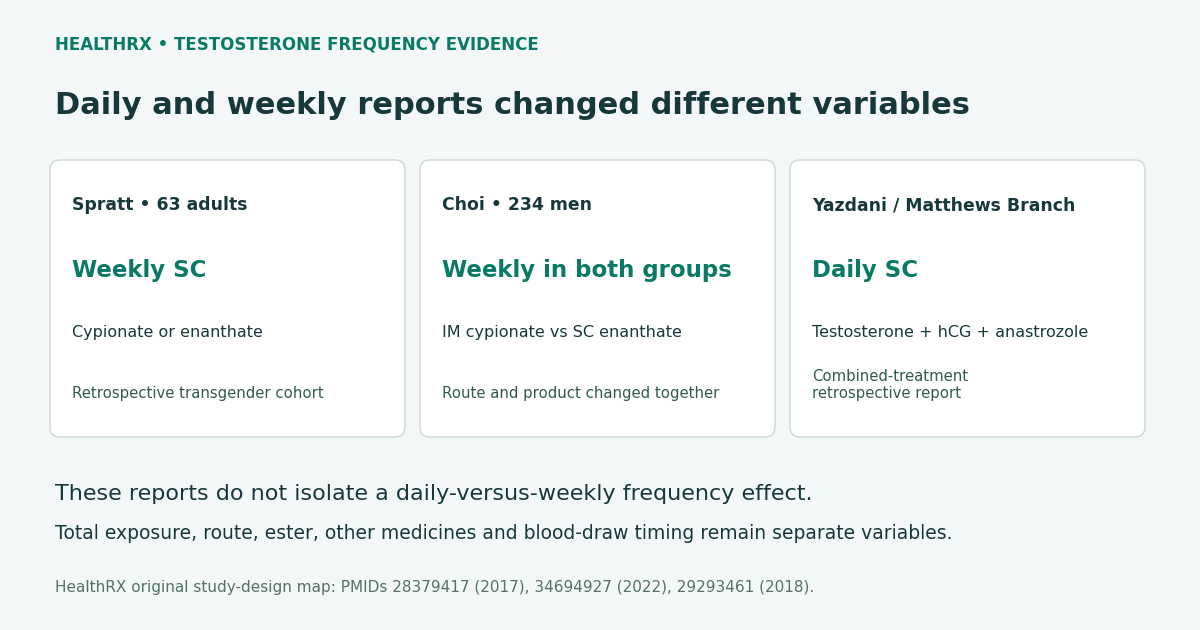
A study can support the regimen it examined without proving that another frequency produces the same result. The following map separates the actual schedules from the factors that prevent a clean daily-versus-weekly conclusion.
| Study | Frequency examined | What else changed or accompanied treatment | Main interpretive boundary |
|---|---|---|---|
| Spratt, 2017 | Weekly subcutaneous testosterone | Cypionate or enanthate; doses adjusted during treatment; some participants previously used intramuscular injections | Retrospective masculinizing-therapy study, not a randomized daily trial in hypogonadal men |
| Choi, 2022 | Weekly in both groups | Intramuscular cypionate versus subcutaneous enanthate autoinjector | Route, ester, and delivery system differed; frequency did not |
| Yazdani and Matthews Branch, 2018 | Daily subcutaneous testosterone | hCG and anastrozole were used alongside testosterone | Cannot isolate daily frequency from the combined regimen |
All three studies are relevant, but none isolates the clinical benefit of daily testosterone injections against an otherwise identical weekly regimen.[3–5]
Weekly subcutaneous evidence
Spratt and colleagues retrospectively studied 63 adults receiving masculinizing therapy. Weekly subcutaneous cypionate or enanthate began at 50 mg and was adjusted within 50–150 mg. All 63 achieved testosterone levels in the normal male range. Among 22 participants who had previously used intramuscular injections, all preferred subcutaneous administration after switching.[3]
This supports weekly subcutaneous use in the studied setting. It does not establish a universal subcutaneous starting dose, demonstrate daily superiority, or substitute for a randomized trial in hypogonadal men. Preference is also a different outcome from hormone control or long-term safety.
The weekly route-and-ester comparison
Choi and colleagues compared 234 hypogonadal men over 12 weeks: 100 mg weekly intramuscular cypionate versus 100 mg weekly subcutaneous enanthate by autoinjector. Total testosterone troughs increased from 313.6 to 536.4 ng/dL and from 246.6 to 552.8 ng/dL, respectively. The adjusted total testosterone difference had P=.057. Subcutaneous treatment was associated with lower estradiol and hematocrit, both P<.001.[4]
This was not a randomized daily-frequency comparison. Because route, ester, and delivery system differed, the associations cannot establish that daily injections lower estradiol or hematocrit, or guarantee safety.
The daily combination report
The retrospective report by Yazdani and Matthews Branch used daily subcutaneous testosterone together with hCG and anastrozole and reported increased testosterone levels. Its abstract does not provide a cohort size or dose and does not isolate the effect of frequency.[5]
That limitation is decisive. Results from the combination cannot establish what daily testosterone alone would do. Nor can the report justify routinely adding hCG or anastrozole, or claim that testosterone-only daily treatment preserves fertility.
Keep an exact regimen and measurement record
The details below are evidence records, not dosing instructions. They help distinguish what was administered from what was measured—and show where the available information stops.
| Record before and after a schedule change | What it helps distinguish |
|---|---|
| Exact product, ester, vial or autoinjector, concentration and route | A frequency change from a formulation or delivery change |
| Prescribed amount per administration and total over the same seven-day period | Smaller individual injections from a lower total exposure |
| Actual injection dates, missed doses and blood-collection time | A trough, mid-interval sample or other measurement position |
| hCG, anastrozole and any other medicine added, stopped or changed | Frequency effects from a combined-treatment change |
| Target symptoms and their dated response | A laboratory change from a meaningful treatment outcome |
| Hematocrit and other clinician-selected monitoring with collection dates | A scheduling preference from an assessed safety finding |
The record reflects the product and study boundaries above and the guideline's monitoring priorities. [1–6]
For a before-and-after lab comparison, record the product, ester, route, total dose over the same time interval, frequency, accompanying medications, and time between the last injection and blood collection. If several factors change together, a changed result cannot confidently be assigned to frequency alone. The weekly trough findings above should remain identified as trough findings, rather than being described as average or continuously stable levels.[4]
Steadier levels are not a complete treatment outcome
More frequent administration of a long-acting ester does not recreate the body's endogenous daily testosterone rhythm. Even if smaller injections alter fluctuations, the studies discussed here do not establish a direct clinical advantage for daily treatment. Total exposure and the measurement schedule remain important to interpretation.
Estradiol and hematocrit likewise cannot be reduced to a scheduling promise. Choi's associations concern two different weekly formulations. The daily report included anastrozole, which prevents attributing its findings to testosterone frequency alone.[4,5]
An estradiol number needs clinical context; these sources provide no fixed threshold for automatically adding anastrozole. Daily treatment also does not establish fertility protection. Testosterone-related fertility suppression remains possible at every frequency.[5,6]
What guideline-based assessment adds
The Endocrine Society guideline supports diagnosis based on symptoms plus consistently low morning testosterone. Treatment aims for the mid-normal range, with monitoring of response, adverse effects, testosterone, and hematocrit. It advises against starting testosterone when near-term fertility is planned or hematocrit is elevated. It does not supply a standardized daily schedule or an automatic anastrozole threshold.[6]
A useful before-and-after comparison keeps the exposure and blood-draw timing visible. If several parts of the regimen changed, the result cannot establish that frequency caused the difference.
Frequently asked questions
Is daily testosterone microdosing FDA approved?
The product labels do not establish an approved daily microdosing schedule. Depo-Testosterone specifies intramuscular cypionate; Xyosted specifies once-weekly subcutaneous enanthate.[1,2]
What is the standard daily TRT dose?
These sources establish no standard daily dose. The weekly study regimens and broad Depo-Testosterone label range should not be converted into personal daily instructions.[1,3,4]
Is subcutaneous testosterone supported by evidence?
Yes, for the weekly regimens studied and the labeled Xyosted product. That support does not establish equivalent evidence for daily treatment or every formulation.[2–4]
Does daily dosing eliminate peaks and troughs?
That is not established. Smaller injections may alter fluctuations, but these studies do not prove their elimination or show that daily injections recreate endogenous diurnal rhythms.[3–5]
Will daily injections prevent high estradiol?
No prevention claim is supported. Lower estradiol was associated with one weekly formulation comparison; the daily report also used anastrozole.[4,5]
Should anastrozole be added above a certain estradiol number?
These sources provide no automatic numerical threshold. An estradiol result needs clinical context; the combination report does not establish a routine anastrozole regimen.[5,6]
Does daily dosing prevent high hematocrit?
That has not been demonstrated. Choi compared weekly treatments, while the guideline calls for hematocrit monitoring rather than relying on injection frequency for protection.[4,6]
Does daily TRT preserve fertility?
Daily dosing does not establish protection from fertility suppression. The daily report included hCG; the guideline advises against starting testosterone when near-term fertility is planned.[5,6]
Can Xyosted be divided into daily doses?
No. Its instructions specify a single-dose autoinjector used once weekly, not device reuse or division into daily doses.[2]
How should labs be compared after a frequency change?
Compare documented regimens and injection-to-blood-draw timing. Record total exposure, route, ester, and co-medications; a trough should not be treated as an average level.[3–5]
References
Sources checked October 14, 2026.
References
- DailyMed: Depo-Testosterone prescribing information.
- DailyMed: Xyosted prescribing information.
- Spratt et al. (2017): Weekly subcutaneous testosterone in masculinizing therapy.
- Choi et al. (2022): Intramuscular cypionate versus subcutaneous enanthate autoinjector.
- Yazdani and Matthews Branch (2018): Daily subcutaneous testosterone with hCG and anastrozole.
- Bhasin et al. (2018). Testosterone Therapy in Men With Hypogonadism: An Endocrine Society Clinical Practice Guideline. Full guideline; PubMed.