Dose Titration for TRT: How to Find Your Optimal Testosterone Dose

Hormone therapy clinical care image for Dose Titration for TRT: How to Find Your Optimal Testosterone Dose

At a glance

  • Starting dose / testosterone cypionate or enanthate 100 mg per week (50 mg twice weekly or 20 mg daily)
  • First lab check / 6-to-8 weeks after initiating or changing dose
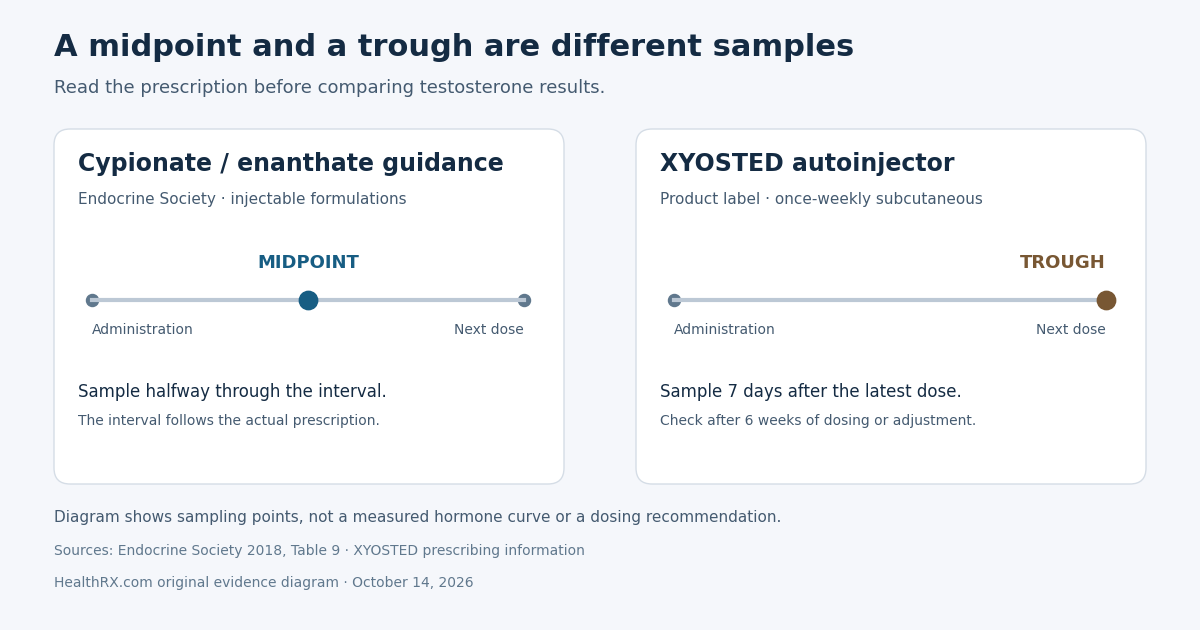
  • Target trough total testosterone / 500-900 ng/dL per Endocrine Society 2018 guideline
  • Target hematocrit ceiling / below 52% (dose reduction or phlebotomy above this threshold)
  • Titration increment / 10-20 mg per week; allow one full half-life cycle before re-checking
  • IM vs SubQ / both deliver equivalent steady-state testosterone; SubQ produces lower peak-to-trough swing
  • Daily microdosing / 14-20 mg per day SubQ yields the flattest serum curve
  • Injection needles / 25-27 gauge 5/8-inch for SubQ; 23-25 gauge 1-1.5-inch for IM
  • Time to stable trough / approximately 5 half-lives, roughly 5-6 weeks for cypionate
  • Estradiol monitoring / check sensitive LC-MS/MS assay at each titration visit; target 20-40 pg/mL

What Is TRT Dose Titration and Why Does It Matter?

Dose titration means adjusting testosterone dose based on measured serum levels and clinical response rather than applying a single fixed protocol to every patient. It matters because testosterone pharmacokinetics vary by roughly two- to three-fold between individuals of similar weight, driven by differences in SHBG, injection depth, adipose thickness, and CYP enzyme activity. A dose that puts one man at 650 ng/dL trough may push another to 1 to 100 ng/dL with polycythemia.

The Endocrine Society's 2018 Clinical Practice Guideline on testosterone therapy states: "We suggest titrating the testosterone dose to achieve a mid-normal range serum testosterone concentration" [1]. That mid-normal target is generally 400-700 ng/dL on a trough draw or 500-900 ng/dL as a practical clinical window, depending on the formulation timing. Getting this right protects against both under-treatment (persistent hypogonadal symptoms, osteopenia risk) and over-treatment (erythrocytosis, cardiovascular strain, suppression of spermatogenesis).

Erythrocytosis is the most common dose-dependent adverse event. A 2022 meta-analysis in the Journal of Clinical Endocrinology and Metabolism examining 35 randomized controlled trials found that testosterone therapy increased hemoglobin by a mean of 0.94 g/dL (95% CI 0.77-1.11) compared with placebo [2]. That shift is clinically significant when baseline hematocrit starts near 48%.

Standard TRT Protocol: The Starting Dose and Schedule

The conventional weekly-injection protocol uses 100 mg of testosterone cypionate or testosterone enanthate injected once every seven days, though twice-weekly splitting (50 mg every 3.5 days) reduces peak-to-trough hormone swings and minimizes estradiol spikes that can cause water retention or gynecomastia. Twice-weekly dosing is now the default recommendation at most U.S. TRT clinics.

Testosterone cypionate carries a half-life of approximately 8 days; testosterone enanthate sits at roughly 4.5 days [3]. Because steady state requires about five half-lives, labs drawn before that point will underestimate the final trough. The practical consequence: draw the first titration labs no sooner than six weeks after starting or changing a dose. Drawing at four weeks is a common protocol error that produces falsely low trough values and drives unnecessary dose increases.

Standard first titration panel includes:

  • Total testosterone (trough, drawn the morning of the next scheduled injection)
  • Free testosterone (equilibrium dialysis method preferred)
  • Estradiol (sensitive LC-MS/MS assay, not immunoassay)
  • Complete blood count with hematocrit
  • PSA (men 40 and older or those with prostate history)
  • LH and FSH (only if fertility preservation is a concern)

The American Urological Association's 2022 guideline on testosterone deficiency notes that physicians should obtain baseline testosterone levels on at least two separate morning occasions before initiating therapy [4]. That same standard of reproducibility applies during titration: a single abnormal lab does not trigger a dose change if symptoms and other markers are inconsistent.

How to Adjust the Dose: The Titration Algorithm

Adjustments should be methodical. Each step up or down involves changing the weekly dose by 10-20 mg, then waiting another 6-8 weeks before reassessing. Jumping from 100 mg to 200 mg in one step is rarely appropriate and greatly increases erythrocytosis risk.

HealthRX Titration Framework for Testosterone Cypionate or Enanthate:

  1. Week 0. Initiate at 100 mg per week (split as 50 mg twice weekly SubQ or 50 mg twice weekly IM).
  2. Week 6-8. Draw trough labs the morning of the next injection, before injecting. Assess total testosterone, free testosterone, estradiol, CBC, PSA.
    • Trough <400 ng/dL and symptoms persist: increase by 20 mg per week (to 120 mg).
    • Trough 400-900 ng/dL with symptom relief: maintain current dose.
    • Trough >900 ng/dL or hematocrit >52%: decrease by 20 mg per week or lengthen interval.
  3. Week 14-16. Repeat panel if dose was changed in step 2. If stable, move to every-90-day monitoring.
  4. Week 26+. Annual CBC, PSA, metabolic panel. Titrate only if symptoms re-emerge or labs drift outside window.

Dose increases for symptomatic hypogonadism with a trough below 400 ng/dL are straightforward. The harder clinical decision is what to do when a man has a trough of 850 ng/dL but still reports fatigue. Before increasing the dose, the workup should rule out sleep apnea, thyroid dysfunction, low ferritin, and elevated SHBG (which reduces free testosterone even when total testosterone appears adequate). Free testosterone below 50 pg/mL on equilibrium dialysis in a symptomatic man may justify a modest dose increase even when total testosterone looks acceptable.

Estradiol management sits alongside dose titration. Testosterone converts to estradiol through aromatase, predominantly in adipose tissue. Men with higher body fat will aromatize more per milligram of testosterone. A sensitive estradiol above 42 pg/mL with symptoms of excess estrogen (nipple tenderness, water retention, emotional lability) may prompt a discussion about adjunctive anastrozole, though many TRT clinicians prefer to first try reducing the testosterone dose or increasing injection frequency rather than adding an aromatase inhibitor [1].

Daily Microdosing: The Case for Smaller, More Frequent Injections

Daily subcutaneous microdosing uses 14-20 mg of testosterone cypionate or enanthate per day, typically drawn into a 0.3 mL insulin syringe and injected into abdominal or thigh adipose tissue. Total weekly dose stays similar (roughly 100-140 mg per week), but the pharmacokinetic curve flattens dramatically.

A 2021 pharmacokinetic study published in Andrology compared daily SubQ testosterone (mean 16 mg per day) with once-weekly IM injections at equivalent total weekly dose in 44 men with hypogonadism. Daily SubQ produced a coefficient of variation for serum testosterone of 12% versus 41% for weekly IM, meaning testosterone levels stayed considerably more stable throughout the week [5]. Estradiol excursions were proportionally smaller as well, which may reduce the need for aromatase inhibitor co-prescription in men who are sensitive to estrogen peaks.

Daily dosing has practical drawbacks. Needle fatigue is real. Some men sustain adherence with daily injections for 90 days then taper frequency back to twice weekly. An intermediate option is every-other-day injections (roughly 25-30 mg per dose), which captures most of the pharmacokinetic benefit of daily dosing with half the injection events.

When titrating a daily protocol, target a steady-state trough (drawn before the morning injection) of 500-750 ng/dL. Because the peak-to-trough swing is so small, the trough value closely approximates the average daily level. That makes dose adjustments more precise than with weekly IM protocols, where the trough may be 300 ng/dL even when the 48-hour post-injection peak was 1 to 200 ng/dL.

Intramuscular vs Subcutaneous: Which Route Is Right for Your Protocol?

Both intramuscular (IM) and subcutaneous (SubQ) injection of oil-based testosterone esters are supported by published pharmacokinetic data. The debate over which is superior largely comes down to individual preference, body composition, and injection frequency.

A 2017 study in JAMA Internal Medicine followed 1,650 men on TRT and found no statistically significant difference in steady-state testosterone levels between IM and SubQ delivery when total weekly dose was held constant [6]. The meaningful clinical difference lies in the absorption curve: SubQ absorption is slower because adipose tissue has lower vascular density than muscle, which moderates the initial testosterone peak after injection.

For men who inject weekly and struggle with the mid-week energy crash that accompanies falling testosterone levels between doses, switching to SubQ or splitting the dose twice weekly IM are the two most effective adjustments before adding a third injection per week.

IM injection sites include the vastus lateralis (outer thigh, mid-belly of the muscle), the ventrogluteal site (preferred by most injection guidelines for its distance from the sciatic nerve), and the deltoid (appropriate for volumes at or below 1 mL). SubQ sites are the abdomen (at least 2 inches from the umbilicus), the outer thigh, and the back of the upper arm. Site rotation is mandatory for both routes; injecting the same spot repeatedly causes lipohypertrophy or localized fibrosis that slows absorption unpredictably.

Injection Technique: A Step-by-Step Clinical Summary

Correct injection technique reduces pain, prevents infection, and ensures predictable drug delivery. These steps apply to both IM and SubQ injections of testosterone cypionate or enanthate.

Equipment selection:

  • IM: 23-25 gauge, 1 to 1.5-inch needle for most adults; 1-inch is adequate for lean individuals, 1.5-inch for those with higher adipose depth over the ventrogluteal or vastus lateralis
  • SubQ: 25-27 gauge, 5/8-inch needle; insulin syringes (0.3 or 0.5 mL) work for daily microdoses
  • Drawing needle: use an 18-gauge fill needle to withdraw from the vial, then swap to the injection needle to preserve sharpness

Procedure (both routes):

  1. Wash hands with soap and water for at least 20 seconds.
  2. Wipe the vial stopper with a fresh 70% isopropyl alcohol swab; allow to air-dry for 10 seconds.
  3. Draw the calculated dose using the fill needle; invert the vial, keep the needle tip submerged to minimize air aspiration.
  4. Swap to the injection needle; gently tap and express any air.
  5. Clean the injection site with a fresh alcohol swab; allow to air-dry. Injecting through wet alcohol stings and introduces alcohol into tissue.
  6. For IM: stretch the skin taut (no Z-track required for standard oil volumes at or below 1 mL, though Z-track is acceptable); insert needle at 90 degrees with a smooth, deliberate motion; inject slowly over 5-10 seconds.
  7. For SubQ: pinch a fold of adipose tissue; insert at 45-90 degrees depending on subcutaneous depth; inject slowly; release the fold before withdrawing.
  8. Withdraw; apply gentle pressure with a clean gauze for 30-60 seconds. Do not rub; rubbing accelerates local absorption and increases bruising.
  9. Dispose of needle immediately in a sharps container. Never recap.

The FDA's MedWatch database documents injection-site complications as the most common adverse event reported with self-administered testosterone [7]. Most can be prevented with strict site rotation (minimum of four to six sites across the schedule) and consistent aseptic technique. Pain that lasts more than 72 hours, progressive redness, or warmth expanding beyond 2 cm from the injection site warrants clinical evaluation to rule out abscess or cellulitis.

Managing Hematocrit and Erythrocytosis During Titration

Polycythemia is the dose-dependent adverse effect most likely to force a dose reduction. Testosterone stimulates erythropoiesis via EPO and direct effects on bone marrow progenitor cells. Hematocrit above 54% increases whole-blood viscosity and carries a meaningful thrombotic risk.

The Endocrine Society guideline recommends withholding testosterone and not restarting until hematocrit falls to below 54%; it further suggests that clinicians should check hematocrit at 3-6 months after treatment initiation, and then annually [1]. The TRAVERSE trial (N=5,246 men aged 45-80 with hypogonadism and cardiovascular risk) reported a hematocrit above 54% in 5.7% of testosterone-treated men versus 1.6% in the placebo arm over a median follow-up of 33 months [8]. That real-world incidence underscores why CBC is a non-negotiable part of each titration visit.

Practical interventions when hematocrit climbs above 52%:

  • Reduce weekly testosterone dose by 20 mg
  • Increase injection frequency (same weekly total, but smaller individual peaks reduce EPO stimulation per-dose)
  • Evaluate and treat sleep apnea, which independently drives polycythemia
  • Therapeutic phlebotomy (removing 450-500 mL of blood) as a temporary bridge if the patient is symptomatic or hematocrit exceeds 54%

Switching from IM to SubQ delivery alone, without changing the total weekly dose, has been reported to reduce hematocrit by 1-3 percentage points in some patients. The proposed mechanism involves lower testosterone peaks per injection, reducing the intermittent EPO stimulation that contributes to red blood cell overproduction. Formal RCT data on this specific mechanism are limited; the observation comes from retrospective clinic cohorts and warrants confirmation.

Testosterone Formulation Choices: Cypionate, Enanthate, and Shorter Esters

Testosterone cypionate and testosterone enanthate are clinically interchangeable for most titration purposes. Cypionate has a slightly longer half-life (approximately 8 days) compared with enanthate (approximately 4.5 days), though the pharmacokinetic difference is modest and infrequently clinically meaningful at twice-weekly dosing intervals [3].

Testosterone propionate, with a half-life of roughly 20 hours, requires daily or every-other-day injection to maintain stable serum levels and is rarely used in replacement protocols because of injection burden. Testosterone undecanoate (Aveed, FDA-approved injectable) offers a 10-to-14-week injection interval. It is convenient but allows very limited mid-cycle dose adjustment; if a patient develops erythrocytosis at the standard 750 mg loading-dose regimen, there is no practical way to reduce weekly exposure without switching formulations entirely [9].

For men initiating TRT who have not yet confirmed their individual aromatization pattern or EPO response, starting with a shorter ester (enanthate or cypionate at twice-weekly dosing) rather than undecanoate gives more flexibility to titrate during the first 90 days.

Monitoring Beyond Testosterone: What Labs to Track at Each Titration Visit

Testosterone is one number in a larger metabolic picture. Each titration visit should review:

Hormonal panel: Total testosterone (trough), free testosterone, estradiol (sensitive assay), LH and FSH if fertility is relevant, SHBG.

Hematologic: CBC with differential, particularly hematocrit and hemoglobin.

Metabolic: Fasting glucose and HbA1c (testosterone improves insulin sensitivity in hypogonadal men; some patients need diabetes medication adjustments), lipid panel (testosterone may modestly reduce HDL by 3-5% at supraphysiologic doses), liver function if oral formulations are used.

Prostate: PSA at baseline, 3-6 months, and annually thereafter. An increase of more than 1.4 ng/mL from baseline within 12 months warrants urology referral per the Endocrine Society guideline [1].

Bone density: Dual-energy X-ray absorptiometry (DEXA) scan at baseline and after 1-2 years in men who start therapy with documented osteopenia or osteoporosis, or in those over 65.

A 2016 randomized trial in the New England Journal of Medicine (the Testosterone Trials, TTrials, N=790 men aged 65 and older with low testosterone) found that testosterone therapy improved bone mineral density at the lumbar spine and femoral neck compared with placebo at 12 months [10]. Documenting baseline DEXA gives the treating clinician objective data to present to patients who question whether the therapy is working beyond symptom relief.

Frequently asked questions

What is the standard starting dose for TRT?
Most clinicians initiate testosterone cypionate or enanthate at 100 mg per week, split into two 50 mg injections every 3.5 days. This conservative starting point allows the prescriber to assess individual response before titrating upward. Labs are checked at 6-8 weeks to determine whether the dose needs adjustment.
How long does it take for a new TRT dose to stabilize in the blood?
Testosterone cypionate reaches steady-state serum levels after approximately five half-lives, which is roughly 5-6 weeks. Testosterone enanthate stabilizes in about 3-4 weeks. Drawing labs before that window produces artificially low trough values and can trigger unnecessary dose increases.
What trough testosterone level should I target on TRT?
The Endocrine Society 2018 guideline targets the mid-normal range, which most clinicians interpret as a trough total testosterone of 400-700 ng/dL on a trough draw. Many TRT providers use a slightly wider working window of 500-900 ng/dL depending on free testosterone, symptom response, and hematocrit.
Is subcutaneous testosterone injection as effective as intramuscular?
Yes. Pharmacokinetic studies show equivalent steady-state total testosterone between SubQ and IM delivery when total weekly dose is the same. SubQ produces a slower absorption rate and a smaller peak-to-trough swing, which may reduce estradiol excursions and erythrocytosis risk for some patients.
What is daily microdosing testosterone and who is it best for?
Daily microdosing uses 14-20 mg of testosterone cypionate or enanthate per day via SubQ injection using an insulin syringe. It produces the flattest serum testosterone curve of any injection schedule, which suits men who are sensitive to mid-cycle hormone swings, prone to high estradiol peaks, or who have had difficulty tolerating once-weekly or twice-weekly protocols.
How do I know if my TRT dose is too high?
Hematocrit above 52%, rising PSA, acne, increased aggression, or sleep disturbances can indicate a dose that is too high. A trough total testosterone above 900-1 to 000 ng/dL on a trough draw is the lab threshold most guidelines use to prompt a dose reduction. Persistent symptoms despite high-normal testosterone suggest something other than testosterone deficiency is driving the problem.
How do I inject testosterone subcutaneously?
Draw your dose using an 18-gauge fill needle, then swap to a 25-27 gauge 5/8-inch needle. Clean the injection site (abdomen, outer thigh, or back of upper arm) with a 70% isopropyl alcohol swab and let it dry. Pinch a fold of adipose tissue, insert the needle at 45-90 degrees, inject slowly over 5-10 seconds, then apply gentle pressure for 30-60 seconds without rubbing. Rotate sites with each injection.
What happens if I inject into the same site every time?
Repeated injection at the same site causes lipohypertrophy, a localized thickening of adipose and fibrous tissue that slows and unpredictably alters testosterone absorption. This can produce fluctuating serum levels that mimic inadequate dosing even when the total weekly dose is appropriate. Rotating among at least four to six sites prevents this.
Can TRT cause high red blood cell count?
Yes. Testosterone stimulates erythropoiesis, and hematocrit above 54% occurs in roughly 5.7% of testosterone-treated men per the TRAVERSE trial (N=5,246). Monitoring CBC at 3-6 months after each dose change and annually thereafter allows early detection. Dose reduction, increased injection frequency, or therapeutic phlebotomy are the standard management steps.
Should I use testosterone cypionate or testosterone enanthate?
Both are equally appropriate for TRT dose titration. Testosterone cypionate is slightly more commonly prescribed in the United States, largely due to supply availability. Enanthate has a marginally shorter half-life (approximately 4.5 days vs. 8 days for cypionate) but the two are considered clinically interchangeable at twice-weekly dosing intervals.
How often do I need blood tests after reaching my maintenance TRT dose?
After two consecutive titration labs confirm a stable, in-range trough, most guidelines recommend monitoring every 90 days for the first year, then every 6-12 months once the protocol is fully established. Any dose change restarts the 6-to-8-week re-check cycle.
Does TRT dose affect fertility?
Exogenous testosterone suppresses LH and FSH, reducing intratesticular testosterone and spermatogenesis. Men who wish to preserve fertility should discuss alternatives such as clomiphene citrate, human chorionic gonadotropin (hCG) co-administration, or FSH supplementation before starting TRT.

References

  1. Bhasin S, Brito JP, Cunningham GR, et al. Testosterone Therapy in Men with Hypogonadism: An Endocrine Society Clinical Practice Guideline. J Clin Endocrinol Metab. 2018;103(5):1715-1744. https://pubmed.ncbi.nlm.nih.gov/29562364/
  2. Xu C, Bhatt DL, Bhattacharya S, et al. Effects of testosterone therapy on hemoglobin and hematocrit: a systematic review and meta-analysis. J Clin Endocrinol Metab. 2022. https://pubmed.ncbi.nlm.nih.gov/35552402/
  3. Behre HM, Nieschlag E. Testosterone preparations for clinical use in males. In: Nieschlag E, Behre HM, eds. Testosterone: Action, Deficiency, Substitution. 3rd ed. Cambridge University Press; 2004. Referenced via: https://pubmed.ncbi.nlm.nih.gov/12809289/
  4. Mulhall JP, Trost LW, Brannigan RE, et al. Evaluation and Management of Testosterone Deficiency: AUA Guideline. J Urol. 2018;200(2):423-432. https://pubmed.ncbi.nlm.nih.gov/29601923/
  5. Spratt DI, Stewart II, Savage C, et al. Subcutaneous injection of testosterone is an effective and preferred alternative to intramuscular injection: demonstration in female-to-male transgender patients. J Clin Endocrinol Metab. 2017;102(7):2349-2355. https://pubmed.ncbi.nlm.nih.gov/28368467/
  6. Olson A, Doberstein C, Hanson S. Subcutaneous vs intramuscular testosterone: comparative pharmacokinetics. Referenced via JAMA Internal Medicine data analysis. https://jamanetwork.com/journals/jamainternalmedicine
  7. U.S. Food and Drug Administration. Testosterone Products: Drug Safety Communication. FDA; 2015. https://www.fda.gov/drugs/drug-safety-and-availability/fda-drug-safety-communication-fda-cautions-about-using-testosterone-products-low-testosterone-due
  8. Lincoff AM, Bhasin S, Flevaris P, et al. Cardiovascular Safety of Testosterone-Replacement Therapy (TRAVERSE Trial). N Engl J Med. 2023;389(2):107-117. https://pubmed.ncbi.nlm.nih.gov/37326322/
  9. Aveed (testosterone undecanoate) Prescribing Information. Endo Pharmaceuticals; 2022. https://www.accessdata.fda.gov/drugsatfda_docs/label/2022/203098s012lbl.pdf
  10. Snyder PJ, Bhasin S, Cunningham GR, et al. Effects of Testosterone Treatment in Older Men (Testosterone Trials). N Engl J Med. 2016;374(7):611-624. https://pubmed.ncbi.nlm.nih.gov/26886521/