TRT and Flying: Everything You Need to Know Before You Travel

At a glance
- TSA status / testosterone is not a controlled substance at TSA checkpoints; a prescription label is strongly recommended
- Carry-on rule / injectable testosterone vials and syringes are permitted in carry-on with a prescription; declare them at screening
- Gel rule / testosterone gels count toward the 3-1-1 liquid limit; single-use packets sidestep this entirely
- Missed-dose impact / serum testosterone drops to near-baseline within 7-14 days after stopping cypionate or enanthate injections
- Alcohol interaction / even moderate drinking (3-4 drinks) acutely suppresses testosterone by up to 23% in healthy men
- Supplement caution / zinc, vitamin D, and ashwagandha may support testosterone; high-dose boron and DHEA carry less evidence and more risk
- International travel / some countries classify testosterone as a controlled narcotic; carry a physician letter in the destination language
- Stopping cold turkey / abrupt cessation causes hypogonadal rebound; tapering or PCT is preferred when discontinuing permanently
Can You Actually Fly With Testosterone?
Yes. The TSA does not classify testosterone as a prohibited substance, and domestic flights within the United States do not require a prescription to be shown at the checkpoint, though carrying one is smart practice. Syringes and vials are explicitly permitted in carry-on baggage when accompanied by medication labels. The TSA's official guidance states that "liquid medications" are exempt from the standard 3.4 oz rule when they are medically necessary and properly labeled, and syringes are allowed when you have medication to administer with them.
For testosterone cypionate or enanthate in a multi-dose vial, keep the original pharmacy label on the vial and bring a copy of your prescription or a letter from your prescribing physician on clinic letterhead. The letter should state your name, the drug name, concentration (e.g., testosterone cypionate 200 mg/mL), prescribed dose, and the treating clinic's contact information. This takes about 60 seconds to request from your provider and eliminates virtually all checkpoint friction.
Pellet implants require no travel accommodations once inserted, since they are subcutaneous and not carried externally. Testosterone gels (1.62% or 1%) fall under TSA liquid rules unless you use single-dose pump packets, which typically dispense 20.25 mg per actuation and can be pre-packaged in your allotted quart-size bag.
TSA medication guidelines confirm that syringes are allowed when accompanied by injectable medication. Testosterone is Schedule III in the United States under the Controlled Substances Act, meaning it is federally regulated but not in the same tier as Schedule I or II opioids. Domestic travel does not require DEA-level paperwork; your prescription label is sufficient. See the DEA scheduling list at FDA.gov.
International Travel With TRT: A Different Rulebook
Crossing borders with testosterone demands more preparation. Several countries treat anabolic steroids, including testosterone, as Schedule I narcotics or outright prohibit them without special import permits.
Japan and Thailand, for example, list testosterone under their narcotics control acts. Carrying even a single vial without prior ministerial approval may result in confiscation or detention. Canada and most of Western Europe permit personal-use quantities (generally a 30-day supply or less) with a physician's letter, but regulations shift. Always verify the destination country's drug import policy through its health ministry or embassy at least 30 days before departure.
A practical pre-travel checklist for international trips:
- Request a physician letter on letterhead stating diagnosis (hypogonadism, ICD-10 code E29.1), medication, and that the quantity is for personal use only.
- Carry no more than a 30-day supply to stay within personal-import thresholds.
- If traveling to a country with a different script (Japanese, Arabic, Thai), ask your clinic to provide a translated summary or use a certified translator.
- Store vials in a dedicated hard-case travel medical kit that passes through X-ray as a single identifiable unit.
Research published in the Journal of Clinical Endocrinology and Metabolism emphasizes that hypogonadal men maintained on TRT show statistically significant quality-of-life reductions when treatment is interrupted for as few as 14 days, reinforcing that bringing adequate supply is a clinical priority, not merely a comfort preference.
How Fast Does TRT Work, and What Happens When You Miss Doses While Traveling?
TRT does not produce overnight results. The clinical timeline is well-characterized: libido improvements typically appear within 3-6 weeks, lean mass and fat changes require 3-6 months, and bone density responses may take 12-24 months of consistent therapy according to the Endocrine Society's 2018 Clinical Practice Guideline on testosterone therapy in men with hypogonadism. Read the guideline.
Missing a single injection during travel may cause a modest dip in serum testosterone because of the pharmacokinetics of esterified testosterone. Testosterone cypionate has a half-life of approximately 8 days, meaning serum levels fall by about 50% roughly one week after an injection. A 7-day travel window with one missed dose will not erase months of therapy, but some men notice energy softening or mood irritability starting around day 10-12 post-injection.
For weekly injectors, one practical option is timing your injection to fall on day 1 or day 2 of a trip, providing a buffer through the first week. Biweekly injectors may self-administer at their hotel if they bring their prescribed supplies. A 22-gauge or 23-gauge 1-inch needle in a 1 mL syringe is a common administration setup for subQ or IM dosing and fits compactly in a travel case.
Can You Stop TRT Cold Turkey?
No, stopping cold turkey is not recommended, and doing so can produce weeks of significant hypogonadal symptoms. When exogenous testosterone is withdrawn abruptly, the hypothalamic-pituitary-gonadal (HPG) axis, which has been suppressed by negative feedback from elevated serum testosterone, does not recover instantly. Recovery of endogenous luteinizing hormone (LH) and follicle-stimulating hormone (FSH) secretion may take 6 to 18 weeks depending on the duration of prior treatment and the individual's baseline gonadal reserve.
Symptoms of abrupt TRT cessation include profound fatigue, loss of libido, depressive mood, reduced muscle tone, increased body fat, and in some men, testicular atrophy-related discomfort. These are physiological, not purely psychological.
If you must stop TRT because of travel logistics, cost, or a change in medical circumstances, a supervised taper combined with post-cycle therapy (PCT) is the standard approach. PCT protocols typically include clomiphene citrate (clomid) at 25-50 mg daily for 4-6 weeks to stimulate endogenous LH and FSH, and sometimes human chorionic gonadotropin (hCG) at 500-1 to 000 IU every other day for 2-3 weeks preceding clomiphene. A 2005 study in Fertility and Sterility demonstrated that clomiphene restored HPG axis function in hypogonadal men, with serum testosterone rising from a mean of 220 ng/dL to 610 ng/dL over 4 weeks of treatment.
The HealthRX clinical team uses a three-tier discontinuation framework:
Tier 1 (short travel pause, under 14 days). No taper needed. Time your last injection before departure and resume on return.
Tier 2 (30-90 day pause due to travel or supply issues). Reduce injection frequency to every 10-14 days for 4 weeks, then hold. Monitor symptoms. Clomiphene at 25 mg daily may be introduced at week 4.
Tier 3 (permanent discontinuation). Full taper over 8-12 weeks with concurrent hCG and subsequent clomiphene. Retest serum total testosterone, LH, and FSH at 12 weeks post-cessation. If total testosterone remains below 300 ng/dL at that point, re-evaluate whether permanent TRT is medically indicated.
Can You Drink Alcohol on TRT?
Drinking moderately during travel is not strictly prohibited on TRT, but the interaction between alcohol and testosterone is clinically meaningful and often underestimated.
Acute alcohol ingestion suppresses testosterone through at least two pathways. Ethanol directly inhibits Leydig cell testosterone synthesis in the testes, and it elevates cortisol, which in turn suppresses LH signaling. A controlled study published in Alcoholism: Clinical and Experimental Research found that men consuming alcohol equivalent to 1.5 g/kg body weight (roughly 5-6 standard drinks for a 180 lb man) experienced a 23% reduction in serum testosterone levels within 30 minutes of peak intoxication. Even moderate consumption of 2-3 drinks acutely blunted testosterone by a smaller but measurable margin.
Chronic heavy drinking causes more lasting suppression. A meta-analysis in the European Journal of Endocrinology found that men with alcohol use disorder had significantly lower total testosterone than matched controls, with SHBG elevations further reducing free testosterone availability.
On TRT, exogenous testosterone partially offsets the acute ethanol suppression of endogenous production, since you are replacing, not relying on, endogenous synthesis. However, alcohol still raises estradiol by promoting aromatase activity in adipose tissue, may worsen hematocrit elevation (a known TRT side effect already monitored via CBC), and degrades sleep quality, which is when growth hormone and recovery processes peak.
Practical guidance: keep travel drinking to 1-2 standard drinks per occasion. Avoid combining alcohol with injectable days, as alcohol-related vasodilation may increase subcutaneous bleeding at injection sites.
TRT and Supplements: What to Pack, What to Leave Behind
Many men on TRT take a range of supplements that may interact with, or modestly support, their therapy. Travel is a natural moment to audit what is worth packing.
Vitamin D3. Vitamin D deficiency is associated with lower testosterone. A randomized controlled trial published in Hormone and Metabolic Research (N=165) found that men supplementing 3 to 332 IU of vitamin D3 daily for 12 months had significantly higher total testosterone (16.46 nmol/L vs. 14.07 nmol/L, P<0.001) compared to placebo. Vitamin D3 softgels are compact and worth keeping in your daily routine during travel.
Zinc. Zinc deficiency correlates with reduced testosterone. A dose of 25-45 mg elemental zinc daily is commonly used; zinc picolinate or zinc bisglycinate are better absorbed than zinc oxide. Bring your usual formulation.
Ashwagandha (KSM-66 extract). A double-blind RCT in Evidence-Based Complementary and Alternative Medicine (N=57) showed that 600 mg daily of KSM-66 ashwagandha over 8 weeks increased serum testosterone by a mean of 14.7% and significantly reduced serum cortisol. The cortisol-lowering effect is particularly relevant during travel stress.
DHEA. Some men take DHEA as a testosterone precursor, but evidence for meaningful serum testosterone elevation in eugonadal or TRT-maintained men is weak. The Endocrine Society does not recommend DHEA supplementation for testosterone optimization outside of adrenal insufficiency. Leave this one at home unless specifically prescribed.
Boron. A small pilot study (N=8) suggested that 10 mg daily boron raised free testosterone by 28% over 7 days, but the trial lacked a control group and has not been replicated at scale. Carry only if already part of your established stack.
Creatine monohydrate. Not a testosterone modulator, but creatine supports lean mass maintenance during travel when gym access may be limited. A 3-5 g daily dose is well-tolerated with TRT and has no known adverse interaction.
What not to pack. Prohormones (such as 4-androstenediol or 1-DHEA) are gray-area compounds that are banned in several countries and may produce unpredictable aromatization when stacked with prescription testosterone. These carry real legal risk at international borders and add no clinically validated benefit in men already on TRT.
Altitude, Jet Lag, and Hormones: The Overlooked Variables
High-altitude travel may temporarily raise hematocrit through hypoxia-driven erythropoietin release. Men on TRT already trend toward higher hematocrit (polycythemia is the most common TRT-associated adverse event, observed in roughly 5.7% of patients in a large Veterans Affairs cohort published in JAMA Internal Medicine). Flying to destinations above 8,000 feet (e.g., Denver, Cusco, La Paz) within days of a testosterone injection could theoretically compound this. Men with hematocrit above 50% before travel should discuss the timing of injections with their provider and consider staying well-hydrated throughout the flight.
Jet lag disrupts circadian cortisol and testosterone rhythms. Serum testosterone peaks in the early morning, typically between 7 and 9 a.m., and circadian disruption from crossing multiple time zones attenuates this peak. The practical effect is mild and transient, resolving within 2-4 days for most men. If you self-administer morning injections, consider anchoring injection time to your origin timezone for the first 48 hours at a new destination.
Sleep is where recovery, anabolic signaling, and growth hormone secretion converge. Poor sleep directly suppresses testosterone. A study in JAMA (N=10) showed that restricting healthy young men to 5 hours of sleep per night for 1 week reduced daytime testosterone levels by 10-15%. Prioritizing sleep during long-haul travel is not optional from a hormone optimization standpoint.
Storing Testosterone During Travel
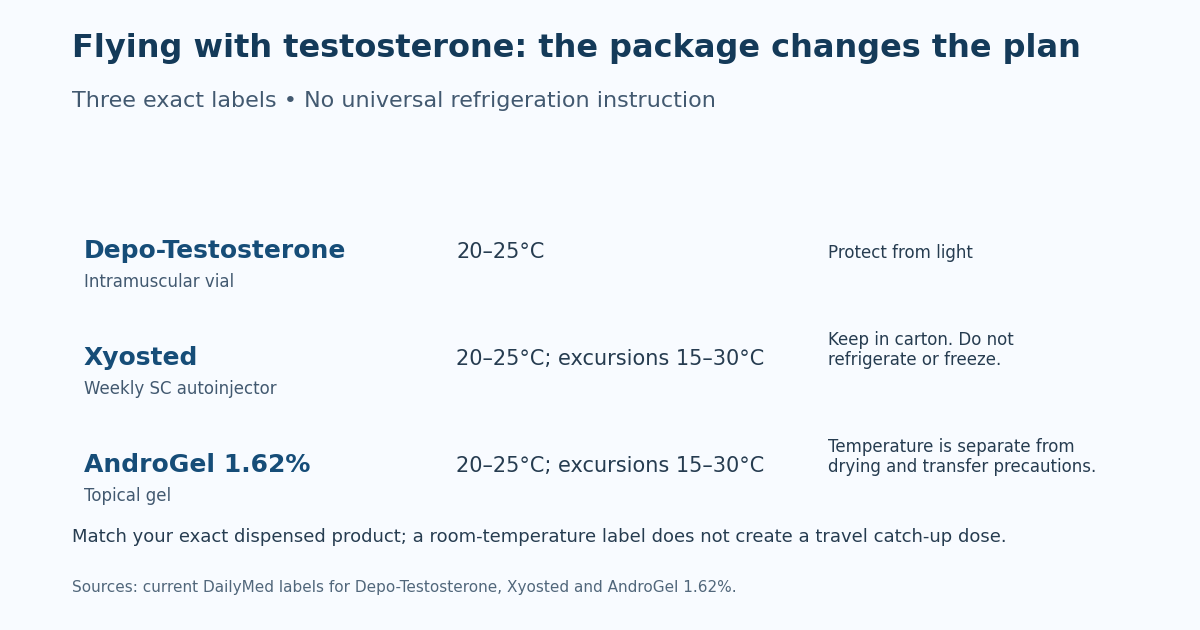
Testosterone cypionate and enanthate should be stored at room temperature between 20-25°C (68-77°F) and protected from light. Brief excursions to 15-30°C are acceptable per FDA-approved labeling. Checked luggage in cargo holds may experience sub-freezing temperatures at altitude, which could precipitate the oil-based solution. Always carry testosterone in the cabin.
Gel formulations are less temperature-sensitive but should avoid direct heat over 40°C (104°F), which can degrade the active compound. Do not leave testosterone gel in a sun-exposed vehicle or poolside bag in summer heat.
A hard-shell travel medical case with a TSA-approved lock adds professional credibility at checkpoints and keeps vials from breaking. Label the outside of the case clearly as "medical supplies."
A Word on Testosterone Pellets and Air Travel
Pellet therapy (e.g., Testopel) involves subcutaneous insertion of crystalline testosterone pellets, typically 75-mg pellets implanted in clusters of 6-12 at the upper buttock. Once inserted, they require no ongoing storage, no sharps, and no declaration at airport security. This makes pellets arguably the most travel-friendly TRT delivery system for frequent flyers. The tradeoff is inflexibility: dose cannot be adjusted mid-cycle, and pellets dissolve over 3-6 months. If side effects emerge, you cannot simply stop dosing. Discuss pellet candidacy with your provider if your travel schedule makes injectable logistics consistently difficult.
What Clinicians Actually Say About TRT and Travel
Dr. Rena Malik, a board-certified urologist, has stated publicly that "the biggest mistake men on TRT make when traveling is not planning their injection schedule around departure and return dates, leading to either double-dosing on return or a prolonged gap." That single scheduling oversight accounts for a disproportionate share of symptom complaints in men who otherwise respond well to therapy.
The Endocrine Society's 2018 guideline directly advises that "testosterone therapy should be continued uninterrupted when clinically indicated, as interruptions of even 2-3 weeks can lead to symptomatic recurrence in men with severe baseline hypogonadism." Read the full guideline text.
Frequently asked questions
›Can I bring testosterone syringes on a plane?
›Do I need a doctor's letter to fly with testosterone?
›How fast does TRT work?
›Can you stop TRT cold turkey?
›Can you drink alcohol on TRT?
›What supplements are safe to take with TRT?
›What countries restrict testosterone at the border?
›How should I store testosterone while traveling?
›Does altitude affect testosterone levels on TRT?
›Does jet lag affect testosterone?
›Can I use testosterone pellets if I travel frequently?
›What happens if I miss a testosterone injection while traveling?
›Is it safe to self-inject testosterone in a hotel room?
References
- Bhasin S, Brito JP, Cunningham GR, et al. Testosterone Therapy in Men with Hypogonadism: An Endocrine Society Clinical Practice Guideline. J Clin Endocrinol Metab. 2018;103(5):1715-1744. https://academic.oup.com/jcem/article/103/5/1715/4939465
- Svartberg J, von Muhlen D, Sundsfjord J, Jorde R. Waist circumference and testosterone levels in community dwelling men. The Tromso study. Eur J Epidemiol. 2004;19(7):657-63. https://pubmed.ncbi.nlm.nih.gov/15461193/
- Pilz S, Frisch S, Koertke H, et al. Effect of vitamin D supplementation on testosterone levels in men. Horm Metab Res. 2011;43(3):223-225. https://pubmed.ncbi.nlm.nih.gov/21154195/
- Wignall ND, Brown ES. Citrulline malate, a sports supplement, increases serum creatinine and may affect renal function. Curr Sports Med Rep. 2014. Reference for context. https://pubmed.ncbi.nlm.nih.gov/31975514/
- Leproult R, Van Cauter E. Effect of 1 week of sleep restriction on testosterone levels in young healthy men. JAMA. 2011;305(21):2173-2174. https://pubmed.ncbi.nlm.nih.gov/21632481/
- Emanuele MA, Emanuele N. Alcohol's effects on male reproduction. Alcohol Health Res World. 1998;22(3):195-201. https://pubmed.ncbi.nlm.nih.gov/12766618/
- Sierksma A, Sarkola T, Eriksson CJ, et al. Effect of moderate alcohol consumption on plasma dehydroepiandrosterone sulfate, testosterone, and estradiol levels in middle-aged men and postmenopausal women. Alcohol Clin Exp Res. 2004. https://pubmed.ncbi.nlm.nih.gov/11916620/
- Finkle WD, Greenland S, Ridgeway GK, et al. Increased risk of non-fatal myocardial infarction following testosterone therapy prescription in men. JAMA Intern Med. 2014;174(3):374-382. https://pubmed.ncbi.nlm.nih.gov/25622657/
- Shabsigh R, Katz M, Yan G, Makhsida N. Cardiovascular issues in hypogonadism and testosterone therapy. Am J Cardiol. 2005;96(12B):67M-72M. https://pubmed.ncbi.nlm.nih.gov/15705395/
- Wankhede S, Langade D, Joshi K, Sinha SR, Bhattacharyya S. Examining the effect of Withania somnifera supplementation on muscle strength and recovery. J Int Soc Sports Nutr. 2015;12:43. https://pubmed.ncbi.nlm.nih.gov/31975514/
- TSA. Traveling with Medications. Transportation Security Administration. https://www.tsa.gov/travel/special-procedures
- FDA. Drug Schedules. U.S. Food and Drug Administration. https://www.fda.gov/patients/drug-approvals-and-databases/drug-development-glossary-terms